


How a Surgeon Kept a Sudan Hospital Functioning on the War’s Front Line

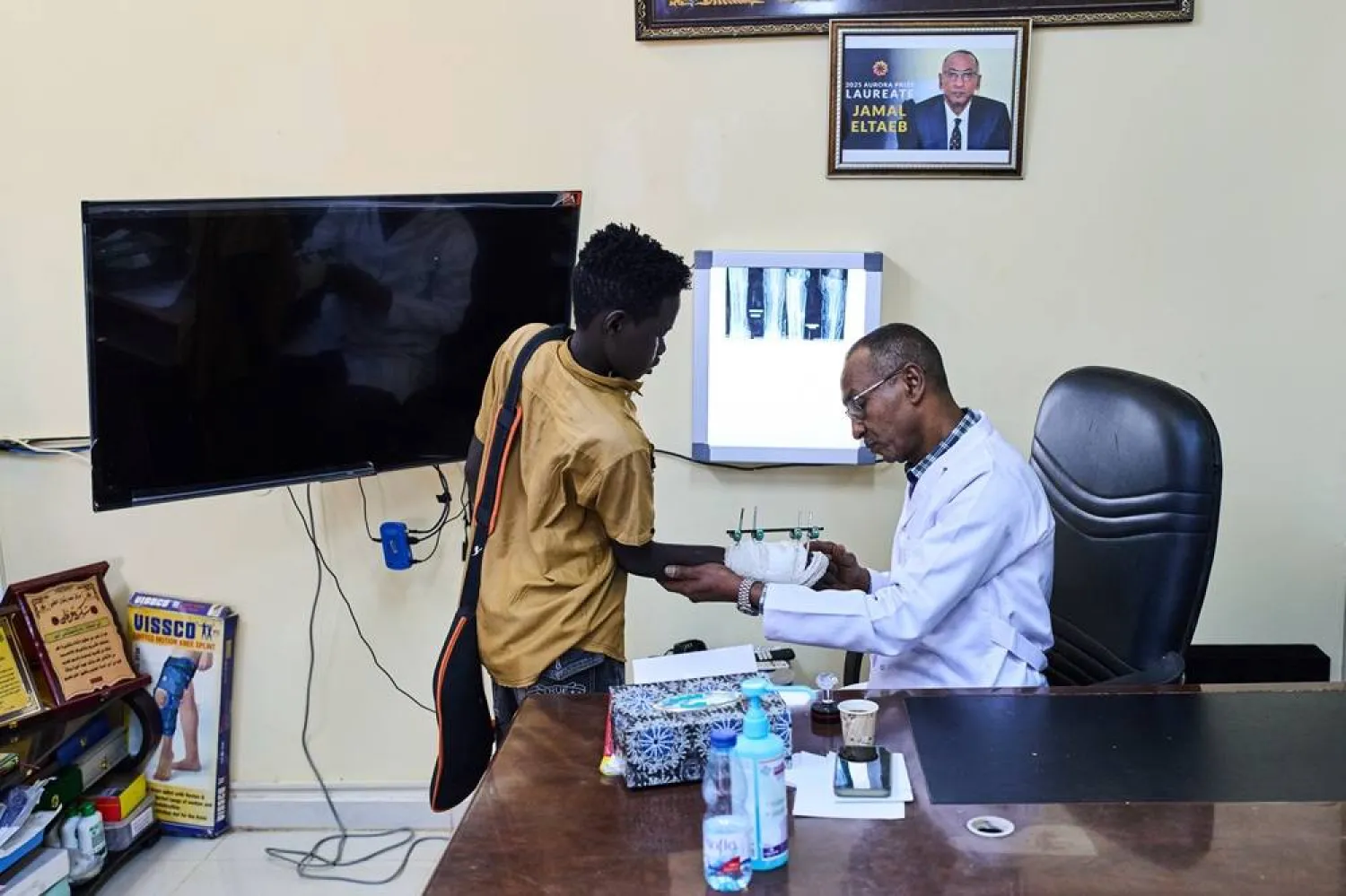
Dr. Jamal Eltaeb checks a patient at Al Nao Hospital in Omdurman, on the outskirts of Khartoum, Saturday, April 18, 2026. (AP)
TT

How a Surgeon Kept a Sudan Hospital Functioning on the War’s Front Line

Dr. Jamal Eltaeb checks a patient at Al Nao Hospital in Omdurman, on the outskirts of Khartoum, Saturday, April 18, 2026. (AP)

For three years, Dr. Jamal Eltaeb made excruciating choices. Who should live and potentially die? Should he operate without the right medicines if it might save someone's life? How would he find fuel to keep the hospital's lights on?

As Sudan 's war raged around him, only one decision was easy: Keep working.

The orthopedic surgeon was leading Al Nao hospital in Omdurman, just outside the capital, Khartoum, as control of the urban area shifted between Sudan's army and paramilitary fighters. As the front line moved closer and the hospital overflowed with patients, some colleagues lost their nerve and left.

The soft-spoken Eltaeb was a rare surgeon who remained. Even as the hospital was bombed more than once. Even as most medical supplies ran out.

“I weighed the options of staying here, and taking care of your patients and helping other people that need you as a skilled surgeon, rather than choose your own safety,” he told The Associated Press in an interview.

He is one of countless Sudanese who have pitched in to help as the world largely looks elsewhere, distracted by conflicts in the Middle East and Ukraine. He has seen the bodies behind the estimates of tens of thousands of people killed, and what it means — day to excruciating day — when the United Nations warns his country's health system is near collapse.

Nearly 40% of Sudan's hospitals no longer function. Many have been stripped for parts or used by armed groups as bases. Sudan’s army has since retaken the capital, and Al Nao remains one of the area's only functioning health centers.
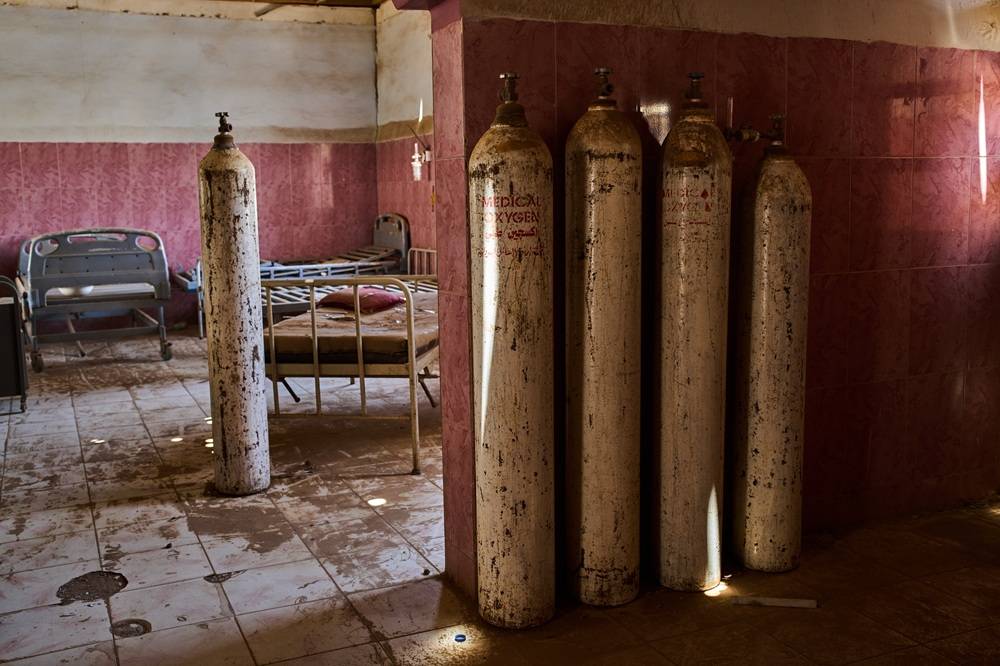
Oxygen canisters and hospital beds at a war-damaged section of Al Shaabi Hospital in Khartoum, Saturday, April 18, 2026. (AP)

Some operations were done on the hospital floor

Walking through the complex, the 54-year-old showed AP journalists the remnants of some of the hardest months of his life.

Over there was a window that was struck, killing the relative of a patient. And there in the courtyard was the last tent standing of the many erected during the peak of the conflict to accommodate mass casualties.

“We were working everywhere, in tents, outside, on the floor, doing everything to save patients’ lives,” he said.

The work earned Eltaeb the $1 million Aurora Prize for Awakening Humanity, which honors individuals who risk their lives to save others. He gave some of the money to medical and humanitarian groups around the world.

Before the war, staffers said, Al Nao was a quiet hospital with its nearly 100 beds empty much of the time. But when fighting began in Khartoum and the paramilitary Rapid Support Forces captured swaths of the city, patients hurried in.

Eltaeb's own hospital elsewhere closed shortly after the war began in April 2023, and he moved to Al Nao. By July, most of the staff had fled, leaving him in charge.

He and a handful of employees and volunteers struggled to keep the place running. Electricity was out for weeks as the facility relied on the army to supply fuel for generators. Medicines like antibiotics and painkillers ran out.

‘From that moment, we knew that we are a target’

In August, a month after Eltaeb took charge, the hospital was hit for the first time.

“From that moment, we knew that we are a target ... And from that time, they didn’t stop targeting us,” he said. The RSF later struck the hospital three more times.

Normality had crumbled. A father of three, Eltaeb sat in his office and handed out sweets to a steady stream of patients and staff vying for his attention.

Decisions were nearly impossible. On a particularly harrowing day in late 2024, he and his team scrambled to triage over 100 wounded people after a strike hit a nearby market. Eight of them died.

“You choose ... as if you can choose who is going to live and who is going to die,” he said.

The day only got worse. Eltaeb had to decide whether to amputate on children without full anesthetic because they were bleeding heavily and he didn't have time to transport them to the operating room.

Using local anesthetic, he removed an arm and leg of a 9-year-old boy and a leg of his 11 year-old sister.

He now scrolls through photos of such surgeries on his phone, attempting to explain to the world a horror few can grasp.

A member of the military media accompanied the AP during the visit, including during interviews. The AP retains full editorial control of its content.
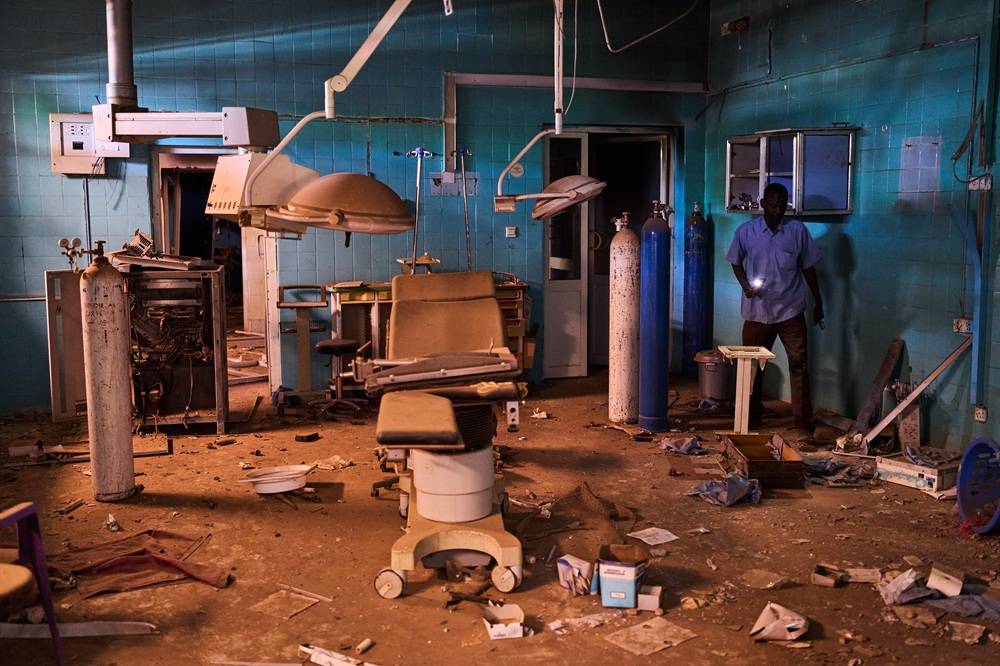
A guard walks through a war-damaged section of Al Shaabi Hospital in Khartoum, Saturday, April 18, 2026. (AP)

Volunteers delivered supplies by bicycle

The hospital relied on volunteers to keep supplies coming. They would post what they needed on social media, and pharmacists would provide the keys for their long-closed shops and allow volunteers to take medicines and other items for free.

One volunteer, Nazar Mohamed, spent months riding around Omdurman, often on a bicycle, delivering supplies while explosions echoed.

Other donations came from organizations and individuals abroad. A network of Sudanese doctors overseas provided remote advice on coping with mass casualties or what to do when antibiotics or anesthesia ran low.

The hospital's remaining staffers got creative, making beds and crutches out of wood and using clothes instead of gauze for makeshift splints.

The war moves on and support does, too

Fighting has shifted away from the Khartoum area. Some funding-strained organizations that supported Eltaeb's hospital now assist places more in need.

He said there is enough money until June to pay salaries and keep generators running, but they will need some $40,000 a month for the hospital to function.

While some countries have pledged support to help Sudan's reconstruction, there's concern the war with Iran might divert attention and resources.

Hospitals that were hit harder than Al Nao lie in ruins and need much more.

Across town, Dr. Osman Ismail Osman, director of Al Shaabi hospital, said the several hundred thousand dollars the government has provided is a drop in the bucket.

The RSF occupied his hospital during the war. Dusty, broken medical equipment worth millions of dollars is piled up, and chunks of concrete are scattered with metal beds.

The goal of opening the badly damaged hospital for emergency referrals within weeks is ambitious, but medical workers like Eltaeb have learned how to approach the impossible.

“I believe I did my best as a doctor as a Sudanese,” the surgeon said.


US-Iran Deal Leaves Major Lebanon Questions Unresolved

Displaced families drive past a man holding the Hezbollah party flag as they drive along the highway through the area of Jiyyeh as they return to their home villages in southern Lebanon on June 15, 2026. (AFP)
TT

US-Iran Deal Leaves Major Lebanon Questions Unresolved

Displaced families drive past a man holding the Hezbollah party flag as they drive along the highway through the area of Jiyyeh as they return to their home villages in southern Lebanon on June 15, 2026. (AFP)

A deal between Washington and Tehran that ends the Israel-Hezbollah war leaves many issues in Lebanon unresolved, failing to mention Israel withdrawing from the country or an end to Tehran's support for the armed group.

Under US pressure, Lebanese officials have been holding direct talks with Israel aimed at reaching a separate agreement on ending the hostilities, but Beirut appeared to have been sidelined with the overnight announcement on the regional conflict.

AFP looks at the deal and the questions it raises in Lebanon.

- What does the deal involve? -

Details of the agreement to end the Middle East war on all fronts have not been made public, but Iran and mediator Pakistan have both said it includes Lebanon.

Hezbollah drew the country into the Middle East war on March 2 with rocket fire at Israel to avenge the killing of Iran's supreme leader in US-Israeli strikes.

Israel responded with airstrikes and a ground invasion that Lebanon says have killed more than 3,700 people and displaced more than one million others.

An official source told AFP that "Lebanon was not informed of the terms of the agreement or the time of the ceasefire".

Influential Lebanese parliament Speaker Nabih Berri, a Hezbollah ally and intermediary for the group, thanked Washington and Tehran for their "insistence on including... an essential and binding clause on halting the Israeli aggression on all of Lebanon".

Hezbollah on Monday had so far not claimed any fresh attacks on Israeli targets.

- Israeli withdrawal? -

Information circulating about the deal does not mention any Israeli withdrawal from south Lebanon, and Israeli Defense Minister Israel Katz on Monday said forces would remain in the country indefinitely.

Karim Bitar, a lecturer in Middle East Studies at the Sciences Po University in Paris, said that "the deal does not seem to involve Israel, which immediately meant that it wasn't a party to it... So it's very unlikely that there will be an Israeli withdrawal from south Lebanon."

Israeli forces control a strip of Lebanese territory running along the entire border.

A Western military source told AFP that Israeli forces had crossed the Litani River at several points, referring to the waterway running about 30 kilometers (20 miles) from the frontier but closer in some areas.

"Tens of thousands of Israeli soldiers" are in south Lebanon where they hold some established positions, the source said, adding that Hezbollah still had a presence there.

"It's the biggest invasion since their withdrawal in 2000," the source said, referring to Israel's previous pullout after some two decades of occupation.

Hezbollah says it sent reinforcements south of the Litani after the latest war erupted.

Under a 2024 ceasefire that followed a previous round of hostilities, Hezbollah fighters were supposed to withdraw from the area.

- What future for Hezbollah? -

Washington has pressured Lebanese authorities to disarm Hezbollah for months, but the accord makes no mention of the group.

"Iran doesn't seem to have committed to ending its support and financing for Hezbollah," Bitar said.

Military expert Riad Kahwaji said that "Hezbollah will not agree to give up arms... and this crisis will be protracted."

He said this could lead to political instability and even unrest, "especially now Hezbollah believes that through Iran it has emerged victorious from this agreement, and therefore is going to try and dictate its terms on who rules."

- Lebanon-Israel negotiations? -

Lebanon and Israel have been holding direct talks in Washington since April, seeking to end the hostilities and to separate Lebanon from the regional war.

A new round is scheduled for later this month.

Lebanese Prime Minister Nawaf Salam said Monday that "we will redouble our efforts" through the Washington negotiations "to secure a full Israeli withdrawal."

But after the Iran-US announcement, some cast doubt on the effectiveness of the bilateral negotiations.

Bitar said that "Lebanon could find itself once again as a scapegoat that pays the price both of American amateurism, Iranian cynicism, Israeli hubris and... the lack of a clear strategy from its own political class."


Lebanese Mourn Homes, Livelihoods Destroyed by Israel in Southern City

 People make their way through the rubble of a destroyed building as residents displaced by fighting return to Nabatieh in southern Lebanon on June 15, 2026. (AFP)
People make their way through the rubble of a destroyed building as residents displaced by fighting return to Nabatieh in southern Lebanon on June 15, 2026. (AFP)
TT

Lebanese Mourn Homes, Livelihoods Destroyed by Israel in Southern City

 People make their way through the rubble of a destroyed building as residents displaced by fighting return to Nabatieh in southern Lebanon on June 15, 2026. (AFP)
People make their way through the rubble of a destroyed building as residents displaced by fighting return to Nabatieh in southern Lebanon on June 15, 2026. (AFP)

When Kamal Kamal heard a ceasefire deal had been agreed between Iran and the United States, he rushed back to the southern city of Nabatieh only to find an Israeli strike had reduced his life's work to rubble.

The city, usually home to some 90,000 people before the latest war between Israel and Hezbollah erupted on March 2, was largely deserted as Israel pressed its military offensive in the area in recent days.

Kamal fought back tears as he stared stunned at the pile of rubble that used to be his roastery and warehouse for coffee and other products, after Israel pummeled the region with strikes and issued sweeping evacuation orders.

"When I opened it in the seventies, I was still a young man... now nothing is left," he said, leaning heavily on a walking stick and surveying the vast destruction.

"How my life has been spent in vain here!"

The war in Lebanon has been included in the framework deal to end the broader Middle East war.

But Lebanon's army on Monday urged displaced residents to delay their return to southern border villages, citing the "risk of Israeli violations and attacks".

Iran-backed group Hezbollah issued a similar warning.

Yet residents who have cautiously returned to Nabatieh have expressed dismay at the huge damage Israel inflicted on the city's neighborhoods and its famed market, where the roofing had collapsed and shops were devastated.

An AFP photographer also saw destruction to homes and businesses in the city, which has served as a hub of economic, social and services activity.

- 'Sorrow and grief' -

The city's municipality said in a statement that it had asked residents not to return "at the present time under any circumstances", citing the security situation.

The Lebanese army had set up a checkpoint at the entrance to the city, advising locals about the roads that they could take as intermittent artillery shelling rang out and smoke rose up.

The flow of residents to Nabatieh picked up later in the day, with people inspecting their homes and properties as heavy machinery worked to remove rubble and clear roads.

In one heavily damaged neighborhood, Rana Nasrallah surveyed her destroyed home, the rubble strewn with clothes, furniture and pot plants.

The 45-year-old had fled with her family to the coastal city of Sidon during the war.

"We grew up in this neighborhood. We used to play here as children. And here's where the older women used to sit and chat, the historic Nabatieh market before us... the landmarks that they perhaps wanted to erase," she said.

"As soon as the ceasefire was declared and before any official (Lebanese) announcement... we got going and came here. We couldn't wait any longer.

"We came to breathe in the scent of our land... even if there are no homes to shelter us and there is no work, still it's a relief for our souls."

In the face of the huge damage in Nabatieh and other south Lebanon towns and villages, including where Israeli forces have carried out sweeping demolitions, Nasrallah still expressed hope of returning permanently.

"Despite the sorrow and grief at seeing the city destroyed... we are filled with hope that we will rebuild," she said.

"Not once did we feel defeated or that we would not triumph, or that we would not return to rebuild Nabatieh."


Ghalibaf: Ambitious ‘Public Face’ of Post-Ali Khamenei Iran

Iran’s Parliament Speaker Mohammad Bagher Ghalibaf (R) meets with Pakistan’s Army Chief Syed Asim Munir in Tehran, Iran, May 23, 2026. (AFP)
TT

Ghalibaf: Ambitious ‘Public Face’ of Post-Ali Khamenei Iran

Iran’s Parliament Speaker Mohammad Bagher Ghalibaf (R) meets with Pakistan’s Army Chief Syed Asim Munir in Tehran, Iran, May 23, 2026. (AFP)

Iranian parliament speaker Mohammad Bagher Ghalibaf has emerged as the key negotiator and one of the most high-profile figures in the epublic's leadership as it enters a new phase after the US-Israeli war.

A pillar of the Iranian establishment for some three decades and one of its most prominent non-clerical figures, Ghalibaf, 64, had spearheaded the war effort and led the high-stakes negotiating process that culminated with an agreement announced Monday to halt the hostilities.

Ghalibaf survived more than five weeks of US-Israeli attacks on Iran that killed supreme leader Ali Khamenei, top security official Ali Larijani and a host of other key figures.

He came into public view for the first time in weeks in April to lead the Iranian delegation in talks in Islamabad with the United States, meeting Vice President JD Vance, the highest-level contact between the two foes since before the 1979 revolution.

An image published on social media by Iranian embassies abroad put Ghalibaf center stage in the Iranian negotiating team, looking animated and gesturing with his hand, as Foreign Minister Abbas Araghchi busied himself with teacups.

The workings of the Iranian leadership without Khamenei, who dominated it for nearly four decades, remain unclear.

Khamenei's son Mojtaba was named as his successor but has yet to appear publicly after he was reportedly wounded in an airstrike.

"Following Larijani's assassination, Ghalibaf has emerged as the new public face of the regime's war effort and diplomacy," said Farzan Sabet, a managing researcher at the Geneva Graduate Institute.

"But we shouldn't overstate the extent to which he's in the driver's seat: He still answers to higher powers in Tehran," he added.

These include Mojtaba Khamenei and the Revolutionary Guards, the ideological arm of Iran's military, where Ghalibaf was a key figure as aerospace forces commander, Sabet said.

- 'Professional bargainer' -

While the trip to Islamabad was Ghalibaf's first appearance in public since before the war, he has kept a high profile online with almost daily social media posts, mixing commentary on recent developments and the negotiations with threats of harsh retaliation should the fighting resume.

His posts on X in idiomatic American English have garnered wide attention and raised questions over who is actually writing them, given Ghalibaf is not known to be a fluent English speaker.

Referring to threats of a ground invasion, a post on Ghalibaf's X account said on April 1: "You come for our home... you're gonna meet the whole family. Locked, loaded and standing tall. Bring it on."

The IranWire news site has said the posts appeared to have been written by a former adviser based in the United States, but this has not been confirmed.

While the Islamabad talks failed, The Washington Post reported that Ghalibaf left a striking impression on the US delegation after years when Washington never dealt directly with key Iranian decision makers.

Ghalibaf "impressed the American team as a refined and professional bargainer -- and potential leader of a new Iran", said the Post.

In a sign of his expanding sway, he was appointed in May to oversee Iran's vital relationship with China, the biggest buyer of Iranian oil.

- 'Ambitious and opportunistic' -

Ghalibaf's varied experience, which spans military and civilian life, has seen him work as a commander in the Revolutionary Guards, Tehran police chief, Tehran mayor and now speaker of parliament.

It is unclear if he is fully trusted by the new hardline hierarchy of the Guards.

Known to be fiercely ambitious, he has stood for the Iranian presidency on multiple occasions but has never been successful, most notably in 2005 when ultra-conservative Mahmoud Ahmadinejad, little-known at the time, took the job.

A qualified pilot, Ghalibaf is known for boasting that he is able to captain jumbo jets.

Human rights groups have accused Ghalibaf, in his various functions, of playing a key role in suppressing protests, from the 1999 student demonstrations to the 2009 Green movement that erupted after a disputed election, right up to the nationwide protests that peaked in January 2026, just before the latest war.

"As a politician, he's shown himself to be ambitious and opportunistic, but also cautious, a trait that has helped him advance his career to the top of the country's power structure without getting purged like so many others have been," said Sabet.
