Budget Airlines First to Cut Flights as Jet Fuel Prices Soar

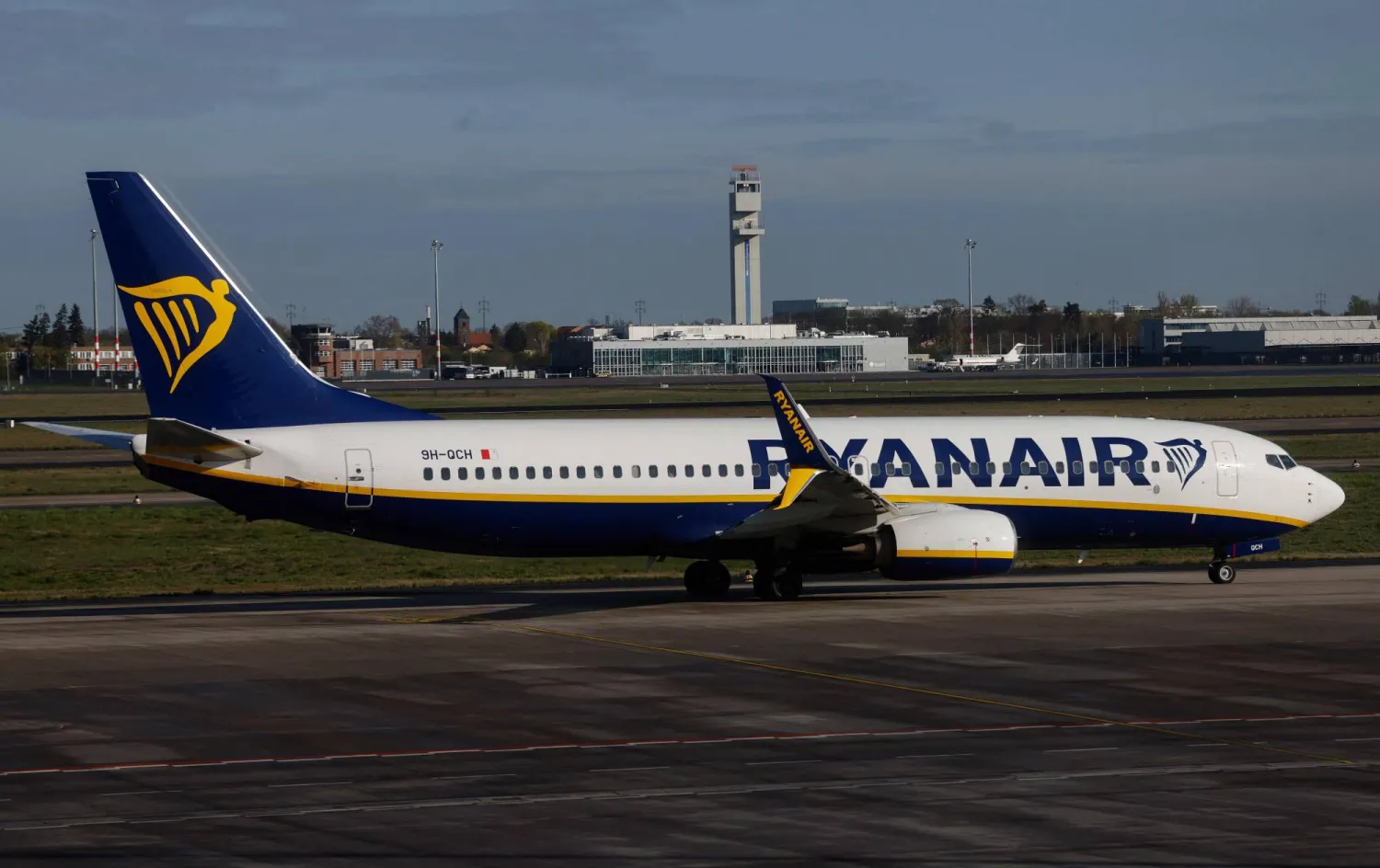
An aircraft of low-cost Irish airline Ryanair taxis before take off the Berlin-Brandenburg airport in Schoenefeld near Berlin, on April 4, 2024. (AFP)
TT

Budget Airlines First to Cut Flights as Jet Fuel Prices Soar

An aircraft of low-cost Irish airline Ryanair taxis before take off the Berlin-Brandenburg airport in Schoenefeld near Berlin, on April 4, 2024. (AFP)

Ryanair, Transavia, Volotea and other low-cost airlines are feeling the financial pain from high jet fuel prices as a result of the Middle East war and are cutting flights.

The closure of the Strait of Hormuz has taken a huge chunk of oil supplies off the market, sending the price of jet fuel soaring and triggering fears of shortages that could force airlines to cancel flights.

Airlines aren't waiting for a lack of supplies to react.

"Travel alert: airlines are cutting thousands of flights right now," Travel Therapy TV host Karen Schaler said in an Instagram reel this past weekend. "Book early."

That advice would win the approval of Ryanair boss Michael O'Leary, who expressed concern earlier this month that fears of fuel shortages were making people put off booking flights.

Low-cost carriers -- which control a little more than a third of the global market, according to various estimates -- are feeling the pinch first due to the nature of their business model.

With cheaper tickets, they have less capacity to absorb the rise in fuel costs.

Some of the cancellations may be the normal adjustments airlines tend to make when demand doesn't meet expectations on certain routes.

"It is not unusual for carriers to adjust their schedules at this time of the year," financial analyst Dudley Shanley at investment bank Goodbody told AFP.

But "if jet fuel prices remain at this level, there will have to be a little bit more trimming for low-cost airlines", he added.

If before the war airlines were able to maintain marginally profitable routes or even unprofitable routes, the surge in jet fuel prices will force them to make difficult choices.

That will start with many during the peak summer travel season.

"Unfortunately, it's very likely that many people's holidays will be affected, either by flight cancellations or very, very expensive tickets," the EU's energy commissioner Dan Jorgensen told Sky News last week.

- 'Faster than the bear' -

The speed with which airlines are reacting depends in part upon the extent to which they secured fuel supplies in advance at fixed prices.

European airlines tend to do this to a greater extent than their rivals in other parts of the world.

Air Transat, a low-cost Canadian airline, has cut six percent of its May-October flight schedule.

Southeast Asia's largest low-cost carrier, AirAsia X, announced on Friday announced it was cutting more flights and even some connections, without providing an overall figure.

Earlier this month the Malaysia-based no-frills airline said it was raising fares by up to 40 percent and about 10 percent of its overall flights had been cut so far.

Hungary's low-cost airline Wizz Air has so far resisted cutting flights.

"We are not taking capacity out, because I think the other guys will take capacity out," its chief executive Jozsef Varadi was quoted as saying recently by trade magazine Aviation Week.

"You don't have to run faster than the bear, but faster than the guy next to you," he added.

He may have been thinking of the most spectacular cuts made in the industry by German group Lufthansa, which had just announced it was chopping 20,000 flights from its schedule through October, along with halting its regional feeder airline CityLine.

Its European rival Air France-KLM has trimmed two percent of flights in May and June at its low-cost Transavia subsidiary.

KLM has kept cancellations down to one percent of its European flights.

Ryanair didn't cite fuel prices but high costs and taxes when announcing last week it would reduce flights to and from Berlin starting in October.

It is also cutting 10 percent of flights from Dublin, criticizing limited capacity at the airport.

Since the beginning of the month, Spain's Volotea has trimmed nearly one percent of flights from its summer schedule.


Boeing Dreamliner to Fly Riyadh Air's First Passengers in July

A Riyadh Air aircraft flies over the Saudi capital, Riyadh (Public Investment Fund)
TT

Boeing Dreamliner to Fly Riyadh Air's First Passengers in July

A Riyadh Air aircraft flies over the Saudi capital, Riyadh (Public Investment Fund)

Riyadh Air, Saudi Arabia’s new national carrier wholly owned by the Public Investment Fund, is moving onto the global aviation stage through London, with an ambition that goes beyond conventional air travel.

The carrier, which reflects the Kingdom’s view of aviation as a strategic industry and economic driver, said it would open tickets to the public for direct flights between King Khalid International Airport and Heathrow Airport on its new Boeing 787-9 Dreamliner fleet from July 1, 2026.

The move is part of plans to connect Saudi Arabia to more than 100 destinations by 2030.

It follows the airline’s launch last year of its first daily flights to Heathrow, when tickets were initially available to selected groups of passengers and Riyadh Air employees under an operational program designed to ensure full readiness before the carrier receives its first aircraft from Boeing.

The program also allowed the airline to use its newly allocated operating slots at Heathrow.

Riyadh Air said bookings would open from Tuesday through its website, official app and approved travel service providers.

Travel classes

Chief Executive Tony Douglas said the launch of flights on the new aircraft marked a “milestone” for Riyadh Air and reflected its vision to redefine air travel and connect Riyadh to the world through comfort, innovation and Saudi hospitality.

The airline said its Boeing 787-9 Dreamliner aircraft would feature four travel classes, Business Elite, Business, Premium Economy and Economy. The two business cabins will include seats that convert into fully flat beds.

Passengers will also have access to advanced entertainment systems through Panasonic Avionics’ Astrova platform, with 4K screens, Bluetooth connectivity and a library of more than 500 films and 600 television series.

Riyadh Air said its hospitality offering would include products from Kayanee, children’s kits in cooperation with Disney, varied menus and bedding from John Horsfall.

The airline also announced the launch of Sfeer, its loyalty program, offering benefits including a “best offer guarantee,” no expiry of points, free in-flight internet and exclusive privileges for founding members.

Aviation specialists said opening ticket sales to passengers marks a new phase for Saudi Arabia’s aviation sector.

The government has set a national strategy to turn the Kingdom into a global aviation logistics hub by doubling capacity to 330 million passengers, linking it to 250 international destinations and raising air cargo capacity to 4.5 million tons by 2030.

Tourism and business traffic

Tourism media expert Mohammed al-Abdulkarim told Asharq Al-Awsat that Riyadh Air’s announcement of the start date for its first commercial flights, along with the official launch of ticket sales from July, was a pivotal step in the transformation of Saudi aviation.

He said it reflected faster implementation of the national aviation strategy under Vision 2030.

Abdulkarim said choosing July 1 for the entry into service of the carrier’s first new B787-9 aircraft showed Riyadh Air was ready to move from building and preparation into actual operations.

The start of ticket sales through the airline’s official platforms, he said, reflected operational confidence and early readiness to enter the international aviation market.

He said launching the first route between Riyadh and London carried major strategic and economic significance. London is one of the world’s biggest centers for business, tourism and air transit, he said, and the route shows Saudi Arabia’s early focus on a high-yield international network directly linked to major global markets.

Raising capacity

Abdulkarim said Riyadh Air’s ownership of four B787-9 aircraft now in the final stages of operational certification showed a push to build a modern fleet focused on efficiency, passenger experience and advanced technology.

That, he said, is essential for competing in the global aviation market, especially after the rapid changes the sector has seen since the pandemic.

He said the entry of a new national carrier of this scale would strengthen Saudi Arabia’s capacity, raise the competitiveness of its air transport sector regionally and internationally, and support tourism, investment, logistics and supply chains.

“The Kingdom is not only targeting higher passenger numbers, but is working to reshape its position as a global aviation hub linking three continents,” he said.

“With new airport projects, expanded air connectivity and the launch of modern carriers, Saudi Arabia is moving toward becoming one of the region’s most important transport and travel hubs in the coming years.”

Competing with major airlines

Aviation expert Al Motaz Al-Mirah said the launch of Riyadh Air’s first tickets showed Saudi Arabia’s strong confidence in the future of aviation.

He said the project is starting with a global vision and modern services aimed at competing with major international airlines, while choosing London as the first destination gives the new carrier a strong presence on one of the world’s most important international travel routes.

Speaking to Asharq Al-Awsat, Al-Mirah said the move was a practical step toward achieving Saudi Arabia’s aviation strategy.

It was not only about adding destinations and flights, he said, but about building an integrated travel experience that strengthens Riyadh’s position as a global air transport hub.

He said the move was expected to support tourism and investment and raise the kingdom’s competitiveness in aviation in the coming years.


Saudi Airports Handle 141 Million Passengers in 2025 as Aircraft Fleet Expands

Travelers move through stanchion lines at the departure terminal of King Khalid International Airport in Riyadh. (AFP)
TT

Saudi Airports Handle 141 Million Passengers in 2025 as Aircraft Fleet Expands

Travelers move through stanchion lines at the departure terminal of King Khalid International Airport in Riyadh. (AFP)

Saudi Arabia’s airports handled 140.9 million passengers in 2025, marking another year of strong growth for the Kingdom’s aviation sector as the national aircraft fleet expanded by 33.8%, according to data released by the General Authority for Statistics.

The number of passengers traveling through Saudi airports rose 9.6% from 2024, reflecting the Kingdom’s accelerating push to strengthen its position as a regional travel hub and global aviation gateway.

International traffic accounted for 75.8 million passengers, up 9.4% year-on-year, while domestic passenger traffic increased 9.8% to 65.1 million. On average, Saudi airports handled around 207,700 international passengers and 178,600 domestic passengers a day.

King Abdulaziz International Airport in Jeddah remained the Kingdom’s busiest airport, handling 53.5 million passengers during the year, an increase of 9.0% from 2024. King Khalid International Airport in Riyadh followed with 40.8 million passengers, up 8.7%, while King Fahd International Airport in Dammam handled 13.7 million passengers, posting annual growth of 7.0%.

The increase in passenger traffic was accompanied by a rise in flight activity across the Kingdom’s airports. Total arriving and departing flights climbed 8.3% year-on-year to 979,800 flights in 2025, including 506,300 domestic flights, up 6.8%, and 473,500 international flights, up 9.9%.

King Abdulaziz International Airport also recorded the highest number of aircraft movements with 314,400 flights, followed by King Khalid International Airport with 296,800 flights and King Fahd International Airport with 108,500 flights.

Saudi Arabia’s aviation fleet recorded one of the strongest areas of growth during the year, with the total number of commercial and general aviation aircraft rising to 483 from the previous year’s level. The fleet included 266 commercial aircraft and 217 aircraft dedicated to general aviation.

Aircraft with capacities ranging from 151 to 250 seats accounted for the largest share of the commercial fleet at 120 aircraft, while the sector continued to modernize its operations, with 99 aircraft less than five years old.

The Kingdom also expanded its global air connectivity during 2025, with Saudi airports linked to 66 countries worldwide, up 1.5% from a year earlier. The total number of domestic and international destinations connected to the Kingdom rose 2.3% to 176 destinations.

Saudi Arabia ranked 18th globally in the 2025 Air Connectivity Index, underscoring the sector’s growing international reach.

Saudia accounted for the largest share of flights operating in Saudi airspace at 25.5%, followed by low-cost carrier flynas at 13.3% and flyadeal at 8.6%.

Air cargo volumes handled through Saudi airports totaled 1.18 million metric tons in 2025, with imports accounting for the largest share at 695,600 tons. Transit cargo reached nearly 420,100 tons, while exports exceeded 69,700 tons.

March recorded the highest monthly cargo throughput of the year, with more than 113,400 tons handled during the month.

The Kingdom also continued to expand logistics infrastructure at its main airports to support cargo growth and broader supply chain ambitions. King Fahd International Airport operated nine cargo facilities, while King Khalid International Airport had eight facilities and King Abdulaziz International Airport operated four integrated cargo facilities.

The expansion forms part of Saudi Arabia’s strategy to position itself as a global logistics hub linking Asia, Africa and Europe.


Supertanker with Iraqi Oil Heads for Vietnam After Hold-up in US Blockade

Tankers are seen off the coast of the Fujairah, as Iran vows to close the Strait of Hormuz, amid the US-Israel conflict with Iran, in Fujairah, United Arab Emirates, March 3, 2026. (Reuters)
TT

Supertanker with Iraqi Oil Heads for Vietnam After Hold-up in US Blockade

Tankers are seen off the coast of the Fujairah, as Iran vows to close the Strait of Hormuz, amid the US-Israel conflict with Iran, in Fujairah, United Arab Emirates, March 3, 2026. (Reuters)

Supertanker Agios Fanourios I is heading for Vietnam to discharge its Iraqi crude oil cargo after it was held by the US Navy for five days in the Gulf of Oman, the vessel's manager said on Monday.

The Maltese-flagged Very Large Crude Carrier sailed out of the Strait of Hormuz on May 10 and was sailing in the Gulf of Oman before making a ‌U-turn on ‌May 11.

It resumed its journey ‌toward ⁠Vietnam on May 16 ⁠and is expected to arrive at the Nghi Son refinery on May 30, LSEG shipping data showed.

A VLCC can carry a maximum of two million barrels of oil.

A source at the vessel's Athens-based manager Eastern Mediterranean Maritime, who spoke on condition of ⁠anonymity, confirmed that the tanker was sailing ‌on to Vietnam after ‌it had received US Navy approval.

The US military's Central Command ‌said last week that the vessel was redirected as ‌part of ongoing enforcement of the blockade against Iran.

At least two other crude tankers sailed from the strait last week, but overall crude traffic through the strait has ‌remained limited.

Before the war on Iran began, the Strait of Hormuz was the conduit ⁠for 20% ⁠of the world's energy supplies, equating to 125 to 140 daily passages.

"Shipping confidence around Hormuz is still very weak," ship broker Clarksons said in a note on Monday.

A further 12 ships crossed the strait in the past 24 hours, including two liquefied petroleum gas tankers bound for India, according to satellite analysis from data analytics specialists SynMax.

A separate LPG tanker was sailing through the strait on Monday also bound for India, data on the MarineTraffic platform showed.