


Israel Using Water Access as ‘Weapon’ in Gaza, Says MSF

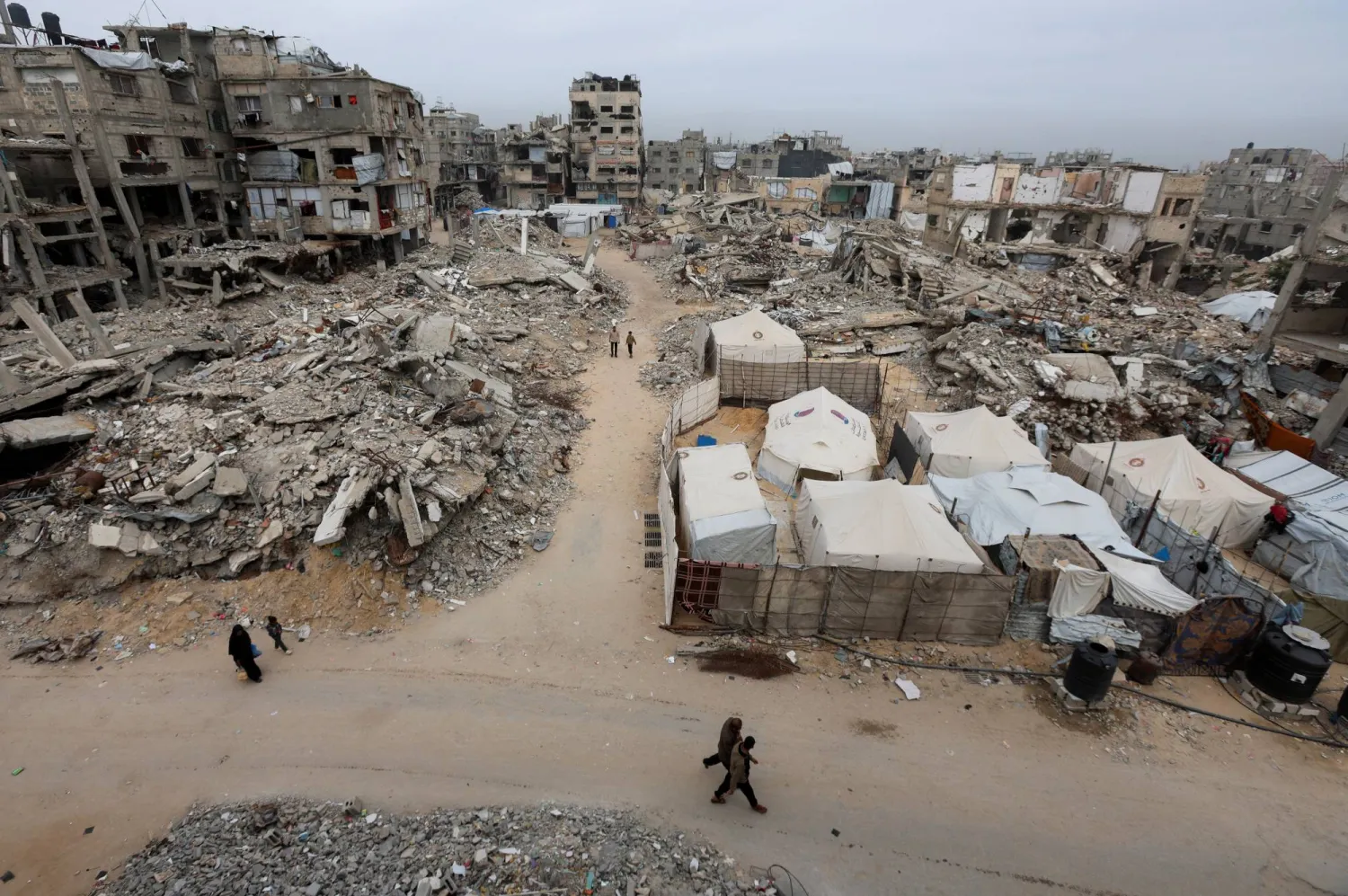
 Palestinians walk past the rubble of residential buildings destroyed during the two-year Israeli offensive, in Khan Younis, southern Gaza Strip, April 15, 2026. (Reuters)
Palestinians walk past the rubble of residential buildings destroyed during the two-year Israeli offensive, in Khan Younis, southern Gaza Strip, April 15, 2026. (Reuters)
TT

Israel Using Water Access as ‘Weapon’ in Gaza, Says MSF

 Palestinians walk past the rubble of residential buildings destroyed during the two-year Israeli offensive, in Khan Younis, southern Gaza Strip, April 15, 2026. (Reuters)
Palestinians walk past the rubble of residential buildings destroyed during the two-year Israeli offensive, in Khan Younis, southern Gaza Strip, April 15, 2026. (Reuters)

Israeli authorities are systematically depriving people in Gaza of the water they need to live, Doctors Without Borders warned Tuesday, decrying a campaign of "collective punishment" against Palestinians.

The extensive destruction of civilian water infrastructure in Gaza coupled with obstruction of access constitutes "an integral part of Israel's genocide", said the medical charity, which goes by its French acronym MSF.

In a report entitled "Water as a Weapon", MSF said the "engineered scarcity" was occurring alongside "direct killing of civilians, the devastation of health facilities, (and) the destruction of homes".

Together, this amounted to "the deliberate infliction of destructive and inhumane conditions of life on the Palestinian population in Gaza", warned the report, based on testimonies and data MSF collected in 2024 and 2025.

"Israeli authorities know that without water, life ends," MSF emergency manager Claire San Filippo said in a statement.

"Yet they have deliberately and systematically obliterated water infrastructure in Gaza, whilst consistently blocking water-related supplies from entering."

Despite an October ceasefire that largely halted the Gaza war that began after Hamas's 2023 attack on Israel, the territory remains gripped by daily violence as Israeli strikes continue and both the Israeli military and Hamas accuse each other of breaking the truce.

- 'Engineered' scarcity -

The MSF report pointed to data from the United Nations, European Union and World Bank indicating that Israel had destroyed or damaged nearly 90 percent of water and sanitation infrastructure in Gaza.

"Desalination plants, boreholes, pipelines and sewage systems have been rendered inoperable or inaccessible," it said.

The charity documented several incidents where it clearly identified water trucks and boreholes had been shot at or destroyed.

"Palestinians have been injured and killed simply trying to access water," San Filippo said.

The charity said that besides the local authorities, it was the largest producer and main distributor of drinking water in Gaza.

Last month, it provided more than 5.3 million liters of water each day, which meets the minimum needs of more than 407,000 people, or a fifth of Gaza's population.

However, throughout the war, "Israeli military displacement orders have locked our teams out of areas where we had provided water to hundreds of thousands of people," the MSF statement said.

- 'Perfect storm' -

MSF said a third of its requests to bring in critical water and sanitation supplies, including water desalination units, pumps, water tanks, insect repellent, chlorine and other chemicals to treat water, had "been rejected or left unanswered".

San Filippo also cautioned that the deprivation of water, "combined with dire living conditions, extreme overcrowding, and a collapsed health system, create a perfect storm for the spread of diseases".

MSF called on Israel to "immediately restore water for people at the required levels in Gaza".

It urged Israel's allies to "use their leverage to pressure Israel to stop impeding humanitarian access".


Iraqi Court Hears First Challenge to Zaidi’s Premiership

This handout picture released by the Iraqi Prime Minister's Media Office shows Iraq's new Prime Minister Ali al-Zaidi giving an address after assuming office in Baghdad on May 16, 2026. (Photo by IRAQI PRIME MINISTER'S PRESS OFFICE / AFP)
TT

Iraqi Court Hears First Challenge to Zaidi’s Premiership

This handout picture released by the Iraqi Prime Minister's Media Office shows Iraq's new Prime Minister Ali al-Zaidi giving an address after assuming office in Baghdad on May 16, 2026. (Photo by IRAQI PRIME MINISTER'S PRESS OFFICE / AFP)

Iraq’s Federal Supreme Court has set July 1 for its first hearing in a lawsuit challenging the validity of Ali al-Zaidi’s designation as prime minister, the first legal move of its kind since the current government was formed.

The court date comes as political forces that failed to push through their ministerial nominees look for legal ways to challenge parliamentary voting procedures, amid a deepening dispute over the constitutional mechanisms for forming the government.

Former lawmaker Raad al-Maliki said in a press statement that he had received the official notice by email, along with a response memorandum submitted by the president’s representative in the case.

The memorandum, according to Maliki, argued that the plaintiff had no legal interest in the case and that the claim had been directed at the wrong party. It said the designation, in the plaintiff’s view, was made by the largest parliamentary bloc, not by the president.

It also raised issues related to the nominee’s competence, political ties and ownership of media outlets, and whether these could create a conflict of interest after he took office.

Al-Zaidi, a businessman who owns companies with his brother and partners, including Al-Oweis, Al-Janoob, and Dijlah TV, remains a little-known figure in Iraqi politics. His designation caught political circles by surprise.

The memorandum said that, after taking office, senior officials must give up private interests to avoid conflicts of interest or risk legal accountability.

Maliki said he would press ahead with the lawsuit and file a detailed response to the arguments presented. He said the challenge concerned “public law” and should not be tied to direct personal interest.

Legal view

Constitutional expert Ali al-Tamimi said the Federal Supreme Court, which operates under Law No. 30 of 2005 and its amended rules of procedure, first reviews legal interest and proper standing before considering the substance of a case.

He said the court would examine whether the designation was constitutional under Article 76, whether the requirements for nominating the prime minister and completing the cabinet had been met, and whether the parliamentary vote was valid.

Tamimi said the court could seek additional evidence, including recordings or the testimony of technical experts. He said predicting its decisions was “extremely difficult,” and that it could either reject or accept the case.

On the political side, Tamimi said al-Zaidi was a “consensus candidate” after former Prime Minister Nouri al-Maliki withdrew from the race. He said al-Zaidi’s nomination had the support of a major parliamentary bloc within complex political balances.

Tamimi said the court could delay its ruling for more than a month, adding that its decisions are final, binding and cannot be appealed.


Last Australians Leave Syria Camp Holding Suspected Militant Relatives

Zeinab Ahmad, one of two women linked to alleged ISIS militants, is seen being taken away in an armored police vehicle outside the Melbourne Magistrates’ Court in Melbourne on May 8, 2026, following her court appearance. (Photo by Martin KEEP / AFP)
TT

Last Australians Leave Syria Camp Holding Suspected Militant Relatives

Zeinab Ahmad, one of two women linked to alleged ISIS militants, is seen being taken away in an armored police vehicle outside the Melbourne Magistrates’ Court in Melbourne on May 8, 2026, following her court appearance. (Photo by Martin KEEP / AFP)

The last Australian women and children held in a northeast Syria camp housing relatives of suspected foreign militants left the site this week seeking to return home, a camp official told AFP on Saturday.

"Twenty-one Australians left Roj camp" on Thursday -- seven women and 14 children, aged eight to 14 -- the Kurdish administrative official said, speaking on condition of anonymity.

Syrian Kurdish forces control the Roj camp, where relatives of suspected foreign militants including Westerners have been held for years.

"They were handed over to the Syrian government and transferred to the Syrian capital with the aim of sending them to Australia," the official said, adding: "There are no more Australians remaining in Roj."

Earlier this month, 13 more Australians -- four women and their nine children -- flew home from Syria.

Two of the women, a mother and a daughter, were arrested on arrival, with police accusing them of having kept a female slave after travelling to Syria in 2014 to support the ISIS, and of crimes against humanity.

They had been detained by Kurdish forces in 2019.

A third woman was also arrested on arrival in Australia and charged with entering a restricted area and joining a "terrorist organization.”

The fourth woman was not arrested.

Small groups of women and children flew back to Australia in 2019, 2022 and 2025.


Tunisia Jails Former Head of Anti-graft Body for 10 Years

Former head of National Anti-Corruption Authority Chawki Tabib (Getty)
TT

Tunisia Jails Former Head of Anti-graft Body for 10 Years

Former head of National Anti-Corruption Authority Chawki Tabib (Getty)

A Tunisian court sentenced the former head of the national anti-graft body to 10 years in prison over charges including forging documents, his lawyer said on Friday.

Chawki Tabib, who is also a prominent lawyer and the former head of the Tunisian bar association, was arrested last April.

Defense lawyer Samir Dilou said Tabib, 62, was convicted on Thursday of "forging documents" and "possessing and using forged documents.”

The charges came after a complaint lodged against him following a report by the National Anti-Corruption Authority, which Tabib headed from 2016 to 2020, accusing former prime minister Elyes Fakhfakh of a conflict of interest during his tenure.

According to AFP, Fakhfakh then sacked Tabib, who called the measure "unconstitutional" and an "abuse of power.”

The anti-graft body was dissolved in 2021 after a sweeping power grab by President Kais Saied, which rights groups have said precipitated a major rollback in freedoms in Tunisia.

Tabib has defended several political opponents of Saied in court.

He is currently facing other judicial cases, including over alleged money laundering and other violations during his tenure as head of the anti-graft body.