Germany Approves New Rescue Bid for Stranded Whale

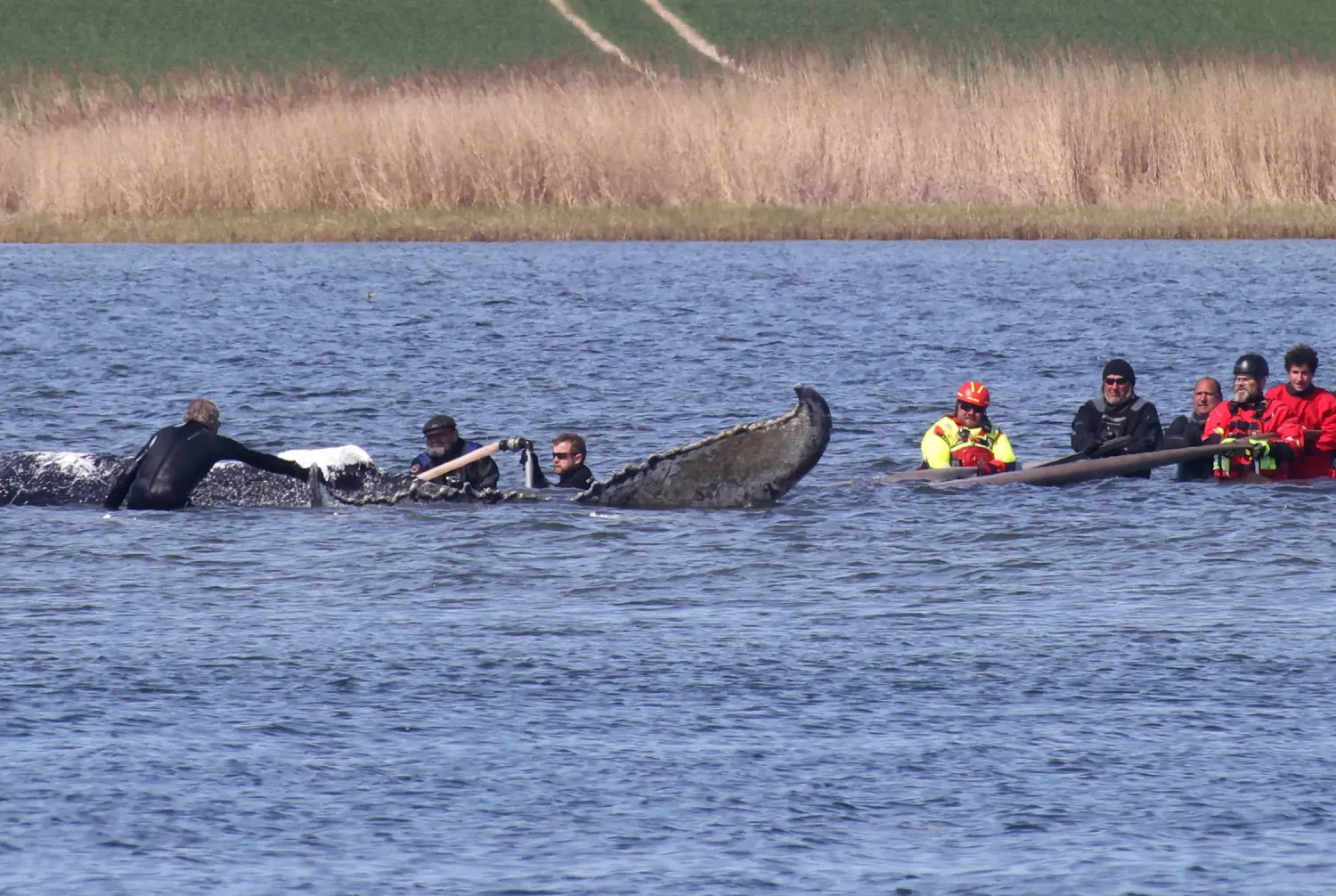
People stand close to a stranded humpback whale in the Wismarer Bucht bay of the Baltic Sea off the island of Poel, northern Germany, close to the village of Faehrdorf-Hof, on April 28, 2026. (AFP)
TT

Germany Approves New Rescue Bid for Stranded Whale

People stand close to a stranded humpback whale in the Wismarer Bucht bay of the Baltic Sea off the island of Poel, northern Germany, close to the village of Faehrdorf-Hof, on April 28, 2026. (AFP)

German officials Tuesday gave the green light for a fresh rescue attempt for a humpback whale which has been stranded off the country's Baltic Sea coast for over a month.

The 13-metre (over 40 foot) whale and its struggle for survival have gripped Germany since the sea mammal beached on a sandbank near the city of Luebeck, far from its natural habitat.

After several initial attempts failed, two entrepreneurs came forward to finance a new rescue bid which will involve loading the cetacean onto a special barge and carrying it out to deeper waters.

Till Backhaus, environment minister for the state of Mecklenburg-Western Pomerania, said that two vets had examined the whale and believed it was "fit to be transported."

After his announcement, rescuers in diving suits could be seen next to the whale, standing in shallow waters near the island of Poel, with the barge close by.

The creature, dubbed "Timmy" by some of the German press, was first spotted stuck on a sandbank on March 23 near Luebeck before freeing itself and then becoming stuck again several times.

At the start of April officials gave up on the animal, saying they believed it could not be saved.

But this triggered an outcry and authorities were persuaded to let the entrepreneurs come up with a rescue plan.

Some scientists have strongly criticized the decision to allow further rescue bids, believing they will be too risky for the whale and estimating the chances of success as low.

Backhaus however insisted it was his "absolute priority" that the mammal be rescued alive, and he was trying to "do everything possible to help" the creature.

The saga has sparked a media frenzy -- with non-stop coverage from TV channels, online outlets and social media influencers -- but has also led to angry spats and conspiracy theories.


No More Taking Out the Trash at Your Airbnb

A general view of apartment and office buildings in Hanoi, Vietnam, 21 October 2026. EPA/LUONG THAI LINH
TT

No More Taking Out the Trash at Your Airbnb

A general view of apartment and office buildings in Hanoi, Vietnam, 21 October 2026. EPA/LUONG THAI LINH

The days of having to take out the trash or wash the dishes before leaving an Airbnb are numbered as the short-term rental platform is tightening rules on what conditions hosts may impose on guests.

"Our rules regarding accommodations allow travelers to receive guidelines from hosts; however, our community has let us know that they can be confusing, restrictive, and difficult to manage," Airbnb said Thursday to AFP.

New rules published this week that will apply to reservations made from November 20 will seek to reduce that confusion.

In particular the new rules will generally prohibit hosts from asking guests "to complete tasks that require significant effort or time, or would typically be performed by a cleaner, including stripping the bed, taking trash offsite, or washing and putting away dishes."

Hosts can still ask guests to put dirty dishes in the sink or separate trash and recyclables.

Hosts will also no longer be able to impose fines or penalties on guests, who instead must seek compensation for any damage from insurance provided through Airbnb.


Champion-chip: Best Fries Contest Heats Up Belgium

Fries are a national passion in Belgium. Nicolas TUCAT / AFP
TT

Champion-chip: Best Fries Contest Heats Up Belgium

Fries are a national passion in Belgium. Nicolas TUCAT / AFP

Thick or thin, greasy or crispy, with samurai sauce or a more traditional mayo dip? A TV show has been on a quest to find the best fries in potato-mad Belgium.

For four years running "La meilleure friterie" (the best chip shop), a lighthearted culinary competition aired by broadcaster RTL-TVI, has been seeking out perfection among fry peddlers in the country's French-speaking region.

Watching it is a "sacred Thursday night ritual", said David Antoine, the host.

Crowning a winner among a dozen contestants is no picnic.

"There's sometimes friction among the judges, but we always find that famous Belgian compromise" over a portion of fries, Antoine told AFP in a joking reference to the country's penchant for lengthy political negotiations.

Fried potatoes are a national dish and symbol of pride in Belgium, home to about 4,600 diners specializing in the dish known as "friteries" in French or "frituren" in Flemish.

That number "has remained stable for many years," said Bernard Lefevre of the National Chip Shop Union, an industry group, noting the "market is doing well".

Each has its own flair.

To Lefevre, a good chip is preferably cut from a Belgian potato of the Bintje variety and double fried in beef fat. And size is paramount.

"Anything under nine millimeters is too thin and anything over fourteen is too thick," he explained.

- Hand-peeled 'gold' -

At Hill's Burger, a diner in Brussels, chef Massimo Sefa has gone for a "size twelve" -- that is "a two-millimeter crust and ten millimeters of creamy flesh", he said.

The 23-year-old smiled nervously when the TV show's judges entered his joint and the cameras started rolling.

But the stress is worth it, he explained. The broadcast will shine a spotlight on his friterie and a win would likely send sales skyrocketing.

Sefa opened up shop with his two younger brothers, Lorenzo and Marco. For them chips are a family matter: their grandfather ran about 10 chip shops in Brussels.

"Wow, delicious, crispy, and peeled by hand," Fabienne De Corte, one of the judges, raved upon tasting the goods.

"Fries in Belgium are our gold," added her husband Patrick De Corte, who is also on the judging panel.

"Every little detail makes a difference."

The show has a devout following, including some who tag along for filming sometimes dressed as fry cones and chanting "We've got the fries, we've got the potatoes!".

It has also had its share of controversies, particularly on the hot topic of sauces.

A technical glitch caused trouble during public voting in the first season and some grumbled the winner had bamboozled jurors with dazzling sauces, while the fries were not to everyone's taste.

Still the show has established itself in the French-speaking Belgian media landscape at a time where fries are sometimes changing along with Belgian society.

"There are halal, vegetarian, and vegan fry shops -- that's perfectly normal; society is evolving. We're not a museum of bygone folklore," Lefevre insists.


Aging Japanese Village Turns to Peru in Search of New Residents

A general view of Nanmoku village, Gunma prefecture is seen on September 26, 2026. (Photo by Rie KIKUCHI / AFP)
TT

Aging Japanese Village Turns to Peru in Search of New Residents

A general view of Nanmoku village, Gunma prefecture is seen on September 26, 2026. (Photo by Rie KIKUCHI / AFP)

In a misty mountain village in Japan, residents recently welcomed unlikely guests from a Peruvian district along the Amazon River, seeing a chance to revive an aging community facing extinction.

The mayor of Belen and two young women visited a care home on their trip to Nanmoku, a village of just 1,300 people in Gunma Prefecture, greeting the elderly with broad smiles as some looked on slightly puzzled.

"From the moment I arrived, I began to admire everything about this place," 19-year-old student Wendy Sangama told AFP during a week-long tour of Japan that followed the signing of a sister-city agreement between her hometown and the village last year.

"And yes, it's a town where I could see myself living and settling down," she said.

The village is the oldest municipality in Japan, with 70 percent of its residents aged 65 or above. A 2014 think tank report described it as "most at risk of disappearing."

The main street along the Nanmoku River is lined with houses and shops, some abandoned, and appeared largely deserted on the rainy weekend AFP visited.

Village officials hope the sister-city agreement, which promotes cultural and people-to-people ties, will ultimately attract young people from Belen to live in Nanmoku, although how they might obtain residency remains unclear.

While Peru has the world's third-largest population of Nikkei -- Japanese immigrants and their descendants -- Nanmoku Mayor Saijo Hasegawa told AFP the pact was down less to strategy than to a chance meeting with a Japanese-Peruvian businessman.

The village needed "to broaden its horizons and attract more residents, including foreigners,” no matter where they came from, he said.

"Without them, we could reach a point where even public transportation stops operating."

Despite its rapidly aging population and labor shortages, opposition to immigration is growing within Japan, prompting a push by Prime Minister Sanae Takaichi for tighter regulations on foreign nationals.

Nanmoku has tried various initiatives to attract young people from elsewhere in the country, but employment opportunities remain scarce, and farmland is limited in the mountainous area.

"Around 60 people die each year here, and just two or three babies are born," Hasegawa said.

Belen, meanwhile, is young. The impoverished district of Iquitos, a remote Amazonian city in northeastern Peru, has a median age of about 27 years old.

Home to more than 60,000 residents, the "Venice of Latin America" -- accessible only by plane or boat -- is filled with wooden houses built on stilts to withstand seasonal flooding.

"I think the young people would be more enthusiastic about wanting to settle in other cities because of the economic situation we have," Mayor Lina Arista Lopez told AFP.

The district's residents rely largely on informal trade and agriculture, growing crops such as yuca, rice and corn.

"We have a harsh reality in Belen," Lopez said. "There is no work."

Ketsi Yahuarcani, a 23-year-old student, called the visit to Nanmoku "incredible,” citing the sense of warmth she felt.

"If I had the opportunity to settle here, I would," she said.

Sangama, the other student, said moving to the Japanese village could be "a better option" if it allowed them to build a brighter future and support their families back home.

Not being able to see her family regularly, however, would "certainly be a challenge", she conceded.

While municipalities near Nanmoku have accepted foreign workers, particularly caregivers, it has typically been via short-term programs for skilled workers and technical interns.

Mayor Hasegawa said his vision was different.

Rather than attracting people who stay only a few years for work, he hopes to welcome residents of Belen as fellow villagers ready to build long-term lives in Nanmoku.

"The approach of simply bringing in workers from an agency just because we're short-staffed isn't right for our village," he said.

Yuki Wanibuchi, 34, who moved to Nanmoku several years ago from the Kyoto area, said potential newcomers would face hurdles, including the language barrier.

"You cannot live here without a car, and getting a driver's license will require Japanese skills," Wanibuchi said.

"But personally, I think it's more interesting when people from different backgrounds come here to live."

Hiroshi Ihara, an 87-year-old villager, told AFP he had watched his community grow greyer and greyer, with young people, including his three children, moving to bigger cities to make a living.

"I want more younger people to come and live in the village," he said.

"The Japanese population is shrinking. I think it would be best if people from overseas could come here and do what they can to support us."