


Saudi Arabia Reiterates its Support for Efforts to Achieve Global Peace and Stability

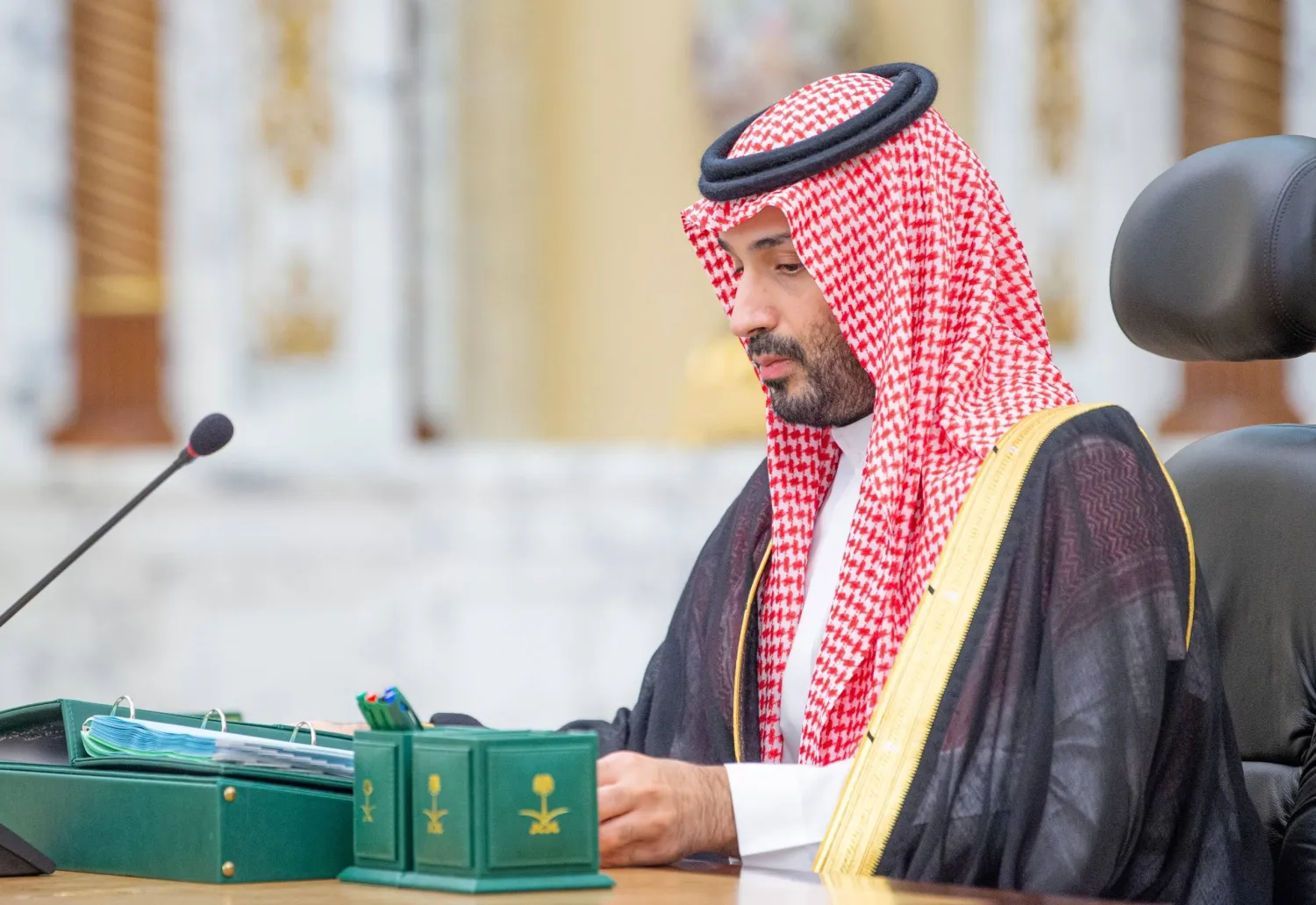
Prince Mohammed bin Salman bin Abdulaziz Al Saud, Crown Prince and Prime Minister, chairs the Cabinet meeting in Jeddah. (SPA)
TT

Saudi Arabia Reiterates its Support for Efforts to Achieve Global Peace and Stability

Prince Mohammed bin Salman bin Abdulaziz Al Saud, Crown Prince and Prime Minister, chairs the Cabinet meeting in Jeddah. (SPA)

The Saudi government reiterated on Tuesday the Kingdom’s firm stance on regional developments and its continued support for all diplomatic efforts aimed at establishing the foundations of global peace and stability.

Prince Mohammed bin Salman bin Abdulaziz Al Saud, Crown Prince and Prime Minister, chaired the Cabinet meeting that was held in Jeddah.

The Crown Prince briefed the Cabinet on the message received by Custodian of the Two Holy Mosques King Salman bin Abdulaziz Al Saud from Djibouti’s President Ismail Omar Guelleh covering bilateral relations.

He informed the ministers of his consultations and discussions with Syrian President Ahmed al-Sharaa, Lebanese President Joseph Aoun, Swiss President Guy Parmelin, Ukrainian President Volodymyr Zelenskyy, Japanese Prime Minister Sanae Takaichi, Czech PM Andrej Babis and Bangladesh’s PM Tarique Rahman.

The Crown Prince expressed his gratitude to the leaders of the Gulf Cooperation Council (GCC) states for their efforts during the GCC Consultative Summit that was held in Jeddah earlier on Tuesday, saying it reflected the Kingdom's commitment to strengthening communication, consultation, and joint action to achieve regional security and stability.

The Cabinet reviewed the latest regional and international developments, particularly those in the region and their security and economic repercussions.

It discussed several reports related to domestic affairs and the various achievements realized under Saudi Vision 2030. The achievements support the development process and establish a more diversified and resilient economic model by increasing the contribution of non-oil sectors, expanding the production and investment base, launching specialized national programs and strategies to utilize resources and wealth, and enhancing the ability to adapt to global changes.

The Cabinet commended the achievements of Vision 2030 across its first and second phases as it nears its objectives in reaching its overarching goals. The percentage of indicators that achieved their annual targets reached 93% of the key performance indicators, driven by structural, economic, financial, and legislative reforms that contributed to empowering sectors, attracting investments, improving the quality of life, and consolidating the Kingdom's global standing and competitiveness.

The Cabinet stressed the importance of redoubling efforts to sustain this impact in the third phase, accelerating the pace of work, and ensuring continued progress and prosperity.

It commended government entities for their remarkable progress in the 2026 Emerging Technologies Adoption Readiness Index, highlighting their continued provision of innovative services that enhanced digital integration, increased productivity, and expedited completion while maintaining leadership in international rankings and indicators.



Saudi FM: We Welcome Trump's Decision to Allow More Time for Diplomacy to End the War

Saudi Foreign Minister Prince Faisal bin Farhan bin Abdullah. (SPA)
TT

Saudi FM: We Welcome Trump's Decision to Allow More Time for Diplomacy to End the War

Saudi Foreign Minister Prince Faisal bin Farhan bin Abdullah. (SPA)

Saudi Foreign Minister Prince Faisal bin Farhan bin Abdullah expressed on Wednesday the Kingdom's appreciation for US President Donald Trump’s granting negotiations more opportunity to reach an agreement that ends the war on Iran and restores security and freedom of navigation in the Strait of Hormuz

In a statement, the Saudi Foreign Minister underlined the Kingdom's appreciation for diplomatic efforts aimed at containing the escalation.

He added that Saudi Arabia remained supportive of ongoing mediation efforts carried out by Pakistan and urged Iran to seize "the opportunity to avoid the dangerous implications of escalation". 

Prince Faisal stressed the importance of leveraging this opportunity to avoid further tensions, saying Saudi Arabia is awaiting Iran’s response to the efforts that aim to reach an agreement that achieves lasting peace and boosts regional and international security and stability.

Trump announced on Monday that he had postponed an attack on Iran set for Tuesday in response to a request from Gulf leaders.


UAE Demands that Iraq Halt Attacks Launched from its Territories

A handout picture obtained from the media office of the Barakah Nuclear Power Plant on February 13, 2020 shows a general view of the power plant in the western Al Dhafra Region of Abu Dhabi on the Gulf coastline about 50 kilometers west of Ruwais. (Barakah Nuclear Power Plant / AFP)
TT

UAE Demands that Iraq Halt Attacks Launched from its Territories

A handout picture obtained from the media office of the Barakah Nuclear Power Plant on February 13, 2020 shows a general view of the power plant in the western Al Dhafra Region of Abu Dhabi on the Gulf coastline about 50 kilometers west of Ruwais. (Barakah Nuclear Power Plant / AFP)

The United Arab Emirates strongly condemned on Wednesday “the unprovoked terrorist drone attacks launched from Iraqi territory, including an attack targeting the Barakah Nuclear Power Plant on Sunday, which struck an electricity generator located outside the inner perimeter of the plant.”

In a statement, the Ministry of Foreign Affairs stressed the UAE’s “strong condemnation and categorical rejection of the heinous terrorist attacks launched from Iraqi territory against critical civilian institutions across the Gulf Cooperation Council (GCC) countries, in flagrant violation of their sovereignty, airspace, and in clear breach of the principles of international law, international humanitarian law, and the Charter of the United Nations.”

The Ministry underscored the importance of the Iraqi government’s commitment “to immediately and unconditionally halt and prevent all acts of aggression launched from its territory,” stressing the need to address these threats in an immediate and responsible manner, in accordance with relevant international and regional laws and charters.

Furthermore, the Ministry underscored “the importance of Iraq fulfilling its role in strengthening security and stability in the region, thereby preserving its sovereignty and boosting its position as an active and responsible partner within the region.”


UN Security Council Condemns Attack on UAE Nuclear Plant

The Barakah nuclear power plant in Abu Dhabi. (WAM)
TT

UN Security Council Condemns Attack on UAE Nuclear Plant

The Barakah nuclear power plant in Abu Dhabi. (WAM)

Russia joined other UN Security Council members on Tuesday to condemn the drone strike on the UAE's Barakah nuclear power plant, which Abu Dhabi said originated from Iraq where pro-Iranian proxies are active.

The unclaimed drone struck an electrical generator on Sunday near the Arab world's first nuclear power plant in Barakah in the emirate of Abu Dhabi, triggering a fire but causing no injuries nor radiation leak.

"Attacks targeting peaceful nuclear facilities in any country of the world...are categorically unacceptable," said Russia's ambassador to the UN Vassily Nebenzya.

"Against this backdrop, our country categorically condemns the actions of those who carried out the strike targeting the plant on the territory of the UAE, thereby generating risks of escalation," he continued without naming any party.

"We trust that all stakeholders will do everything necessary to avoid a recurrence of such a dangerous incident," he added, noting that the strike likely would not have happened without the US-Israeli operation against Iran, Moscow's long-standing ally.

Abu Dhabi said Tuesday that the drones came from Iraq, where Iran-backed groups have been carrying out attacks against Gulf nations since the Middle East war erupted.

From China to the United States, the other members of the Security Council also condemned the strikes, which have not been claimed by any group.

"What sane nation, either directly or indirectly through proxies, sends drone attacks into an active and ongoing nuclear power plant?" asked US ambassador Mike Waltz, denouncing "outrageous and unacceptable attacks."

"What is the world left to believe? That if Iran...can't achieve a nuclear weapon -- and it can't use it as it has threatened over and over again on its neighbors -- that it's now going to find a clever and dangerous way to weaponize a nuclear power plant?

"I struggle to come to any other conclusion," he said.