

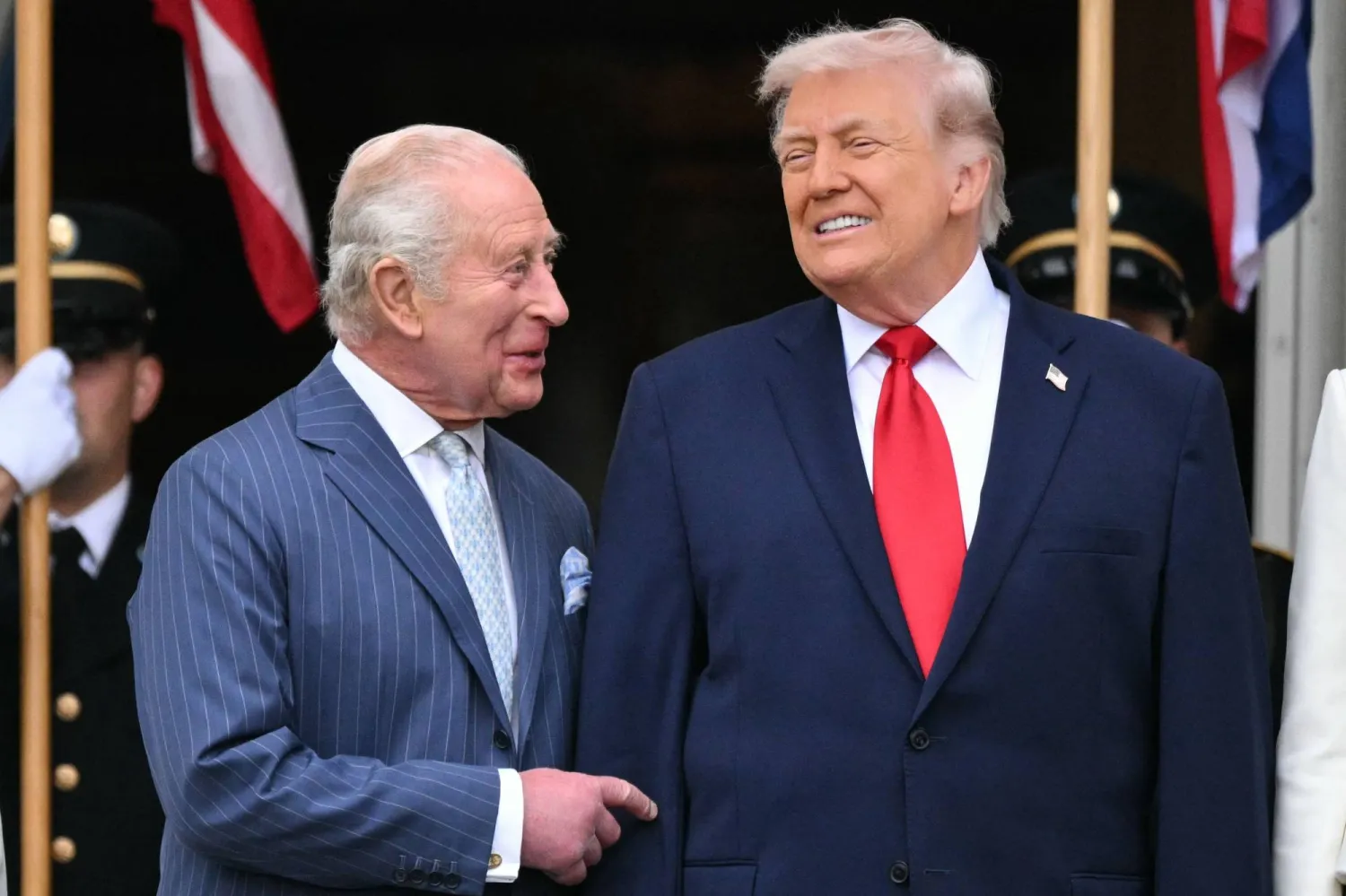

Trump and Charles Greet Each Other Warmly as the King Begins a Day of Diplomacy in Washington

US President Donald Trump speaks with Britain's King Charles III during an arrival ceremony on the South Lawn of the White House in Washington, DC, on April 28, 2026. (AFP)
TT

Trump and Charles Greet Each Other Warmly as the King Begins a Day of Diplomacy in Washington

US President Donald Trump speaks with Britain's King Charles III during an arrival ceremony on the South Lawn of the White House in Washington, DC, on April 28, 2026. (AFP)

President Donald Trump and King Charles III greeted each other warmly on Tuesday as the monarch began a day of diplomacy in Washington designed to emphasize a bond between the United Kingdom and the United States that is so strong it can withstand the political turmoil of the moment.

Trump welcomed Charles and Queen Camilla to the White House in a ceremony on the South Lawn. The king shook hands with members of Trump's Cabinet before joining the president for a rendition of the national anthem.

The leaders will huddle later in the Oval Office for a meeting that’s closed to the public, reducing the potential for the freewheeling, sometimes controversial meetings with foreign officials that have become routine during Trump’s second term.

Charles will later become the first British monarch to address the US Congress since his mother, Queen Elizabeth II, in 1991. Her speech highlighted the shared history of both countries and the importance of their democratic values, themes Charles will likely reinforce on Tuesday.

Such addresses are an opportunity afforded to only the most prominent world leaders, including Pope Francis, Václav Havel and Winston Churchill. It will likely mark the most extensive public remarks Charles will deliver during a four-day visit to the US that's intended to celebrate the country's 250th anniversary of independence from Britain.

House Speaker Mike Johnson, R-La., became the first sitting leader of his chamber to address the UK Parliament earlier this year. He attended a garden party with the king in Washington on Monday and said he told him he would be “well received” in Congress.

The visit comes at a challenging moment for US-UK relations. Trump’s up-and-down relationship with British Prime Minister Keir Starmer has taken a particularly sour turn over the past several months as the Republican president has sought to rally international support for the war in Iran. Trump criticized Starmer, who has largely resisted his overtures, by saying “this is not Winston Churchill that we're dealing with.”
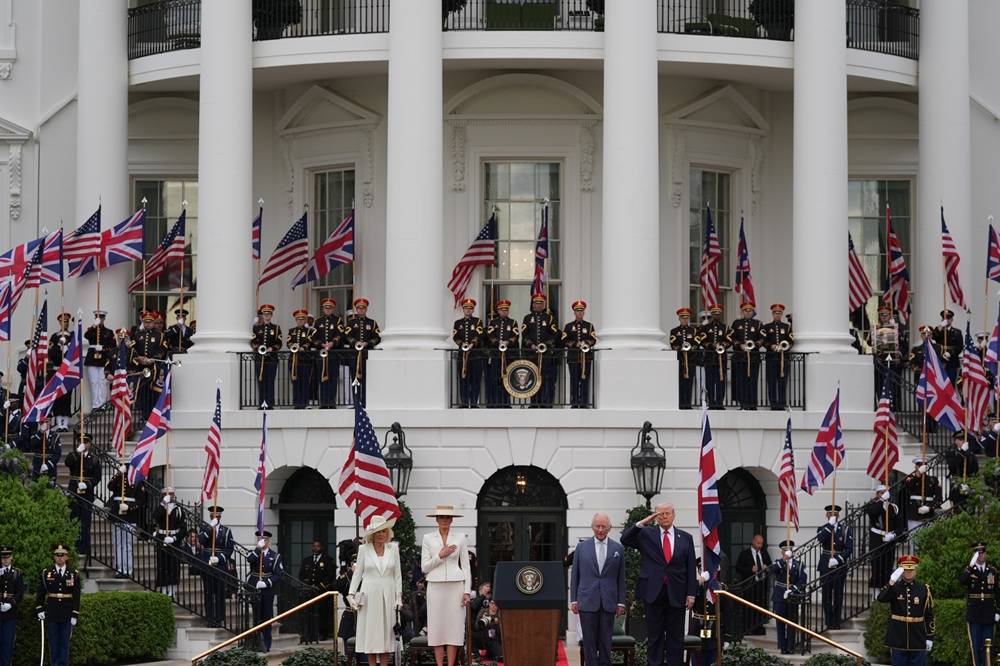
President Donald Trump and first lady Melania Trump stand on stage with Britain's King Charles III and Queen Camilla during a State Visit arrival ceremony on the South Lawn of the White House, Tuesday, April 28, 2026, in Washington. (AP)

Trump has also imposed tariffs on the UK and warned of additional levies despite a Supreme Court ruling earlier this year that has made such unilateral moves more challenging. Trump threatened just last week to slap a “big tariff” on the UK if it doesn't scrap a digital services tax on US technology companies.

Trump has more broadly challenged the traditional trans-Atlantic alliance with efforts to annex Greenland and threats to walk away from NATO. He has repeatedly imposed tariffs on and taunted Canada, a member of the British Commonwealth.

Meanwhile, Charles has faced some calls on Capitol Hill to meet with victims of Jeffrey Epstein while he is in the US. There's no indication that he will do so even as the scandal involving the convicted sex offender has ensnared his brother, who was arrested in February over misconduct allegations, which he denies.

Rep. Ro Khanna, D-Calif., urged the king over the weekend to at least address the issue during his congressional speech.

House Democratic leader Hakeem Jeffries of New York blamed Republican policies on Monday for straining the US-UK relationship.

“Hopefully, the king's visit is going to go a long way toward repairing the damage that this administration has done to one of our most important allies in the world,” Jeffries said.

Charles and Camilla arrived at the nation's capital on Monday and held a tea with the president and first lady Melania Trump. The royal couple will continue their US trip later this week with stops in New York City and Virginia.



US Calls for Coalition of Like-Minded Partners, Dozens of Countries Urge Reopening of Hormuz

Vessels in the Strait of Hormuz, Musandam, Oman, April 27, 2026. REUTERS/Stringer
TT

US Calls for Coalition of Like-Minded Partners, Dozens of Countries Urge Reopening of Hormuz

Vessels in the Strait of Hormuz, Musandam, Oman, April 27, 2026. REUTERS/Stringer

Dozens of countries gathered at the United Nations in New York on Monday to discuss “the safety and protection of waterways in the maritime domain,” demanding the reopening of the Strait of Hormuz, which has been closed by Iran since February.

During his speech at the Security Council open debate convened at the invitation of Bahrain, UN Secretary General Antonio Guterres said that ensuring the security of global waterways has become a fundamental test for the current international system, stressing that their stability is a cornerstone of global security and peace.

He said maritime routes have historically been vital arteries for global trade and energy flows among continents.

“Open the Strait. Let ships pass. No tolls. No discrimination. Let trade resume. Let the global economy breathe,” he noted.

Guterres warned that prolonged disruption risks triggering a global food emergency – pushing millions, especially in Africa and South Asia, into hunger and poverty.

Secretary-General of the International Maritime Organization (IOM) Arsenio Dominguez said straits used for international navigation cannot be closed by bordering States.

He said the geopolitical conflict around the Strait of Hormuz is having a very negative effect on seafarers and shipping, and on the global population and economy.

Coalition of like-minded partners

For his part, US Representative to the UN, Ambassador Mike Waltz said the Strait of Hormuz is not Iran’s to wield like its own moat and drawbridge.

“It is not Iran’s bargaining chip, it is not Iran’s toll road. And that’s what over 100 countries right outside these doors just testified in one of the most supported press conferences in recent years—100 countries just said what I said,” he told the open debate.

Waltz criticized both China and Russia for vetoing a resolution to protect the freedom of navigation and maritime security in the Straits of Hormuz. Instead, he said, they chose a radical religious regime for its partner, and ignored not only the plight of our Gulf countries, but the global economy.

He therefore called for a coalition of like-minded partners to step up and step in with real capabilities and help.

British Minister of State for Europe, North America, and the Overseas Territories Steven Doughty said shipping and seafarers must not be used as leverage, and there is no place for tolls or permissions in international straits.

“Throughout this crisis, the UK has been clear: Iran must not be able to hold the global economy hostage or indeed threaten regional and international security,” he said.

French Foreign Minister Jean-Noël Barrot emphasized that strategic straits are “arteries of the world" and "not the property of any individual.”

Barrot said Iran must make “major concessions” for a lasting solution to the Middle East crisis.

Speaking at the United Nations Security Council, he stressed that only a radical shift in Tehran’s stance can restore stability.

Russia and China

In return, Russia’s Permanent Representative at the Security Council open debate, Vassily Nebenzia said the situation in the Strait of Hormuz is the result of unprovoked US-Israeli aggression against Iran.

His Chinese counterpart, Fu Cong, said the root cause of the blockade of the Strait of Hormuz is the illegal military actions launched by the US and Israel against Iran.

He said China commends Pakistan and others for their role as mediators, and urges relevant parties to resolve disputes and conflicts by political and diplomatic means.

Saudi Arabia Rejects Threats

Saudi Arabia’s permanent representative to the UN, Abdulaziz Alwasil, said the Arab Gulf region is witnessing unprecedented tensions around the Strait of Hormuz.
“Any threat to freedom of navigation in this strategic waterway would directly impact global stability,” he noted.

The Saudi envoy condemned Iran for its actions and threats targeting international shipping and freedom of navigation, warning that such behavior constituted a serious threat to global peace and stability.

Alwasil said the waterway must remain open without restrictions, in accordance with international law.

Pakistan's ambassador to the UN Asim Iftikhar Ahmad emphasized that safeguarding sea lanes is essential not only for trade, but also for broader development and security goals.

The ambassador said Pakistan, alongside partners such as China, Saudi Arabia, Türkiye, and Egypt, is actively working toward de-escalation.

For his part, Iran’s envoy to the United Nations, Amir Saeid Iravani, said, “Lasting stability and security in the Arabian Gulf and the wider region can only be achieved through a durable and permanent cessation of aggression against Iran supplemented by credible guarantees of non-recurrence and full respect for the legitimate sovereign rights and interests of Iran.”

Joint Statement

Ahead of the open debate session, Bahrain's Foreign Minister Abdullatif bin Rashid Al Zayani, whose country holds the rotating presidency of the Council this month, read a joint statement on behalf of a broad coalition of countries, expressing strong opposition to actions affecting navigation in the Strait of Hormuz.

The statement reaffirmed support for Security Council Resolution 2817 and condemned what it described as Iranian actions, including the closure of the strait and attacks on regional neighbors.

It warned that such measures pose “a threat to international security and to navigational rights and freedoms,” emphasizing that free passage through the strait is essential to global stability and prosperity.

“We reiterate our call for the urgent and unimpeded opening of the strait,” Al Zayani said, reading from the statement.

Also on Monday, the US and Iran clashed at the United Nations over Tehran's nuclear program and its selection to be one of dozens of vice presidents at a month-long conference to review the nuclear Non-Proliferation Treaty.

The 11th conference to review implementation of the NPT, which came into force in 1970, began on Monday at the UN in New York.

Different groups nominated 34 conference vice presidents, and the conference chair, Vietnam's UN ambassador Do Hung Viet, said Iran was picked by “the group of non-aligned and other states.”

Christopher Yeaw, assistant secretary for the US Bureau of ⁠Arms Control and Nonproliferation, told the conference that Iran's selection was an “affront” to the NPT.

Reza Najafi, who serves as Tehran's ambassador to the International Atomic Energy Agency, rejected the US statement as “baseless and politically motivated.”


UK Summons Iranian Ambassador Over Embassy’s ‘Unacceptable’ Comments on Social Media

Police officers stand guard outside the Iranian embassy as demonstrators continue protesting outside during a rally in support of nationwide protests in Iran, in London, Britain, January 13, 2026. (Reuters)
TT

UK Summons Iranian Ambassador Over Embassy’s ‘Unacceptable’ Comments on Social Media

Police officers stand guard outside the Iranian embassy as demonstrators continue protesting outside during a rally in support of nationwide protests in Iran, in London, Britain, January 13, 2026. (Reuters)

Britain said on Tuesday the Iranian ambassador to London had been summoned over what the government described as the Iranian embassy's "unacceptable and inflammatory" comments on social media.

Britain's minister for the Middle East, ‌Hamish Falconer, made ‌clear that the embassy "must ‌cease ⁠any form of communications ⁠that could be interpreted as encouraging violence in the UK or internationally", the Foreign Office said in a statement.

Iranian officials in Tehran could not be immediately reached for ⁠comment on Britain's move.

A ‌statement posted ‌by the Iranian embassy on its Telegram channel ‌earlier this month called on ‌Iranians in Britain to volunteer for a campaign to declare their willingness to sacrifice their lives in a war ‌in defense of their country.

The British government did not ⁠specify ⁠which of the embassy's social media comments it was referring to.

British lawmakers have warned of significant and wide-ranging threats posed by Iran to Britain.

The government also summoned the Iranian ambassador last month after an Iranian national and a British-Iranian dual national were charged on suspicion of helping Iran's intelligence services.


Ukraine Says It Shot Down 33,000 Russian Drones in March, a Monthly Record

Police officers inspect fragments of a Russian drone after an air attack in Kyiv, Ukraine, Tuesday, April 28, 2026. (AP)
TT

Ukraine Says It Shot Down 33,000 Russian Drones in March, a Monthly Record

Police officers inspect fragments of a Russian drone after an air attack in Kyiv, Ukraine, Tuesday, April 28, 2026. (AP)

Ukraine used interceptor systems to shoot down more than 33,000 Russian drones of various types in March, a record monthly figure since Moscow launched its all-out invasion more than four years ago, Ukraine’s defense minister claimed.

Meanwhile, Ukraine’s domestically developed long-range attack drones struck a Russian oil refinery and terminal on the Black Sea for the third time in less than two weeks, prompting the evacuation of local people as a precautionary measure.

Ukraine has developed cutting-edge and battle-tested drone technology that has proved essential in holding back Russia’s bigger army and has drawn military interest from around the world.

Ukraine is scaling up supplies of interceptor drones to thwart Russian aerial attacks, and its military has introduced a new command within the air force to boost the country’s capabilities, Defense Minister Mykhailo Fedorov said in a post on Telegram late Monday.

Ukraine’s offensive capabilities have also improved, with the Defense Ministry saying Tuesday that the country’s forces have more than doubled the range of their deep-strike capabilities since Russia’s February 2022 invasion.

At that time, Ukrainian forces were able to hit military targets about 630 kilometers (400 miles) away, it said. They are now striking targets as far as roughly 1,750 kilometers (1,100 miles) behind enemy lines, the ministry said in a statement.

That improvement has allowed Ukraine to hit Russian oil installations that provide crucial revenue for Moscow’s war effort. It has also targeted manufacturing plants that supply Russia’s armed forces.

Ukraine struck a Russian oil refinery at the Black Sea port of Tuapse for the third time this month in a coordinated operation involving multiple branches of the country’s defense and security services, Ukraine’s Unmanned Systems Forces said Tuesday

The two strikes earlier this month destroyed 24 oil storage tanks and damaged four others, it said. Independent verification of the claims was not possible.

Video from Tuapse released Tuesday by Krasnodar regional Gov. Veniamin Kondratyev showed a massive plume of black smoke rising from the refinery and black, steaming puddles on an adjacent street. An emergency official reported to the governor that boiling oil products had spilled onto the street from one of the oil tanks, damaging several cars.

People who live near the Tuapse refinery were being evacuated, Kondratyev said. He didn’t provide any details about how many people were being evacuated or for how long.

The Russian Defense Ministry said Tuesday its air defenses overnight intercepted 186 Ukrainian drones over Russian regions, the annexed Crimea and the Black and the Azov seas.

In the Belgorod region on the border with Ukraine, three people were killed and three more were wounded in a drone attack, Gov. Vyacheslav Gladkov said.

Russian drone attacks on Ukraine, meanwhile, killed three civilians and wounded five others, Ukrainian authorities said.

Two people were killed in the city of Chuhuiv in the northeastern Kharkiv region, according to the head of the regional military administration Oleh Syniehubov.

A 40-year-old man died and five other men sustained injuries in Kryvyi Rih, the hometown of Ukrainian President Volodymyr Zelenskyy.

A rare daytime drone attack on Kyiv on Tuesday wounded two people, Mayor Vitali Klitschko said.

Another Russian attack on Konotop, in Ukraine’s northern Sumy region, knocked out the city’s power and water supply.