


Researchers: Tropical Forest Loss Eases After Record Year

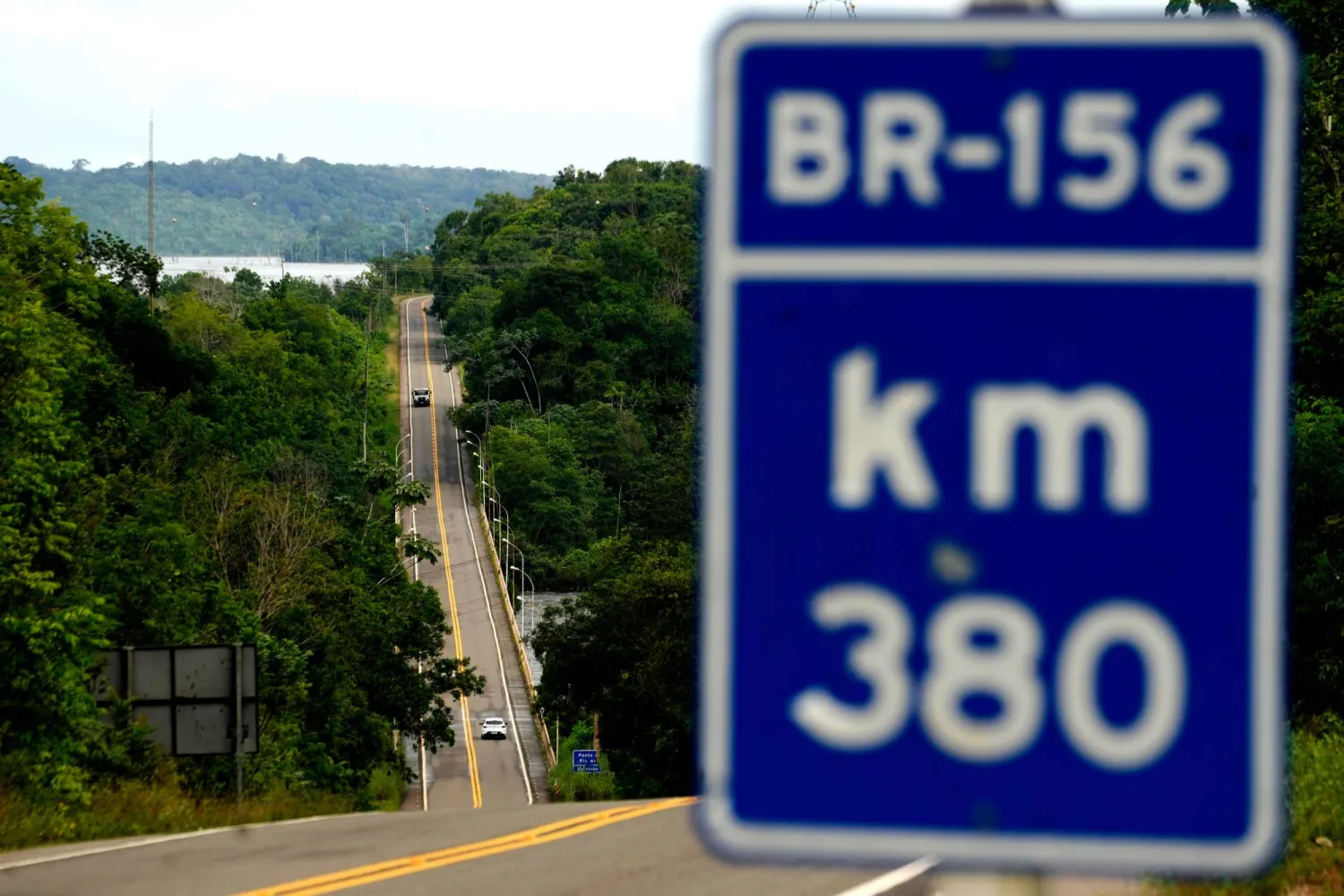
Vehicles drive on a fully paved section of BR-156 highway that connects the state capital Macapa with the city of Oiapoque, Amapa state, Brazil, Monday, March 9, 2026. (AP Photo/Eraldo Peres)
TT

Researchers: Tropical Forest Loss Eases After Record Year

Vehicles drive on a fully paved section of BR-156 highway that connects the state capital Macapa with the city of Oiapoque, Amapa state, Brazil, Monday, March 9, 2026. (AP Photo/Eraldo Peres)

The pace of tropical forest destruction slowed in 2025 after record losses the year before but remained at worrying levels equivalent to 11 football fields per minute, researchers said Wednesday.

The world lost 4.3 million hectares (10.6 million acres) of tropical primary rainforest last year -- down 36 percent from 2024, said researchers from the World Resources Institute (WRI) and the University of Maryland.

"A drop of this scale in a single year is encouraging -- it shows what decisive government action can achieve," said Elizabeth Goldman, co-director of WRI's Global Forest Watch platform.

"But part of the decline reflects a lull after an extreme fire year," Goldman said.

The researchers also warned that fires fueled by climate change have become a "dangerous new normal" which threatens to reverse the recent gains made by government efforts to tackle deforestation.

The warming El Nino weather phenomenon is expected to return in the middle of the year, which could push global temperatures even higher, raising the threat of heatwaves, droughts and wildfires.

The researchers, who used satellite data for their report, noted that last year's forest loss was still significant -- about the size of Denmark and 46 percent higher than a decade ago.

Despite last year's progress, global forest loss remains 70 percent above the level required to meet the 2030 goal of halting and reversing forest loss, the researchers said.

"A good year is a good year, but you need good years forever if you're going to conserve, for example, the tropical rainforest," Matthew Hansen, director of the GLAD Lab at the University of Maryland, said in a media briefing.

Much of last year's slowdown was due to sharp declines in Brazil, home to the biggest rainforest in the world.

Brazil's forest loss, excluding fires, was 41 percent lower than in 2024 -- its lowest rate on record.

"Brazil's declines are associated with stronger environmental policies and enforcement since President Lula took office in 2023," Goldman said in a news briefing, referring to Brazilian leader Luiz Inacio Lula da Silva.

Lula relaunched an anti-deforestation action plan and increased penalties for environmental crimes, AFP quoted her as saying.

But the country's forests are still threatened by agriculture, which remains the largest driver of forest loss to make room for soy fields and cattle ranches.

Some states in the Amazon have passed legislation to weaken environmental protections, the researchers said.

"Several countries showed that strong policy action can reduce forest loss quickly," Goldman said.

Forest loss in neighboring Colombia fell 17 percent, the second lowest year on record since 2016, thanks to government policies and agreements limiting forest clearing.

Government policies also helped to limit forest loss in Indonesia, where it increased by 14 percent but was well below the highs seen a decade ago.

In Malaysia, government efforts have helped to stabilize forest loss in the country.

Tropical forest loss remained high in other parts of the world, including in Bolivia, the Democratic Republic of Congo, Cameroon and Madagascar, the researchers said.

Global tree cover loss fell by 14 percent last year.

While agricultural expansion is still the leading driver of tree cover loss across the tropics, fires played a major role worldwide, accounting for 42 percent of the destruction.

"For the past three years, fires burned more than twice as much tree cover as they did two decades ago," Goldman said.

While humans cause most fires in the tropics, climate change is intensifying natural fire cycles in northern and temperate regions, the researchers said.

Canada had its second-worst fire year on record last year as wildfires tore through 5.3 million hectares of forest.

"Climate change and land clearing have shortened the fuse on global forest fires," Hansen said. "They are turning seasonal disturbances into a near-permanent state of emergency."




Brazil’s Natural Areas Shrink, Worsening El Nino Impact

A general view shows the water conditions in the Piraiba river before a summit of Amazon rainforest nations, in Belem, Para state, Brazil August 5, 2023. (Reuters)
TT

Brazil’s Natural Areas Shrink, Worsening El Nino Impact

A general view shows the water conditions in the Piraiba river before a summit of Amazon rainforest nations, in Belem, Para state, Brazil August 5, 2023. (Reuters)

Brazil has lost an area of native vegetation more than twice the size of France in the past four decades, increasing vulnerability to extreme weather events from El Nino, a study showed Wednesday.

Different areas of the vast nation are bracing for droughts, floods and fires as the El Nino weather pattern, confirmed in June, is expected to intensify towards the end of the year.

In its annual study of land use in Brazil, environmental monitoring network MapBiomas said that native vegetation that covered 79 percent of Brazil's territory four decades ago, now covers only 65 percent.

The biggest losses were seen in the Amazon rainforest and biodiverse Cerrado savanna.

Much of the affected land was converted for agriculture or livestock farming, which now covers 32 percent of Brazil's territory, up from 18 percent in 1985.

An analysis by MapBiomas showed that areas where native vegetation had given way to agriculture were more vulnerable to weather extremes during El Nino events that were as strong as this year's is forecast to be.

Tasso Azevedo, general coordinator of MapBiomas, told AFP that deforested areas of the Amazon had experienced "a more significant drop in rainfall compared to forested areas" during the 2023-2024 El Nino.

Meanwhile, in agricultural areas of the southern grasslands, there was excess rainfall compared to areas of native vegetation.

The southern state of Rio Grande do Sul suffered historic floods in 2024, which left around 200 people dead.

"Land-use patterns don't change El Nino itself, but they can alter the impact it has," said Azevedo.

"This shows that our land-use decisions can impact our level of vulnerability and determine how intense these climate events will be in the country."

He said the study did not address why agricultural areas experienced more intense impacts from El Nino.

"But one hypothesis is that, in the Amazon, removing forest reduces evapotranspiration and local air humidity. This leads to rising temperatures and reduced rainfall...El Nino amplifies the magnitude of the effect."

Last month, Brazil's government warned of a "very strong El Nino" this year, with Pacific Ocean sea-surface temperatures forecast to exceed two degrees above average temperatures.

This warming can have major effects on weather patterns around the world.

The Brazilian Confederation of Agriculture and Livestock (CNA) has also warned that a "super El Nino" could impact crops such as coffee, soy and sugar.


UK on Course to Record Warmest Summer for Second Year in a Row

A man runs across the parched park lands of Hyde Park in central London, Britain, 11 August 2026. (EPA)
TT

UK on Course to Record Warmest Summer for Second Year in a Row

A man runs across the parched park lands of Hyde Park in central London, Britain, 11 August 2026. (EPA)

Britain is "on course" to chalk up its warmest summer on record for the second-year running, the UK's Met Office weather agency said Tuesday as the country braced for its fifth heatwave of the season.

"The UK is on course to record its warmest summer on record for mean temperature, with only average conditions needed for the remainder of August to surpass the record set only last year," the Met Office said in a statement.

Britain last year sweltered through its hottest summer on record with a mean temperature of 16.10C, surpassing the previous record of 15.76C set in 2018.

The current average temperature for the summer, from June 1 to August 10, was already at 16.48C, the Met said.

"Another record-breaking summer now looks increasingly likely for the UK, following the second-warmest June, and second-warmest July on record and yet another heatwave imminent," said Met senior scientist Mike Kendon said.

"These statistics are a clear reminder -- if one were needed -- of the stark changes that we are seeing in the UK's climate."

High temperatures and low rainfall in swathes of the country, which is built for more temperate weather, have also plunged almost three-quarters of England and all of Wales into drought.

England and Wales also experienced their driest July on record this year.

Scientists say climate change is making extreme weather events like heatwaves and droughts more intense, and resulting in records tumbling more frequently.

Heatwaves and record temperatures in May and June disrupted schools, transport and hospitals, leading to an estimated 2,877 excess deaths in England -- almost double the total of the whole of summer 2025.


Extreme Heat Becoming More Frequent and Intense, UN Agency Says

 Castel Sant'Angelo, at background right, towers over the Tiber River, which has reached a low water level after several months without rain, in Rome, Tuesday, Aug. 11, 2026. (AP)
Castel Sant'Angelo, at background right, towers over the Tiber River, which has reached a low water level after several months without rain, in Rome, Tuesday, Aug. 11, 2026. (AP)
TT

Extreme Heat Becoming More Frequent and Intense, UN Agency Says

 Castel Sant'Angelo, at background right, towers over the Tiber River, which has reached a low water level after several months without rain, in Rome, Tuesday, Aug. 11, 2026. (AP)
Castel Sant'Angelo, at background right, towers over the Tiber River, which has reached a low water level after several months without rain, in Rome, Tuesday, Aug. 11, 2026. (AP)

Periods of extreme heat are becoming more frequent, intense and longer-lasting as climate change warms the planet, the UN weather agency said on Tuesday, noting changes since the famously hot European summer of 1976. Parts of Europe are enduring their fifth heatwave of a summer marked by drought, wildfires and record-breaking temperatures.

"Extreme heat is becoming more frequent, more intense, ‌it's lasting longer, and ‌covering much wider areas than in ‌the ⁠cooler climates of the ⁠past," John Kennedy, the World Meteorological Organization's head of climate information, told a press briefing in Geneva.

Kennedy said the current pattern of heat across Europe, the world's fastest-warming continent, reflected the interaction between a persistent pattern of high-pressure systems across the Northern Hemisphere and a warmer climate.

The high-pressure systems trap warm air, reduce cloud cover and ⁠block cooler air from moving in, allowing heat ‌to build over large regions for ‌days or weeks. El Niño, the naturally occurring climate pattern that typically boosts ‌global temperatures, was not contributing to Europe's heat this year ‌because conditions in the tropical Pacific are currently neutral, he added.

CHANGES OVER THE PAST FIVE DECADES

Kennedy noted that June 1976 featured a broadly similar pattern of high and low pressure systems to those seen this year, ‌but said the outcomes were very different because of decades of global warming.

"The picture for 1976 ⁠is one ⁠of a few isolated areas above average temperatures in a much cooler world," he said, whereas today "the picture is reversed" with much of the globe experiencing above-average temperatures and only a few isolated cooler regions.

Exceptionally warm seas and parched soils were amplifying temperatures across Europe, Kennedy said.

Marine heatwaves in the Mediterranean Sea and waters west of Europe are fueling hotter conditions on land by providing additional background warmth for persistent high-pressure systems, he added.

Dry ground was also intensifying the heat because soils warm more quickly once moisture is depleted.

"Lots of these factors are coming together to give us the record heat that we're seeing this year," Kennedy stated.
