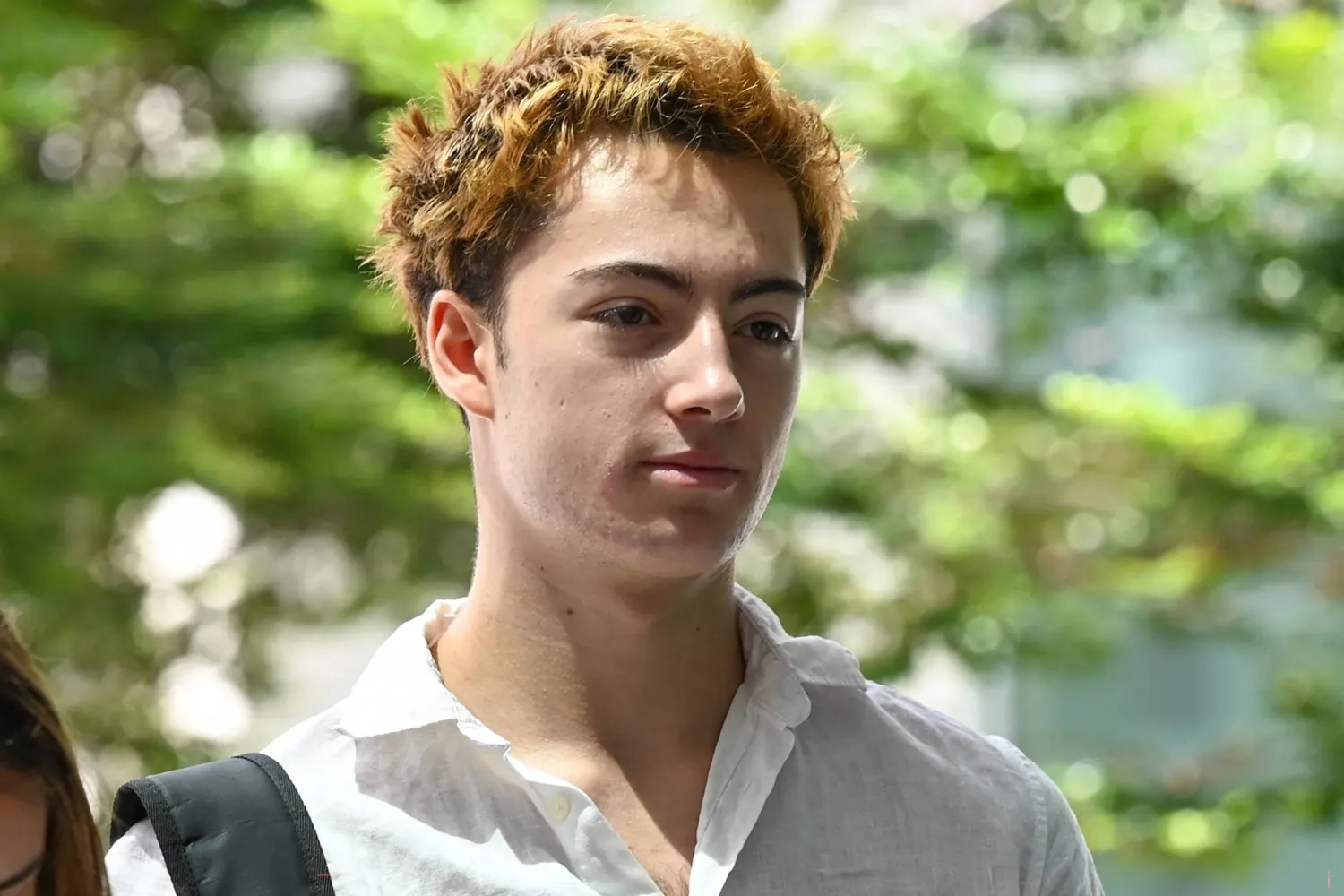
French Teen in Straw Licking Case Allowed to Leave Singapore

French teenager Didier Gaspard Owen Maximilien arrives for an application to leave jurisdiction, for the court's permission to leave Singapore, at the State Courts in Singapore on April 29, 2026. (Photo by Roslan RAHMAN / AFP)
TT

French Teen in Straw Licking Case Allowed to Leave Singapore

French teenager Didier Gaspard Owen Maximilien arrives for an application to leave jurisdiction, for the court's permission to leave Singapore, at the State Courts in Singapore on April 29, 2026. (Photo by Roslan RAHMAN / AFP)

A French teen facing criminal charges in Singapore for a straw licking stunt was granted permission on Wednesday to leave the country for three weeks on pledges to return.

The 18-year-old is accused of posting to social media a video of himself putting the straw he licked back into the dispenser on an orange juice vending machine.

Didier Gaspard Owen Maximilien's clip went viral and triggered a backlash that led to his arrest in Singapore, which has a reputation for not tolerating bad behavior.

The teen's lawyer sought permission from a judge for him to travel to Manila from May 2-25 for an internship, a key requirement for him to graduate, AFP reported.

The judge granted the request after the prosecution posed no objection, but asked that he must remain contactable while overseas and required a SG$5,000 ($3,900) bond.

His next appearance in the Singapore court was also rescheduled from May 22 to May 29.

The teen, who is studying in Singapore and is out on bail, was charged last Friday over the straw stunt.

He uploaded the video on Instagram knowing that it "would or would probably cause annoyance to the public", according to court documents.

The public nuisance offence carries a jail term of up to three months and a fine.

A second charge of committing mischief said Maximilien knew that he was "likely to cause wrongful loss or damage" to iJooz, the company operating the vending machine which had to replace all 500 straws in the dispenser.

The mischief offence carries a punishment of up to two years in jail on conviction and a fine, according to the charge sheet.

Both offences were allegedly committed on March 12.

The Straits Times newspaper said the video "quickly went viral, sparking shock and concern among netizens".


Scientists Studying Cockroach Milk and Nose-Blowing Win Ig Nobel Prizes for Quirky Science

Canadian Associate Professor Changhong Cao poses with a fake mosquito ahead of the 2026 Ig Nobel Prize Ceremony in Zurich, on September 3, 2026. (AFP)
TT

Scientists Studying Cockroach Milk and Nose-Blowing Win Ig Nobel Prizes for Quirky Science

Canadian Associate Professor Changhong Cao poses with a fake mosquito ahead of the 2026 Ig Nobel Prize Ceremony in Zurich, on September 3, 2026. (AFP)

Ten research teams were honored Thursday at a satirical science awards ceremony that was hosted outside the US for the first time due to travel concerns.

Researchers who studied milk from cockroaches and analyzed soil health using underwear received Ig Nobel prizes celebrating unusual and imaginative contributions to science.

The awards organized by a digital magazine called the Annals of Improbable Research shifted to Europe after 35 years in the United States over concerns about attendees being able to get visas.

At a convention center in Zurich, Switzerland, research teams received a custom trophy resembling a cross between a mushroom and a human foot. Among them were Matilda Brindle and Stuart West from the University of Oxford and the Florida Institute of Technology's Catherine F. Talbot, who reconstructed the evolutionary history of kissing, and the late Dr. Tokuji Unno who investigated the science of blowing one's nose.

Another research team buried 1,000 pairs of underwear in more than 25 countries to study how critters in the soil helped them decompose.

For future ceremonies, organizers plan to alternate between Zurich and other European countries. The 2027 ceremony will be held in the Belgian city of Antwerp. Previous iterations took place at Harvard University, the Massachusetts Institute of Technology and Boston University, but there are no immediate plans to return to the US.

“During the past year, it has become unsafe for our guests to visit the country,” Marc Abrahams, master of ceremonies and editor of the magazine, told The Associated Press in an email in March.

The Nobel Prizes, which have no relation to their cheekily named counterpart, will be announced at the start of October.


Hugh Jackman Aims to Buy into Football Club Norwich, a Division Rival of Ryan Reynolds’ Wrexham

Ryan Reynolds, left, and Hugh Jackman pose for photographers upon arrival at the screening of the film "Deadpool & Wolverine" on July 11, 2024 in London. (AP)
TT

Hugh Jackman Aims to Buy into Football Club Norwich, a Division Rival of Ryan Reynolds’ Wrexham

Ryan Reynolds, left, and Hugh Jackman pose for photographers upon arrival at the screening of the film "Deadpool & Wolverine" on July 11, 2024 in London. (AP)

Hugh Jackman wants to joins his fellow Hollywood star and friend Ryan Reynolds in owning part of a football club in the English leagues.

Jackman has long been a fan of Norwich, his mother’s home city in the east of England. The Wolverine star was asked in an interview broadcast on Thursday if he would like to “buy a bit” of the club which is majority owned by Mark Attanasio, the Milwaukee Brewers principal owner.

“I’m very, very interested in talking about it right now,” he told British broadcaster TalkSport while promoting his new movie, “The Death of Robin Hood.”

“You’re the first one to know that. There’s a little exclusive,” Jackman said when asked if he would “follow suit” with Reynolds, who put Wrexham on the global soccer and culture map after buying the club with Rob Mac in 2021.

Norwich and Wrexham are now rivals in the English second-tier Championship, though Jackman’s team has the more illustrious history. Norwich last played in the Premier League four years ago, and had perhaps its finest moment in 1993 eliminating German power Bayern Munich in the old UEFA Cup.

“Good on Ryan, you do your thing, I’m all about the Canaries,” Jackman said, citing Norwich’s nickname linked to the team’s distinctive yellow and green uniform.

Norwich and Wrexham both are expected to be contenders this season to earn promotion to the Premier League, the world’s most valuable club football competition.

“I think it’s an exciting team and it’s going to be an exciting year,” Jackman said, praising Norwich’s turnaround since hiring Belgian coach Philippe Clement last November.


Spacecraft Bound for Mercury Begins ‘Tricky’ Arrival

This composite image provided by NASA/Johns Hopkins University Applied Physics Laboratory/Carnegie Institution of Washington on Oct. 22, 2013, shows Mercury as it appeared to the Messenger spacecraft following a flyby of the planet. (NASA/Johns Hopkins University Applied Physics Laboratory/Carnegie Institution of Washington via AP)
TT

Spacecraft Bound for Mercury Begins ‘Tricky’ Arrival

This composite image provided by NASA/Johns Hopkins University Applied Physics Laboratory/Carnegie Institution of Washington on Oct. 22, 2013, shows Mercury as it appeared to the Messenger spacecraft following a flyby of the planet. (NASA/Johns Hopkins University Applied Physics Laboratory/Carnegie Institution of Washington via AP)

After an eight-year journey, a spacecraft carrying European and Japanese probes began the months-long, high-risk approach to Mercury on Thursday to study the Sun-scorched planet.

The BepiColombo mission set off from Earth in 2018 on a winding path to study the smallest and least understood planet in our Solar System with the aim of releasing the two probes into its orbit.

On Thursday it began its arrival phase, described by the European Space Agency (ESA) as its "most operationally challenging planetary arrival sequences ever attempted".

Mercury's relatively tiny mass -- it is only slightly bigger than the Moon -- means its gravitational pull is extremely weak compared to the Sun, making it complex for spacecraft to approach the planet without ending up incinerated or lost in space.

"It's a very ambitious mission," Santa Martinez, the mission manager at ESA, told a press conference ahead of its arrival.

The spacecraft had to travel more than 10 billion kilometers (miles), executing a series of nine flybys, to speed up, slow down and perfect its trajectory.

The two probes, which are attached to each other, finally separated on Thursday from the transfer module that has propelled them -- a crucial first step in the final approach.

It was the equivalent of "launching a new spacecraft. Only this spacecraft happens to be around a different planet," explained Ignacio Tanco, ESA's head of inner solar system mission operations, before the separation began.

- All went to plan -

On Thursday, Mercury was some 63 million km from the Sun and 200 million km from Earth.

"At these distances... any real-time operation becomes impossible," Tanco said, explaining there was about a 30-minute delay between checks being performed and commands being executed from the ground to the craft.

It means the spacecraft had to check and execute the separation autonomously -- a "tricky business," Tanco said.

But all went to plan.

The spacecraft autonomously cut the four mechanical struts connecting the orbiters to the module.

Spring mechanisms then gently pushed them away.

The separation took place at a speed of 40 centimeters (16 inches) per second, leaving the two entities relatively close given the vastness of space.

Due to the distance between the probes and Earth, the signal confirming the operation's success reached the control center in Darmstadt, Germany, nearly two hours later -- at 1353 GMT -- sparking rounds of applause and cheers.

"This is the best case scenario, that the telemetry comes exactly at the moment we expect it," said Elsa Montagnon, in charge of module operations at ESA.

"The spacecraft has completed its reconfiguration as expected," she said happily.

The probes are due to come into Mercury's orbit on November 21.

The next tricky phase will come on December 9 and 10, when the two probes separate into their respective orbits.

From April, the ESA's Mercury Planetary Orbiter (MPO) will begin studying the planet closest to the Sun with unprecedented precision, passing just 480 km from its surface.

The Japanese Mercury Magnetospheric Orbiter (Mio) will focus on its space environment and magnetic field, following an elliptical orbit that will carry it as far as 11,000 km away.

- New chapter -

Mercury is the least studied of the four rocky, innermost planets in our solar system, which include Venus, Earth and Mars.

NASA's Mariner 10 was the first probe to capture a close picture of its lunar-looking surface in 1974.

The MESSENGER probe then orbited the planet in 2011.

But many mysteries remain about its magnetic field, iron core and surface marked by hollows.

With its 16 instruments and 1.7-billion-euro ($2.0-billion) budget, BepiColombo "is going to bring to humanity and to the scientific community unprecedented views of Mercury... and it's going to open a new chapter in our understanding of the solar system", Martinez said.