


Ferragamo Expands Leather Mapping Efforts as EU Sustainability Rules Take Shape

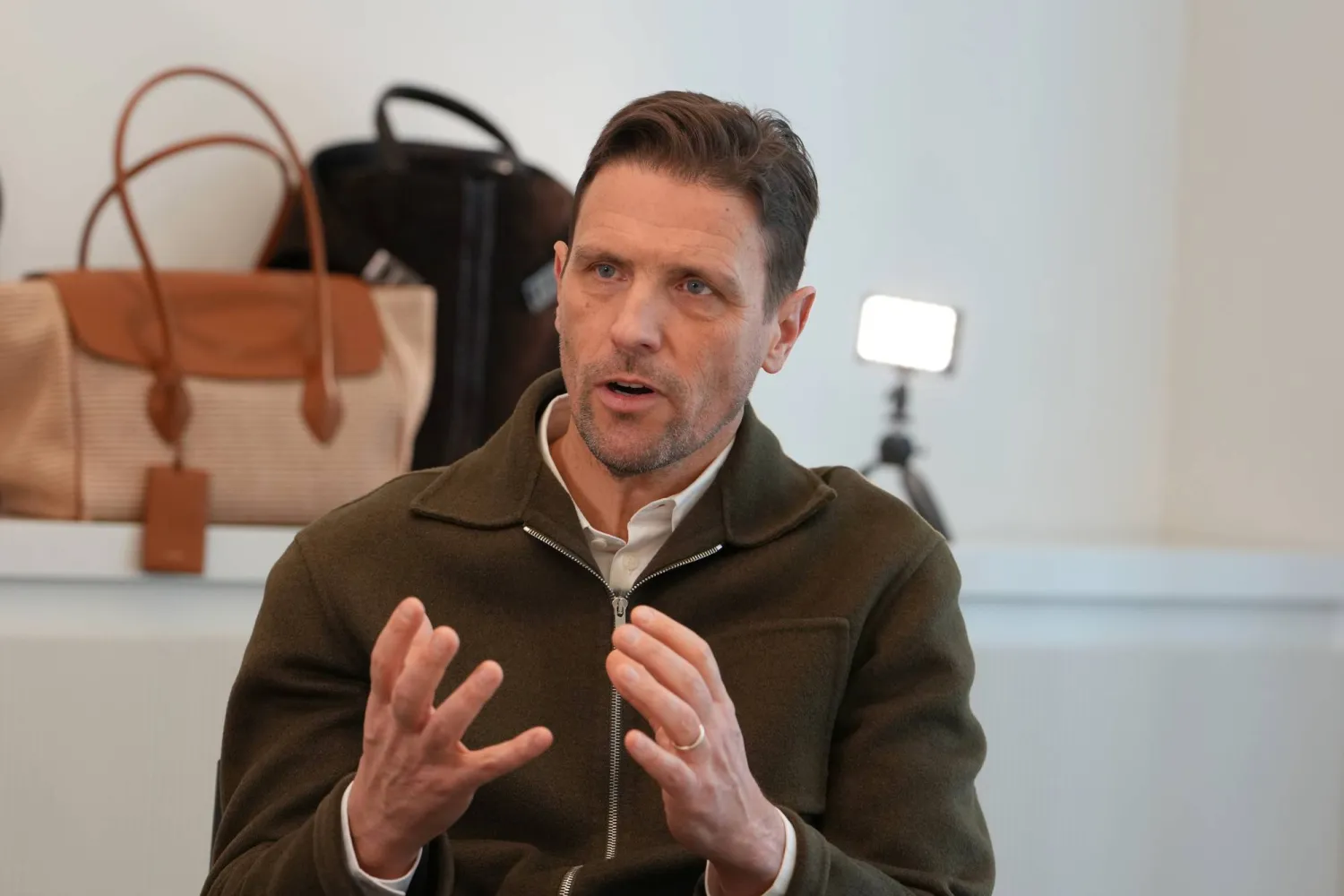
James Ferragamo, a chief product officer for the Salvatore Ferragamo group, talks with journalists during an interview with the Associated Press, in Milan, Italy, Wednesday, April 22, 2026. (AP Photo/Antonio Calanni)
TT

Ferragamo Expands Leather Mapping Efforts as EU Sustainability Rules Take Shape

James Ferragamo, a chief product officer for the Salvatore Ferragamo group, talks with journalists during an interview with the Associated Press, in Milan, Italy, Wednesday, April 22, 2026. (AP Photo/Antonio Calanni)

Italian luxury brand Ferragamo said it can map the country of origin for much of the leather used to make its coveted footwear and handbags, a first step in traceability according to experts.

The announcement comes during a wave of European Union sustainability rules that are increasing pressure on fashion brands to account for materials in their supply chains.

The family-run and publicly traded fashion house has been issuing sustainability reports for over a decade, but the 2025 report released March 31 is the first that contains figures on material traceability — notably for leather, which experts say is harder to trace than textile fibers such as cotton.

“We have been using leather in a more sustainable way,’’ James Ferragamo, the brand’s chief product officer and grandson of founder Salvatore Ferragamo, told The Associated Press in an interview last week. “I think it is one of the more sustainable materials in my point of view.”

Most of the tanneries working with the brand “control their water, have fair treatment of the workforce, monitor their supply chain ensuring that they’re buying leather from those who are not deforesting, and taking the right approach also in terms of breeding and animal welfare,” he said.

Traceability in fashion sustainability Traceability of materials is considered a first and necessary step for the fashion industry, which is facing a new EU framework that will require brands and their suppliers to ensure the items they produce are sustainable from the drawing board to end-of-life disposal. Precise terms are still being defined and compliance will be phased in over the coming years.

“Traceability is an essential factor, but it’s not sufficient,’’ said Francesca Romana Rinaldi, a sustainability expert and director of the Monitor for Circular Fashion at SDA Bocconi School of Management. “It enables the implementation of sustainability and circularity.”

She said that any company that is not tracing their materials “doesn’t know their supply chain” and “could be also criticized for greenwashing.”

EU regulations and directives are moving toward full circularity of materials to include measures extending the life cycle of garments, accessories and footwear through repairs and end-of-life management, including recycling and upcycling, she said.

The EU is also phasing in restrictions on destroying unsold apparel, accessories and footwear produced by companies with more than 250 employees and more than 40 million euros ($46.8 million) in annual revenues.

From breeding to assembly The family-run fashion house was founded in 1927 by Salvatore Ferragamo in Florence, after his return from Hollywood, where he had established himself as shoemaker to the stars with clients including Marilyn Monroe and Judy Garland. Material scarcity during World War II pushed Ferragamo to experiment with alternatives, substituting wicker for leather and using cork for soles, the younger Ferragamo said.

In keeping with its origins, Ferragamo remains primarily a footwear and leather goods maker. Together, they comprised 86% of 2025 sales of 976.5 million euros ($1.1 billion).

Ferragamo launched its initiative on leather traceability with the calf leather used for its Fiamma bag, tracing it from breeding to assembly, the group announced in its 2024 annual report.

In 2025, Ferragamo enlisted tanneries supplying 80% of the hides it buys in a project to identify the country of origin of raw materials through supplier declarations. When including textiles such as cotton, silk and nylon, the company says 81% of its materials are certified under third-party sustainability standards.

“Today there is not one single solution, one single technological solution to trace the leather to the birth farm of the cows,’’ said Davide Triacca, Ferragamo’s sustainability director. “We got to that result through a very dedicated and consistent approach and today we are able to trace more than 80% of the entire leather that we supply and the vast majority of which comes from Europe.”

The EU does not require leather to be traceable. Sustainability experts underscore that approaches based on country-level mapping and supplier declarations do not establish a full chain of custody and instead reflect an early stage of traceability.

Ferragamo previously included a capsule collection with silky textiles made from orange fibers in 2017, one of its first research investments. More recently it used nylon from castor oil instead of fossil oil for a men’s tote bag, and its Back to Earth collection featured the brand’s trademark Hug handbag treated with vegetable dyes.

“Research keeps on going. It’s something that we’re doing all the time,'' Ferragamo said.

“We’re trying to find different ways of creating different materials. And sometimes the materials that we produce are not ready for market. But it doesn’t mean that we don’t experiment.”



Paris Store to Part Ways with Shein After Ownership Change

This photograph shows a view of the Asian e-commerce giant Shein store at the Bazar de l'Hotel de Ville (BHV) department store in Paris on March 19, 2026. (AFP)
TT

Paris Store to Part Ways with Shein After Ownership Change

This photograph shows a view of the Asian e-commerce giant Shein store at the Bazar de l'Hotel de Ville (BHV) department store in Paris on March 19, 2026. (AFP)

French department store BHV Marais will end its partnership with Shein after its operating company said Tuesday it was selling the Paris outlet, following criticism of its deal with the Asian e-commerce giant.

The announcement comes after Shein in November opened its first permanent physical shop in BHV's flagship store, a move that sparked outcry over the brand's fast-fashion business model and environmental impact.

SGM, which has operated the landmark store opposite Paris City Hall since 2023, has sold it at a loss to a group of executives, including outgoing SGM CEO Karl-Stephane Cottendin, the two parties told reporters.

Cottendin, who will step down as SGM's chief executive following the deal, said Shein would "ideally" leave the store by Christmas, describing the decision to allow the retailer to open in BHV as a "strategic error".

A second BHV store west of Paris will also come under new management, while SGM will retain control of seven other locations, five of which have welcomed Shein this year.

Contractual commitments with Shein at the non-Paris stores will be "honored" pending a "long-term" review, SGM director Frederic Merlin said.

Merlin acknowledged having made "mistakes", adding that the sale of BHV was a "genuine plan for an effective takeover by serious people".

Founded in China in 2012 and now based in Singapore, Shein has faced criticism in several countries over working conditions at its suppliers and the environmental impact of its ultra-fast-fashion business model.

Around 100 brands left the BHV Marais following Shein's arrival, with management saying it was either over opposition to the Asian brand or over unpaid invoices linked to IT systems.

Earlier this month, France said it imposed two fines on Shein totaling more than 22 million euros ($26 million), citing problems with product traceability, environmental labelling and delivery times.

The penalties bring the total fines imposed by France against the Asian fashion giant to more than 210 million euros.


Hugo Boss Shares Jump after Frasers' $2.3 Billion Takeover Bid

FILE PHOTO: Men's shoes are on display at the Boss store in London, Britain, May 30, 2024. REUTERS/Chris J. Ratcliffe/File Photo
TT

Hugo Boss Shares Jump after Frasers' $2.3 Billion Takeover Bid

FILE PHOTO: Men's shoes are on display at the Boss store in London, Britain, May 30, 2024. REUTERS/Chris J. Ratcliffe/File Photo

Shares in Hugo Boss rose about 7% on Thursday after Britain’s Frasers Group launched a $2.3 billion takeover offer for the German fashion brand.

Frasers, already the largest shareholder of Hugo Boss with a stake of just over 26%, is offering €38 per share in cash for the remaining shares, a 4.3% premium to Wednesday’s close, Reuters reported.

Hugo Boss said late on Wednesday the approach was not coordinated ⁠with the company ⁠and that its board would review the offer, which values the stake not yet owned by Frasers at about €1.98 billion ($2.3 billion).

The deal would bring Hugo Boss into the retail empire controlled ⁠by British billionaire Mike Ashley, whose Frasers Group owns Sports Direct and House of Fraser and holds stakes in Asos, Debenhams and Currys.

J.P. Morgan said the bid likely sets a near-term floor for the shares but flagged limited scope for further upside, adding it did not expect a rival bidder to emerge.

Hugo Boss, ⁠whose ⁠shares are about half their level of three years ago, has been struggling with weaker sales and is pursuing a turnaround strategy focused on store revamps, a streamlined product range and expanding women's wear.

By 0713 GMT, Hugo Boss shares were up 6.2% at €38.7, above Frasers' offer price, taking their year-to-date gains to 7.2%. Frasers shares fell 2.5%.


Primark Names Lucy Slinger as Finance Chief Ahead of AB Foods Split


A Primark store is pictured in the Bullring shopping center in Birmingham, Britain, November 4, 2020. REUTERS/Andrew Boyers
TT

Primark Names Lucy Slinger as Finance Chief Ahead of AB Foods Split


A Primark store is pictured in the Bullring shopping center in Birmingham, Britain, November 4, 2020. REUTERS/Andrew Boyers

Fashion retailer Primark named Lucy Slinger as its chief financial officer on Thursday, strengthening its leadership team ahead of its split from Associated British Foods.

Slinger joins Primark from IKEA franchisee ⁠Ingka Group, where she ⁠has served as deputy CFO.

Prior to Ingka Group, she spent over two ⁠decades at Shell in a range of senior finance leadership roles.

Slinger's appointment follows that of Eoin Tonge as Primark chief executive and Filip Ekvall as chief commercial officer in March, Reuters reported.

⁠AB ⁠Foods said in April it would spin off Primark from its food businesses, telling investors that it will be better positioned to grow on its own.