
US Company Aims to Resurrect Bluebuck Antelope that was Hunted to Extinction

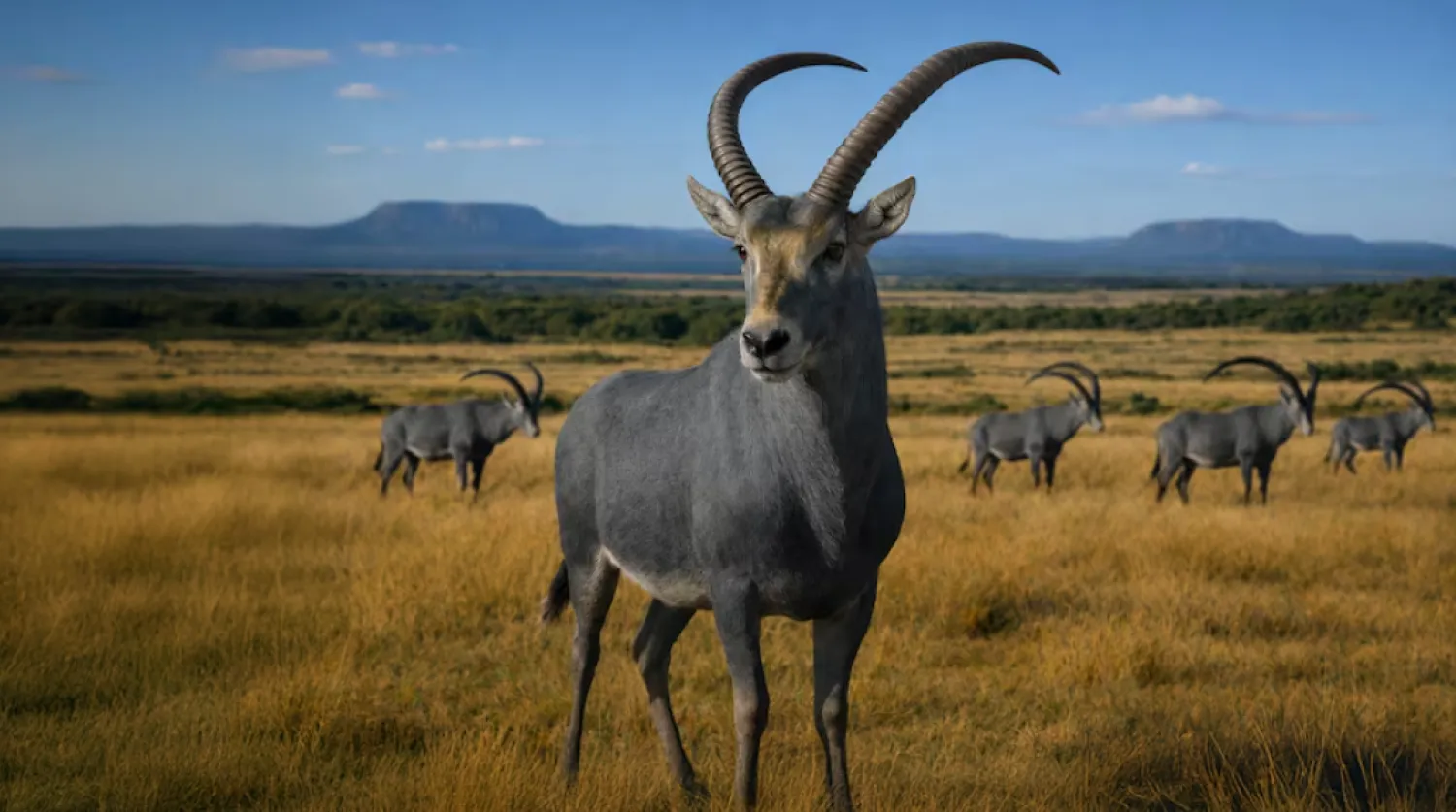
An artist's rendering of the extinct African antelope species called the Bluebuck, released on April 30, 2026. Colossal Biosciences/Handout via REUTERS
TT

US Company Aims to Resurrect Bluebuck Antelope that was Hunted to Extinction

An artist's rendering of the extinct African antelope species called the Bluebuck, released on April 30, 2026. Colossal Biosciences/Handout via REUTERS

The bluebuck, an antelope with a silvery slate-blue coat and striking horns, inhabited the coastal grasslands of South Africa's southwestern Cape region until European settlers hunted it to extinction in around 1800. A US company now plans to resurrect the bluebuck as part of its de-extinction efforts.

Dallas-based Colossal Biosciences announced on Thursday that it has made the bluebuck the sixth species in its de-extinction portfolio based on genetic engineering, alongside three other mammals - the dire wolf, woolly mammoth and thylacine, also called the Tasmanian tiger - and two birds, the dodo and moa, Reuters reported.

"We're two years into the bluebuck project and have already completed several foundational steps," Colossal CEO and co-founder Ben Lamm told Reuters. "We are equally excited about how our technology can help living antelopes today. About a third of the world's roughly 90 antelope species are threatened or near-threatened."

Prized for the unique color of their hides, bluebuck were hunted to extinction just 34 years after the species was first documented scientifically. The animal stood about four feet (1.2 meters) tall at the shoulder, with backward-curving and ringed black horns reaching about 22 inches (56.5 cm) long, and was smaller than the closely related roan and sable antelopes.

"Humans did this. European settlers shot the bluebuck out of the Cape in under 34 years. There's no ambiguity about the cause and there's no ambiguity about the responsibility. If we have the capability to right that wrong, I think we have an obligation to," Lamm said.

The company in April 2025 announced the birth of three genetically engineered wolf pups created with the help of ancient DNA obtained from fossilized remains of dire wolves, an Ice Age predator that went extinct roughly 13,000 years ago. The process used to create them involved editing the genes of the gray wolf, the closest living relative of the extinct species, to add dire wolf traits, and creating an embryo.

In the case of the bluebuck, Colossal is editing the genes of an African antelope called the roan, its closest living relative.

"We are now in the genome-editing phase, where we introduce key bluebuck edits and genes into roan antelope cells," Lamm said, adding, "After finishing the various edits, the next step will be to use the edited cells to create an embryo and move toward implantation. From there, gestation would take about nine months."

The plan is for the embryo to be implanted into a surrogate roan mother. Through cloning, embryos were created from edited gray wolf cells in the dire wolf project, and these were implanted in surrogate domesticated dog mothers.

A MUSEUM SPECIMEN

Lamm said the company mainly used a mounted bluebuck skin from a young male specimen at the Swedish Museum of Natural History in Stockholm to obtain bluebuck DNA.

The team compared the bluebuck and roan genomes to understand what made the bluebuck unique, Lamm said, noting that the two species are more than 98% genomically similar. The team has created pluripotent stem cells in roan antelope - "essentially versatile 'starter cells' that can become many different cell types," Lamm said.

"We've also made breakthroughs in reproductive methods, including successfully collecting eggs from antelope species using advanced techniques," Lamm said.

Even as a growing number of species slip into oblivion due to human actions including hunting and habitat destruction, scientists have debated the ethics of attempting to resurrect extinct species.

"Honestly, I think the debate sometimes functions as a way to avoid a harder conversation, which is that conservation as currently practiced is not winning. We are losing species faster than our existing toolkit can address," Lamm said.

Colossal called the wolves it created dire wolves and referred to the species as the world's first successfully "de-extincted" animal. Some outside experts described them as genetically modified gray wolves.

"The dire wolves are doing great," Lamm said.

"The three dire wolves live on a 2,000-acre (810-hectare) secure, expansive ecological preserve that allows us to monitor and manage them while providing them a semi-wild habitat to thrive in. We hope to have more dire wolf pups by the end of the year. We will also have scientific progress announcements around the mammoth, dodo, thylacine and moa before the end of the year, but the projects are all running on track," Lamm said.



Bird Nests of Fiber-Optic Cables Show War’s Impact on Ukraine

Bird's nests made with fragments of optic fiber, which were found by a Ukrainian serviceman on the front line and then passed to the National Museum of the History of Ukraine in the Second World War, lie on a table in a museum, amid Russia's attack on Ukraine, in Kyiv, Ukraine June 23, 2026. (Reuters)
TT

Bird Nests of Fiber-Optic Cables Show War’s Impact on Ukraine

Bird's nests made with fragments of optic fiber, which were found by a Ukrainian serviceman on the front line and then passed to the National Museum of the History of Ukraine in the Second World War, lie on a table in a museum, amid Russia's attack on Ukraine, in Kyiv, Ukraine June 23, 2026. (Reuters)

Woven from fiber-optic cable and grass, a small bird's nest found near the front line of the war in Ukraine shows how the more than four-year-old conflict is reshaping the natural environment, researchers say.

Areas along the 1,200-km (746-mile) front line are covered with ultra-thin fiber-optic cables, which are used by Ukrainian and Russian troops to guide aerial attack drones to make them impervious to electronic jamming.

The cables, which can stretch for 20 km, lie tangled in trees and scattered across fields and on the rooftops ‌of towns in ‌Ukraine's frontline regions, glistening in the sunlight like giant spider ‌web.

Birds ⁠have begun repurposing ⁠the discarded cables to weave their nests, says Yana Hrynko, a senior researcher at Kyiv's War Museum, cautiously examining two delicate nests which the armed forces sent to the museum from the front line.

"Objects such as bird nests with fragments of optic fiber demonstrate the change in the nature of war," said Hrynko.

Russia invaded Ukraine in February 2022 with tanks, armored vehicles and artillery. Trying to counter ⁠Russia's advantage in such conventional equipment, Ukraine has poured resources ‌into developing aerial drones. Drones now dominate ‌the battlefield.

Hrynko said researchers did not know which birds made the nests nor how they ‌had gathered the long cables.

"The first nest mainly contains dry grass ‌and fiber-optic cable. And it's pretty tightly twisted," she said.

ONLINE VIDEOS AND PHOTOS

Reuters spoke to several Ukrainian servicemen in the frontline regions of Donetsk, Kharkiv and Zaporizhzhia who had found such nests and posted their pictures and videos online.

One of the two nests ‌will remain in Kyiv as a part of the War Museum's war collection, and the other will be sent ⁠for study in the ⁠Netherlands and later returned, researchers said.

Auke-Florian Hiemstra, a 33-year-old biologist based in the Dutch city of Leiden who specializes in artificial nest materials, said Ukraine had rich avian biodiversity and there were many species that could have built the nests.

"We're going to look for DNA traces still in a nest to determine who actually made the nest," she said. "I have never seen nests like this before - and I have seen many, many bird nests."

The impact of the fiber-optic on birds could be mixed, Hiemstra said. It could cause harm as the birds could become entangled but it could also benefit them by helping them make a strong nest. "And by documenting this nest, we're also documenting the impact of war on nature in Ukraine," Hiemstra said.


France to Illuminate Statue of Liberty for US 250th Birthday

The lower Manhattan skyline, including the new One World Trade Center building at right, is shown as viewed from near the Statue of Liberty, Jan. 31, 2014, in New York.  (AP)
The lower Manhattan skyline, including the new One World Trade Center building at right, is shown as viewed from near the Statue of Liberty, Jan. 31, 2014, in New York. (AP)
TT

France to Illuminate Statue of Liberty for US 250th Birthday

The lower Manhattan skyline, including the new One World Trade Center building at right, is shown as viewed from near the Statue of Liberty, Jan. 31, 2014, in New York.  (AP)
The lower Manhattan skyline, including the new One World Trade Center building at right, is shown as viewed from near the Statue of Liberty, Jan. 31, 2014, in New York. (AP)

France will stage an elaborate light show at the Statue of Liberty to mark the 250th anniversary of the United States, the French consulate said Monday.

Described as a "monumental artistic creation," the show will be recorded in advance and broadcast by the ABC network at the start of its 25 hours of programming for Independence Day, July 4.

"The Statue of Liberty will be revealed to the public as it has never been seen before, in a staging designed to magnify its symbolic and emotional power," the consulate said.

"Our friendship goes back 250 years, it is still very strong, it runs deep, and that is why we wanted to do something significant," France's consul to New York Cedrik Fouriscot told AFP.

The Statue of Liberty in New York Harbor was given to the United States by France in 1886, and is one of the country's most famous monuments.

France also dispatched its air force acrobatics team to the United States this month to mark the 250th anniversary.

On June 9, eight Alpha jets of the Patrouille de France filled the skies above Manhattan with the colors of the French tricolor -- soaring above the iconic statue.


Brooch Given to First Passenger to Board Doomed Steamship Found at Roadshow

The brooch contains a dedication with the date April 21 1894 (AP)
TT

Brooch Given to First Passenger to Board Doomed Steamship Found at Roadshow

The brooch contains a dedication with the date April 21 1894 (AP)

A brooch given to the first passenger to board a Dundee-built steamship 37 years before she sank has surfaced at an antiques roadshow.

The decorative item was presented to Elizabeth Anderson on April 21 1894, the date of the maiden voyage of the SS Citrine, according to the British website ‘itv News.’

Built by Dundee shipbuilders W B Thompson & Co, the Citrine was one of a number of vessels in the Glasgow-based “Gem line,” all of which were named after gemstones or minerals.

The shipping firm was owned by William Robertson, who started out with a single barge in 1852 before growing it into one of the largest coastal bulk shipping fleets in Britain.

The brooch was presented to Anderson by Robertson and is inscribed with the words “SS Citrine, April 21 1894, Elizabeth McIntyre Anderson, from William Robertson.”

The sides of the gold-colored item are shaped as a ship’s rope and its center has been designed as a life ring mounted with a citrine stone, echoing the name of the vessel.

The Citrine sank on March 17 1931 after striking rocks at Bradda Head, Port Erin, on the Isle of Man.

Accounts at the time described the ship’s final moments in darkness, heavy weather and confusion, and the disaster claimed the lives of nine of her 11 crew members.

William Robertson had been dead for 12 years by the time of the sinking but the business remained in family hands under his sons, William Francis Robertson and James Robertson.
The brooch was discovered at a WeBuyVintage roadshow in Fleetwood, Lancashire.