Trump in Fresh Attack on Germany’s Merz Over Iran

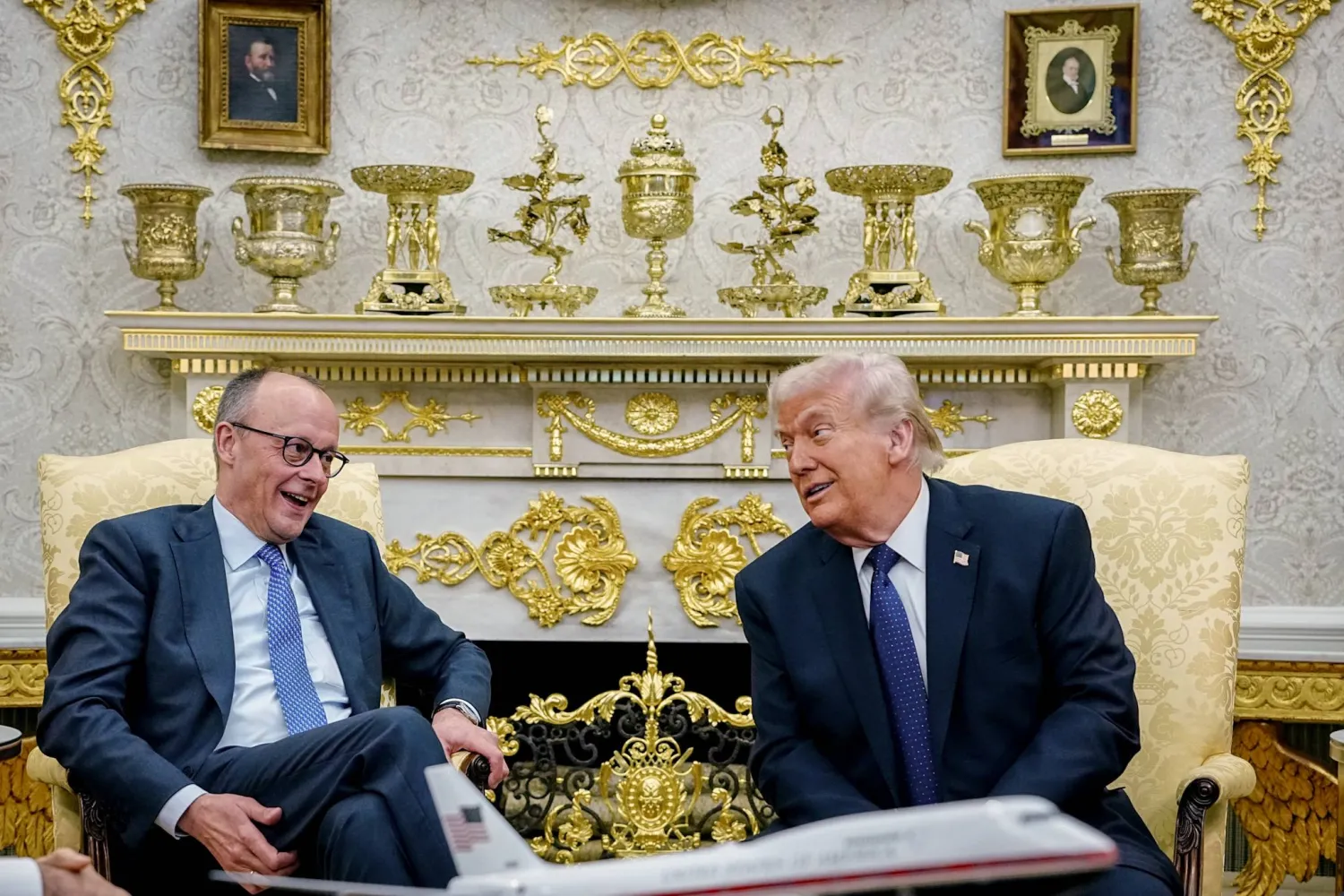
03 March 2026, US, Washington: US President Donald Trump (R) meets with German Chancellor Friedrich Merz at the White House. (dpa)
TT

Trump in Fresh Attack on Germany’s Merz Over Iran

03 March 2026, US, Washington: US President Donald Trump (R) meets with German Chancellor Friedrich Merz at the White House. (dpa)

US President Donald Trump renewed his criticism of German Chancellor Friedrich Merz on Thursday, telling him to focus on ending the Ukraine war instead of "interfering" on Iran.

Trump's second broadside of the week against Merz came a day after he said he was considering the redeployment of some of the tens of thousands of US troops stationed in key NATO ally Germany.

"The Chancellor of Germany should spend more time on ending the war with Russia/Ukraine (Where he has been totally ineffective!), and fixing his broken Country, especially Immigration and Energy," Trump said on his Truth Social network.

He added that Merz should spend "less time on interfering with those that are getting rid of the Iran Nuclear threat, thereby making the World, including Germany, a safer place!"

Trump was apparently infuriated by Merz's comments on Monday that Tehran was "humiliating" the United States in negotiations to end the US-Israeli war on Iran that has just entered its third month.

The US leader's comments also come a day after he had a call with Russian President Vladimir Putin that Trump said focused mostly on ending the war in Ukraine, which Moscow's forces invaded in February 2022.

Trump has long said he could bring a quick end to the war there but has made little progress.


Iran FM Says ‘Security Breach’ Led to Khamenei’s Assassination

Iran's Foreign Minister Abbas Araghchi addresses a special session of the Conference on Disarmament at the United Nations, aside of US-Iran talks in Geneva, Switzerland, February 17, 2026. (Reuters)
TT

Iran FM Says ‘Security Breach’ Led to Khamenei’s Assassination

Iran's Foreign Minister Abbas Araghchi addresses a special session of the Conference on Disarmament at the United Nations, aside of US-Iran talks in Geneva, Switzerland, February 17, 2026. (Reuters)

Iranian Foreign Minister Abbas Araghchi said the February 28 strike that killed former Supreme Leader Ali Khamenei revealed a security breach at the highest levels of power that probably “still exists.”

“Within seconds, three attacks targeted the command center in the Pasteur region, which holds the offices and headquarters of Iran’s Supreme Leader,” Araghchi said in a wide-ranging television interview with conservative pro-government media activist Javad Moghayi.

A number of senior Iranian political and military figures were killed on the first day of the US-Israel war, including Khamenei.

“The crucial point, in my view, is that (the US and Israel) knew about these meetings,” Araghchi said. “That possibly points to a security breach that existed and probably still exists.”

He said the problem was not limited to infiltration. “Sometimes it also involves influencing the direction of decision-making processes,” Araghchi said, adding: “I don't wish to say any more about that publicly.”

The FM also said he did not meet with new Supreme Leader Mojtaba Khamenei in person. “Only a handful of people have met him.”

He explained that at the time of the strike, Ali Khamenei was in his office, the Strategic Council for Foreign Relations was holding its weekly meeting, and the Defense Council had also convened.

“They knew that the Supreme Leader (Ali Khamenei) was in the office every morning. As I understand it, the command center meeting was also being held two or three buildings away, and they chose exactly that moment. An Intelligence Ministry meeting was also taking place at that time,” he said.

Araghchi said he told President Masoud Pezeshkian on the morning of February 28 that “the atmosphere is war.” He said that he then met with Khamenei aide Ali Asghar Mir Hejazi shortly after Israel carried out the deadly attack on a Tehran compound where Khamenei was having his high-level meeting.

Araghchi said that during the war, he and his colleagues remained at the Foreign Ministry. “During the 40-day war, my deputies, colleagues, and I did not leave the Ministry of Foreign Affairs building. There was no safe place,” he said.

Araghchi also revealed that he met with Pezeshkian three days after the outbreak of the war, consulted Ali Larijani five days later, and held an official meeting on the sixth day in a safe location.


Russian President Putin Meets with North Korean FM in Latest High-Level Diplomacy

Russian President Vladimir Putin (L) and North Korean Foreign Minister Choe Son Hui shake hands during a meeting at the Kremlin, in Moscow, Russia, 19 July 2026. (EPA/Alexander Shcherbak / Sputnik / Kremlin Pool)
TT

Russian President Putin Meets with North Korean FM in Latest High-Level Diplomacy

Russian President Vladimir Putin (L) and North Korean Foreign Minister Choe Son Hui shake hands during a meeting at the Kremlin, in Moscow, Russia, 19 July 2026. (EPA/Alexander Shcherbak / Sputnik / Kremlin Pool)

Russian President Vladimir Putin met with North Korea’s foreign minister and thanked Pyongyang for supporting his war against Ukraine, in the latest high-level diplomacy between the countries, Russian state media reported.

The visit by North Korean Foreign Minister Choe Son Hui comes without an obvious occasion, such as a multilateral diplomatic event or state anniversary, and has raised speculation that she may be coordinating a possible visit to Russia by North Korean leader Kim Jong Un.

North Korean state media said Choe departed for Russia on Saturday at the invitation of Russian Foreign Minister Sergei Lavrov but has yet to comment on the purpose of her visit.

Yoon Min Ho, spokesperson for South Korea’s Unification Ministry, which handles affairs related to North Korea, said Monday that Seoul was closely monitoring the meetings but declined to assess whether Moscow and Pyongyang were discussing another summit between their leaders.

Russia’s Tass news agency said Putin during his meeting with Choe at the Kremlin on Sunday praised the countries’ bilateral relations and reiterated his “gratitude to the North Korean leadership and people” for supporting his military operations against Ukraine.

Choe told Putin that Kim remains committed to the “comprehensive development” of relations with Russia, Tass said.

Kim traveled to Russia’s Far East for summits with Putin in 2019 and 2023. Putin invited Kim to visit Russia again during their summit in Pyongyang in June 2024, where the leaders signed a strategic partnership agreement pledging mutual aid if either country faces aggression.

Kim in recent years has made Russia the priority of his foreign policy, sending thousands of troops and huge supplies of weapons to support Putin’s war in Ukraine, possibly in exchange for economic aid and technology transfers that some experts say are helping advance North Korea’s military capabilities.

Kim has also been seeking stronger ties with China, including hosting Chinese President Xi Jinping for a June summit in Pyongyang, as he embraces the idea of a “new Cold War” and projecting Pyongyang as part of a united front against Washington.

Choe’s visit to Moscow came shortly after North Korea and China exchanged high-level visits, with North Korean Cabinet premier, Pak Thae Song, Kim’s top economic official, meeting Xi in Beijing and Wang Huning, a member of the Chinese Communist Party’s powerful Politburo Standing Committee, visiting Kim in Pyongyang this month.

Kim has suspended all meaningful dialogue with the United States and South Korea since the collapse of his nuclear diplomacy with US President Donald Trump in 2019.

He has used Russia’s war on Ukraine as a distraction to accelerate the advancement of his nuclear weapons and missile program, while demanding that Washington abandon its calls for North Korea’s nuclear disarmament as a precondition for talks.


Rubio Says Iran Using Hormuz as Leverage

A vessel at the Strait of Hormuz, as seen from Musandam, Oman, July 17, 2026. (Reuters)
TT

Rubio Says Iran Using Hormuz as Leverage

A vessel at the Strait of Hormuz, as seen from Musandam, Oman, July 17, 2026. (Reuters)

US Secretary of State Marco Rubio said Sunday that Iran is using the Strait of Hormuz as leverage in the ongoing Middle East conflict, adding that other countries needed to step up pressure to protect global shipping.

"It's clear that Iran, at least some people in Iran, want to control the straits and hold that as leverage against the world," Rubio told reporters ahead of traveling to the Philippines for a meeting of foreign ministers with the Association of Southeast Asian Nations (ASEAN).

"The United States will do and continue to do what it needs to, to protect global shipping, but other countries need to begin to step up and provide, whether it's hardware or finances, to help carry that burden," he continued.

When asked if there was still a diplomatic off-ramp to the escalating conflict, Rubio said: "I think we're always open to diplomacy. It has to be real. It has to be a deal that they're willing to live by."

A fragile truce between Iran and the United States broke down after reported attacks by Iran on ships in the Strait of Hormuz, the critical international waterway through which a fifth of the global oil and gas supply transited prior to the war.

"They can't have an MoU that's alive if they're violating the terms of it," Rubio said.

"What I will say is that the United States always remains open to a diplomatic solution. We've tried multiple times with Iran, and we'll continue to try."