


A Citizen Campaign Returns Iconic Kiwi Birds to New Zealand's Capital after a Century-long Absence

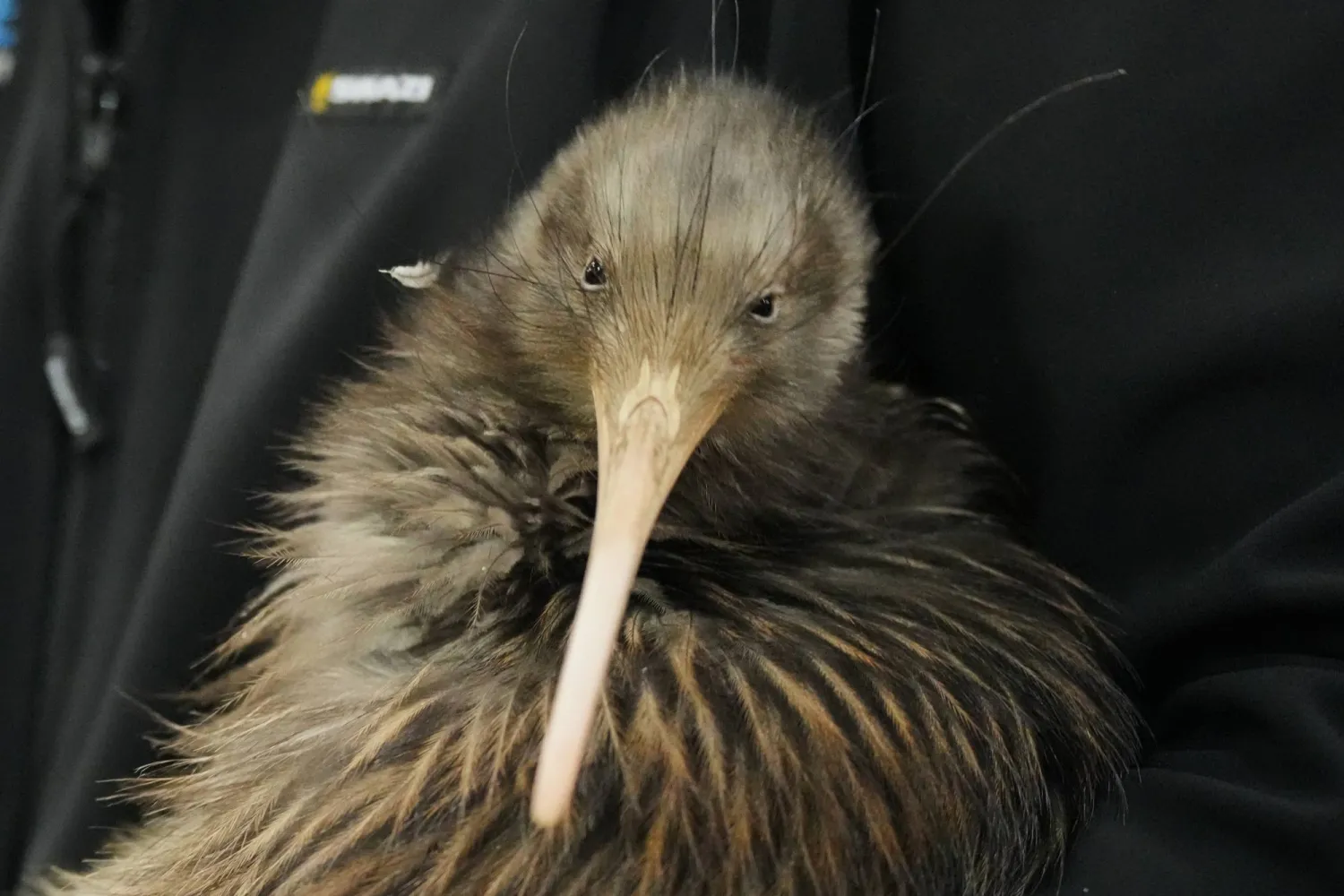
A staff member of a conservation organization carries a kiwi bird during an event at Parliament in Wellington, New Zealand, on Tuesday, April 28, 2026. (AP Photo/Charlotte Graham-McLay)
TT

A Citizen Campaign Returns Iconic Kiwi Birds to New Zealand's Capital after a Century-long Absence

A staff member of a conservation organization carries a kiwi bird during an event at Parliament in Wellington, New Zealand, on Tuesday, April 28, 2026. (AP Photo/Charlotte Graham-McLay)

The kiwi, New Zealand’s sacred national bird, vanished from the hills around Wellington more than a century ago. Now the capital's residents are waging an improbable citizen campaign to return the endangered flightless birds to the city.

“They are a part of who we are and our sense of belonging here,” said Paul Ward, founder of the Capital Kiwi Project, a charitable trust. “But they’ve been gone from these hills for well over a century and we decided as Wellingtonians that wasn’t right.”

On a hill wreathed in mist above the dark sea that runs between New Zealand’s North and South Islands, Ward and others crossed rugged farmland late on Tuesday night, carrying seven crates in silence by dim red torchlight.

Inside each one nestled a kiwi, including the 250th bird relocated to Wellington since the Capital Kiwi Project began.

Birds receive a quiet welcome to new homes The kiwi gives New Zealanders the name by which they’re often known. It’s a shy and odd-looking bird with underdeveloped wings and a whiskery face.

Spiritually significant for many New Zealanders, the kiwi’s image appears everywhere, including on the tail of the country’s air force planes — curious for a bird with no tail which can’t fly.

It’s thought that there were 12 million of the birds roaming the landscape before humans arrived in New Zealand. Today only about 70,000 kiwi are left across the country, with the population dropping 2% each year.

In the hills where Wellington’s kiwi now live and breed, the only late-night sound on Tuesday was the whoosh of wind turbines. Ward and his friends set their crates down in pairs, slid them open and gently tilted the boxes.

Some in the small group of hushed onlookers were tearful. One man chanted a karakia, a Māori prayer.

From each crate, a long, curved beak eventually protruded as kiwi took their first tentative steps into the shadowed landscape, then sped to a run and disappeared into the darkness.

Kiwi make their first Parliament visit One place kiwi had never set foot until this week was inside New Zealand’s Parliament. Hours before Wellington’s seven newest residents were transported to their hillside home, they were carried into Parliament’s grand banquet hall by handlers for a celebration of the 250th kiwi's arrival in the city.

Lawmakers and schoolchildren alike expressed whispered delight at seeing the timid, nocturnal birds up close, many for the first time, as conservation workers cradled the large birds like human babies, with their gnarled feet outstretched.

“This animal has given us as a people so much in terms of our sense of identity,” Ward told The Associated Press. “We want to challenge our civic leaders, our politicians and say this is a relationship we need to honor.”

Rare birds move from sanctuaries to urban life New Zealand is home to some of the world’s strangest and rarest bird species. Some have only survived because of against-all-odds conservation programs, at times with uncertain funding.

Initiatives decades ago saw all surviving birds of some species moved onto offshore, predator-free islands or into sanctuaries where they could be carefully monitored and protected, but where few New Zealanders would ever see one.

Ward and his group had a different dream: that New Zealand’s iconic national bird could flourish alongside people in a bustling capital city, where human encroachment and introduced predators had wiped out the kiwi before.

“Where people are is also the places where we can bring them back because we’ve got the means to do that guardianship,” Ward said.

Thousands of traps protect capital’s kiwi Although unmanaged kiwi populations are shrinking, their numbers have thrived in carefully managed wild bird sanctuaries — so much, in fact, that some of these protected areas have run out of room for them.

That’s prompted their relocation to places like Wellington, where groups such as Ward’s rally residents to embrace their new neighbors. Kiwi have been spotted by late night mountain bikers and on backyard security camera footage in the capital, he said.

“They’re living and calling and being encountered on the hills surrounding our city,” Ward said.

That's taken work. Over the past decade, efforts between landowners, the local Māori tribe and the Capital Kiwi Project have produced a sprawling, 24,000-hectare tract of land where kiwi can roam.

It’s dotted with more than 5,000 traps for stoats, the main predator of kiwi chicks. So far, the Wellington population has a 90% chick survival rate.

New Zealand aims to become predator free The kiwi initiative is part of New Zealand’s quest to rid the island nation of introduced predators, including feral cats, possums, rats and stoats, by the year 2050. Since a previous government established the target in 2016 its chances of success have been debated, but community groups have taken up the work in earnest.

Parts of Wellington are now entirely free of mammalian predators apart from household pets, and native birds flourish. Volunteers monitor suburbs with military precision for the appearance of a single rat.

“When I think of endangered species globally, for the most part you can’t do much other than campaign or donate money,” said Michelle Impey, chief executive of Save the Kiwi. “But we have this incredible movement throughout the country where everyday people are taking it on under their own steam to do what they can to protect a threatened species.”




Cooking Was Already an Artform in Bronze Age Syria

What they once ate now tells the story of how they lived (SPA)
TT

Cooking Was Already an Artform in Bronze Age Syria

What they once ate now tells the story of how they lived (SPA)

While the folk of Bronze Age Europe were mostly making do with simple stews and bread, people in Syria were already importing ingredients and using pots of differing temperatures to support “sophisticated” cuisine, researchers said on Friday.

The evidence from Danish experts suggests people living in what is now the city of Hama 4,500 years ago were already enjoying dishes of simmered goat, gazelle and cereals, AFP reported.

The city’s cooks used pots with different heating properties depending on the type of meal they were about to prepare, much as we choose between cast-iron or non-stick frying pans today.

Mette Marie Hald, from the National Museum of Copenhagen, and her team reached the conclusion after examining animal bones, plant remains and fats from inside cooking pots found in the city.

“It feels a bit modern, actually, the way that you have different pots and you have different sort of serving wares,” the archaeobotanist told AFP.

Locally produced pots were made from clay and calcite, while others were made from clay mixed with basalt and were imported from as far away as China.

Meals could be prepared with imported ingredients such as gazelle, which itself came from much further east.

Hald said the evidence of “sophisticated cooking” they had uncovered in Hama was supported by recipes written down in much later periods.

Danish archaeologists started digging in Hama in the first half of the 20th century, she said, so there has been quite a lot of research on everyday life there.

But she added that they had not really focused on food culture before.

“This is a period of kingdoms, well-organised cities and stratified societies,” she said.

“In that way, it’s not surprising that they also knew sophisticated cooking. I think the surprising element is we can actually prove it.”


Lady Gaga Welcomes First Child

(FILES) US actress and singer Lady Gaga attends the US premiere of Warner's "Joker: Folie a Deux" at the TCL Chinese theater in Hollywood, California, September 30, 2024. (Photo by Chris DELMAS / AFP)
TT

Lady Gaga Welcomes First Child

(FILES) US actress and singer Lady Gaga attends the US premiere of Warner's "Joker: Folie a Deux" at the TCL Chinese theater in Hollywood, California, September 30, 2024. (Photo by Chris DELMAS / AFP)

Pop superstar Lady Gaga welcomed her first child with fiance Michael Polansky, US media reported Friday.

The 40-year-old "Bad Romance" singer, whose real name is Stefani Germanotta, began dating Polansky in 2020, and became engaged to the entrepreneur in 2024.

A source confirmed news of the child's birth to Page Six and People, but no additional details about the baby, including its name, sex or date of birth, were immediately available.

The musician affectionately referred to as "Mother Monster" by her fans has spoken in recent years about her desire to have a child.

She wrapped up her most recent world tour, the Mayhem Ball, in April, and her latest album "Mayhem" garnered multiple Grammy nominations, winning the award for "Best Pop Vocal Album" earlier this year.


Coastal Erosion Forces Cancellation of California Music Festival

MALIBU, CALIFORNIA - SEPTEMBER 10: People gather near erosion damage along a beach access road to Point Dume, which remains closed due to the erosion from powerful surf and high tides earlier this summer, on September 10, 2026 in Malibu, California. Mario Tama/Getty Images/AFP
TT

Coastal Erosion Forces Cancellation of California Music Festival

MALIBU, CALIFORNIA - SEPTEMBER 10: People gather near erosion damage along a beach access road to Point Dume, which remains closed due to the erosion from powerful surf and high tides earlier this summer, on September 10, 2026 in Malibu, California. Mario Tama/Getty Images/AFP

A music festival set to feature The Killers, Olivia Dean and Jack White was cancelled Friday because the California beach where it was to be held has been eaten away by coastal erosion.

The two-day Ocean Way Festival had been planned for later this month in Santa Monica, but waves up to 15 feet (4.5 meters) and storm runoff has left the beach in the city near Los Angeles badly degraded, forcing local officials to pull the plug.

"Storm surf generated by Hurricane Marie and runoff from a storm drain outfall eroded a large portion of the festival site," AFP quoted a statement from the city of Santa Monica as saying.

The storm, which churned the waters of the Pacific over the last week, stripped sand off the beach, making it no longer safe to hold the festival there, the city said.

"The surf took the beach we planned this on, and we cannot put tens of thousands of festival-goers on that sand until it's safe," said Mayor Caroline Torosis.

The coastal city of Santa Monica -- the official end point of Route 66 -- has a wide stretch of golden sand and a large wooden pier that features frequently in American television shows and movies.

News of the festival cancellation came days after the pounding surf opened a huge sinkhole on the driveway of a beachfront home belonging to Oscar-winning US actor Nicolas Cage.

Officials in Malibu, which sits just north of Santa Monica, have ordered the evacuation of 31 homes because of the danger posed by the hole.

Further south, at least seven homes in Dana Point were declared uninhabitable after the coast on which they sit rapidly eroded, with one house collapsing into the sea.

A similar problem has occurred in nearby Laguna Beach.

The waters of the Pacific Ocean have been unsettled in recent weeks by a series of tropical storms, with some of them developing into hurricanes.

Scientists say a near-record strength El Nino climate episode is warming the ocean's waters and creating extra volatility.

While the phenomenon is part of a natural cycle, human-caused climate change is thought to be super-charging the heating and exacerbating its effects.