


NATO and China: A Slow Alliance Confronts a Fast-Rising Rival

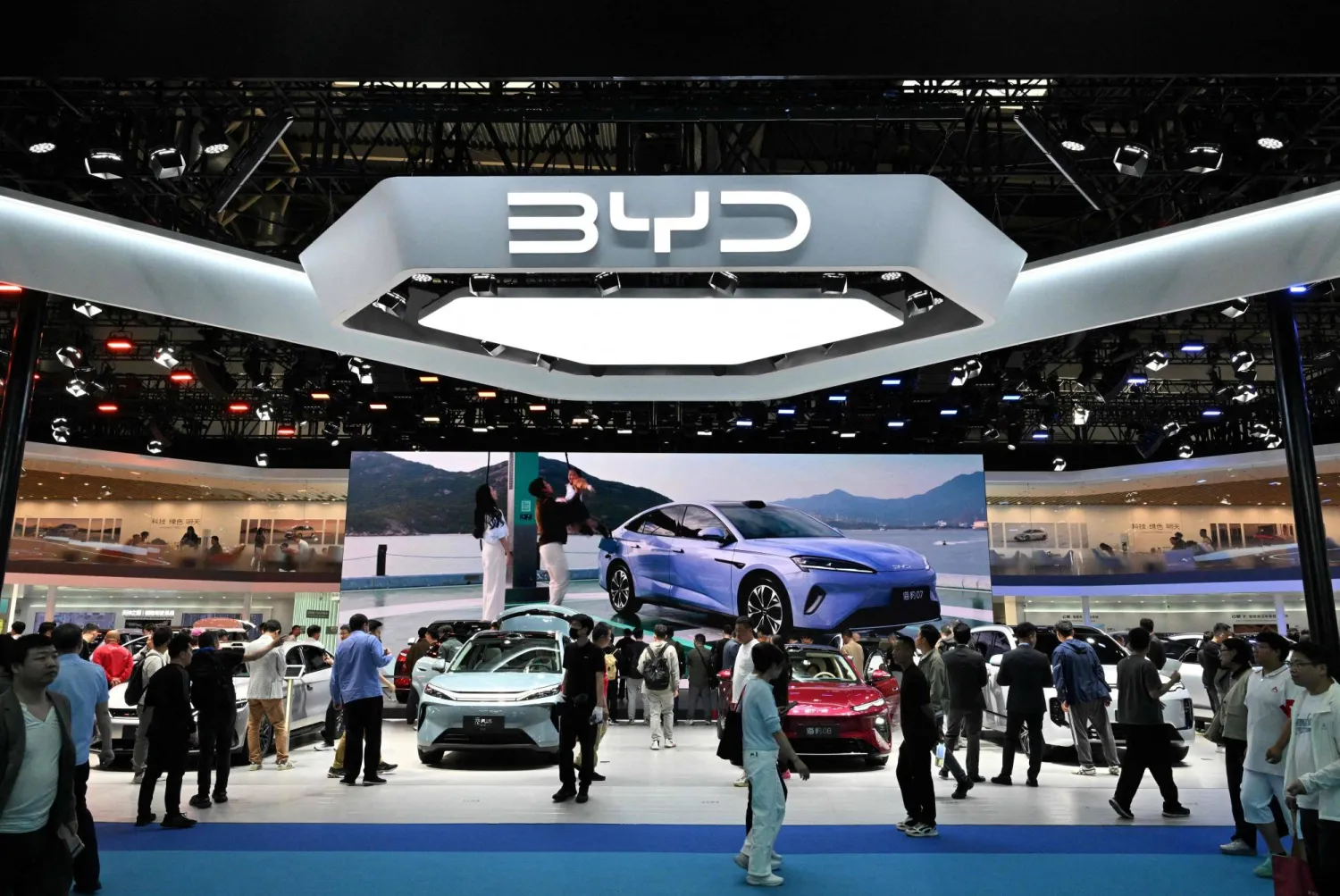
People visit the BYD booth at the Beijing Auto Show in Beijing on April 30, 2026. (Photo by Adek BERRY / AFP)
TT

NATO and China: A Slow Alliance Confronts a Fast-Rising Rival

People visit the BYD booth at the Beijing Auto Show in Beijing on April 30, 2026. (Photo by Adek BERRY / AFP)

NATO was established in 1949 to provide collective defense against the Soviet Union, based on the principle that an attack on one member is an attack on all. At the time, US President Harry Truman also sought to anchor an American presence in war-ravaged Europe to ensure security and prevent a strategic vacuum.

The collapse of the Soviet Union, along with the socialist bloc, brought the Cold War to an end and forced NATO to adapt. The alliance expanded its operations beyond Europe, intervening in the Balkans during the Bosnia and Kosovo wars, then in Afghanistan after the September 11, 2001 attacks in the United States. It also undertook maritime missions to combat piracy, including off the Horn of Africa, alongside intelligence-sharing and counterterrorism cooperation.

NATO has since built partnerships with countries beyond its traditional scope and broadened its definition of threats to include cybersecurity, hybrid warfare, and energy security, as well as, more recently, the challenge posed by China.

In sum, NATO has evolved from a purely European defensive alliance into a broader global security actor, largely driven by the United States, while still maintaining a central focus on deterring threats within Europe.

In recent years, the Brussels-based alliance has expanded its attention toward the Indo-Pacific region for strategic reasons that extend beyond Europe. Chief among these are the interconnected nature of global security, particularly in cyberspace, the need to ensure resilient and unobstructed supply chains, and the rapid spread of advanced technologies that increasingly diminish the importance of geographic boundaries.
FILED - 03 April 2025, Belgium, Brussels: A NATO flag flies in the wind in front of the NATO headquarters in Brussels. Photo: Anna Ross/dpa

China’s Rise

Another key factor is the view of China’s rise as a strategic challenge reshaping the global balance of power. For NATO’s 32 member states, up from 12 at its founding, safeguarding trade routes is a priority, especially maritime corridors in the Indo-Pacific that are critical to the global economy.

These include the Strait of Malacca between Malaysia and Indonesia, the world’s most important shipping lane, linking the Indian Ocean to the South China Sea and carrying roughly 25 percent of global trade annually. It is also a vital artery for oil and energy flows to major Asian economies such as China, Japan, and South Korea.

NATO member states express “strategic concern” over China for several core reasons. First, China is rapidly modernizing its military, particularly in areas such as missile systems, space capabilities, and cyber operations, developments that are shifting the global balance of power.

Second, and closely linked, is China’s economic rise, reflected in initiatives such as the Belt and Road, which provide Beijing with avenues to expand its economic and political influence across Asia, Africa, and Europe. This expansion risks creating dependencies among countries in or near NATO’s strategic periphery.

Concerns are also fueled by growing ties between China and Russia, particularly following Russia’s invasion of Ukraine in February 2022, which could signal coordination between two major powers against the West.

At the same time, an indirect competition is underway over leadership in fields such as artificial intelligence, telecommunications networks, and semiconductors. NATO sees technological superiority as a core component of security.

The alliance has concluded partnership and cooperation agreements with Japan, South Korea, Australia, and New Zealand, encompassing joint military exercises, intelligence sharing, and political coordination. However, NATO does not appear to be planning an expansion of membership into the Indo-Pacific, instead favoring flexible partnerships over a permanent military presence.



Iranian President Pezeshkian Arrives in New York

Iranian President Masoud Pezeshkian waves before departing for New York, at Mehrabad Airport in Tehran, Iran, September 22, 2026. Iran's Presidential website/WANA (West Asia News Agency)/Handout via REUTERS
TT

Iranian President Pezeshkian Arrives in New York

Iranian President Masoud Pezeshkian waves before departing for New York, at Mehrabad Airport in Tehran, Iran, September 22, 2026. Iran's Presidential website/WANA (West Asia News Agency)/Handout via REUTERS

Iranian President Masoud Pezeshkian arrived in New York where he is expected to speak at the United Nations General Assembly, Iranian state media reported on Wednesday.

State broadcaster IRIB posted a video clip of Pezeshkian exiting a plane with a caption saying that the Iranian president has arrived at a New York airport, AFP reported.

This is the first time that a leader whose country is at war with the United States sets foot on American soil to address a UN gathering, analysts say.


Far-Right Israeli Minister Seeks Defense Post in Next Government

 Israel's far-right National Security Minister, Itamar Ben-Gvir, holds a press conference ahead of Israel's general elections in October, in Jerusalem, September 22, 2026. (Reuters)
Israel's far-right National Security Minister, Itamar Ben-Gvir, holds a press conference ahead of Israel's general elections in October, in Jerusalem, September 22, 2026. (Reuters)
TT

Far-Right Israeli Minister Seeks Defense Post in Next Government

 Israel's far-right National Security Minister, Itamar Ben-Gvir, holds a press conference ahead of Israel's general elections in October, in Jerusalem, September 22, 2026. (Reuters)
Israel's far-right National Security Minister, Itamar Ben-Gvir, holds a press conference ahead of Israel's general elections in October, in Jerusalem, September 22, 2026. (Reuters)

Israel's far-right National Security Minister Itamar Ben-Gvir said Tuesday he will seek the post of defense minister in the next government, as the country prepares for next month's elections.

Ben-Gvir, who is a key minister in the right-wing coalition of Prime Minister Benjamin Netanyahu, regularly sparks international outrage with his provocative statements and political stunts.

"The reason I am putting myself forward is that the time has come to change the mindset within the army," Ben Gvir said, at a press conference in Jerusalem.

"The time has come to transform the State of Israel's security doctrine with a single objective -- decisive victory on every front," he added.

The firebrand minister put forward a "security plan" that includes the "encouragement of voluntary emigration" of Palestinians from both Gaza and the occupied West Bank, disarming what he called the "terrorist" Palestinian Authority, and increased support for Israeli soldiers.

Earlier in September, Ben-Gvir presented a detailed plan to "encourage" Palestinians from the Gaza Strip to move abroad.

Although members of the ruling right-wing coalition have made multiple statements about transferring Palestinians out of Gaza, it is unclear to what extent their remarks will be followed by action.

Forced displacement of civilians in occupied territory is considered a war crime under the Geneva Conventions.

Ben-Gvir's announcement that he is seeking the defense post caused an uproar among Israeli opposition leaders.

Gadi Eisenkot, a key contender for the premiership, accused his main rival Netanyahu on X of having "lost it" by accepting "criminal Ben-Gvir" in his coalition.

In his youth, Ben-Gvir was charged more than 50 times for incitement to violence or hate speech, but boasts he was cleared in the vast majority of those cases.

According to Israeli media, he was not drafted into the military due to his involvement in extremist far-right groups.

The October 27 vote is expected to be close, and there is no guarantee that the parties currently in power will remain so after then.

According to a Channel 16 survey published Sunday, Ben-Gvir's Otzma Yehudit (Jewish Power) party is polling at seven percent, which would grant it eight out of 120 seats in Israel's parliament, the Knesset.


Trump Hails Burnham as ‘Natural Business Person’ After First Meeting

 President Donald Trump meets with Britain's Prime Minister Andy Burnham during the United Nations General Assembly, Tuesday, Sept. 22, 2026, at the UN headquarters. (AP)
President Donald Trump meets with Britain's Prime Minister Andy Burnham during the United Nations General Assembly, Tuesday, Sept. 22, 2026, at the UN headquarters. (AP)
TT

Trump Hails Burnham as ‘Natural Business Person’ After First Meeting

 President Donald Trump meets with Britain's Prime Minister Andy Burnham during the United Nations General Assembly, Tuesday, Sept. 22, 2026, at the UN headquarters. (AP)
President Donald Trump meets with Britain's Prime Minister Andy Burnham during the United Nations General Assembly, Tuesday, Sept. 22, 2026, at the UN headquarters. (AP)

US President Donald Trump hailed Andy Burnham on Tuesday as a "natural business person" at what the new British leader's team described as a smooth first face-to-face meeting.

After days of preparation for the Trump meeting, Burnham emerged relatively unscathed, with the US leader only taking issue with what he called a "terrible deal" to cede sovereignty of the Chagos Islands, home to a US-British air base.

Otherwise, Trump praised Burnham, saying Britain's seventh prime minister in a decade was someone with whom he could do business and a patriot who had put Britain on the up after replacing the former prime minister, Keir Starmer, in July.

"I think right now, based on my relationship with the prime minister, Andy, I think that ... we're doing very well," Trump said after they met on the sidelines of the United Nations General Assembly in New York for around 40 minutes.

"I think he's a natural business person. We've had a lot of discussions, even before this meeting we were talking with each other numerous times on the phone."

'ENCOURAGING MEETING'

Burnham, who travelled to New York on Monday to take part in the UN assembly, had ‌said little beforehand ‌about his expectations for the meeting with Trump, saying only that in their two phone calls he ‌had found "a ⁠connection" with the ⁠US president.

Afterwards, he repeated that earlier conversations had established that connection "and that very much came through today".

"(I) can certainly work with him. It was a very encouraging meeting," Burnham told reporters, saying the two leaders had found "common ground" on dealing with cost-of-living pressures, ending the conflict in the Middle East and reindustrializing nations to spur economic growth, among other issues.

"He was very upbeat about the country's (Britain's) prospects, which, to be honest, was great to hear."

Before arriving in New York, Burnham had sought common ground with Trump on AI, a focus of his comments to the UN on Monday in which he described the technology as having the ability to bring "huge benefits" to the British and global economy.

Trump has said he wants to cherish AI rather than stifle its growth, dismissing fears ⁠about it as a hoax and "sick conspiracy". The US leader has said concerns can be addressed through the ‌existing justice system without extra regulation — an issue that might cause some friction with Britain.

Yet, ‌while the two leaders seemed to find common ground on a number of issues, there were some pitfalls.

Trump again criticized Britain's move, under Starmer, to cede ‌sovereignty of the Chagos Islands while retaining control of Diego Garcia air base on a 99-year lease.

Trump called the agreement with Mauritius, ‌now on hold, a "terrible" deal. "It's amazing how strategic it is, and I think the prime minister is going to be looking at it," he said.

Burnham later told reporters he had inherited the problem and would work to find a resolution between the different sides. "It was clear that we need to come to that agreement, but I'm confident we can find it working with our US partners," he said.

Burnham also showed a willingness to disagree with Trump if it is ‌in his nation's interest, saying he would "stand firm in the face of any threats" to the right of Falkland Islanders to self-determination and to remain British.

In August, Trump said he was reviewing the ⁠United States' neutral position on the ⁠remote archipelago in the South Atlantic. Days later Argentine President Javier Milei — who will address the UN on Wednesday — said he would impose sanctions on oil companies drilling in the islands.

And the British leader navigated some other bilateral sticking points. Trump appeared unmoved over Britain's decision to block imports from Israeli settlements in the occupied West Bank, while its decision not to back the US over the Iran war was also skated over.

OPENS WAY FOR BURNHAM TO FOCUS ON AI

With the meeting done, Burnham turns his focus for UNGA to AI and his support for the technology, which he hopes will help Britain assume a leading role globally.

At an earlier business roundtable, Burnham said he would make the case for Britain in a speech later on Tuesday to help establish "a single set of global principles and standards" to unlock the potential of AI.

Describing Britain as being stuck in 10 years of political turbulence since voting to leave the European Union in 2016, Burnham told business leaders he wanted to usher in a period of stability and embrace AI, while being clear-eyed on the risks.

"So outside Downing Street, on my first day, I said I want to be the circuit breaker," he told the roundtable, including Tim Cook, executive chairman of Apple, and Citigroup CEO Jane Fraser.

"(To) bring forward a very clear path that everyone can understand, a 10-year plan for Britain ... so that nobody's in any doubt at all about what we're trying to do."