

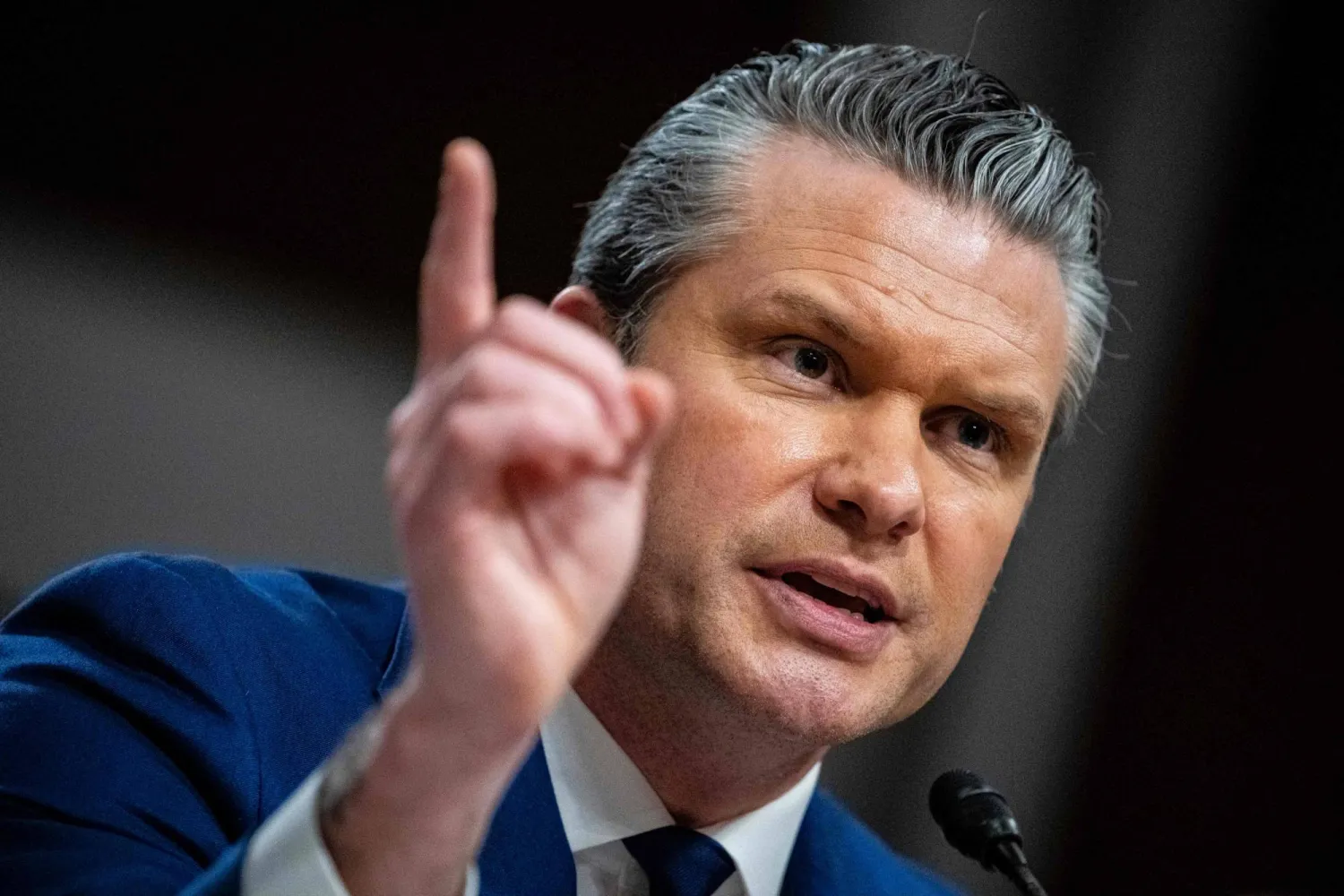

US to Withdraw About 5,000 Troops from Germany

US Secretary of Defense Pete Hegseth testifies during a Senate Armed Services Committee hearing on April 30, 2026 in the Dirksen Senate Office Building in Washington, DC. (Getty Images/AFP)
TT

US to Withdraw About 5,000 Troops from Germany

US Secretary of Defense Pete Hegseth testifies during a Senate Armed Services Committee hearing on April 30, 2026 in the Dirksen Senate Office Building in Washington, DC. (Getty Images/AFP)

US Defense Secretary Pete Hegseth has ordered the withdrawal of about 5,000 troops from Germany within the next year, the Pentagon said on Friday, in the latest rift in transatlantic ties over the Middle East war.

The move came as US President Donald Trump announced that tariffs on cars and trucks from the European Union will increase to 25 percent next week, accusing the bloc of not complying with a trade deal inked last summer.

Trump has renewed criticism of German Chancellor Friedrich Merz, who said Monday that Iran was "humiliating" Washington at the negotiating table. Trump said Merz "thinks it's OK for Iran to have a Nuclear Weapon. He doesn't know what he's talking about!"

On Wednesday, the American leader said Washington was "studying and reviewing the possible reduction" of US troops in Germany, and that he would decide in a "short period of time."

Pentagon spokesman Sean Parnell said in a Friday statement that "we expect the withdrawal to be completed over the next six to twelve months."

"This decision follows a thorough review of the Department's force posture in Europe and is in recognition of theater requirements and conditions on the ground," Parnell added.

During both of his terms in office, Trump has made a number of threats to slash US troop numbers in Germany and other European allies, saying he wants Europe to take on greater responsibility for its defense rather than depending on Washington.

Trump on Friday accused German automakers like Mercedes-Benz and BMW of ripping off Americans, saying that Germany and "other European nations have not adhered to our trade deal."

Germany would likely be hit hard by a sharp vehicle tariff, as it is responsible for a significant portion of EU auto exports.

- 'Why shouldn't I?' -

Trump now appears determined to punish allies who have failed to back the war or contribute to a peacekeeping force in the crucial Strait of Hormuz waterway, which Tehran's forces have effectively closed.

On Thursday, Trump said he may pull US troops from Italy and Spain due to their opposition to the war, telling reporters in the Oval Office: "Italy has not been of any help to us and Spain has been horrible, absolutely horrible."

"Yeah, probably, I probably will. Why shouldn't I?" Trump said.

As of December 31, 2025, there were 12,662 active-duty US troops in Italy and 3,814 in Spain. In Germany, there were 36,436.

Speaking during a visit to Morocco, German Foreign Minister Johann Wadephul said Thursday that Germany was "prepared" for a reduction in US troops and was "discussing it closely and in a spirit of trust in all NATO bodies."

While saying he was "relaxed" about the idea of fewer US troops in Germany, Wadephul said that large American bases in Germany are "not up for discussion at all."

He said for example that the Ramstein Air Base had "an irreplaceable function for the United States and for us alike."

- Ukraine support -

The EU said Thursday that the deployment of US troops in Europe was in Washington's interest, and that the United States was "a vital partner in contributing to Europe's security and defense."

Trump meanwhile took aim at Merz again, telling him to focus on ending the Ukraine war instead of "interfering" on Iran.

European powers have been on alert since Russia invaded Ukraine in 2022, and a spate of drone incursions in the last year -- as well as US promises to move away from defending the continent -- have pushed the issue to the top of the agenda.

Merz has made national security a priority, announcing unprecedented investments in an army that has been underfunded and under-equipped for decades.

He has also reaffirmed support for Ukraine, for whom Germany has been the second-largest individual supplier of aid after the US.



Israel Signs 3 Billion Euro Defense Deal with Greece, Defense Ministry Says

Greece to buy a defense system from Israel (Reuters)
TT

Israel Signs 3 Billion Euro Defense Deal with Greece, Defense Ministry Says

Greece to buy a defense system from Israel (Reuters)

Israel and Greece signed a 3 billion euro ($3.48 billion) defense deal on ‌Monday ‌under which ‌Israel would ⁠build a "multi layered" ⁠defense system for Greece, according to a ⁠statement by ‌the ‌spokesperson of ‌Israel's ‌defense ministry.

The statement said a supplementary deal ‌valued at 26 million euros ⁠would see ⁠Israel sell Greece drone dome systems.


World Leaders Need to See Rising Oceans in Pacific, Says UN Official

View of a rock formation at the Pacific Ocean in Cabo San Lucas, Baja California state, Mexico on August 4, 2023. AFP
TT

World Leaders Need to See Rising Oceans in Pacific, Says UN Official

View of a rock formation at the Pacific Ocean in Cabo San Lucas, Baja California state, Mexico on August 4, 2023. AFP

Leaders from the world's top economies should stand on a Pacific atoll to see the reality of record sea level rise, a top UN official said in Palau on Monday.

Noting last week's deadly floods in Nepal, United Nations Deputy Secretary-General Amina Mohammed said rising seas in the Pacific were the "other side of that story".

"We do already know that a warming climate is changing the world's ice at extraordinary speeds, not only threatening the communities below glaciers but adding more water to our oceans," she told reporters.

Mohammed was speaking in Palau, where Pacific leaders have gathered for an annual summit to discuss challenges including climate change, crime and regional security.

The United Nations is pushing for G20 leaders to attend and make commitments at a meeting hosted by the tiny nation of Tuvalu in October, ahead of the upcoming UN climate summit in Türkiye, according to Mohammed.

"We think they should turn up and really engage with the world on what they need to do," she said, even though there are concerns few leaders outside the Pacific will make the trip.

Tuvalu, which is among the most vulnerable countries in the climate crisis, is preparing to relocate its population after scientists predicted most of its land may become inundated.

Palau's minister for the environment Steven Victor said the Pacific was "not begging for any handouts" but had fewer resources to deal with rising seas that threaten its communities the most.

"We need them to come and see," he said.

A UN report published Monday showed a record pace of sea level rise driven by warming oceans and glacier melt.

Up to 1.2 billion people could be displaced by 2050, with Pacific island countries experiencing sea level rise at twice the global average, it said.

It also highlighted a financing gap, with developing countries needing $310-$365 billion to adapt, yet having only $26 billion in adaptation finance available in 2023.

- Coral reefs under pressure -

Coral reefs are facing a "staircase of decline", with global hard coral cover declining 9.5 percent due to climate change over 40 years, another report released Monday in Palau by scientists found.

The Global Coral Reef Monitoring Network analyzed data from 37,000 reefs in 120 countries, finding a narrowing window between major bleaching events.

Although reefs can recover after bleaching if they have enough time, the frequency of marine heatwaves means only partial progress is made.

The study found a major bleaching event every five to six years since 2010.

"We are steadily eroding the conditions they need to recover," said the study's lead author Manuel Gonzalez Rivero.

"Climate change is driving more frequent and severe marine heatwaves, but local pressures such as poor water quality, overfishing and coastal development are making reefs even less able to withstand them," he added.

Among the worst affected are reefs in Australia, the Pacific and Caribbean.

Around 100 million people live within five kilometers (3.1 miles) of a coral reef, a 46 percent increase over two decades.

The ocean was a highway for Pacific nations, connecting its people, but was in crisis, Palau's President Surangel Whipps said on Sunday.


Iran FM Accuses ‘Serpent’ Netanyahu of Tricking US into War

16 March 2018, Austria, Vienna: Abbas Araghchi, Deputy Foreign Minister of Iran, gives an interview in Vienna. (dpa)
TT

Iran FM Accuses ‘Serpent’ Netanyahu of Tricking US into War

16 March 2018, Austria, Vienna: Abbas Araghchi, Deputy Foreign Minister of Iran, gives an interview in Vienna. (dpa)

Iran's Foreign Minister Abbas Araghchi on Monday called Israeli Prime Minister Benjamin Netanyahu a "serpent", accusing him of tricking Washington into going to war with the country.

"In Hebrew, Netanyahu openly crows that he suckered the US Administration into a war on Iran on behalf of Israel. Netanyahu explicitly laughs about how he 'influenced' America through 1,000 hours of airtime on US networks," Araghchi said in a post on X.

"In English, he praises POTUS' leadership. Serpent," he added.

War broke out between Iran and the United States on February 28 with US-Israeli strikes killing Iranian Supreme Leader Ali Khamenei along with senior military officials.

Iran retaliated with attacks across the region as the conflict continued to spread.

An April ceasefire put an end to the most intense fighting, but sporadic attacks mainly near the Strait of Hormuz have dimmed prospects for a final peace agreement, and the US recently shifted toward a campaign of what it calls "economic asphyxiation" of Iran.

The US struck the Iranian island of Larak late Sunday, its first such attack in a month.

In response, Iran says it launched attacks on Jordan and the UAE.

Last week, Netanyahu dismissed any prospect of an Iran-US deal and called Iran's leaders "savages".