


Israeli Statements Signal Prolonged Conflict in South Lebanon

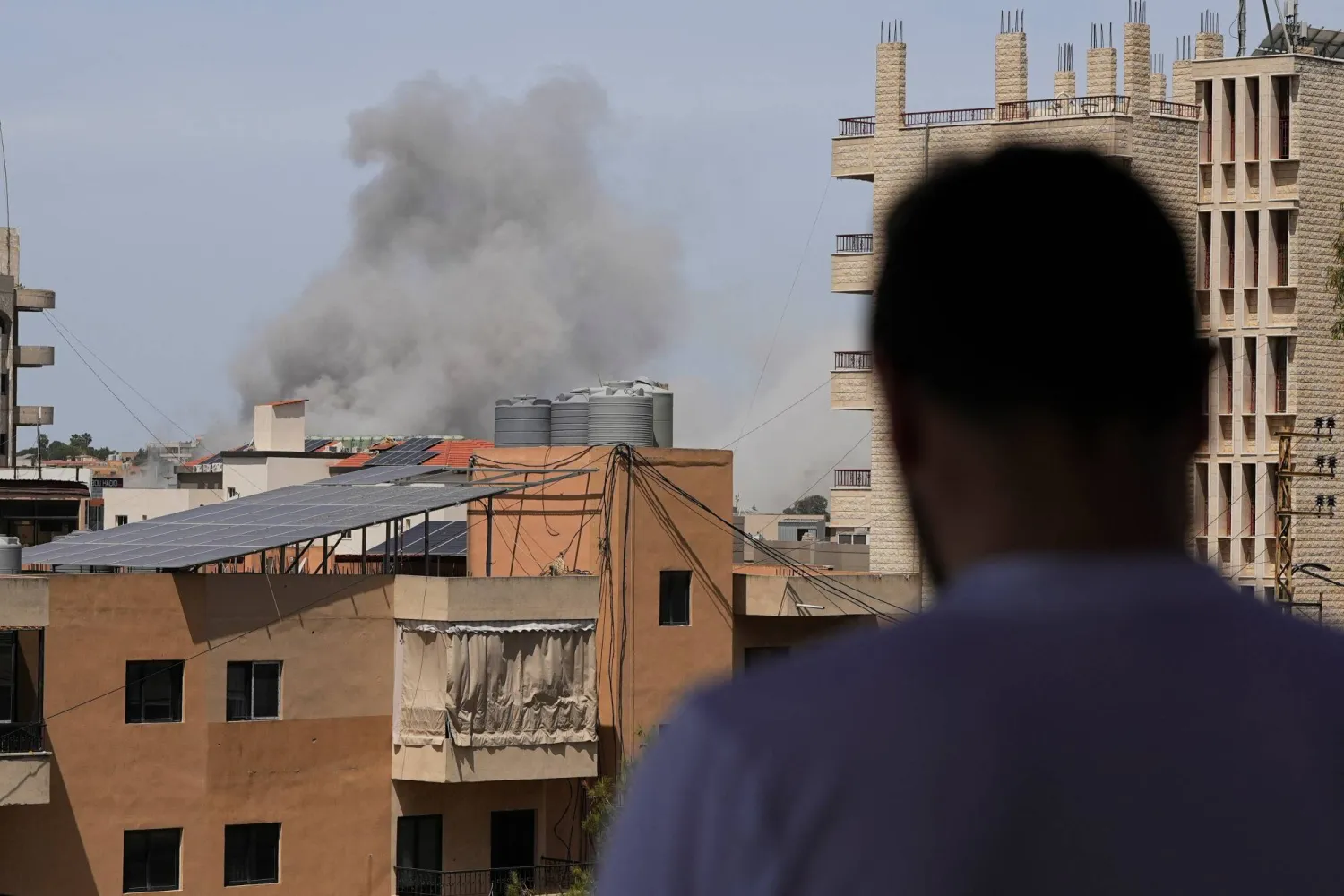
Smoke rises following Israeli strikes, as seen from Nabatieh, Lebanon, May 2, 2026. REUTERS/Stringer
TT

Israeli Statements Signal Prolonged Conflict in South Lebanon

Smoke rises following Israeli strikes, as seen from Nabatieh, Lebanon, May 2, 2026. REUTERS/Stringer

Statements made by the Israeli military on war objectives in southern Lebanon, along with battlefield developments, point to a prolonged conflict, as Israel seeks demographic change and the removal of villages to pave the way for a future occupation, while Hezbollah shows signs of preparing for a long fight by upgrading its combat tools, experts say.

Strikes have reached villages in the Nabatieh and Tyre districts, more than 30 km from the border, a move seen in Beirut as pressure on the Lebanese state and Hezbollah.

‘Yellow Line’, long-term withdrawal

Retired brigadier general Saeed Qazah told Asharq Al-Awsat that an Israeli withdrawal from the buffer zone defined by the “Yellow Line” in southern Lebanon would not come easily or unilaterally.

He said it would likely hinge on clear security arrangements similar to past agreements that set understandings between the two sides.

Israel will not give up the area without a price, he said, but will seek to use it as leverage on the Lebanese government, aiming to reach a final agreement with the Lebanese state and pressure Hezbollah to hand over its weapons.

Qazah said the situation is likely to escalate. The relative calm in some areas will not hold, he added, as any direct negotiation track between Lebanon and Israel could trigger escalation and lead to its collapse, while even a limited security incident could reignite the front.

New tools

Technological developments on the battlefield, particularly drones, are adding complexity, Qazah said. Even a limited operation could trigger wider escalation, especially if it causes heavy casualties, prompting a large-scale Israeli response.

He added that the conflict’s expansion is tied not only to developments in Lebanon but also to the regional situation. Any confrontation between Iran and the United States could directly affect the southern front and further complicate it.

He said the duration of Israeli troop presence in the buffer zone will remain subject to political and security understandings.

Without a clear agreement that ensures security in northern Israel, there will be no quick withdrawal, opening the door to a phase that may resemble, in some respects, the period before 2000.

Beyond destruction to reshaping realities

Retired brigadier general Naji Malaeb said Israeli intentions are evident despite multiple and sometimes ambiguous statements, pointing to the positions of Prime Minister Benjamin Netanyahu, especially with open US backing that allows him to use force under political cover.

“We are facing a situation that goes beyond destruction itself,” Malaeb said, adding that what is happening inside the “Yellow Line” is a process of erasing landmarks, settling scores with Hezbollah and exhausting it.

He said the main objectives are threefold. First, consolidating the “zero zone,” extending not only on land but into the sea off Naqoura, effectively stripping Lebanon of rights to the Qana field and cancelling the 2022 maritime demarcation deal, placing the area under Israeli control and allowing exploration without adhering to the agreement.

Second, there is intent to annex areas extending toward the Litani River, particularly zones within two to three kilometers of the border, as reflected by blasts hitting villages beyond the river within the Yellow Line, opening the way for a long-standing Israeli goal of controlling Litani waters.

Third, when Netanyahu speaks of an area stretching from the sea to Mount Hermon, he is referring to expanding control across that space, including areas not considered part of Hezbollah’s base and that have not seen direct fighting, within a security project placing the zone from the occupied Golan Heights to the sea under Israeli control.

Demographic concerns

Malaeb said the destruction serves no real military purpose. Destroying a few kilometers does not secure northern Israel, given the range of rockets and drones, making that logic invalid.

“What is happening is an attempt to engineer demographic change and remove villages in preparation for imposing a future occupation reality, if Israel is able to expand and entrench its presence,” he said.

Regarding the US role, he said that statements by the US embassy on restoring Lebanon’s sovereignty and on reconstruction remain conditional.

Washington links any negotiation outcomes to ending the war with Iran and halting its involvement in Lebanon through Hezbollah, meaning all promises remain tied to that track.


Lebanon ‘Not Informed’ of Terms of Iran-US Deal, Says Official

A photograph taken from the southern area of Marjeyoun shows smoke rising from fires reportedly ignited at a site targeted by Israeli artillery shelling in the southern village of Kfar Tibnit on June 15, 2026. (AFP)
TT

Lebanon ‘Not Informed’ of Terms of Iran-US Deal, Says Official

A photograph taken from the southern area of Marjeyoun shows smoke rising from fires reportedly ignited at a site targeted by Israeli artillery shelling in the southern village of Kfar Tibnit on June 15, 2026. (AFP)

Lebanon has not been informed of details of an agreement between the United States and Iran to end the Middle East war on all fronts including in Lebanon, an official source told AFP on Monday.

Lebanon's state-run National News Agency (NNA) reported intermittent artillery shelling in the country's south on Monday but no airstrikes -- a lower level of violence compared to previous days.

Hezbollah has not commented on the agreement, but the Iran-backed group has not claimed any fresh attacks on Monday on Israeli targets.

"Lebanon was not informed of the terms of the agreement or the time of the ceasefire," the source said on condition of anonymity.

Few details have been made public about the agreement announced overnight.

Lebanese parliament Speaker Nabih Berri, a Hezbollah ally who acts as an intermediary between the group and the US, praised the deal, thanking the United States and Tehran for their "insistence on including... an essential and binding clause on halting the Israeli aggression on all of Lebanon".

Israel and Hezbollah have been at war since March 2 when the Iran-backed group fired rockets at Israel to avenge the killing of Iran's supreme leader in US-Israeli strikes days earlier.

Israel responded with a campaign of airstrikes and a ground invasion. Previous ceasefire announcements have failed to stop the fighting.

Pakistan's Prime Minister Shebhaz Sharif, whose country has been mediating between Tehran and Washington, said that "both sides have declared the immediate and permanent termination of military operations on all fronts, including in Lebanon".

Iran's Deputy Foreign Minister Kazem Gharibabadi said that "a permanent and immediate end to the war has been declared on all fronts, including Lebanon".

AFP correspondents on Monday reported a cautious return of some residents to their homes in areas of south Lebanon not occupied by Israel's army.


Police Captain Injured in Car Bomb Explosion in Syria’s Aleppo

 A damaged car is seen after an explosion in the city of al-Bab, Aleppo, on Sunday. (Syrian Al-Ikhbariya TV)
A damaged car is seen after an explosion in the city of al-Bab, Aleppo, on Sunday. (Syrian Al-Ikhbariya TV)
TT

Police Captain Injured in Car Bomb Explosion in Syria’s Aleppo

 A damaged car is seen after an explosion in the city of al-Bab, Aleppo, on Sunday. (Syrian Al-Ikhbariya TV)
A damaged car is seen after an explosion in the city of al-Bab, Aleppo, on Sunday. (Syrian Al-Ikhbariya TV)

A Syrian police officer holding the rank of captain was among two people injured Sunday when an explosive device detonated inside a vehicle in the city of al-Bab in eastern Aleppo province, according to local media.

Syrian state-affiliated media said the blast occurred near the al-Center roundabout and was caused by a bomb placed inside the vehicle. The explosion wounded two people, who were transported to nearby hospitals for treatment.

A source told Syria TV that, according to preliminary information, the vehicle was parked near the city’s Grand Mosque when the explosion occurred.

The incident comes amid heightened security tensions across Aleppo province.

Authorities have reported a recent increase in attacks targeting checkpoints and facilities operated by government Internal Security Forces, particularly around the city of Kobani, or Ain al-Arab, in northeastern Aleppo.

Syrian officials have blamed many of the attacks on the Revolutionary Youth movement, a group linked to the Syrian Democratic Forces (SDF), although the allegations have not been independently verified.

On Friday, Aleppo Internal Security Commander Col. Mohammed Abdel Ghani sought to reassure residents of Kobani, stressing that maintaining security, stability, and public safety remained the authorities’ top priority.

His remarks followed a series of attacks on security personnel and installations, including an incident last Thursday in which unidentified assailants fired RPG rounds at an Internal Security Forces checkpoint near Kobani.

The violence has fueled debate over the motives. A tribal elder from Hasakah described the attacks as an attempt to pressure the Syrian government into making further concessions during the implementation of an agreement with Kurdish forces reached on Jan. 29.

By contrast, an official from the Syrian Democratic Council (SDC), the political wing associated with the SDF, said the incidents were isolated acts carried out by individuals rather than an organized campaign.


Lebanon Warns Displaced against Rushing Home after US-Iran Deal

This photograph taken from the southern Lebanese area of Marjayoun shows smoke as it rises from the site of an Israeli airstrike that targeted the village of Kfar Tibnit on June 11, 2026. (Photo by AFP) /
TT

Lebanon Warns Displaced against Rushing Home after US-Iran Deal

This photograph taken from the southern Lebanese area of Marjayoun shows smoke as it rises from the site of an Israeli airstrike that targeted the village of Kfar Tibnit on June 11, 2026. (Photo by AFP) /

Authorities in southern Lebanon warned people displaced by three months of war between Israel and Hezbollah against rushing home on Monday despite a US-Iran deal to end the wider conflict, as Israel said it would not withdraw troops from the south.

Lebanon has suffered the deadliest spillover of the conflict between the US and Iran, with thousands of people killed and some 1.2 million people uprooted by an Israeli offensive against the Iran-backed Hezbollah group, which ‌opened fire on ‌Israel in support of Tehran on March 2.

Pakistani ‌Prime ⁠Minister Shehbaz Sharif, ⁠a key mediator between Tehran and Washington, announced that a deal was struck early on Monday local time, and that the pact called for "the immediate and permanent termination of military operations on all fronts, including in Lebanon".

In south Lebanon, where Israeli forces have occupied a self-declared security zone, municipal councils issued statements calling on residents to hold off on returning, the state-run National News ⁠Agency reported.

Mona Mazeh, a displaced woman sheltering in Beirut's ‌Hamra district, had no immediate plans to ‌return to her village near the southern city of Tyre. "Frankly, we are hesitant; ‌Israel cannot be trusted," she said.

ISRAEL IS NOT A PARTY TO US-IRAN ‌DEAL

Israeli Defense Minister Israel Katz, whose country is not a party to the US-Iran deal, said Israel would not withdraw from security zones in southern Lebanon, Gaza and Syria, and that it would retaliate if Iran attacked Israel due to ‌events in Lebanon.

Katz said the security zone in southern Lebanon would be cleared of local residents, and "all terrorist ⁠infrastructure, including houses in ⁠contact villages", in reference to Hezbollah.

The Israeli military has been razing villages in southern Lebanon for weeks, saying it is acting against Hezbollah militants embedded in civilian areas of the predominantly Shi'ite Muslim region.

Hundreds of thousands of Lebanese Shi'ites are sheltering in other parts of the country.

In Nabatieh, a devastated city in the south, Mohammed Daqdouq said he had returned on Monday morning to check on his home. "We'll need a lifetime to rebuild - to rebuild it again and bring Nabatieh back to how it was," he said.

Iran, whose Revolutionary Guards established Hezbollah in 1982, had insisted that a Lebanon ceasefire be included as part of any broader deal with the United States.
