


Iran-Linked Cells Accused of Exploiting Chaos in Syria

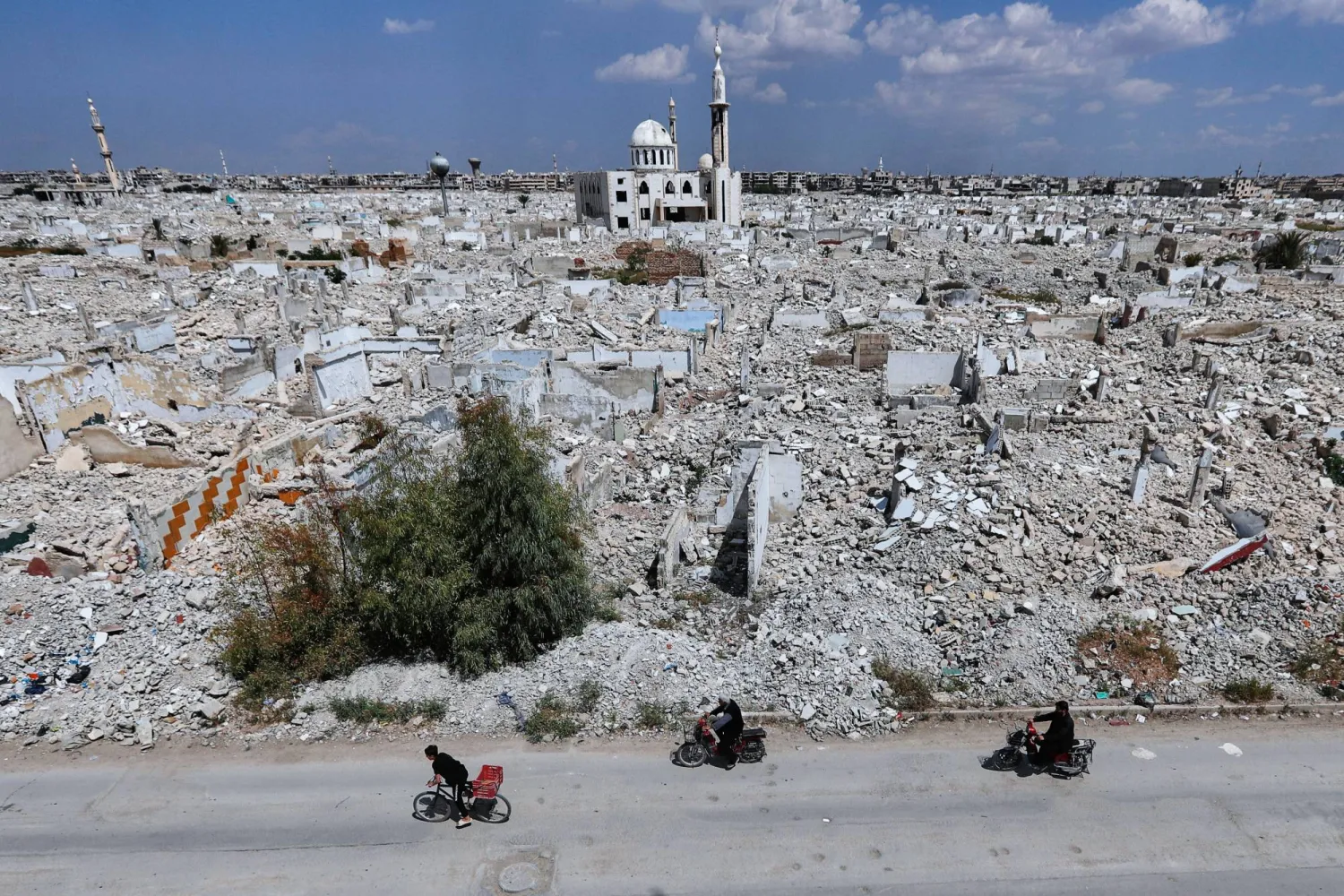
Motorcyclists pass destruction in the al-Qadam area on the outskirts of Damascus, Syria, Wednesday, April 29, 2026 in a area that was heavily bombed by forces loyal to former Syrian president Bashar Assad during the Syrian war. (AP Photo/Omar Sanadiki)
TT

Iran-Linked Cells Accused of Exploiting Chaos in Syria

Motorcyclists pass destruction in the al-Qadam area on the outskirts of Damascus, Syria, Wednesday, April 29, 2026 in a area that was heavily bombed by forces loyal to former Syrian president Bashar Assad during the Syrian war. (AP Photo/Omar Sanadiki)

The Syrian Interior Ministry has said the assassination of a Shiite cleric, seen as close to the government, marks a “dangerous escalation,” adding it is following with “great concern” what it described as “systematic” attempts in recent days to create instability, spread chaos, and undermine civil peace.

A source in Damascus said the cleric killed on Friday was considered a partner of the government in reshaping “the landscape of stability within the Shiite community” in Syria.

That role could have made him a target for cells linked to the “Iran axis,” which, according to circles close to the Syrian government, seek to exploit instability by recruiting local agents.

However, no official Syrian statement has confirmed this scenario, and the attack could also have been carried out by ISIS cells or other parties.

Farhan al-Mansour, imam at the Sayyida Zainab shrine south of Damascus, was killed in a car bomb on Friday, Syrian state television reported.

The Interior Ministry said the assassination fits into a “dangerous escalation” targeting religious and social figures in an attempt to incite sectarian strife.

In a statement issued late Friday, the Ministry said the “crime will not go unpunished,” adding that authorities have launched investigations to uncover the circumstances, identify those responsible, and take the necessary legal measures.

It reaffirmed its commitment to protecting citizens, preserving public security, and confronting any attempts to undermine stability.

A Damascus-based source said the Ministry’s statement appears to link the attack to recent operations dismantling “terrorist” cells.

Wael Alwan, executive director of the Jusoor for Studies in Damascus, told Asharq Al-Awsat that most cells dismantled in recent months are linked to an axis connected to Iran, which “seeks to exploit chaos and recruit local agents, whether from former regime elements or newly recruited individuals.”

Alwan said many of these cells are tied to Hezbollah or Iraqi groups with local members, most of whom had links to the former regime. “They are trying to exploit chaos, because stability in Syria runs counter to Iran’s interests,” he said.

According to Alwan, al-Mansour was “fully aligned with the process of stability and social peace pursued by the Syrian government,” and had played a role in reshaping a “highly sensitive” aspect of stability concerning the Shiite community.

For that reason, he could have been targeted by cells linked to Iran or Hezbollah, although there is no confirmed information.

He added that the Interior Ministry’s framing of the incident may point to an axis in which Hezbollah remains the most influential actor in Syria.

Sheikh Hassan al-Mansour, from the village of al-Kubar in Deir Ezzor, had recently met Syrian President Ahmad al-Sharaa and played a prominent role in promoting civil peace in the Sayyida Zainab area.

He had also rejected any Iranian or Iran-backed militia influence over the shrine or the Shiite religious establishment in Syria.

Iran’s Foreign Ministry spokesman Esmaeil Baghaei strongly condemned the assassination.

Baghaei said on Saturday that such “terrorist acts” are part of “malicious conspiracies by the Zionist entity and the United States to fuel divisions and sow discord in regional countries,” according to Iran’s IRNA news agency.

He called on all parties to remain vigilant and act responsibly in confronting terrorism and extremism, while urging efforts to identify those responsible and strengthen regional cooperation to eradicate the roots of terrorism.

Since the fall of the Iran-backed government of Bashar al-Assad in December 2024, Syria’s Shiite minority, estimated at around 300,000 people and mainly concentrated in Damascus and parts of Homs, Aleppo, and Idlib provinces, has been living in a state of concern.

While the community has not faced retaliatory attacks like those targeting some Alawites on the Syrian coast or Druze in Sweida, a cleric, Rasoul Shahoud, was shot dead near Homs in July 2025.

The Sayyida Zainab area was also targeted by ISIS cells on Jan. 11, 2025, according to the Interior Ministry, which said at the time it had foiled a bombing attempt at the shrine and arrested those involved.

In April, the Ministry said it had dismantled several cells linked to Hezbollah in Damascus and Quneitra that were planning “sabotage” operations and rocket attacks.

It also announced it had thwarted an attempt to assassinate Syrian Jewish rabbi Michael Houri through an explosive device planted outside his home near the Mariamite Cathedral in Bab Touma, Damascus. It said it arrested five suspects, including a woman.

On April 27, Syrian authorities said they had dismantled a “terrorist cell” in Homs province and foiled a plot aimed at “targeting security and stability in the region.”

Two members of the cell were killed and a cache of weapons was seized.



Gaza Hospital Says Child among Three Killed in Israeli Strike

Residents inspect the rubble of a building that belongs to the Palestinian family of Abu Saif and was destroyed by an Israeli airstrike in Nuseirat, central Gaza Strip, Saturday, May 23, 2026. (AP Photo/Abdel Kareem Hana)
TT

Gaza Hospital Says Child among Three Killed in Israeli Strike

Residents inspect the rubble of a building that belongs to the Palestinian family of Abu Saif and was destroyed by an Israeli airstrike in Nuseirat, central Gaza Strip, Saturday, May 23, 2026. (AP Photo/Abdel Kareem Hana)

A pre-dawn Israeli airstrike killed three members of a Palestinian family, including a one-year-old child, in central Gaza on Sunday, a hospital said.

Gaza remains gripped with daily violence despite a formal ceasefire in place since October, with both the Israeli military and Hamas accusing one another of violating the truce, says AFP.

Al-Aqsa Martyrs hospital in Deir el-Balah said it had received the bodies of a couple and their infant after an Israeli strike hit a residential apartment in the Al-Nuseirat camp before dawn.

The hospital said around 10 people were wounded.

There was no immediate comment from the Israeli military about the three deaths, though it said it had struck three Hamas weapons storage facilities in central Gaza over the preceding 24 hours.

A ceasefire has been in place in Gaza since October, but Israel reserves the right to strike targets it deems a threat.

At least 890 Palestinians have been killed since the October 10 ceasefire, according to Gaza's health ministry, which operates under Hamas authority and whose figures are considered reliable by the UN.

The Israeli military says five of its soldiers have also been hit during the same period.

Media restrictions and limited access in Gaza have prevented AFP from independently verifying casualty figures or freely covering the fighting.


Iraq’s Nujaba Movement Warns against ‘US Plot’ to Integrate PMF in New Security Ministry

Slain Iranian Supreme Leader Ali Khamanei (R) and Nujaba Movement leader Akram al-Kaabi in Tehran in December 2018. (Supreme leader’s website)
TT

Iraq’s Nujaba Movement Warns against ‘US Plot’ to Integrate PMF in New Security Ministry

Slain Iranian Supreme Leader Ali Khamanei (R) and Nujaba Movement leader Akram al-Kaabi in Tehran in December 2018. (Supreme leader’s website)

The Iran-aligned Nujaba Movement in Iraq warned on Saturday against an “American plot” to merge the pro-Iran Popular Mobilization Forces (PMF) in state institutions, presenting new Prime Minister Ali al-Zaidi with his first test in imposing state monopoly over arms.

It made its warning in wake of a visit to Iraq earlier this week by former US Central Command Commander David Petraeus, who also previously led US forces stationed in Iraq.

The new Iraqi government appears to be a taking a tougher stance against the Iran-aligned armed factions in the country in wake of attacks launched from Iraq against Saudi Arabia and the United Arab Emirates.

Riyadh and Abu Dhabi have said the attacks were launched from Iraqi territory. Zaidi has slammed the attacks as “criminal acts”.

Spokesperson for the Commander-in-Chief of the Iraqi Armed Forces Sabah al-Numan said the committee probing the attacks will cooperate with Riyadh and Abu Dhabi to uncover the perpetrators.

“The official statements are not up for debate: the security of our brothers is a read line and there can be no replacing the rule of law,” he said in statements carried by the official state news agency INA.

Any party found responsible for the attacks will face judicial and military measures, he vowed, adding that the attacks were a “threat to Iraq’s national security and flagrant violation of its sovereignty”.

On the state monopoly over arms, al-Numan said the decision “is not a mere political slogan, but a security strategy that must be implemented.”

“The success of the government will be measured by how much it establishes itself as the sole party that holds power over weapons,” he stressed.

Prominent armed factions, such as the Kataib Hezbollah and Kataib Sayyid al-Shuhada, have not made any statements over the recent developments.

The Nujaba Movement, however, has openly defied the state’s decision to impose monopoly over weapons.

The party, which is seen as the most hardline, has also rejected attempts to restructure the PMF.

Deputy head of the movement’s executive council Hussein al-Saeedi said: “The resistance’s weapons are not open to compromise.”

“Stripping the factions of their weapons will leave society exposed to the ongoing threats,” he declared from Basra.

He also slammed as an “American plot” the alleged plan to merge the PMF with the federal police and other forces as part of a new “federal security ministry”.

He said such efforts are “futile” and “impossible to execute”, warning that insisting on forging ahead with the plan will have “political and popular implications.”


10,000 Kurds Apply for Syrian Citizenship

Syrian Kurds demonstrate to mark Kurdish Language Day, demanding constitutional recognition of the Kurdish language by the Syrian government, in Qamishli, Syria, May 14, 2026. (Reuters)
TT

10,000 Kurds Apply for Syrian Citizenship

Syrian Kurds demonstrate to mark Kurdish Language Day, demanding constitutional recognition of the Kurdish language by the Syrian government, in Qamishli, Syria, May 14, 2026. (Reuters)

Damascus announced on Saturday that it has received over 10,000 applications for Syrian citizenship from Kurds in wake of a recent decree that preserves their rights in the country.

The Interior Ministry said it received applications for citizenship from 2,892 families and 10,516 individuals.

The majority of the applications were filed in the northeastern Hasakeh region, followed by Aleppo, Raqqa, then Deir Ezzor.

Authorities began receiving applications for citizenship from the Kurds on April 6. A May 7 deadline for receiving applications was extended to allow people more time to complete their official procedures ahead of applying.

Receiving the application is the first step towards citizenship. It will be followed by interviews with applicants to verify their documents and eligibility. The final step culminates in receiving citizenship and a document that allows them to enjoy all of their civilian rights.

The process covers all Kurds who do not have an identification document in Syria, as well as expatriates.
