

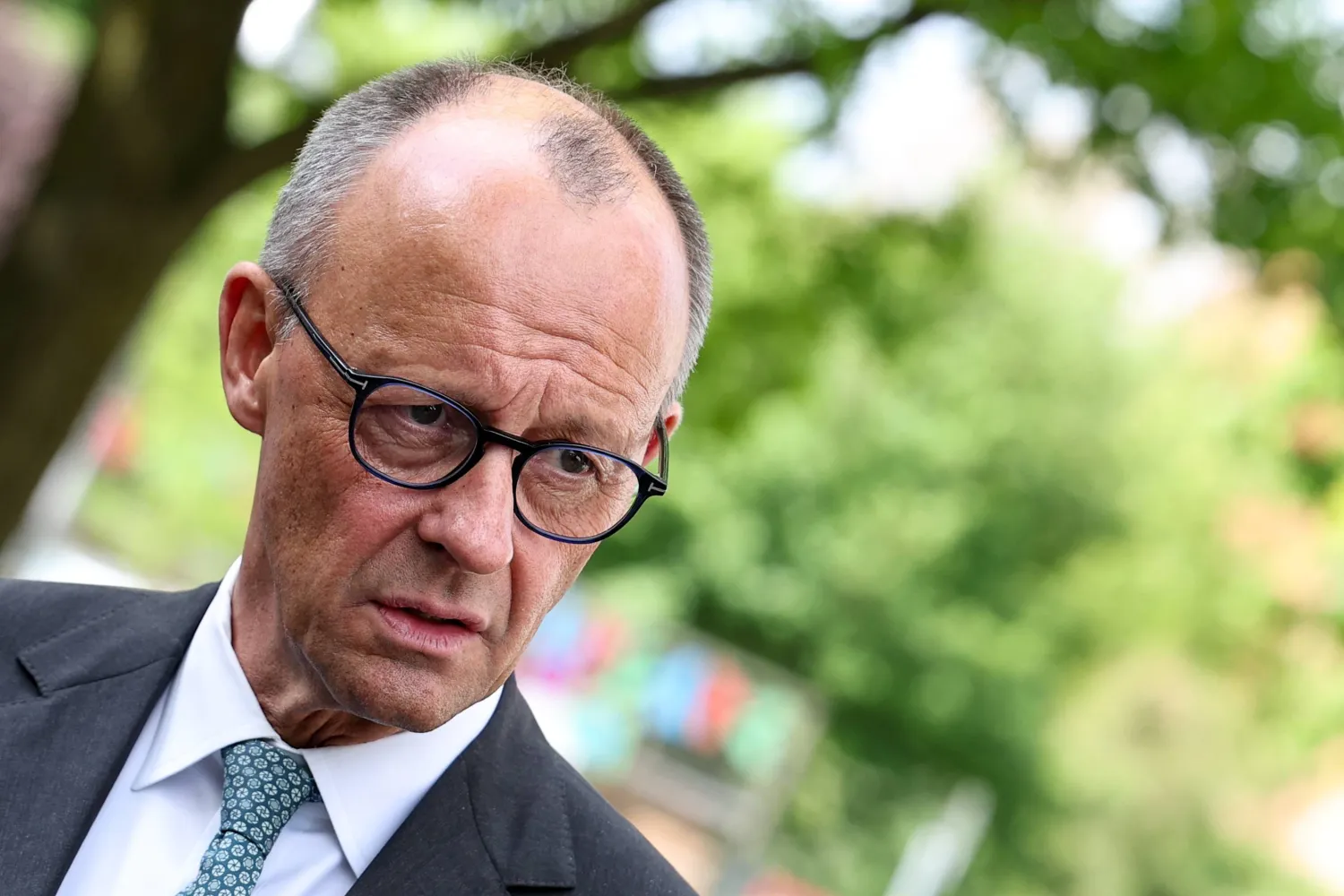

Germany’s Merz Marks a Year in Office Facing Deep Transatlantic Crisis

German Chancellor Friedrich Merz gives a press statement ahead of the Christian Democratic Union (CDU) Executive Committee meeting at the Chabad Synagogue in Berlin, Germany, 04 May 2026. (EPA)
TT

Germany’s Merz Marks a Year in Office Facing Deep Transatlantic Crisis

German Chancellor Friedrich Merz gives a press statement ahead of the Christian Democratic Union (CDU) Executive Committee meeting at the Chabad Synagogue in Berlin, Germany, 04 May 2026. (EPA)

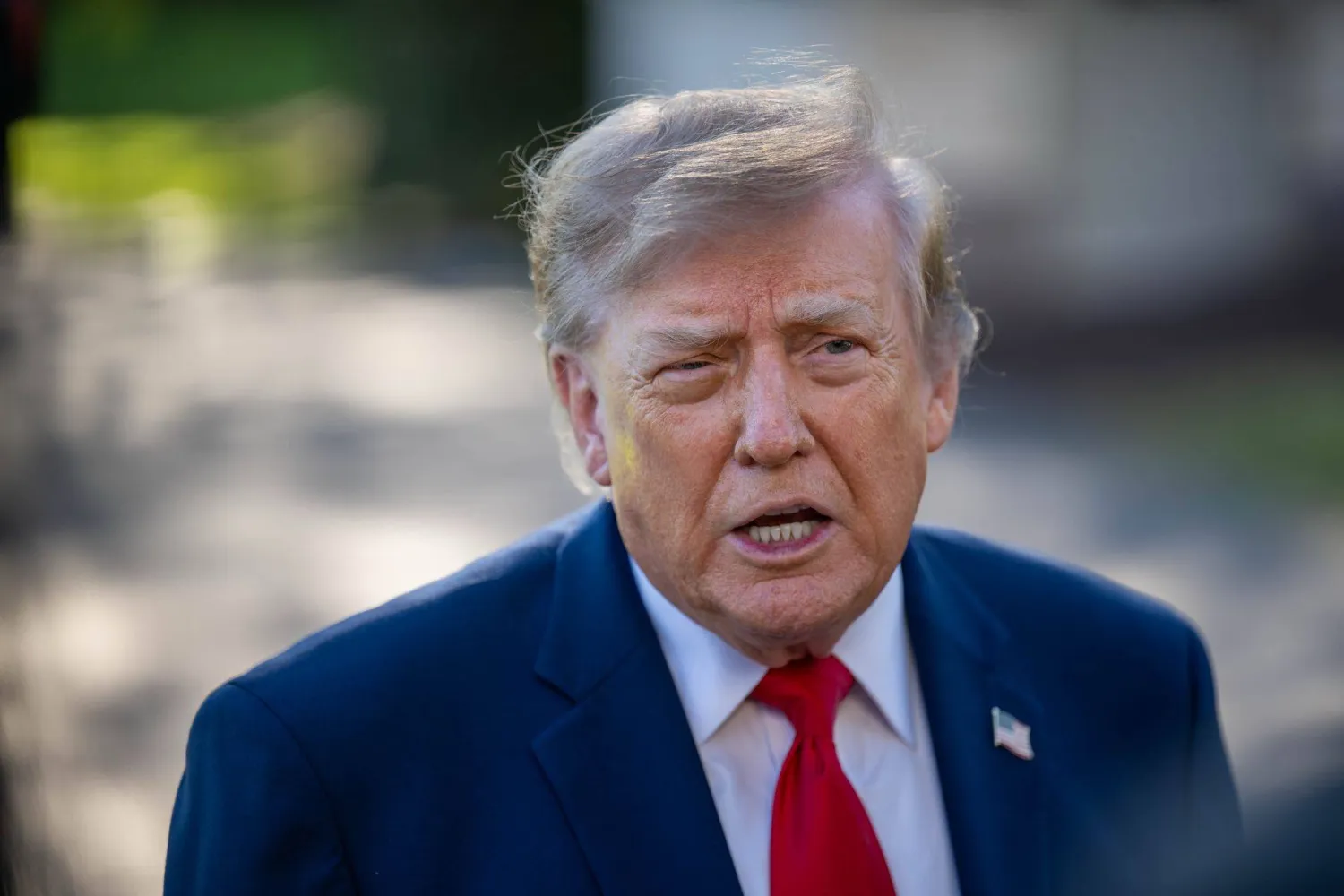
Chancellor Friedrich Merz marks a year in office this week facing the biggest crisis with Washington in decades, after President Donald Trump said he would hit European auto imports with 25% tariffs and pull thousands of troops out of Germany.

The moves, announced on Friday after Trump reacted angrily to criticism by Merz of US strategy in the Iran war, underline the break in transatlantic relations that has become increasingly apparent in Trump's second term and add to an array of problems now facing the German leader.

"We can see what's going on with Donald Trump and the US, and that this is having an impact. We can see that China is getting stronger and stronger," Finance Minister Lars Klingbeil, Merz's deputy and the head of his Social Democrat coalition partners, told Reuters.

"We can see that Europe isn't strong enough. In this regard, a great deal depends on Germany."

MERZ'S CONSERVATIVES TRAILING IN OPINION POLLS

After two years of recession, a timid recovery risks being extinguished by the energy shock from the Iran conflict, a promised package of tax, welfare and health reforms has been overshadowed by coalition wrangling.

Merz's freewheeling communication style, ‌which he himself acknowledges ‌is sometimes impulsive, has also irritated voters. Already squeezed by stifling competition from China, carmakers, the backbone of Germany's ‌industrial ⁠base, now face ⁠a spike in tariffs from 15% to 25% from one of their most important export markets.

In an interview with German public television on Sunday, Merz, who was sworn into office on May 6 last year, acknowledged public doubts, reflected in opinion polls that now put the far-right Alternative for Germany ahead of his conservatives as the country's most popular party.

"The doubts are growing. Not about me, but about the coalition," he said.

For much of his first year, Merz has made up for discontent at home with a relatively assured performance abroad, for a while enjoying a reputation as one of the few European leaders to establish a good personal relationship with Trump.

"He has strengthened key relationships, particularly with France and Poland, and has secured European influence in the context of the war in Ukraine through forums such as the E3," said Oliver Lembcke, a political ⁠scientist at Ruhr University Bochum, adding that Merz's main problem was at home.

"In domestic policy, he's fallen short ‌of expectations – particularly when it comes to leadership."

A fluent English speaker, Merz continues to believe in the US ‌alliance, which he has sought to preserve while Germany rebuilds its own depleted armed forces after decades of neglect.

With the war in Ukraine still raging on the European ‌Union's doorstep, he has also moved carefully to try to persuade Trump not to turn against Kyiv entirely.

But he has repeatedly warned that the era ‌of relying on US forces to protect Europe is over and has become increasingly critical of the US-Israeli conflict with Iran, refusing to send German forces to help clear the strategic Strait of Hormuz until fighting stops and a full international mission is agreed.

MUCH DEPENDS ON GERMANY

The events of the past week, however, have made clear how fine a line there is to tread with a US administration that has made no secret of its disdain for Europe's leaders, even those like Merz or Italian Prime Minister Giorgia Meloni who were ‌once praised by Trump.

German Defense Minister Boris Pistorius downplayed the significance of Trump's decision to withdraw at least 5,000 troops from Germany and withhold the planned deployment of Tomahawk cruise missiles, saying at the weekend that the ⁠move came as no surprise.

Merz denied that ⁠the decision was prompted by his remark to students last week that the US had no exit strategy in Iran and was being "humiliated", despite Trump's angry social media attacks on the chancellor he once called a friend.

Such communication snags have marked Merz's year in office, including when he sparked outrage last year by suggesting that migration had altered the appearance of German towns.

But Trump's impatience with Europe has been abundantly clear throughout his time in office, notably since Vice President JD Vance's stinging attack at last year's Munich Security Conference.

"I think that just sped things up, but it wasn't what set it off," said Roderich Kiesewetter, a member of the parliamentary foreign affairs committee from Merz's conservative CDU party. He said scrapping a Biden-era plan to deploy a US battalion with long-range Tomahawk missiles was more serious for Germany.

"That undermines our deterrent. And it undermines trust in the US. And that is the real bad news," he said.

It remains unclear exactly what troops will be withdrawn from the 40,000 US forces stationed in Germany and how that will affect some of the biggest US military facilities outside the United States, including the sprawling Ramstein air base.

Although polls show Trump is deeply unpopular in Germany and public opinion overwhelmingly backs staying out of the war with Iran, the presence of US troops has become a fixture for Germans in the western part of the country.

In Landstuhl, home to one of the biggest US military hospitals, local resident Maria Raftopoulo said relationships between locals and US personnel had been deep over the years.

"And even though there are fewer Americans now, they still provide jobs, they still rent, they contribute to the region doing as well as it does."



UK Says New Law Will Crack Down on Hostile States’ Proxies from Next Month

 Britain's Prime Minister Keir Starmer hosts a roundtable meeting for leaders of NHS Trusts, at 10 Downing Street in central London on June 9, 2026. (AFP)
Britain's Prime Minister Keir Starmer hosts a roundtable meeting for leaders of NHS Trusts, at 10 Downing Street in central London on June 9, 2026. (AFP)
TT

UK Says New Law Will Crack Down on Hostile States’ Proxies from Next Month

 Britain's Prime Minister Keir Starmer hosts a roundtable meeting for leaders of NHS Trusts, at 10 Downing Street in central London on June 9, 2026. (AFP)
Britain's Prime Minister Keir Starmer hosts a roundtable meeting for leaders of NHS Trusts, at 10 Downing Street in central London on June 9, 2026. (AFP)

Britain said on Tuesday ‌that a law to crack down on proxies acting for states deemed to be hostile such as Iran was expected to come into force next month, as it steps up powers to counter what it says is a growing threat posed by such groups.

The new powers, promised in the wake of a spate of antisemitic attacks in London, seek to close a gap in legislation to target state-linked organizations paying organized crime groups or low-level felons to carry out surveillance, sabotage, or other activities on ‌their behalf.

In recent ‌months there have been numerous arson ‌attacks ⁠on Jewish sites, with ⁠police saying they were investigating possible Iranian links, while there have been convictions for people accused of spying or acting on behalf of Russian and Chinese organizations.

"Where foreign states are found to be engaging in activity that threatens lives or undermines our democratic institutions, we must ensure that such actions have consequences," Prime Minister ⁠Keir Starmer said in a statement. "We will not ‌tolerate hostile actors paying petty criminals ‌to do their dirty work."

Britain's domestic intelligence agency MI5 has ‌warned of state-threat investigations increasing by 35% last year, including 20 ‌potentially lethal Iranian-backed plots.

Britain has accused China and Russia, as well as Iran, of using proxies. All three dismiss the claims as propaganda.

The legislation would make it illegal to express support for designated proxies ‌or to take money from them, providing for jail terms of up to 14 years.

Last ⁠week, an ⁠Iraqi national denied involvement in multiple attacks against American and Israeli interests in Europe, including some of the recent attacks in Britain, during a US court appearance.

He is accused of directing people to carry out attacks in the name of Harakat Ashab al-Yamin al-Islamiya (HAYI), a component of an Iran-backed faction which the US considers a terrorist organization directed by Iran's Revolutionary Guard Corps (IRGC).

Many British lawmakers have called for the banning of the IRGC, but there was no indication of whether it would be included under the new legislation, with about 10 or fewer designations expected in the first year after it has become law.


Ukraine, Latvia Sign Drone Deal, Zelenskiy Says

 Ukraine's President Volodymyr Zelenskiy attends a press conference during the Nordic-Baltic cooperation (NB8) Prime Ministers' meeting in Tallinn, Estonia, June 9, 2026. (Reuters)
Ukraine's President Volodymyr Zelenskiy attends a press conference during the Nordic-Baltic cooperation (NB8) Prime Ministers' meeting in Tallinn, Estonia, June 9, 2026. (Reuters)
TT

Ukraine, Latvia Sign Drone Deal, Zelenskiy Says

 Ukraine's President Volodymyr Zelenskiy attends a press conference during the Nordic-Baltic cooperation (NB8) Prime Ministers' meeting in Tallinn, Estonia, June 9, 2026. (Reuters)
Ukraine's President Volodymyr Zelenskiy attends a press conference during the Nordic-Baltic cooperation (NB8) Prime Ministers' meeting in Tallinn, Estonia, June 9, 2026. (Reuters)

Ukraine has signed a drone deal with Latvia, President Volodymyr Zelenskiy said on Tuesday as he met with Latvian Prime Minister Andris Kulbergs on the sidelines of a summit between Ukraine and Nordic and Baltic states in the Estonian capital Tallinn.

"These are concrete things to strengthen our joint defense and co-production, and, importantly, this also means Ukraine's expertise and experience helping to strengthen our partners," Zelenskiy said in a post on X.

He gave no ‌details of what ‌the deal entailed.

Kulbergs said the agreement ‌would ⁠give Latvia technological know-how ⁠and co-production opportunities.

"We need to protect our skies, and nobody knows how to do that better than Ukraine," he told a joint press conference with Zelenskiy and other leaders attending the summit, adding that drones were responsible for the vast majority of deaths of Russian troops in the ⁠Ukraine war.

Since the outbreak of the Iran ‌war in late February, Zelenskiy ‌has managed to leverage Ukraine's expertise in drone warfare into a ‌series of successful diplomatic deals during visits to Europe and elsewhere.

Rustem Umerov, the chairman of Ukraine's defense and security council, said Latvia was the sixth country to join Kyiv's drone cooperation initiative.

Last month, Zelenskiy said nearly 20 countries ‌were interested in drone deals with Ukraine.

"Ukraine is interested in ensuring that every region of Europe ⁠has sufficient ⁠protection against Russian threats," Zelenskiy said on X.

The Baltic countries, which are all members of NATO, have seen several instances of drones entering their airspace in recent weeks, as Ukraine has stepped up its long-range attacks on Russian energy facilities. Ukraine has blamed the incidents on Russia affecting the drone paths with electronic warfare.

Responding to a question on such incidents during an earlier joint press conference with his Estonian counterpart Alar Karis, Zelenskiy repeated that Ukraine was sending its experts to help protect the skies of its close partners.


France Bans Israeli Minister Smotrich in Coordinated Sanctions Push

Israel's Finance Minister Bezalel Smotric looks on as he addresses the relatives of Israelis being held hostage by Palestinian group Hamas in the Gaza Strip, during a rally in the center of Jerusalem on June 3, 2024. (AFP)
TT

France Bans Israeli Minister Smotrich in Coordinated Sanctions Push

Israel's Finance Minister Bezalel Smotric looks on as he addresses the relatives of Israelis being held hostage by Palestinian group Hamas in the Gaza Strip, during a rally in the center of Jerusalem on June 3, 2024. (AFP)

France Tuesday banned Israel's far-right Finance Minister Bezalel Smotrich from entering the country, the French foreign minister said, as part of coordinated sanctions with other countries over settler violence against Palestinians.

France's sanctions were in coordination with Britain, Canada, Australia, Norway and New Zealand targeting "those responsible for the escalation of settlement activity and violence in the West Bank", French Foreign Minister Jean-Noel Barrot said on X.

He said Smotrich "actively promotes the annexation of the West Bank, which he openly claims, the creation of new settlements in the West Bank, the re-colonization of Gaza, the economic collapse of the Palestinian Authority and its harmful consequences for the Palestinian population".

"This is a policy that the overwhelming majority of the international community, firmly committed to the two-state solution, cannot accept," Barrot wrote on X.

Smotrich is the second member of the Israeli government to be forbidden from entering France in recent months, after National Security Minister Itamar Ben-Gvir was barred on May 23 for mocking activists detained by Israeli soldiers from a Gaza-bound flotilla carrying aid for the Palestinian territory.

France also banned four leaders of settler organizations and 21 violent settlers.

- 'Scant accountability' -

Norway said it would adopt the same sanctions as those announced by the European Union on May 28, as well as impose an entry ban targeting "20 violent settlers", without naming them.

Along with sanctions against "networks financing and enabling settler attacks against Palestinians in the West Bank", the United Kingdom also urged British businesses and citizens to refrain from conducting financial activities in Israeli settlements deemed illegal under international law.

"We believe that violent settler groups should not be profiting from the land that they have seized from Palestinians," Foreign Secretary Yvette Cooper told parliament.

The Israeli "government has condemned some settler violence, but that rings hollow when there is scant accountability", she added.

Israel's foreign ministry quickly condemned the sanctions as "disgraceful".

"The real essence of these steps is the attempt to impose a political stance regarding the right of Jews to settle in the Land of Israel and concerning the Israeli-Palestinian conflict -- camouflaged as measures against violence," ministry spokesman Oren Marmorstein said.

- Banned ministers -

Ben-Gvir and Smotrich had already been banned by the five other countries in June last year, over accusations of inciting violence against Palestinians, particularly in the occupied West Bank.

The Israeli government at the time condemned the sanctions as "scandalous".

Other countries have also banned the ministers, including Spain, Slovenia and most recently Ireland.

Firebrand Ben-Gvir became a minister in 2022, after an alliance with the far-right Religious Zionist party of Smotrich came third in legislative elections.

Together, Ben-Gvir and Smotrich form a cornerstone of Israeli Prime Minister Benjamin Netanyahu's right-wing coalition government.

Since the war in Gaza broke out in October 2023 with Palestinian group Hamas's attack on Israel, near-daily violence has also rocked the West Bank, which Israel has occupied since 1967.

Israeli soldiers or settlers have killed at least 1,080 Palestinians since then, including both fighters and civilians, according to an AFP tally based on Palestinian health ministry data.

Official Israeli figures show that at least 46 Israelis, both civilians and soldiers, have been killed in Palestinian attacks or during Israeli military operations in the same period.

A United Nations-mandated inquiry on Tuesday said Palestinian civilians are caught between "mass atrocities" of Israeli forces, settlers and the brutal rule of Hamas in war-torn Gaza.