Iran Says No Damage after Drone Interception near Qeshm

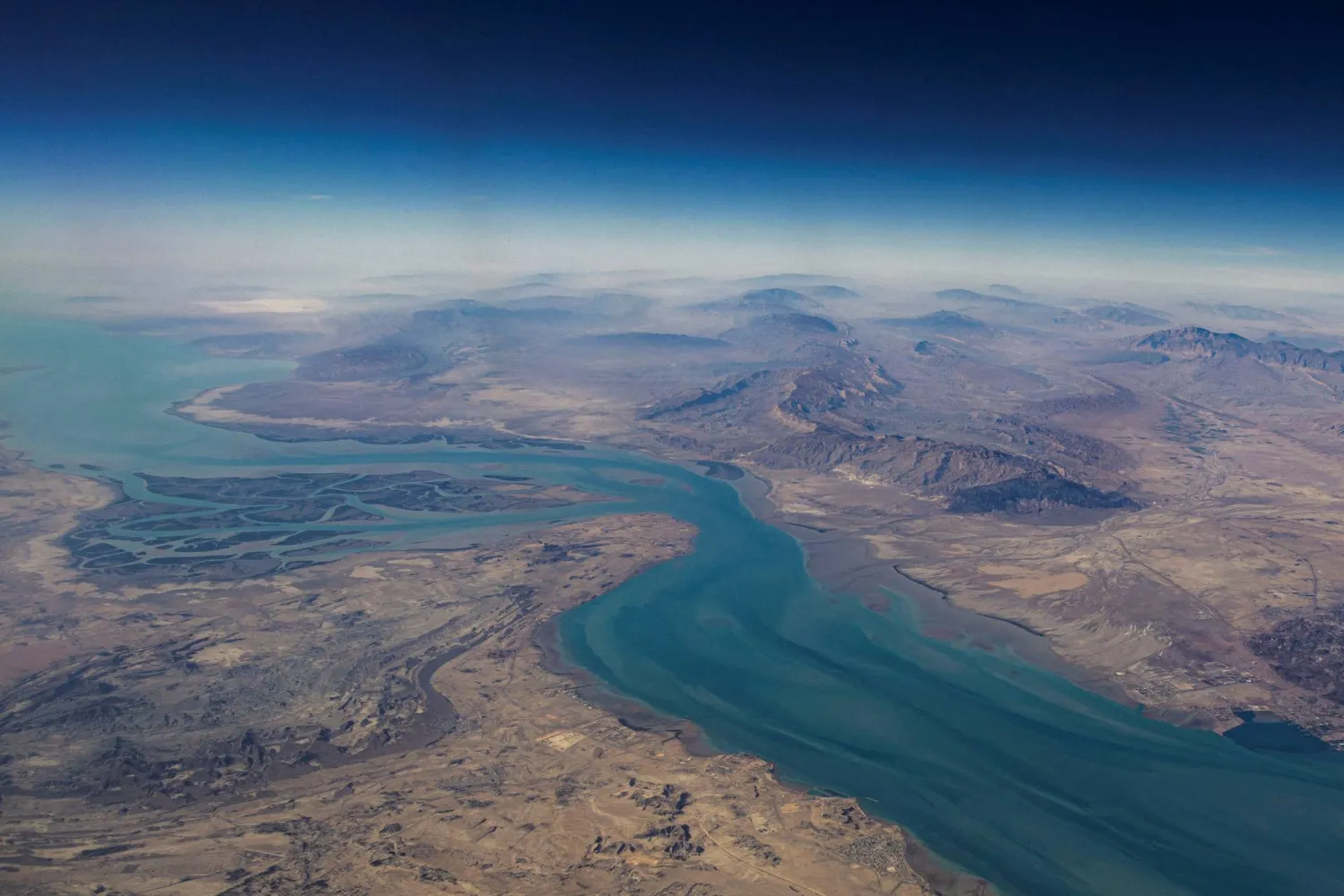
FILE PHOTO: An aerial view of the Iranian shores and the island of Qeshm in the strait of Hormuz, December 10, 2023. REUTERS/Stringer/File Photo
TT

Iran Says No Damage after Drone Interception near Qeshm

FILE PHOTO: An aerial view of the Iranian shores and the island of Qeshm in the strait of Hormuz, December 10, 2023. REUTERS/Stringer/File Photo

A loud noise heard on Qeshm island in southern Iran was caused by ‌air ‌defenses intercepting small ‌drones ⁠and reconnaissance drones, the ⁠Hormozgan provincial authorities said according to the Students ⁠News Network, ‌adding that ‌no impact, ‌damage ‌or explosion had occurred.

Drone interceptions by Iranian ‌air defenses have taken place several ⁠times ⁠in recent weeks, notably over Tehran, despite a ceasefire with the US, reported Reuters.


Iran Retaliates after First US Strikes in a Month

A man drives next to a billboard of Iranian supreme leader Mojtaba Khamenei in a street in Tehran, Iran, 09 July 2026. EPA/ABEDIN TAHERKENAREH
TT

Iran Retaliates after First US Strikes in a Month

A man drives next to a billboard of Iranian supreme leader Mojtaba Khamenei in a street in Tehran, Iran, 09 July 2026. EPA/ABEDIN TAHERKENAREH

Iran vowed on Monday a "decisive response" to the first American strikes on its territory in a month, in a fresh flare-up in the Middle East war.

Tehran's powerful Revolutionary Guards said they had retaliated to Sunday's attack by striking two US military air bases with ballistic missiles in Washington-allied Jordan, causing "heavy damage."

Jordan's army said it had intercepted eight missiles, without stating their origin, AFP said.

The Guards also said on Monday they had shot down a US drone over the Strait of Hormuz.

The attacks came after the United States said Sunday it had attacked Iranian rocket launchers on a small island in the strategic shipping lane.

Washington said its attacks were aimed at preventing Iran from launching more sea mines into the strait, days after it announced it had completed clearing explosives from the waterway.

"US forces took limited, precise action against IRGC (Iran's Revolutionary Guards') minelaying forces posing an imminent threat in the Strait of Hormuz," the US Central Command wrote on X.

The Guards said the US strikes resulted in "casualties" and that their subsequent attack on Jordan was "in response to the US-Zionist aerial aggression."

"We are not seeking war, but we will deliver a decisive response to the aggressors," Iranian President Masoud Pezeshkian said in a statement quoted by state TV.

Pezeshkian was speaking before traveling to Kyrgyzstan for the summit of a bloc that seeks to be a counterinfluence to the West, along with Russia's Vladimir Putin and China's Xi Jinping.

The exchange of fire between the United States and Iran came shortly after their war hit the six-month mark, and at a time when hostilities had been subsiding.

In recent weeks, the administration of US President Donald Trump has prioritized "economic warfare" over military strikes on Iran.

Tehran has effectively blocked the Strait of Hormuz, a strategic sea lane through which one-fifth of the world's oil passed before the United States and Israel triggered hostilities with strikes on Iran on February 28.

"Last week, CENTCOM completed clearing sea mines from the strait's international shipping routes," said Navy Captain Tim Hawkins, a spokesman for US Central Command.

"US forces are monitoring the area closely and remain prepared to protect the free flow of commerce through this essential waterway," he said.

- Unpopular war -

Diplomatic efforts, spearheaded by mediators including Pakistan and Qatar, have tried for months to bring an end to the war.

While a ceasefire was agreed in April and a memorandum of understanding towards a final peace deal was signed in June, no agreement has been forthcoming, and Washington has since declared "economic warfare" against Tehran.

A US naval counterblockade of Iranian ports is squeezing petrol supplies in Iran during a shortfall in domestic production, as the US ramps up the pressure.

The April ceasefire put an end to the most intense fighting, but sporadic attacks, mainly around the Strait of Hormuz, have dimmed the prospects of a final peace agreement.

The last US strike on Iran prior to Sunday's came on July 29 in response to "an attempted surprise attack on US forces" in the region, the US military said. Earlier in July, CENTCOM attacked Iran for 13 consecutive nights.

Throughout the war, Iran has fought back by striking US facilities and allies in the Gulf region, hitting targets in Kuwait, Oman, Saudi Arabia and the United Arab Emirates, among others.

Its closure of the Strait of Hormuz has caused pain around the world in the form of price hikes and shortages of fertilizer and energy.

Both main crude oil contracts rose at least two percent on Monday.

The Iran war is deeply unpopular with the US public, with midterm elections looming in November that could overturn Republican control of Congress.

In a statement on Friday, US Senator Jack Reed criticized Trump over the war.

"Six months later, not a single objective has been achieved," said Reed, the top Democrat on the Senate Armed Services Committee.

"Indeed, he has weakened our position in the Middle East and the world significantly."


Google Maps Will Show ‘Lake America’ in US, not ‘Lake Ontario’

A sign reading "Lake Ontario, Now and Always," unveiled by Ontario Premier Doug Ford at Fifty Point Conservation Area, after US President Donald Trump signed an executive order renaming Lake Ontario as "Lake America," near Grimsby, Ontario, Canada, August 29, 2026. (Reuters)
TT

Google Maps Will Show ‘Lake America’ in US, not ‘Lake Ontario’

A sign reading "Lake Ontario, Now and Always," unveiled by Ontario Premier Doug Ford at Fifty Point Conservation Area, after US President Donald Trump signed an executive order renaming Lake Ontario as "Lake America," near Grimsby, Ontario, Canada, August 29, 2026. (Reuters)

Google Maps has changed the ‌name of "Lake Ontario" to "Lake America" for US users to reflect President Donald Trump's executive order renaming the lake, according to a Google statement.

Trump announced on Thursday that he was changing the name of the smallest of the five Great Lakes, part of an escalating trade feud with Canada that has prompted the two countries to impose reciprocal tariffs on billions of dollars in goods.

The president's order affects the US Geographic Names Information System (GNIS), which sets ‌the standards for ‌official US maps. It does not have ‌any ⁠impact on Canadian ⁠naming conventions or how the rest of the world refers to the lake.

"Since we update Google Maps to reflect name changes in official government sources, which is GNIS for the US, people using Maps in the US will see 'Lake America,' those in Canada will continue to see 'Lake ⁠Ontario,' and those outside of the US and ‌Canada will see both names," ‌Google said in a blog post issued on Saturday.

The White ‌House, Carney's office and Ford's office did not immediately comment ‌on Sunday on Google's decision.

Google Maps made a similar change to the Gulf of Mexico last year, labeling it the "Gulf of America" following Trump's executive order on his first day ‌in office renaming the body of water.

Canadian Prime Minister Mark Carney immediately rejected the lake's name ⁠change on ⁠Thursday. Democratic Governor Kathy Hochul of New York, which shares a long border with Canada, declared that "New York won't be calling it that," while Phil Scott, the Republican governor of neighboring Vermont, called Trump's decision "petty and disappointing" on social media.

The premier of Ontario, Doug Ford, on Saturday unveiled a large lakeside sign that reads, "Lake Ontario: Now and Always," in both English and French.

"President Trump can call it whatever he wants, but I can tell you, the rest of the world will always call it Lake Ontario," Ford said.


Trump Says US Will Refill Strategic Petroleum Reserve Using Venezuelan Oil

An oil tanker sails off the coast of Maracaibo, Venezuela, 29 August 2026. (EPA)
TT

Trump Says US Will Refill Strategic Petroleum Reserve Using Venezuelan Oil

An oil tanker sails off the coast of Maracaibo, Venezuela, 29 August 2026. (EPA)

US President Donald Trump said on Sunday that oil from a recently struck deal with Venezuela will be used to replenish the Strategic Petroleum Reserve, which has been drawn down sharply in recent years to respond to global supply disruptions ‌and high ‌fuel prices.

Trump said in ‌a ⁠social media post ⁠that the "topping out" process will begin shortly, describing the Venezuelan oil as a “Gift from Venezuela to the People of the United States.”

It is unclear ⁠how quickly the Venezuela ‌deal could ‌provide oil for the reserve or deliver ‌any near-term benefit to US motorists. ‌

The agreement Trump announced on Friday is aimed at reviving Venezuela's battered oil industry, but it will ‌require significant investment and infrastructure work before production can rise substantially.

The ⁠reserve ⁠held about 290 million barrels as of August 21, near a 44-year low, after the United States drew down its stockpile under both the Biden and Trump administrations in response to global supply disruptions, including Russia's invasion of Ukraine and the conflict with Iran.