


Antarctica's Tourism Boom Raises Concerns about Contamination and Disease

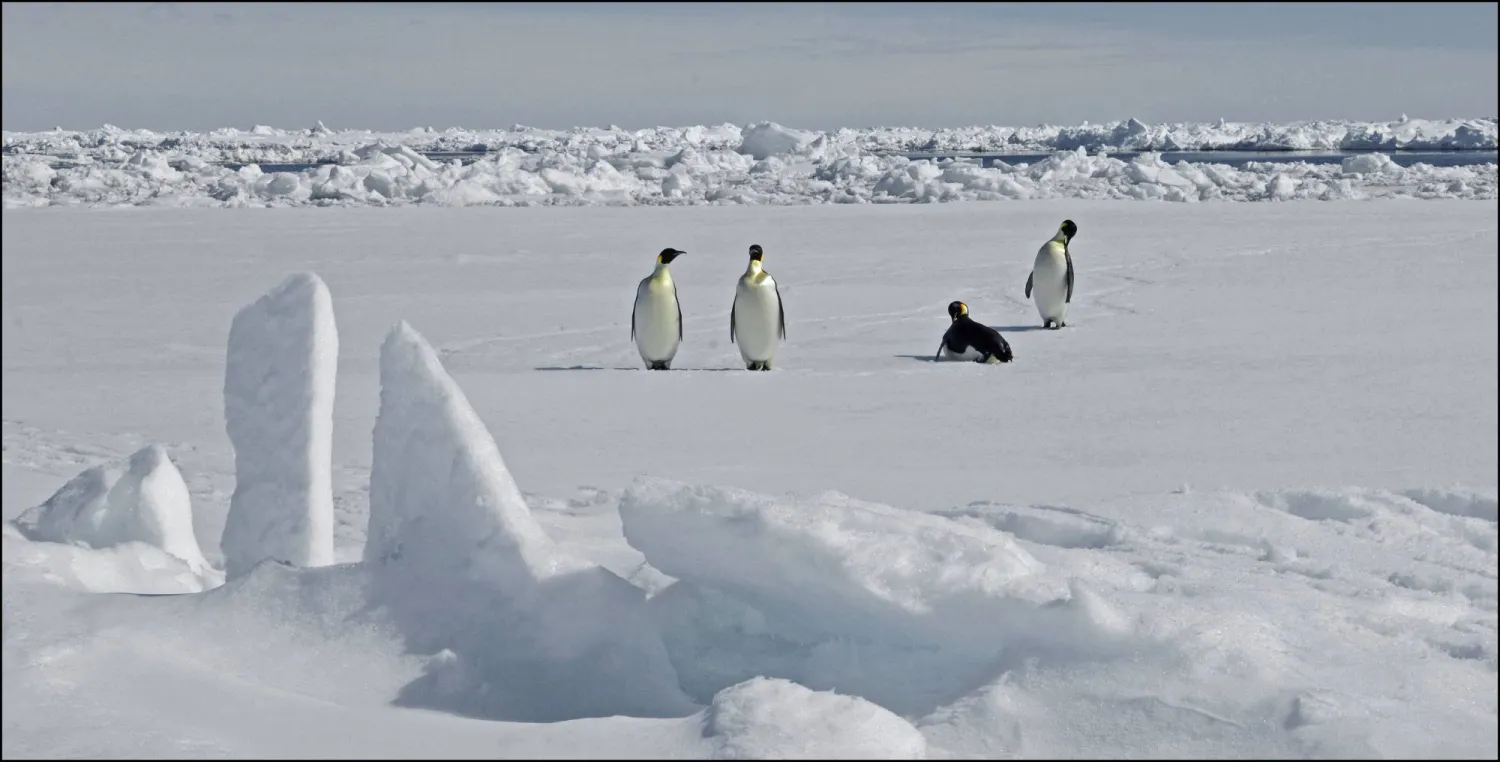
This handout photograph released by The British Antarctic Survey on April 8, 2026, shows Emperor Penguins on Antarctica on November 13, 2010. (Photo by PETER BUCKTROUT / BRITISH ANTARCTIC SURVEY / AFP)
TT

Antarctica's Tourism Boom Raises Concerns about Contamination and Disease

This handout photograph released by The British Antarctic Survey on April 8, 2026, shows Emperor Penguins on Antarctica on November 13, 2010. (Photo by PETER BUCKTROUT / BRITISH ANTARCTIC SURVEY / AFP)

Driven in part by fears that the frozen landscapes of Antarctica may be irreversibly melting away because of climate change, tourism to the bottom of the world is soaring. And experts warn that with more visitors comes an increased risk of contamination, illness and other damage to the continent.

While visitor numbers are still small — in part due to the high costs and time it can take — they are growing so fast that scientists and environmentalists are sounding alarms.

A deadly outbreak of the rare hantavirus aboard a Dutch ship on a weekslong polar cruise has brought attention to the growing tourism trend, The Associated Press said.

Most expeditions head to the Antarctic Peninsula, one of the fastest-warming places in the world. From 2002 to 2020, roughly 149 billion metric tons (164 billion tons) of Antarctic ice melted per year, according to the National Aeronautics and Space Administration.

A common route is to voyage south from Argentina toward Antarctica before heading north up the coast of Africa — the same route taken by the cruise ship MV Hondius.

“The sites you will see in Antarctica are extremely unique and not replicable anywhere else on the planet — the whales, the seals, the penguins, the icebergs — it’s all really stunning and it makes a huge impression on people,” said Claire Christian, executive director of the environmental group Antarctic and Southern Ocean Coalition.

Explosive growth of trips to the southern continent

In 2024, more than 80,000 tourists touched down on the vast ice-cloaked continent and 36,000 viewed from the safety of ships, according to data collected by the International Association of Antarctica Tour Operators.

The International Union of Concerned Scientists estimates that tourism to Antarctica has grown tenfold in the past 30 years.

That number could rise further in the next decade as costs fall with more ice-capable hulls hitting the water and technological advances, said Hanne Nielsen, a senior lecturer of Antarctic law at the University of Tasmania. Her colleagues at the university estimate the annual figure could triple or quadruple to over 400,000 visits in that time.

Some tourists come to Antarctica for “last chance tourism,” knowing the melting landscape is rapidly changing, Nielsen said.

Risks of contamination Officials have not indicated any evidence of contamination from the MV Hondius.

However, flocks of migratory birds brought avian flu from South America to Antarctica in recent years, according to the US Centers for Disease Control and Prevention.

That outbreak prompted the International Association of Antarctica Tour Operators and others to harden rules for tourists’ conduct and hygiene to protect visitors from being contaminated. To protect the fragile ecosystem from invasive species large and microscopic, visitors are told to stay away from animals and to avoid touching the ground with anything but their feet.

“There are rules that people are bound by when they’re heading south,” Nielsen said, describing her five voyages as a former guide. Crews and passengers use vacuums, disinfectants and brushes to scrub shoes and equipment clear of bugs, feathers, seeds and microbe-carrying dirt.

“Between the tongues and the laces of the boots you can find a lot of things,” she said.

Cruise ships have been struck by outbreaks of diseases like norovirus, which can spread quickly in a ship's close quarters. In 2020, a COVID-19 outbreak on the Diamond Princess turned the cruise ship into an incubator for the then-mysterious virus.

Hantavirus usually spreads by inhaling contaminated rodent droppings.

The Hondius' island hopping cruise The World Health Organization said Tuesday that MV Hondius left Ushuaia, Argentina, on April 1 and visited Antarctica and several isolated islands.

WHO is investigating possible human-to-human transmission on the cruise ship, said Dr. Maria Van Kerkhove, WHO’s director of epidemic and pandemic preparedness. Officials suspect the first infected person likely contracted the virus before boarding, she said, and officials have been told there are no rats on board.

Antarctica is governed by the Antarctic Treaty, which in 1959 enshrined the territory as a scientific preserve used only for peaceful purposes. A series of rules that followed “aim to ensure that all visits, regardless of location, do not adversely impact the Antarctic environment or its scientific and aesthetic values,” according to the treaty’s secretariat.

Companies and scientific ventures voluntarily comply with biosecurity guidelines and submit environmental impact assessments for Antarctic operations.

The treaty was written when tourism numbers were much lower, Christian said.

“Activity needs to be regulated appropriately, as you would with any of the world’s sensitive and precious ecological sites,” Christian said from Hiroshima, Japan, where she was preparing for an Antarctic Treaty Consultative Meeting. There she'll join calls to strengthen protections for Antarctica's penguins, whales, seabirds, seals and krill — tiny creatures at the base of the food chain.

For now, the lure of the frozen frontier continues to draw visitors.

“You can put a footprint in Antarctica and it’s still there 50 years later,” Christian said.


Voting Opens in Alaska's Annual Fat Bear Week

A brown bear eats his catch while fishing for salmon in Brooks Falls, Alaska on August 12, 2023. (Photo by JOHN MOORE / GETTY IMAGES NORTH AMERICA / AFP)
TT

Voting Opens in Alaska's Annual Fat Bear Week

A brown bear eats his catch while fishing for salmon in Brooks Falls, Alaska on August 12, 2023. (Photo by JOHN MOORE / GETTY IMAGES NORTH AMERICA / AFP)

Polls opened Tuesday in the only American election that really matters: Fat Bear Week.

While the United States might be gearing up for midterm ballots that will decide who runs Washington, hundreds of thousands of people were readying to vote on animals gorging themselves in rural Alaska.

In a contest that has rapidly become one of the internet's favorite moments, the brown bears of Katmai National Park unwittingly compete in a series of head-to-head contests to see which one of them has most impressively piled on the pounds ahead of hibernation.

Viewers can watch a livestream of the enormous animals as they scoop salmon from the Brooks River, or browse biographies of some of the top contenders, including before-and-after pictures showing how much weight the bears have gained over a summer of feasting.

"For each match-up, vote for the bear you believe best exemplifies fatness and success in brown bears," said organizers, according to AFP.

"The bear with the most votes advances to the next round. Only one will be crowned Fat Bear Week champion."

Last year's winner, Chunk, beat out a stiff challenge from two-time winner Grazer.

Summer and early autumn are key fueling periods for the brown bears, which will not eat for five months of hibernation, relying on their store of fat to survive the punishing Alaskan winter.

The online contest began in 2014 with just a few thousand people voting, but has now turned into an eagerly awaited exercise in tongue-in-cheek democracy with more than a million people voting every year.

The aim is to raise awareness of brown bears and their habitat in Alaska, and the risks they face from human activity.


Another Beluga Whale Dies at Chicago Aquarium after Rescue Mission from Canada Park

This photo provided by Shedd Aquarium shows a beluga whale named Osiris at Shedd Aquarium in Chicago, Aug. 20, 2026. (Rachel Mittelstaedt/Shedd Aquarium via AP)
TT

Another Beluga Whale Dies at Chicago Aquarium after Rescue Mission from Canada Park

This photo provided by Shedd Aquarium shows a beluga whale named Osiris at Shedd Aquarium in Chicago, Aug. 20, 2026. (Rachel Mittelstaedt/Shedd Aquarium via AP)

A third beluga has died at a Chicago aquarium after being rescued this summer from a shuttered Canadian marine park in a complex international operation that moved 30 whales to aquariums in the US and Spain.

Osiris, a 26-year-old female whale, died on Monday, Chicago's Shedd Aquarium said in a statement. The death comes less than a week after a fourth beluga, named Jelly Bean, died since it was rehomed at Oceanogràfic de València in Spain.

The deaths were sudden and unexpected as their health wavered amid the challenges of adjusting to a new home, according to statements from the aquariums.

Beluga whales are particularly vulnerable to changes in their environment, like climate change, pollution and other sources of stress, according to the National Oceanic and Atmospheric Association. Beluga whales native to the Cook Inlet on Alaska's coast are classified as an endangered species, and their population rapidly declined by nearly 80% from 1979 to 2018.

“When Shedd was asked to help with this rescue, we understood that these animals arrived with significant vulnerabilities and that the outcome for every individual could not be guaranteed,” The Associated Press quoted the Shedd Aquarium as saying in a statement.

The Shedd Aquarium took in 10 of the 30 belugas and four dolphins stranded at Marineland, an Ontario park that closed years ago and could no longer care for them. The Canadian government signed off on a last-minute agreement to move its last captive whales out of the country earlier this year, saving them from euthanasia.

The belugas came from the Marineland park and zoo in Niagara Falls, Ontario, which announced in early 2023 that it was for sale and closed to the public in late summer 2024.

Twenty whales — 19 belugas and one killer whale — had died at Marineland since 2019, according to provincial government data obtained through freedom of information laws and official statements.

The rescued belugas were moved in custom-made slings and temperature-controlled containers, Shedd staff told The Associated Press. Aquarium personnel traveled to Marineland to examine their health records in preparation for the move. They have monitored their health minute-by-minute since they arrived, the aquarium staff said.

Peekachu and Rain died at the Shedd in late August and early September after arriving from Canada. Another beluga that had lived at the aquarium for decades died around the same time.

Osiris was a “whale of clinical concern” since she arrived, according to the aquarium. The whale did not eat as consistently as her fellow animals, which complicated the efforts to keep her well-fed and hydrated, according to the statement.

“Osiris experienced periods of meaningful progress, both nutritionally and socially, but her overall condition remained closely monitored,” the aquarium stated.

Osiris' caretakers noticed sudden changes in her behavior and breathing patterns the morning of her death, according to the aquarium. She was moved to the medical habitat, but “her condition declined rapidly,” and she “passed away despite lifesaving efforts.”

A beluga sent to Spain died suddenly Jelly Bean, the whale that died at Oceanogràfic de València, also died “suddenly and unexpectedly,” according to José Rafael Serra, a spokesperson for the facility. The whale “experienced feeding difficulties, prompting the veterinary team to intensify her monitoring,” despite periods of improvement, Serra said in an email.

The Spanish aquarium took in two of Marineland's beluga whales, including Jelly Bean. The Georgia Aquarium and SeaWorld locations in San Diego and San Antonio have also accepted whales from the Canadian park.

The two rescued whales at the Georgia Aquarium showed decreased appetites and were examined, but no issues were found, the aquarium said in a social media post Friday. The whales at SeaWorld are in “stable health,” according to AnneMarie Iturrizaga, a spokesperson for the company that owns the parks.

The Shedd Aquarium notified the NOAA of Osiris’ death Monday, according to John Chu, a spokesperson for NOAA Fisheries. Within 30 days of the whales’ deaths, the aquarium must formally submit their names and causes of death, and on request, provide copies of necropsy reports, Chu said in an email earlier this month.

The Shedd Aquarium said it will conduct necropsies into the whales and will share the results when they are confirmed.

Andrew Trites, the director of the University of British Columbia’s Marine Mammal Research Unit, said it was concerning that the four belugas had died “so shortly after arriving in their new homes."

The belugas were in small, confined spaces on the flights out of Marineland, but that's not out of the ordinary for them, Trites said. The whales often swim in narrow spaces between sheets of ice, and “should be reasonably well adapted to that sort of condition,” he said.

“Four animals have died so shortly after arriving in the new homes, and that’s what stands out to me as being surprising," Trites said.


Tunisia Says 2026 Summer Hottest on Record

Tourists pose for a picture in downtown Tunis, Tunisia, August 4, 2017. REUTERS/Zoubeir Souissi
TT

Tunisia Says 2026 Summer Hottest on Record

Tourists pose for a picture in downtown Tunis, Tunisia, August 4, 2017. REUTERS/Zoubeir Souissi

Tunisia's summer this year was its hottest on record, the country's weather authority said Tuesday, following multiple heatwaves, water shortages and power cuts.

"The summer of 2026 was ranked the hottest in Tunisia since 1950," the year temperature records began, the National Meteorological Institute said.

The average temperature was about 2.9 degrees Celsius higher than the previous record, it added.

Although accustomed to scorching heat, Tunisia experienced a particularly gruelling summer this year, with July and August marked by "intense and prolonged heatwaves", the authority said.

Scientists attribute these episodes to climate change.

This summer also saw persistently high nighttime temperatures, the agency added.

The highest temperature was recorded in the central city of Kairouan, which reached 49.7 degrees Celsius in mid-July.

Temperatures also reached 49.2 degrees Celsius in Beja in the northwest, and in the south they reached 48.4 degrees Celsius in Tozeur.

Authorities have yet to provide figures on the health impact of the heatwaves, but a group representing young Tunisian doctors reported numerous deaths it said were caused by the heat.
