


US-Gulf Draft UN Resolution to Hold Iran Accountable over Hormuz Closure

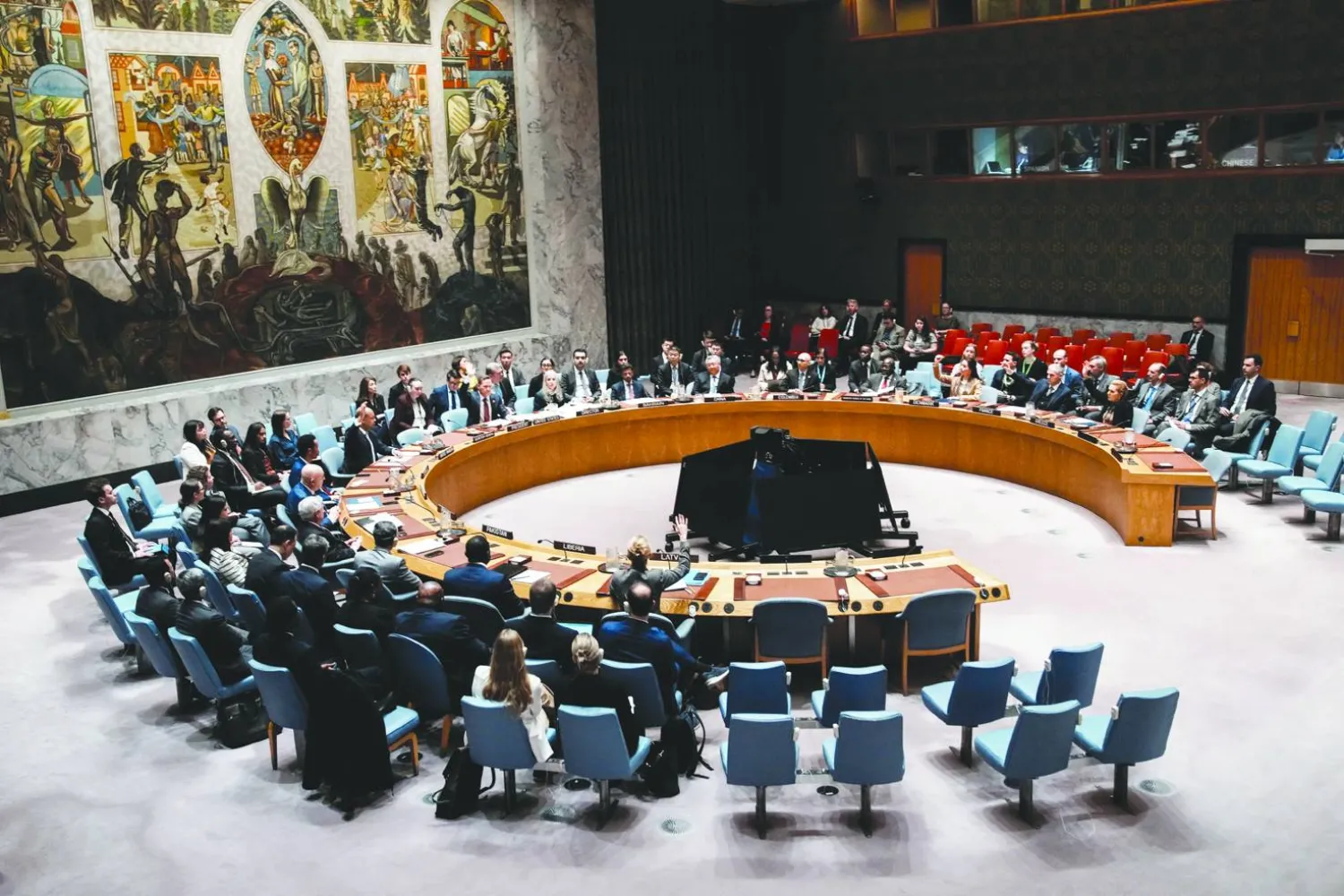
A UN Security Council session held on March 12 (Reuters)
TT

US-Gulf Draft UN Resolution to Hold Iran Accountable over Hormuz Closure

A UN Security Council session held on March 12 (Reuters)

The United States and Bahrain have begun drafting a UN Security Council resolution aimed at holding Iran accountable for closing the Strait of Hormuz and advancing international efforts to reopen it to commercial shipping.

US Ambassador to the UN Mike Waltz, speaking during a phone press conference on Monday, said the draft states that the Security Council strongly condemns repeated attacks and threats by Iran against commercial vessels, as well as actions aimed at obstructing lawful transit through the Strait of Hormuz. These include the laying of naval mines and the imposition of illegal fees on ships.

The proposal determines that such actions constitute a threat to international peace and security, opening the possibility of placing the resolution under Chapter VII of the UN Charter and, consequently, the potential adoption of enforcement measures at a later stage.

It affirms the right of all ships and aircraft to transit the Strait of Hormuz without unlawful interference, in accordance with international law, including the UN Convention on the Law of the Sea.

It further calls on Iran to immediately cease all attacks or threats directed against commercial shipping, as well as any attempts to obstruct or impede freedom of navigation.

A key provision stipulates that Iran must disclose the number of mines it has laid and their precise locations in and around the Strait of Hormuz, and work toward their removal. The draft also calls on Tehran to refrain from interfering in international demining efforts.

Humanitarian corridor

Another clause asks Iran to cooperate with the United Nations in establishing a humanitarian corridor in the Strait of Hormuz, aimed at facilitating the flow of essential goods, including food and fertilizers, which the text says have been disrupted by recent developments in the region.

It also includes a prohibition on any UN member state assisting Iran in closing the strait or restricting transit through it. At the same time, it affirms the right of states to defend their vessels against attacks, in accordance with international law.

This is the latest diplomatic effort by Washington and Manama after China and Russia vetoed a similar resolution hours before a temporary ceasefire was announced in early April.

Waltz said negotiations on the draft would take place this week, adding that it remains unclear whether the resolution will include an enforcement mechanism to secure navigation in the strait.

He revealed that Bahrain is contributing to drafting the text, with input from Saudi Arabia, Kuwait, Qatar and the United Arab Emirates, in a way that would require Iran to halt attacks on commercial vessels and attempts to impose transit fees, as well as to stop laying naval mines and disclose their locations.

Waltz underlined that the draft is narrower in scope than the previous unsuccessful proposal and comes amid a ceasefire with Iran.

The United States and Gulf countries are continuing negotiations this week and are seeking swift adoption of the resolution, provided consensus among the countries concerned is maintained.

Waltz framed the issue not only as part of a confrontation with Iran but also as a matter related to international law and the freedom of global trade, stressing that no country has the right to blackmail global trade.

A previous draft resolution blocked by Russia and China had sought authorization for the use of defensive force to protect navigation in the Strait of Hormuz and free it from Iranian attacks. It also would have allowed states, individually or through voluntary multinational maritime partnerships, to use all necessary and proportionate defensive means, applying to the strait and adjacent waters to secure passage and deter attempts to close, obstruct or otherwise interfere in any way with international navigation through the Strait of Hormuz, through which about one-fifth of the world’s oil passes.



Pilgrims Pray on Mount Arafat as Hajj Reaches Peak

The flow of pilgrims to Mina proceeded smoothly and easily, supported by all services (Photo: Ali Khamaj)
TT

Pilgrims Pray on Mount Arafat as Hajj Reaches Peak

The flow of pilgrims to Mina proceeded smoothly and easily, supported by all services (Photo: Ali Khamaj)

Huge numbers of Muslims prayed on Mount Arafat on Tuesday at the climax of the hajj pilgrimage.

From daybreak, thousands of white-robed worshippers recited Quranic verses on the 70-meter rocky hill near Makkah.

Law enforcement personnel and field teams managed crowd flows along vehicle and pedestrian routes, while comprehensive medical, ambulance, and logistical networks stood fully prepared to support the pilgrims.

After Mount Arafat, pilgrims will spend the night in Muzdalifah, where they will collect pebbles for the symbolic "stoning of the devil" ritual in Mina, starting on Wednesday.


Saudi Joint Chiefs of Staff Director Inspects Armed Forces Preparations for Hajj

Director of the Joint Chiefs of Staff of the Armed Forces Major General Pilot Hamid Al-Omari and other officials are seen during his inspection tour. (SPA)
TT

Saudi Joint Chiefs of Staff Director Inspects Armed Forces Preparations for Hajj

Director of the Joint Chiefs of Staff of the Armed Forces Major General Pilot Hamid Al-Omari and other officials are seen during his inspection tour. (SPA)

Director of the Joint Chiefs of Staff of the Armed Forces Major General Pilot Hamid Al-Omari, on behalf of Chief of the General Staff Lieutenant-General Fayyad Al-Ruwaili, inspected on Monday the readiness of Armed Forces units involved in this year’s Hajj across the holy sites to ensure support for security and government agencies serving pilgrims.

The tour included the air force detachment at Arafat Airport, Ministry of Defense camps, religious affairs facilities, military police operations at the Grand Mosque, Armed Forces headquarters in Al-Awali, and the Defense Ministry’s field hospital in Mina.

Al-Omari reviewed operational plans, awareness programs, crowd management efforts, and medical preparedness to support pilgrims throughout the Hajj season.

The Military Police of the Royal Saudi Land Forces is participating in the Ministry of Defense's comprehensive Hajj plan, coordinating with internal security forces to manage crowd movement in the Grand Mosque's courtyards, oversee the Grand Mosque's gates, and organize the flow of pilgrims arriving from Mina, ensuring smooth movement during peak times.

The participating force underwent intensive training and exercises simulating various scenarios to boost its capacity for effective response and crowd management in coordination with relevant security entities.


Saudi Arabia Condemns Terrorist Attack on Train in Pakistan’s Balochistan

People inspect the wreckage of vehicles the day after a deadly train blast, in Quetta, Pakistan, 25 May 2026. (EPA)
TT

Saudi Arabia Condemns Terrorist Attack on Train in Pakistan’s Balochistan

People inspect the wreckage of vehicles the day after a deadly train blast, in Quetta, Pakistan, 25 May 2026. (EPA)

Saudi Arabia condemned on Monday the “heinous terrorist” attack targeting a train in Pakistan’s Balochistan province.

In a statement, the Ministry of Foreign Affairs said the Kingdom reiterates its “complete rejection of all forms of terrorism and extremism and strongly condemns attempts to undermine the security and stability of Pakistan and its people.”

It expressed its condolences to the families of the victims, as well as to the government and people of Pakistan.

An explosion targeted a train in Balochistan's provincial capital, Quetta, on Sunday, killing at least 24 people and wounding more than 50 others, according to officials.