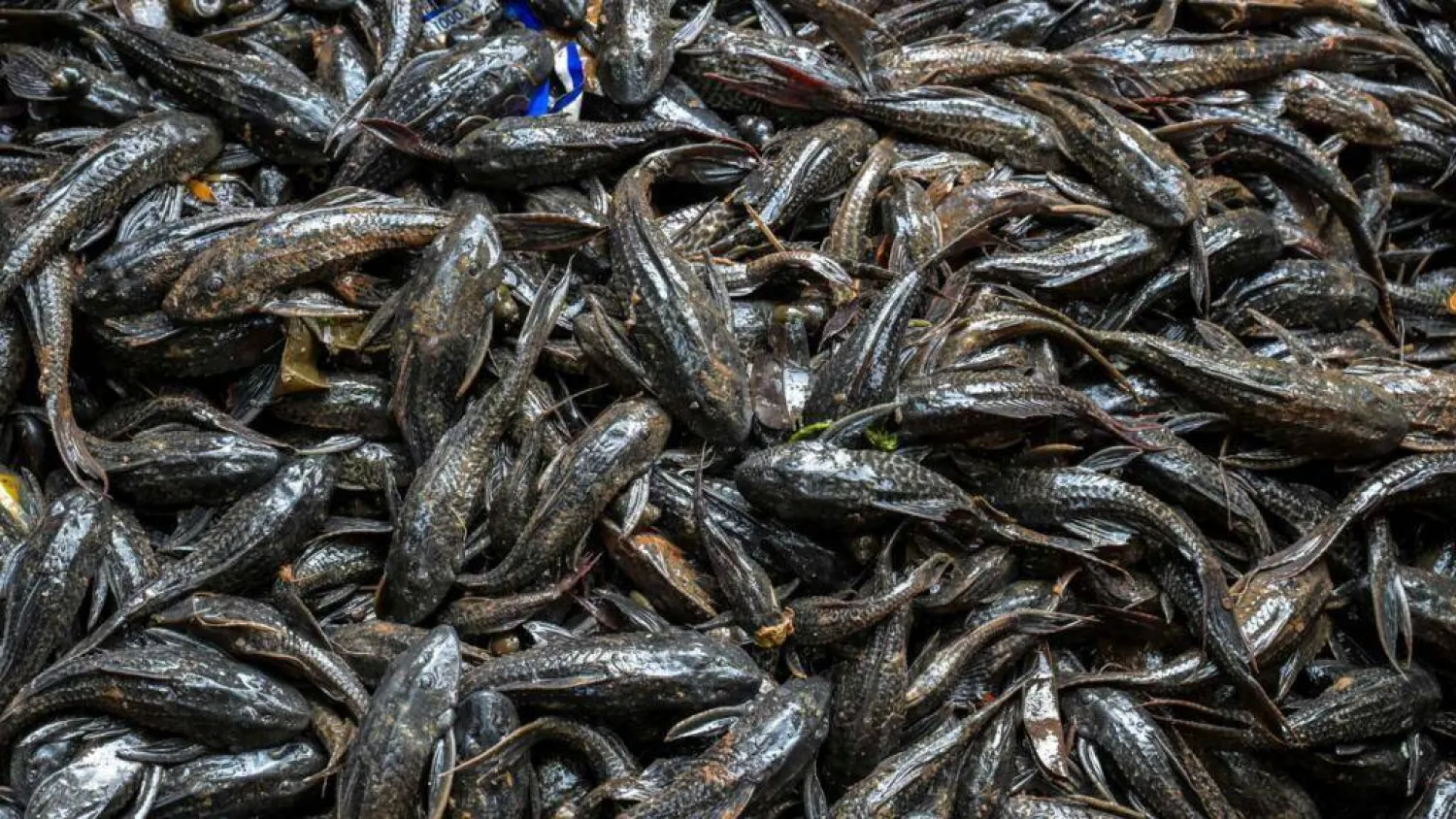

Troubled Waters: Jakarta Battles Deadly, Invasive Suckerfish

The sapu-sapu was introduced to Indonesia from South America, brought in to keep aquariums algae free but chucked into rivers as they outgrew their tanks. BAY ISMOYO / AFP
TT

Troubled Waters: Jakarta Battles Deadly, Invasive Suckerfish

The sapu-sapu was introduced to Indonesia from South America, brought in to keep aquariums algae free but chucked into rivers as they outgrew their tanks. BAY ISMOYO / AFP

Mounds of slimey carcasses pile up on a riverbank in Jakarta where authorities are fighting an uphill battle against a fast-breeding invasive fish flourishing in Java island's heavily polluted waterways.

The sapu-sapu, a sucking fish introduced from South America decades ago to keep Southeast Asian aquariums algae-free, has made a home in Javan rivers, many after being thrown out for outgrowing their tanks.

Unlike in the Amazon River where it has natural predators, the sapu-sapu quickly took over in Java, outbreeding indigenous freshwater fish, eating their eggs and outcompeting them for food.

Residents and campaigners have complained about the stinky, unsightly pileups of fishy remains, and the potential health risk for those who consume snacks made from polluted sapu-sapu stock.

Invasive species are spreading ever faster across the globe and cost well over $400 billion a year in damages and lost income, according to a 2023 United Nations assessment.

Surprisingly adept at living in polluted water, the sapu-sapu -- also known as suckermouth catfish, janitor fish or pleco -- can grow to half a meter (20 inches) in length and a female can lay thousands of eggs every year.

"That there are thousands of (sapu-sapu) fish in some of these river bodies, where, you know, the rivers are like dark black, almost smelling like rotten eggs... is completely crazy," clean river campaigner Gary Bencheghib told AFP.

Killing sapu-sapu is not addressing the real problem, he added in a phone interview, nearly halfway through a 1,200-kilometer (746-mile) run from Bali to Jakarta to raise money for river cleanups and having witnessed the crisis at several stops along the way.

The real solution is cleaning up "the waste it lives off... that you find in these polluted waters," said Bencheghib, co-founder of the Sungai Watch NGO.

- 'A dangerous snack' -

More than half of Indonesia's rivers are heavily polluted, and two of the country's major river systems are among the dirtiest in the world, according to data from the UN Environment Program.

Nationwide, only about 7.4 percent of municipal wastewater is safely collected and treated.

Greater Jakarta, a water-stressed metropolis of 42 million people, is particularly affected.

But sapu-sapu are able to live in oxygen-poor and polluted waters, digging holes into riverbanks to lay their eggs and weakening walls that have been known to collapse as a result.

In recent weeks, Jakarta has embarked on a killing campaign involving residents, sanitation workers, fisheries ministry workers and even soldiers.

In two weeks, about 5.3 tons of the fish have been removed from rivers in South Jakarta alone, mayor Muhammad Anwar told AFP while overseeing an operation at Babakan Lake this week.

The sapu-sapu are caught in nets, separated from indigenous fish that are thrown back, then decapitated to make sure they are dead, and buried in mass graves.

Some activists have criticized the procedure as wasteful, arguing the skin could be used for fish leather products and the rest processed into fertilizer or animal feed.

But others say the fish are too contaminated to be useful, and definitely not fit for human consumption.

"It contains... heavy metals and is dangerous to humans," Anwar said.

Tests conducted for scientific studies have found traces of lead and mercury as well as E.coli bacteria beyond safe levels in sapu-sapu.

"In some places, it is consumed as a dangerous snack called siomay (steamed fish dumpling) and pempek (fish cakes)," the mayor said.

"Please be careful when buying fish cakes. Don't be led by the (cheap) price."


Nobel Medicine Prize Goes to 3 Scientists for Research into Brain Activity

Nobel Medicine Prize Goes to 3 Scientists for Research into Brain Activity
TT

Nobel Medicine Prize Goes to 3 Scientists for Research into Brain Activity

Nobel Medicine Prize Goes to 3 Scientists for Research into Brain Activity

The Nobel Prize in medicine was awarded Monday to three scientists whose work led to a tool that uses light to help unravel how the brain works.

Karl Deisseroth, Peter Hegemann and Georg Nagel have carried out research into light-gated ion channels and optogenetics. The Nobel Assembly lauded their work and said their tool is now being used in laboratories around the world to reveal the brain’s mysteries.

Deisseroth, 54, is a Howard Hughes Medical Institute investigator and Stanford University professor in California. Hegemann, 71, is at Humboldt University in Berlin, and Nagel, 73, most recently worked at the University of Würzburg, also in Germany, the assembly said.

The work that won the 2026 Nobel Prize in medicine Optogenetics opened what the Nobel assembly called a new era in neuroscience following the discovery of a light-controlled switch to turn on and off nerve cells and circuits in the brain to better learn how it works. The research has started unraveling the pathways that lead to behavior and disease.

The breakthrough began when Hegemann explored how a single-celled type of green algae can swim toward light. He and Nagel discovered a particular protein that, when illuminated by blue light, opens a channel to create an electrical impulse. Putting that protein into other cells makes them light-sensitive.

Deisseroth then worked with the gene that controls that protein to create a light-controlled switch for nerve cells in the brains of living mice.

“People usually think about light as a way of collecting information to observe things,” he said. “But this is the opposite of that. This is using light to control things, to make things happen, and to do it in a very precise way.”

Deisseroth first developed tiny fibers to deliver light to cells modified with the light-sensitive gene and said there now are other techniques to switch on or off neurons being studied.

Optogenetics is mostly a research technique to learn how specific neurons and neural circuits work, which can then lead to development of treatments, including regimens for autism and schizophrenia that other scientists are pursuing, he said. A technique he called direct optogenetics is being used to test a treatment for a genetic form of vision loss called retinitis pigmentosa.

Why the research is important Brain cells communicate in milliseconds, and optogenetics for the first time offered scientists a way to control them at the same speed in a laboratory, said Patrick Forcelli, the chairman of the pharmacology and physiology department at Georgetown University, whose lab uses optogenetics.

Now a mainstay in neuroscience labs, the field has moved from using fixed maps of brain activity to building functional wiring diagrams. It has also jump-started additional techniques to explore neural complexity.

“It has let us go from a ‘Rand McNally’ road atlas of the brain to something more akin to ‘Google Earth,’” Forcelli said in an email.

The University of Pittsburgh’s Jeremy Berg was at the U.S. National Institutes of Health in the early 2000s when it awarded Deisseroth major funding for “this vision of optogenetics that was pretty much spot-on the way it played out.”

“It’s a very precise set of tools for doing experiments about how the brain works that are pretty hard to do any other way,” Berg said.

Abdel El Manira, a member of Nobel Assembly, said the impact of optogenetics goes beyond the understanding of a healthy brain.

“It has also helped reveal how specific brain circuits are disrupted, with implications for conditions such as blindness, depression, addiction and dementia," El Manira said. "Yet despite these extraordinary advances, the brain still holds countless mysteries, with much more left to learn and discover. And optogenetics has given us a powerful means to take on these challenges.”

Deisseroth had just gone to bed when he learned of the award Deisseroth, a self-described night owl, said he was up late in his Northern California home working on papers and emailing students. He had just gone to lie down when he got the call from the Nobel Assembly.

“No real sleep was achieved,” he told The Associated Press in a phone call an hour after the announcement.

He said the next task on his to-do list was to pack school lunches for his children, who were still sound asleep.

“That’s my one obligation I have in the next few hours, to make sure I make their sandwiches,” he said.

Thomas Perlmann, the secretary of the medicine committee, said he was able to reach all three winners Monday. The AP could not immediately reach Hegemann and Nagel.

Medicine prize kicks off Nobels week The prize was announced at the Karolinska Institute in Stockholm, kicking off Nobels week. The prize money this year is 12 million Swedish kronor (about $1.2 million), whether for an individual, small group of laureates or organization.

Last year, the prize went to three scientists researching the immune system.

Monday's medicine prize is followed by the physics prize on Tuesday, chemistry on Wednesday and literature on Thursday.

After Friday’s peace prize is awarded, the Nobel Memorial Prize in Economic Sciences will be announced on Oct. 12.


AI Camp Kicks Off in Madinah with 120 Participants

AI Camp kicks off in Madinah with 120 participants. (SPA)
TT

AI Camp Kicks Off in Madinah with 120 Participants

AI Camp kicks off in Madinah with 120 participants. (SPA)

The AI Camp kicked off at the Madinah Chamber of Commerce and Industry on Sunday as part of the MED AI Forum, bringing together 120 participants and nine speakers over five days, the Saudi Press Agency said on Monday.

The camp aims to develop innovative solutions to real-world challenges through three tracks: sports, agriculture, and tourism, enabling participants to progress from identifying challenges and generating ideas to building prototypes and preparing for the hackathon.


Tokyo Residents Fight for More Trees

This picture taken on August 25, 2026 shows a woman crossing with her bike on a street in Tokyo. (Photo by Philip FONG / AFP)
TT

Tokyo Residents Fight for More Trees

This picture taken on August 25, 2026 shows a woman crossing with her bike on a street in Tokyo. (Photo by Philip FONG / AFP)

One sweltering day in Tokyo, Kaoru Morimoto told friends she wasn't sure she could endure another summer in her neighborhood, where tree cover and the crucial shade it provides is dwindling.

As Japan experiences ever more frequent extreme heat, tree cover that can help lower temperatures is shrinking rather than growing in Tokyo, bucking a trend among many major world capitals.

Morimoto wants that to change. Last year she launched a campaign urging officials to set a canopy cover target, a rare grassroots initiative focused on the issue.

"Everyone says the summer has become more intense," but public awareness about Tokyo's lack of tree cover is low, Morimoto told AFP.

In this picture taken on August 25, 2026 activist Kaoru Morimoto looks on while checking the temperature in Nakano district of Tokyo. (Photo by Philip FONG / AFP)

Together with Susumu Nirasawa, a fellow resident in her western Tokyo neighborhood of Nakano, the 66-year-old organizes expert talks, shares temperature data on social media, and attends local council meetings where she petitions officials. Around 30 others in the community have joined the cause.

"We want the ward government to take the issue seriously," Nirasawa, 71, said.

Japan saw its hottest summer on record in 2025, with warmer days on the rise globally due to climate change.

This year, the country recorded almost 120 heat-related deaths between May and August, while more than 73,000 people needed emergency care.

Although experts say greater tree cover can help lower air temperatures, a University of Tokyo study in 2024 showed the city lost canopy cover equivalent to three and a half times the size of New York's Central Park in under a decade.

Thermometers and notebook in hand, Morimoto and Nirasawa take their own temperature readings in Nakano, hoping hard data will help unite their neighbors behind the cause.

We "measured the shade under trees with large canopies and under trees that had been more heavily pruned," said Morimoto. "There was about a three-degree difference."

In the 2024 study, University of Tokyo researcher and urban forestry expert Kinya Shiraishi found that canopy cover in central Tokyo fell to 7.3 percent in 2022 from 9.2 percent in 2013, a loss of 12 square kilometers.

By comparison, canopy cover in New York stands at around 23 percent, with the city aiming to raise it to 30 percent by 2040.

London aims for a 10 percent increase from its current 20 percent by 2050, while Paris also plans to boost coverage from about 18 percent.

"If we want to improve the quality of urban life, canopy cover is one of the key factors," Shiraishi told AFP, adding that trees also lower flooding risks and can help city dwellers feel calmer.

He said the decline was driven largely by the loss of private residential gardens, with ageing landowners selling their properties and mature trees often felled as large plots are subdivided to meet housing demand in the capital.

Many roads in Tokyo are also narrow and have little space for greenery, while authorities are wary of trees toppling over in extreme weather.

A Tokyo metropolitan government official told AFP that the city "is currently working to expand tree canopies through careful pruning, focusing on roads where the pavements are wide and the trees can grow".

Without proper management, trees threaten the visibility of traffic lights and are at risk of falling during typhoons, he said, adding that Tokyo uses a benchmark for measuring greenery which includes farmland and grassland found in its outer reaches.

But on a hot, sunny day in the city center, there was little shade along a street home to the finance ministry. One plane tree stood almost bare, its upper branches cut back close to the trunk.

"Unless we promptly make efforts to increase canopy cover and shift our policies, we'll run out of time," said Eijiro Fujii, professor emeritus at Chiba University who specializes in horticulture, glancing at a group of heavily pruned trees in Tokyo's central district of Kasumigaseki.

In this picture taken on August 25, 2026 Eijiro Fujii, professor emeritus at Chiba University, speaks during an interview with AFP in the Kasumigaseki neighbourhood, where most government ministries are located, in Tokyo. (Photo by Philip FONG / AFP)

Fujii blames overpruning, developed to manage trees in limited spaces, as well as the frequent rotation of public officials overseeing street greenery, for the decrease in canopy cover.

In Nakano, Morimoto and Nirasawa say the ward's mayor has recently begun to emphasize the importance of tree shade, but neighborhood officials have so far failed to set a target for canopy cover.

"Deaths from heat stroke are rapidly increasing in Japan," Fujii said. "We need to act before it's too late."