

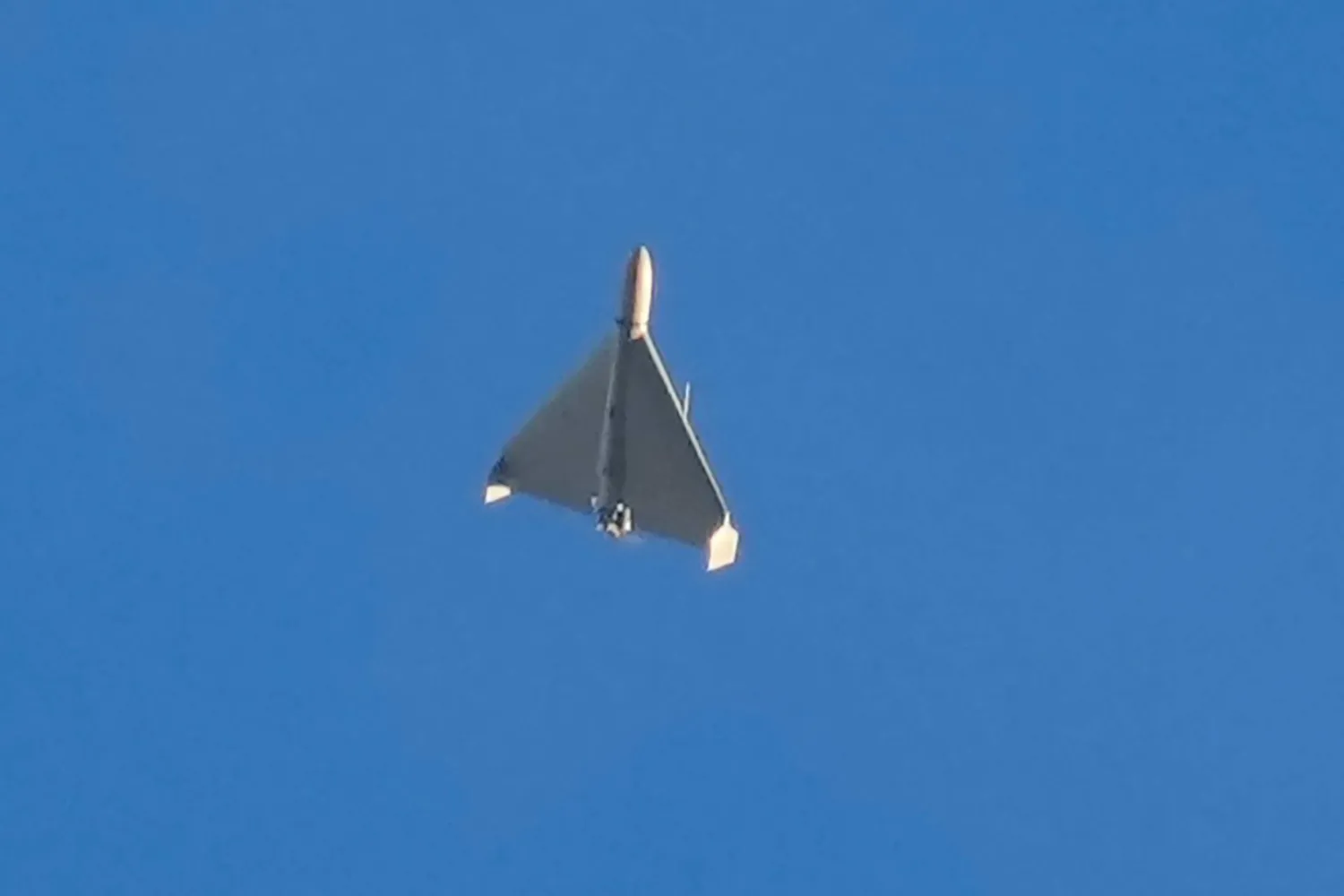

UAE Reports Drone and Missile Attack as Iran War Ceasefire is Challenged

FILE - An Iranian Shahed exploding drone. (AP Photo/Efrem Lukatsky, File)
TT

UAE Reports Drone and Missile Attack as Iran War Ceasefire is Challenged

FILE - An Iranian Shahed exploding drone. (AP Photo/Efrem Lukatsky, File)

The Iran war’s shaky ceasefire came under further strain on Friday as the United Arab Emirates' responded to a missile and drone attack hours after the US said it thwarted attacks on three Navy ships in the Strait of Hormuz and retaliated against Iranian military facilities.

The violence jeopardized the fragile truce between Iran and the US while the two sides considered a deal to end the fighting.

On Thursday, Tehran said it was examining the latest US proposals for ending the war.

Iranian Foreign Ministry spokesperson Esmail Baghaei said Iran was reviewing messages from Pakistan, which is mediating peace negotiations, but Iran “has not yet reached a conclusion, and no response has been given to the US side,” Iranian state TV reported.

The Trump administration has sent mixed messages on its strategy to end the war. The ceasefire and previous declarations that military operations were over have given way to new threats of bombing if Tehran does not accept a deal that allows for resumption of oil and natural gas shipments disrupted by the conflict.

Trump reiterated those threats after Thursday’s exchange of fire involving the US Navy.

“They have to understand: If it doesn’t get signed, they’re going to have a lot of pain,” he told reporters in Washington.

Asked how close the US was to a deal with Iran, Trump said: “It could happen any day,” but quickly added, “And it might not happen.”

The ceasefire between the US and Iran has largely held since April 8. In-person talks between the two countries, hosted by Pakistan last month, failed to reach an agreement to end the war that began Feb. 28 when the US and Israel launched strikes against Iran.

US military says it's not seeking escalation

The UAE's defense ministry advised residents not to approach, photograph or touch “any debris or fragments that have fallen as a result of successful air interceptions.”

Hours earlier, the US military said it had intercepted Iranian attacks on three Navy ships in the Strait of Hormuz Thursday night and “targeted Iranian military facilities responsible for attacking US forces.”

US Central Command said in a social media post that US forces intercepted “unprovoked Iranian attacks” and responded with self-defense strikes.

The US military said no ships were hit. It said it doesn’t seek escalation but “remains positioned and ready to protect American forces.”

President Donald Trump told reporters that the ceasefire was holding despite the violence.

Pakistani Foreign Minister Ishaq Dar spoke by phone Thursday with his Iranian counterpart, Abbas Araghchi, the Pakistani Foreign Ministry said.

“We expect an agreement sooner rather than later,” Pakistani Foreign Ministry spokesperson Tahir Andrabi said. “We hope the parties will reach a peaceful and sustainable solution that will contribute not only to peace in our region but to international peace as well.”

He declined to give a timeline.

Pakistani Prime Minister Shehbaz Sharif, speaking in televised remarks, said Islamabad remained in “continuous contact with Iran and the United States, day and night, to stop the war and extend the ceasefire.”

Meanwhile, direct talks between Israel and Lebanon were scheduled to resume next week in Washington, according to a US official who spoke on condition of anonymity to discuss plans for the closed-door meetings. The official said talks will be held May 14 and 15.

Iran creates agency to control passage at Hormuz

Earlier on Thursday, a shipping data company reported that Iran has created a government agency to vet and tax vessels seeking passage through the crucial strait.

The Iranian effort to formalize control over the channel raised new concerns about international shipping, with hundreds of commercial vessels bottled up in the Arabian Gulf and unable to reach the open sea. Still, hope that the two-month conflict could soon be over buoyed international markets.

The report by shipping data firm Lloyd’s List Intelligence that Iran has established a new government agency to approve transit and collect tolls from shipping in the strait raised concerns over the freedom of navigation on which global trade depends.

The agency, called the Arabian Gulf Strait Authority, is “positioning itself as the only valid authority to grant permission to ships transiting the strait,” Lloyd’s reported in an online briefing Thursday. Lloyd’s said the authority had emailed it an application form for ships seeking passage.

Iran has effectively closed the strait, a vital waterway for the shipment of oil, gas, fertilizer and other petroleum products, while the US is blockading Iranian ports. The disruptions have sent fuel prices skyrocketing and rattled the global economy.

The new Iranian agency formalizes a system Iran has used to let ships through the strait and charge tolls during the war. Iran aims to control which ships pass and, for at least some vessels, impose a tax on their cargo.

Maritime law experts say Iran’s demands to vet or tax vessels violate international law. The United Nations Convention on the Law of the Sea calls for countries to permit peaceful passage through their territorial waters.

The US is pushing for the UN Security Council to support a resolution that condemns Iran’s chokehold on the strait and threatens sanctions. A prior resolution calling for reopening the strait was vetoed by Iran's allies Russia and China.



Arab Parliament Speaker Stresses Need for Solidarity to Confront Regional Challenges

Arab Parliament Speaker Stresses Need for Solidarity to Confront Regional Challenges
TT

Arab Parliament Speaker Stresses Need for Solidarity to Confront Regional Challenges

Arab Parliament Speaker Stresses Need for Solidarity to Confront Regional Challenges

Speaker of the Arab Parliament Mohammed Al-Yamahi stressed the importance of solidarity, unity of ranks, positions, and voices, and strengthening consensus among Arab countries in addressing the growing challenges and risks facing the region, which require greater solidarity, cohesion, and joint Arab action now more than ever.

He made the remarks today during the preparatory committee meeting for the Eighth Conference of the Arab Parliament and Speakers of Arab Councils and Parliaments, which is being held in partnership with the Arab Inter-Parliamentary Union, SPA reported.

Al-Yamahi explained that this year's conference is being convened at a critical and exceptional stage for the Arab nation, requiring the highest levels of coordination, consultation, and unified positions on issues and challenges affecting the Arab world's present and future.

He noted that the conference will address several strategic issues, foremost among them the serious developments surrounding the Palestinian cause, the Arab world's primary concern.

It will also discuss recent highly dangerous security developments in the region and Iranian attacks against Arab states, as well as the topic of enhancing Arab digital sovereignty, which has emerged as a strategic issue driven by rapid digital transformation.

He said the issue calls for the development of a unified Arab parliamentary vision that protects Arab interests, strengthens digital security, and supports sustainable development efforts.


Saudi FM Holds Talks with Turkish, Kyrgyz Counterparts

Saudi Minister of Foreign Affairs Prince Faisal bin Farhan bin Abdullah chairs his delegation's a meeting of foreign ministers from Egypt, Saudi Arabia, Türkiye, and Pakistan, at Tahrir Palace in Cairo, Egypt, Sunday, June 21, 2026. (AP)
TT

Saudi FM Holds Talks with Turkish, Kyrgyz Counterparts

Saudi Minister of Foreign Affairs Prince Faisal bin Farhan bin Abdullah chairs his delegation's a meeting of foreign ministers from Egypt, Saudi Arabia, Türkiye, and Pakistan, at Tahrir Palace in Cairo, Egypt, Sunday, June 21, 2026. (AP)

Saudi Minister of Foreign Affairs Prince Faisal bin Farhan bin Abdullah received on Wednesday a telephone call today from his Turkish counterpart Hakan Fidan.

They discussed regional developments and issues of mutual interest.

Prince Faisal also held telephone talks with his Kyrgyz counterpart Zheenbek Kulubaev.

Pince Faisal congratulated him on the election of Kyrgyzstan as a non-permanent member of the United Nations Security Council for the 2027–2028 term, hoping it will contribute in supporting the council’s efforts to promote international peace and security.

They also reviewed bilateral relations and ways to strengthen them across various fields and discussed regional and international developments and efforts made in this regard.


Mohamed bin Zayed, Rubio Discuss Middle East Developments

United Arab Emirates President Sheikh Mohamed bin Zayed Al Nahyan and US Secretary of State Marco Rubio meet on Wednesday. (WAM)
TT

Mohamed bin Zayed, Rubio Discuss Middle East Developments

United Arab Emirates President Sheikh Mohamed bin Zayed Al Nahyan and US Secretary of State Marco Rubio meet on Wednesday. (WAM)

United Arab Emirates President Sheikh Mohamed bin Zayed Al Nahyan received in Abu Dhabi on Wednesday US Secretary of State Marco Rubio, who is visiting the UAE as part of a tour of the Middle East.

They reviewed strategic cooperation between the UAE and US and discussed ways to further strengthen coordination across various fields in support of shared interests, reported the UAE’s state news agency WAM.

The meeting addressed regional and international issues of mutual concern, with a focus on developments in the Middle East.

Sheikh Mohamed bin Zayed and Marco Rubio underscored the importance of advancing the foundations of security, stability, and lasting peace across the region.

The meeting was attended by Sheikh Khaled bin Mohamed bin Zayed Al Nahyan, Crown Prince of Abu Dhabi; Sheikh Tahnoon bin Zayed Al Nahyan, Deputy Ruler of Abu Dhabi and National Security Adviser; Sheikh Abdullah bin Zayed Al Nahyan, Deputy Prime Minister and Minister of Foreign Affairs; Sheikh Mohammed bin Hamad bin Tahnoun Al Nahyan, Adviser to the UAE President; and a number of officials.