

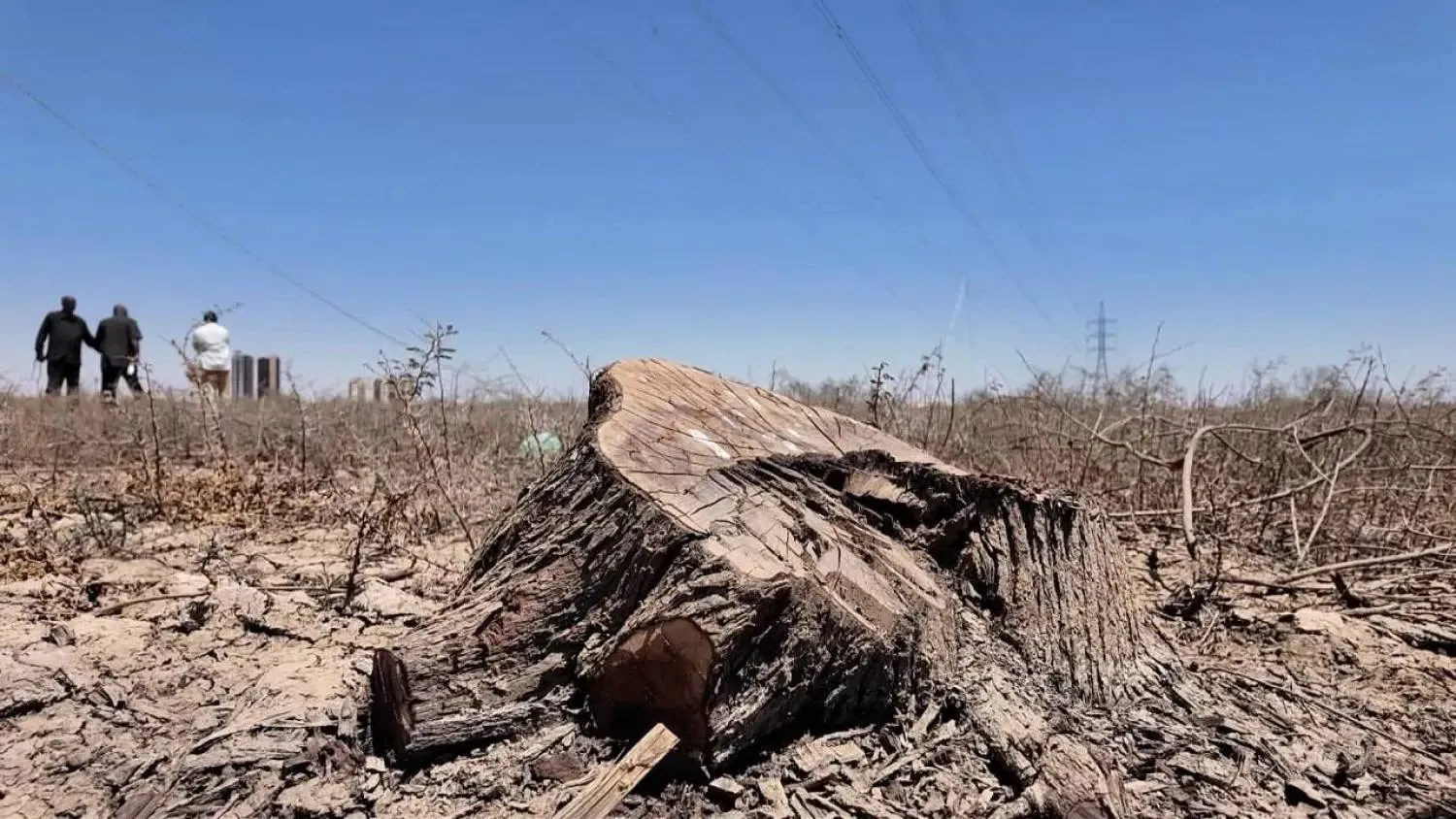

Sudan’s War Fuels Silent Disaster for Forests

Damage to Sudan’s forests caused by the war and indiscriminate tree cutting (Asharq Al-Awsat)
TT

Sudan’s War Fuels Silent Disaster for Forests

Damage to Sudan’s forests caused by the war and indiscriminate tree cutting (Asharq Al-Awsat)

As war tears through Sudan, the environment has been buried beneath the smoke of battle, mass displacement and hunger. Yet it is one of the sectors suffering the broadest and deepest losses.

Experts say what is unfolding in Sudan’s forests is no longer routine environmental degradation. It is a silent disaster threatening the country’s natural resources and climate balance, as the state’s ability to monitor and protect them weakens and living pressures grow.

The collapse of basic services, fuel shortages and soaring living costs have forced thousands of Sudanese families back to firewood and charcoal as alternative energy sources.

The result has been a surge in tree felling and the depletion of forest belts. Internal displacement has added to the pressure, with large numbers of people moving to safer areas and setting up temporary shelters in wooded zones, amid an almost total absence of environmental oversight and law enforcement.

A bitter reality

On the outskirts of Khartoum state, among acacia trees near the confluence of the two Niles, Aisha Abdullah collected firewood and described the choices now facing families.

“We used to rely on cooking gas, but the price of a cylinder has risen to about 90,000 Sudanese pounds, around $22.50, and we can no longer afford it,” she said. “We have no option left but firewood to cook food. We know that cutting trees harms the environment, but how can a family live without food?”

In Gezira state, Salah al-Tayeb said economic hardship has pushed many people toward the forests.

“The price of a sack of charcoal has reached about 105,000 Sudanese pounds, around $26.25, which is beyond the means of most families,” he said. “That is why firewood has become the only available option for many people to meet their daily needs.”

Saadia Abdullah, a tea seller on Nile Street in Omdurman, said the war has upended her work as fuel prices climbed and incomes fell.

“I used to use gas and charcoal in my work normally, but prices have become beyond our capacity,” she said. “Today I rely on firewood so I can prepare tea and continue working under these difficult conditions.”

Accelerating environmental damage

Moussa Suleiman Moussa, director general of the National Forestry Corporation, said forests have become an emergency energy source during the war because of power cuts and shortages of cooking gas.

Official data show about 60% of acacia forests in Gezira state have deteriorated, along with 45% in Sennar state. Other states have been affected to varying degrees.

In remarks to Asharq Al-Awsat, Moussa said Sudan’s forest area is estimated at about 30 million feddans after South Sudan’s secession in 2011, equal to around 12.5% of the country’s area. Plans had aimed to raise that figure to 25% , but the war halted that path and accelerated the depletion.

Bishra Hamed, former head of the Higher Council for Environment and Natural Resources in Khartoum state, said Sudan’s environmental resources are facing a “wide and multifaceted assault” as the effects of war intersect with economic, social and security crises.

He said the weakened role of the state and declining law enforcement have allowed the firewood, charcoal and timber trade to expand. Modern methods are being used to cut trees and move them quickly through networks operating inside and outside the country.

“Between 70% and 80% of the population depends directly on natural resources for their livelihoods, whether through farming, herding or firewood production. This makes environmental degradation a direct threat to economic and social stability in a country already suffering from structural fragility,” he said.

Hamed also warned that unregulated mining inside forests and natural reserves is deepening the crisis by stripping more vegetation and polluting soil and water, creating complex environmental challenges that will be hard to contain in the near term.

Environmental expert Awad Mohammed Siddig said the damage goes beyond temporary resource consumption. It amounts to the rapid dismantling of an entire ecosystem.

He said the loss of vegetation strips soil of its ability to retain moisture and allows desertification to spread in already fragile areas, while habitats disappear and biodiversity declines.

In remarks to Asharq Al-Awsat, Siddig said rural communities are paying the price directly through falling agricultural production, weaker protection from advancing sand and disruption to the water cycle.

Climate and environmental expert Noureldin Ahmed said forests are among Sudan’s most important natural resources because they help moderate the climate, protect soil and provide food and shelter for millions of living organisms.

He said wide areas have become barren after once serving as a natural lung that supplied oxygen and reduced the effects of desertification and climate change. He warned that the continued deterioration of vegetation cover threatens to multiply Sudan’s climate and humanitarian crises.

Mounting economic losses

Forestry expert Talaat Dafallah said the loss of dense vegetation contributes to rising temperatures and weakens the local environment’s ability to absorb carbon emissions.

He said the damage is also draining vital resources such as timber and gum arabic, with annual losses in the forestry sector estimated at about $500 million because of illegal tree cutting.

In remarks to Asharq Al-Awsat, Dafallah said the immediate priority is to reduce household dependence on firewood by providing cooking gas where possible, expanding the use of improved stoves and supporting solar energy in neighborhoods and displacement centers.

The damage has not stopped at the natural environment. It has reached key economic sectors. In Kordofan, one of the world’s most important gum arabic producing regions, production chains have been badly hit, affecting millions of people who depend on the sector as a main source of income.

With the war dragging on and state institutions retreating, Sudan’s environment is facing a real existential challenge. Depletion is accelerating without protection or recovery plans, while environmental, economic and humanitarian losses deepen day by day, raising the prospect of long-term consequences that could affect generations to come.



Beirut Transfers 128 Syrian Convicts Home

Lebanese army soldiers secure the area at the entrance of Zawtar al-Gharbiyah village, southern Lebanon, 23 June 2026, amid a ceasefire between Israel and Hezbollah. EPA/WAEL HAMZEH
TT

Beirut Transfers 128 Syrian Convicts Home

Lebanese army soldiers secure the area at the entrance of Zawtar al-Gharbiyah village, southern Lebanon, 23 June 2026, amid a ceasefire between Israel and Hezbollah. EPA/WAEL HAMZEH

Lebanon has transferred 128 Syrian convicts to their home country, a Lebanese security source told AFP on Wednesday, the second batch of handovers under an agreement the two sides signed earlier this year.

Overcrowded Lebanese prisons host around 2,000 Syrian nationals held on various charges.

Many are still awaiting trial, while hundreds have been brought before military courts on charges of "terrorism" or related offences, including attacks on Lebanese forces.

Others are in custody for alleged membership in militant or armed groups that were opposed to now-ousted Syrian president Bashar al-Assad, who was supported by Lebanon's Hezbollah during the Syrian civil war.

The security source, who requested anonymity, said that Beirut "handed over the second batch of Syrian convicts in Lebanon to Damascus, numbering 128 convicts" on Wednesday.

The transfer follows the handover of more than 130 Syrian detainees in March, under an agreement signed between the two countries the previous month, which will cover almost 300 convicts who have served 10 years or more in Lebanese prisons.

Under the agreement, they will be required to complete the remainder of their sentences in Syria.

At least 260 convicts have now been sent to Syria's Adra prison out of 356 in Lebanon's Roumieh, the source added.

The issue of the detainees had been a sticking point in Beirut-Damascus relations following Assad's overthrow in December 2024.

It was discussed by Lebanese Prime Minister Nawaf Salam during his visit to Damascus in May, where he met Syrian President Ahmed al-Sharaa.

Over the past year, both sides have repeatedly expressed their determination to open a new chapter in their relations.


Syrian Troop Killings Expose Repeated Attacks, Security Lapses

Syrian army personnel on a military vehicle in Deir Hafer, rural Aleppo, in January 2026. (Reuters)
TT

Syrian Troop Killings Expose Repeated Attacks, Security Lapses

Syrian army personnel on a military vehicle in Deir Hafer, rural Aleppo, in January 2026. (Reuters)

The recent killing of two Syrian army members near Manbij, east of Aleppo, was not an isolated attack. It was part of a recurring pattern of strikes on government forces, exposing serious administrative and security gaps that groups opposed to Syria’s new administration are using to target its personnel.

Syria’s Ministry of Defense media and communications department said on June 20 that two soldiers from the 76th Division were killed after unknown gunmen attacked them near Manbij.

The soldiers were riding a motorcycle on a road near the city when they came under direct fire.

Since the fall of the Assad regime, Asharq Al-Awsat has tracked many similar attacks on Syrian security and army personnel. Most have occurred as members were heading to or leaving their posts, often on motorcycles or via irregular transport.

Many see the pattern as evidence of weak protection measures and poor organization of personnel rotations.

Rural Aleppo has witnessed several assassinations this year. Among the most prominent were the killing of two Syrian army members in March and another member of the Interior Ministry in April near the town of al-Rai.

Similar incidents have also been reported across most Syrian provinces, including Daraa, Latakia, rural Hama and Homs.

Embarrassing the Syrian state

Demands have grown for personnel to avoid moving alone, wearing military uniforms or using motorcycles in remote areas where the risk is high and support is hard to reach.

Major Khaled al-Abdullah, director of the Syrian interior minister’s office, said the defense and interior ministries had repeatedly issued circulars banning personnel from wearing official uniforms outside working hours and requiring them to follow safety measures suited to Syria’s current conditions.

He said the immediate aim of attacks by groups opposed to the new administration, including Islamic State and remnants of the ousted regime, was to “try to embarrass the Syrian state.”

Abdullah stressed that authorities were working hard to impose security, eliminate armed groups and organizations, and had made significant progress on what he called a difficult path.

But in remarks to Asharq Al-Awsat, he also pointed to “continued internal and external challenges that the Syrian state is working to overcome and whose danger it seeks to end.”

Manbij, the most dangerous route

Abu Mohammed al-Hussein, who oversees a cluster of checkpoints in eastern rural Aleppo, said the movement of personnel had become a problem. He said he had repeatedly asked for buses to transport rotating shift members, especially in rural areas far from the city center.

Hussein said one member of his checkpoint group survived an assassination attempt on the Manbij-al-Bab road in eastern rural Aleppo at the end of March. The incident pushed him to issue special orders regulating how his personnel move.

“A civilian car offered to take one of my men to Aleppo city,” he said. “After they had driven several miles, they claimed there was an emergency and said they had to return. As soon as he got out, the driver’s companion fired several shots at him with a pistol. Two hit his magazine pouch and one pierced his foot. He survived by a miracle.”

He said shift rotations are “decided centrally by sector commanders” and are often carried out at night because service areas are far from where personnel live. He said a ban on carrying weapons and moving through residential areas had also made personnel easier targets.

“With repeated assassination attempts, I issued a decision banning nighttime shift rotations, prohibiting movement in civilian cars or on motorcycles, which have also become easy targets, and limiting transport to road security vehicles,” he added.

Hussein said they were still waiting for approval of a request to allocate a bus to transport security and military checkpoint personnel deployed along the Aleppo-Manbij road.

He described it as “one of the most dangerous land routes,” linking Aleppo to outlying areas and Raqqa province, and passing through an area that remained for years under the control of the ousted regime and the Syrian Democratic Forces.

Ban on keeping weapons

Haider al-Mohammed, a special tasks member, disagreed. He said “transport buses are, in practice, the easy target” and are often attacked, meaning the problem of securing personnel goes beyond transport.

He said decisions that stripped personnel of the means to protect their safety and identity were the direct reason behind the rise in assassinations, alongside the exceptional conditions in the country and the process of “clearing out groups that believe they can create chaos and fear.”

He said among the most important of these decisions were “the ban on wearing face coverings, the ban on keeping registered weapons, and the strict instruction not to carry personal weapons, along with leniency over wearing official uniforms.”

As a result, he said, personnel are exposed, easy targets for these groups, and left without weapons to defend themselves.

On this point, Major Khaled al-Abdullah said Syria’s security and military institutions were working to “implement solutions to facilitate and reduce regular movement in a way that helps end the threat and strengthen the safety of their personnel.”

He said the pattern of attacks “confirms their randomness.” The failure to select specific targets or have prior knowledge of the personnel being targeted, he said, was “an attempt to create chaos and confuse the Syrian state.”


Arab Parliament Speaker Stresses Need for Solidarity to Confront Regional Challenges

Arab Parliament Speaker Stresses Need for Solidarity to Confront Regional Challenges
TT

Arab Parliament Speaker Stresses Need for Solidarity to Confront Regional Challenges

Arab Parliament Speaker Stresses Need for Solidarity to Confront Regional Challenges

Speaker of the Arab Parliament Mohammed Al-Yamahi stressed the importance of solidarity, unity of ranks, positions, and voices, and strengthening consensus among Arab countries in addressing the growing challenges and risks facing the region, which require greater solidarity, cohesion, and joint Arab action now more than ever.

He made the remarks today during the preparatory committee meeting for the Eighth Conference of the Arab Parliament and Speakers of Arab Councils and Parliaments, which is being held in partnership with the Arab Inter-Parliamentary Union, SPA reported.

Al-Yamahi explained that this year's conference is being convened at a critical and exceptional stage for the Arab nation, requiring the highest levels of coordination, consultation, and unified positions on issues and challenges affecting the Arab world's present and future.

He noted that the conference will address several strategic issues, foremost among them the serious developments surrounding the Palestinian cause, the Arab world's primary concern.

It will also discuss recent highly dangerous security developments in the region and Iranian attacks against Arab states, as well as the topic of enhancing Arab digital sovereignty, which has emerged as a strategic issue driven by rapid digital transformation.

He said the issue calls for the development of a unified Arab parliamentary vision that protects Arab interests, strengthens digital security, and supports sustainable development efforts.