


'Ghost of the Forest' Returns to Kenya as Conservationists Reintroduce Rare Antelope into the Wild

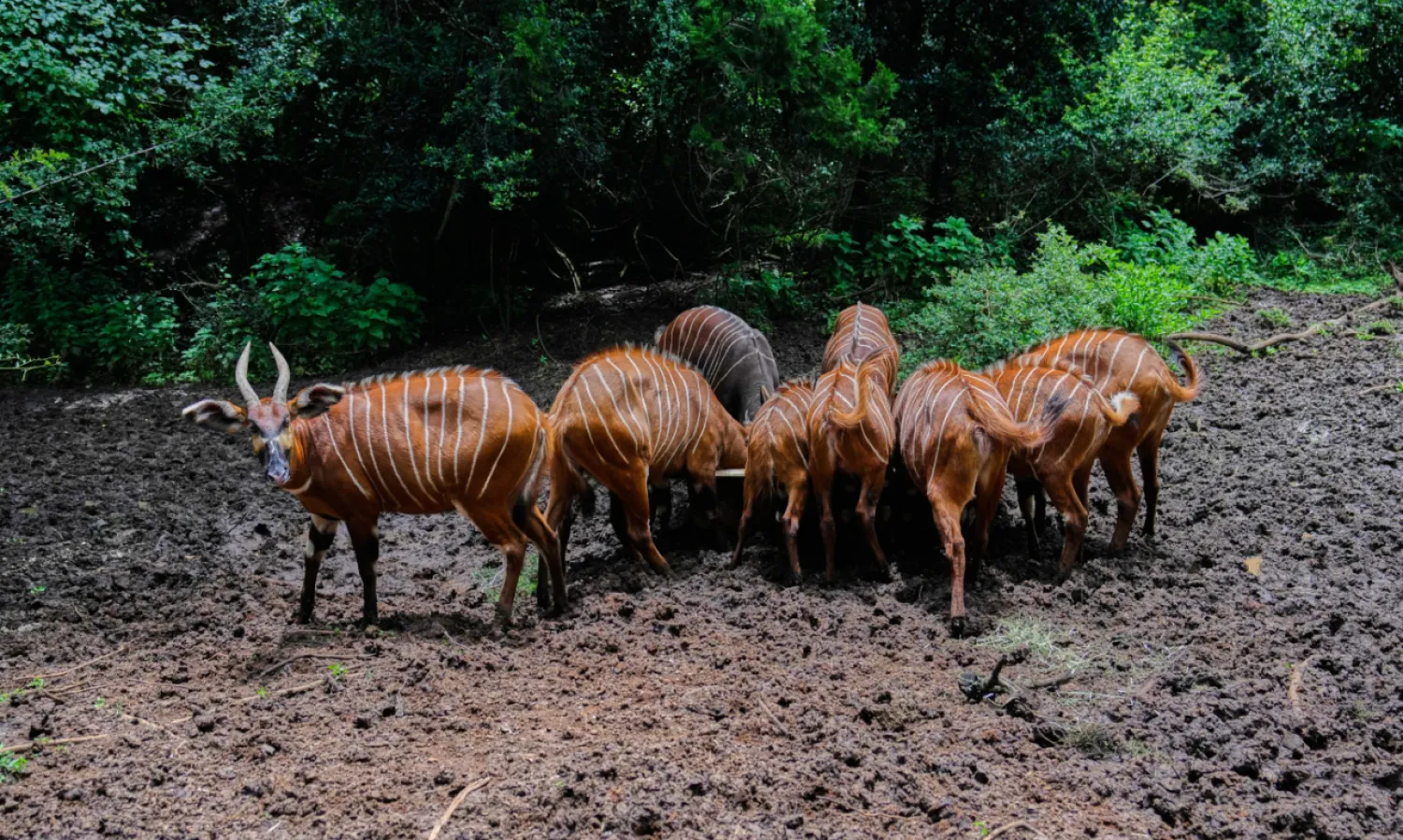
Critically endangered mountain bongos feed in a forest enclosure at the Mount Kenya Wildlife Conservancy in Nanyuki, Laikipia County, Kenya, Saturday, May 9, 2026. (AP Photo/Brian Inganga)
TT

'Ghost of the Forest' Returns to Kenya as Conservationists Reintroduce Rare Antelope into the Wild

Critically endangered mountain bongos feed in a forest enclosure at the Mount Kenya Wildlife Conservancy in Nanyuki, Laikipia County, Kenya, Saturday, May 9, 2026. (AP Photo/Brian Inganga)

The mountain bongo has become the ghost of the forest, hard to spot amid the dense shrubs due to its ability to camouflage.

A critically endangered species, the animal is being slowly reintroduced into the wild by conservationists to increase the number of the rare antelope that are indigenous to Kenya’s forests.

The mountain bongo is a rare antelope known for its brown skin and distinct white stripes. With fewer than 100 individuals left in the wild, a conservancy based in Kenya is breeding them and slowly reintroducing them into the wild, with a target of 750 wild bongos by 2050, The AP news reported.

Located on the misty slopes of Kenya’s highest mountain, Mount Kenya, and on the edge of the forest, the 1,250-acre Mount Kenya Wildlife Conservancy in the Nanyuki area has been restoring the survival instincts of zoo-bred bongos. They want to ensure the animals can feed without human assistance, escape from predators, and build a strong immunity against diseases in the wild.

Last week, the conservancy imported a new batch of four male bongos from the European Association of Zoos and Aquaria though the Czech Republic. These new arrivals, currently quarantined and under constant observation, will interbreed with descendants of 18 bongos that arrived at the conservancy in 2004 from the United States to ensure a more diverse genetic pool.

The conservancy’s head, Dr. Robert Aruho, says inbreeding among bongos with similar genes is discouraged while rebuilding the population of this critically endangered species.

“We want bongos that are not only strong in body, but strong in the genes they pass to the next generation,” he said.

Bongos are native to Kenya’s Mount Kenya, Aberdare, Eburu and Mau forests, which play a key role in protecting the forests that are vital to the country’s water supply.

The last wild bongo was spotted in the Mount Kenya forest in 1994 before the conservancy reintroduced the first 10 bongos to the wild in 2022. Today, they roam among the orange climber vines and shrubs that form part of their favorite plants.

The bongo population dwindled after thousands of them died in disease outbreaks in the 1960s. In the 1980s, conservationist Don Hunt exported 36 of the species to the U.S. as insurance to be bred in captivity, with a plan to return them to the wild when conditions improved.

When the Mount Kenya Wildlife Conservancy was opened in 2004, 18 descendants of these bongos were imported and have since interbred, bringing the conservancy’s population to 102 bongos.

Caroline Makena, 33, grew up in the Mount Kenya region and remembers hearing stories about bongos from her grandmother, who said they were her community’s favorite bush meat. However, Makena never got to see one until she came to work as a gardener at the conservancy.

“I never knew the bongos were this beautiful, and I think my community loved them not just for the meat but because of their beauty,” she said.

The bongos are shy and can camouflage despite their distinct white stripes, and these attributes are critical for their survival in the wild.

Andrew Mulani, the bongo program assistant at the conservancy, said the bongos are monitored for months before being reintroduced into the wild to ensure that the shyest ones are selected because docile animals would fall easily to predators.

His most fulfilling moment was when the fourth calf was born in the wild last year, an indication that the bongos are thriving in their native habitat and that their population will certainly increase.

Bongos have a gestation period of nine months, a factor that has negatively impacted their slow population growth. They are also sensitive and react to some plants and weather conditions compared to other species in the antelope family that thrive in the same ecosystem.

As the team of conservationists in Mount Kenya races to save the critically endangered species, supplementing the bongos’ shrub diet with special nutritious pellets, thousands of tourists who visit the conservancy annually marvel at their spiraled horns, hoping the ghost of the forest will become a more common sight in Kenya’s forests.



‘Fingerprints’ of Black Hole’s Event Horizon Detected for First Time

An actual image of the black hole where scientists looked for a ring of light, which is matter and radiation circling at extreme speeds around a region of darkness representing the black hole. (Event Horizon Telescope collaboration)
TT

‘Fingerprints’ of Black Hole’s Event Horizon Detected for First Time

An actual image of the black hole where scientists looked for a ring of light, which is matter and radiation circling at extreme speeds around a region of darkness representing the black hole. (Event Horizon Telescope collaboration)

Scientists have detected the "fingerprints" of a black hole's event horizon -- the boundary from which nothing can escape -- for the first time, according to research published on Wednesday.

The discovery was made by studying ripples in space-time called gravitational waves that were created when two black holes violently smashed into each other.

A black hole's event horizon is known as the "point of no return" because not even light can avoid being swallowed into its darkness.

This has made them incredibly difficult to learn anything about.

However, there is one event of such cataclysmic violence that it could offer a chance to glimpse this extreme phenomenon -- when two black holes merge into one.

When this cosmic death spiral occurs, it shoots gravitational waves across the universe which scientists have been detecting for the last decade.

For the new research published in Nature, an international team of researchers analyzed data from the strongest gravitational wave ever recorded, known as GW250114, detected by the LIGO observatory in January 2025.

By isolating the last burst of waves -- known as "direct waves" -- from this black hole merger, the scientists said they were able to extract information from closer to an event horizon than ever before.

"This black hole horizon concept normally appears in science fiction," lead study author Sizheng Ma of the Perimeter Institute for Theoretical Physics in Canada told AFP.

"But now we are really able to touch the region around the horizon with gravitational data," he added.

"Sometimes I cannot believe this is really happening."

- Causing a stir -

The last stage of two black holes merging is like a spoon stirring a glass of water, Sizheng Ma explained.

The resulting swirl in space creates the ripple of gravitational waves that travel at the speed of light in all directions.

If the metaphorical spoon is stirring close enough to the black hole's event horizon, "this offers us a chance to decode the physics around that region", Sizheng Ma said.

By supporting the theory of general relativity, the results "proved that Einstein was correct again," he added.

The scientists emphasized that more research was needed to decipher what can be gleaned about event horizons using this method.

But they did detect information about how black holes twist space around themselves as they rotate -- a phenomenon known as "frame dragging".

"This is similar to pushing a glass into a table and twisting it, so that the tablecloth winds up around it," Maximiliano Isi, a gravitational wave astrophysicist at Columbia University, told AFP.

In the future, the team of scientists hope to find signs of tiny changes known as quantum fluctuation.

"In this way, we can really probe this near horizon region to look for a new physics," including searching for a deviation from general relativity, Sizheng Ma said.

- Reaction mixed -

Experts not involved in the study urged caution.

Francesco Sannino, an Italian theoretical physicist who studies black holes, told AFP it was "compelling analysis" but needed to be checked by other researchers.

Still, it was "striking" that the scientists were able to show that gravitational waves carried the event horizon's "fingerprints," he said.

The astrophysicist Isi described the work as "tantalizing".

"More generally, understanding the physics of black holes and their mergers is important as it might shed light on how space and time are woven together at a more fundamental level," he told AFP.

Sean McWilliams, an astrophysicist at West Virginia University, was skeptical that the gravitational wave frequency analyzed by the scientists was actually "dictated" by the event horizon.

For this reason, "the actual observed signal doesn't really tell us anything about the horizon or the other properties directly related to it", he told AFP.

Sizheng Ma said McWilliams's statement was "not correct," suggesting he had conflated two different aspects in the paper.

"There is often considerable resistance and criticism in the early stages of promoting a new concept," he said, adding he is working on another paper to "clarify these confusions and possible misinterpretations".


Asteroid Zooming Past Earth on Saturday Visible to Stargazers

FILE PHOTO: A nighttime view of Earth, derived from satellite images taken daily over the past decade, capturing human activity on the planet through the emissions of artificial light, is seen in this image released on April 8, 2026. Michala Garrison/NASA Earth Observatory/Handout via REUTERS
TT

Asteroid Zooming Past Earth on Saturday Visible to Stargazers

FILE PHOTO: A nighttime view of Earth, derived from satellite images taken daily over the past decade, capturing human activity on the planet through the emissions of artificial light, is seen in this image released on April 8, 2026. Michala Garrison/NASA Earth Observatory/Handout via REUTERS

A large asteroid that will zoom harmlessly past Earth on Saturday will be visible to stargazers using a small telescope or large binoculars, the European Space Agency announced Wednesday.

The asteroid will come within 2,560,000 kilometers of Earth at 1114 GMT on Saturday, which is more than six times the distance between the Earth and the Moon.

Called (152637) 1997 NC1, the asteroid will be speeding along at nearly nine kilometers a second, posing no threat to Earth as any chance of an impact has been ruled out.

Discovered in 1997, the asteroid is estimated to be between 750 and 1,650 meters wide, according to calculations based on how much sunlight it reflects.

However other estimates suggest it could be smaller, AFP quoted the ESA as saying in a statement.

"A close approach to Earth by an object this size only occurs every few years, although this time the bright nearby Moon might impede its observability at closest approach," Juan Luis Cano of the ESA's Planetary Defense Office said in a statement.

For stargazers with telescopes or binoculars, the asteroid will be visible in parts of the Northern Hemisphere as it approaches, almost everywhere as it speeds past Earth, and only from the Southern Hemisphere as it departs.

But this depends if people are in areas of the world where the sky is dark enough as it passes.


Think Tank: Singapore, Indonesia, Malaysia and Brunei Face High Risk of Severe Haze this Year

People stop by a cafe with murals painted on its facade in the Arab Street district of Singapore on June 16, 2026. (Photo by Roslan RAHMAN / AFP)
TT

Think Tank: Singapore, Indonesia, Malaysia and Brunei Face High Risk of Severe Haze this Year

People stop by a cafe with murals painted on its facade in the Arab Street district of Singapore on June 16, 2026. (Photo by Roslan RAHMAN / AFP)

Singapore, Indonesia, Malaysia and Brunei face a high risk of severe haze this year due to hot and dry weather conditions, biofuel demand and economic pressures, a research institute said Wednesday.

The Singapore Institute of International Affairs said it was the second time it had issued a red risk rating since launching its Haze Outlook report in 2019. The previous red risk rating was in ⁠2023, Reuters reported.

Here are some ⁠details:

August to September is the peak danger period for haze in the Southeast Asian region, driven by the El Niño and Indian Ocean Dipole weather phenomena, the report said.

The ⁠return of El Niño is expected to create a longer and stronger dry season at a time when fire preparedness could be adversely affected by economic uncertainty and cost pressures.

The SIIA said rising costs of fertilizer and fuel as a result of the Iran war could lead to unsustainable activity such as the use ⁠of ⁠fire rather than machinery to clear land and dispose of waste.

Land use could also intensify as demand for biofuels rises due to energy supply disruptions.

"This trend will continue even if the US-Iran agreement holds, as countries now want energy independence," said SIIA associate director Khor Yu-Leng.

ASEAN cooperation and sustainable land management will be critical to reducing risks, the report said.