


Report: Iran Supreme Leader Healing from Serious Injuries

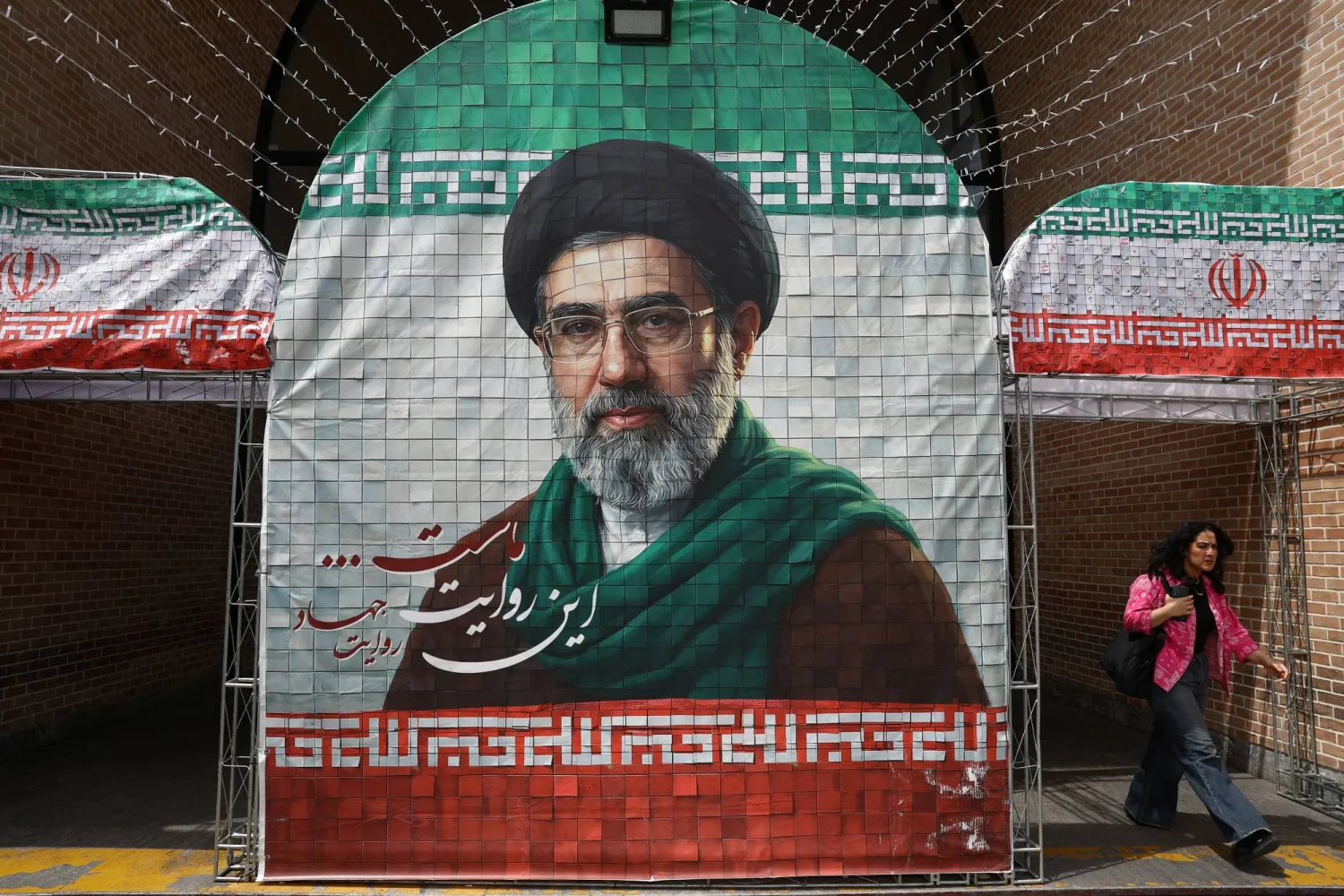
A woman walks next to a banner with a picture of Iran's new Supreme Leader Mojtaba Khamenei in Tehran, Iran, May 8, 2026. Majid Asgaripour/WANA (West Asia News Agency) via Reuters
TT

Report: Iran Supreme Leader Healing from Serious Injuries

A woman walks next to a banner with a picture of Iran's new Supreme Leader Mojtaba Khamenei in Tehran, Iran, May 8, 2026. Majid Asgaripour/WANA (West Asia News Agency) via Reuters

US intelligence assesses that Iran’s new supreme leader is playing a critical role in shaping war strategy alongside senior Iranian officials, according to multiple sources familiar with the intelligence, reported CNN on Saturday.

The reports found that “precise authority within a now-fractured regime remains unclear, but that Mojtaba Khamenei is likely helping direct how Iran is managing negotiations with the US to end the war.”

Khamenei has not been seen in public since he sustained serious injuries during an attack that killed his father and several of the country’s top military leaders at the beginning of the war, leading to speculation about his health and role in the Iranian leadership structure.

The Trump administration continues to pursue a diplomatic end to the conflict as a ceasefire stretches past a month with US intelligence assessing that Iran continues to dig out from the US bombing campaign that left significant Iranian military capabilities intact and the ability to survive months more of an American blockade, according to sources.

Khamenei was announced as Iran’s new supreme leader replacing his father days after the strike that injured him, but to date the US intelligence community has not been able to visually confirm his whereabouts, the sources said.

“Part of the uncertainty stems from Khamenei not using any electronics to communicate, instead only interacting with those who can visit him in-person or by sending messages via a courier,” one of the sources added.

“Khamenei remains isolated as he continues to receive medical treatment for his injuries, including bad burns on one side of his body impacting his face, arm, torso, leg,” the sources added, according to CNN.

Mazaher Hosseini, head of protocol in the office of Iran’s supreme leader, on Friday said Khamenei is healing from his injuries and “is now in complete health.” Hosseini said Khamenei’s foot and lower back were slightly injured and that “a small piece of shrapnel had hit him behind the ear,” but that the wounds are healing.

Iran’s president, Masoud Pezeshkian, told Iranian state media earlier this week that he had held a two-and-a-half-hour meeting with Khamenei, marking the first reported in-person meeting between a top Iranian official and the country’s new supreme leader.

What US officials do know about Khamenei’s status is based on information picked up from those who are communicating with him, the sources familiar told CNN. “There is, however, some question among intelligence analysts as to whether some in Iran’s power structure might be claiming access to Khamenei to coopt his authority to push their own agendas.”

The war has degraded Iran’s military capabilities, but not destroyed them, according to US intelligence reports. CNN previously reported that US intelligence assessed that roughly half of Iran’s missile launchers had survived US strikes. A recent report increased that figure to two thirds partially due to the ongoing ceasefire providing Iran with time to dig out launchers that might have been buried in previous strikes, according to sources familiar with the intelligence.

A separate CIA report found that Iran can likely last up to four more months of the ongoing American blockade without complete destabilization of its economy, the sources said.

While US intelligence assessments indicate that Khamenei is involved in helping develop Iran’s negotiating strategy for a diplomatic end to the war, one source familiar with the latest information told CNN there is evidence he is fairly removed from the decision-making process and only sporadically accessible.

As a result, senior Iranian Revolutionary Guard Corps officials are essentially running the day-to-day operations along with Iranian Parliament Speaker Mohammad Bagher Ghalibaf, the source added. “There is no indication he is actually giving orders on any ongoing basis but nothing proving he is not,” a second source familiar with the US intelligence assessments said, referring to Khamenei.



Indonesia Searches for 129 People Missing After Ferry Capsizes in the Java Sea

Rescue personnel stretcher out a body bag containing a deceased victim of the Virgo Transport 8 passenger ferry, which capsized September 13 while en route from Banjarmasin to Surabaya, at the port in Banjarmasin, South Kalimantan, on September 14, 2026. (AFP)
TT

Indonesia Searches for 129 People Missing After Ferry Capsizes in the Java Sea

Rescue personnel stretcher out a body bag containing a deceased victim of the Virgo Transport 8 passenger ferry, which capsized September 13 while en route from Banjarmasin to Surabaya, at the port in Banjarmasin, South Kalimantan, on September 14, 2026. (AFP)

Indonesian authorities intensified a search Monday for 129 people who were missing after a ferry overturned in bad weather in the Java Sea on Sunday, killing at least six passengers.

The Virgo Transport 8 was carrying more than 240 people when its captain issued a distress call, saying the ship was listing in rough seas with waves of up to 3 meters (10 feet) while traveling from Surabaya in East Java province to Banjarmasin in South Kalimantan province, on Borneo Island.

Contact was lost with the ferry at about 2 a.m. Sunday and about two hours later authorities received information that the vessel had overturned in the Java Sea’s Masalembo waters, about 148 kilometers (92 miles) from Banjarmasin.

Videos released by the National Search and Rescue Agency on Sunday showed an overturned ferry floating in choppy waters during a helicopter search operation.

On Monday, 17 ships and aircraft were deployed for the search carrying about 655 personnel deployed from the military, police and other agencies, said Mohammad Syafii, the National Search and Rescue Agency chief.

Authorities were also deploying specialized underwater teams and navy-operated underwater thermal drones to strengthen search efforts and speed up the evacuation of victims, he said.

“We remain hopeful of finding more survivors,” Syafii told a video briefing.

Search teams, assisted by nearby tugboats and other passing vessels, rescued 108 people and recovered six bodies on Sunday.

The manifest said the ship carried 243 people including 213 passengers and 30 crew members, although it is common in Indonesia for the number of passengers to differ from the manifest. The 119-meter (390-foot) ferry, which was built in Japan in 1987, also was transporting 89 vehicles.

Authorities have not determined the cause of the accident.

A survivor, Ahmad Saudi, said the ferry appeared overcrowded, with many passengers forced to sleep in hallways and common areas because the cabins were full.

Saudi, a bus driver traveling with a vehicle he was transporting, recalled how the ferry suddenly listed without warning, triggering panic among passengers as rough seas battered the vessel in the Java Sea.

Passengers initially tried to hold on before scrambling to the higher side of the ship as it tilted further, he said, speculating the ferry’s balance may have been affected by trucks loaded on one side.

“The women staying in the economy-class cabins likely didn’t survive because the ferry listed so quickly,” Saudi said. “There were no alarms or announcements warning passengers about what was happening, many people in the cabins may not have had enough time to get out.”

Faisal, another survivor who goes by one name, said he and 14 other passengers clung to a section of the overturned ferry that remained above water after it capsized.

“After the ship listed, people panicked and rushed to the upper deck, but eventually the ferry rolled over completely,” he said. “Fourteen of us were left stranded there.”

The group repeatedly recited the Islamic call to prayer, or adhan, while battling exhaustion and rough seas as awaiting rescue. A wave later swept Faisal toward a lifeboat, helping him survive, he said.

Indonesia is an archipelago of more than 17,000 islands. Ferries are a common method of travel and accidents occur regularly, in part due to weak enforcement of safety standards.


US Hosts G20 'Energy Abundance' Talks amid Iran War Shock

The G20 meeting comes as oil and gas prices surge over the Middle East war, with Europe struggling to fill its gas storage facilities ahead of winter. Matthew Hatcher / AFP/File
TT

US Hosts G20 'Energy Abundance' Talks amid Iran War Shock

The G20 meeting comes as oil and gas prices surge over the Middle East war, with Europe struggling to fill its gas storage facilities ahead of winter. Matthew Hatcher / AFP/File

The United States on Monday kicks off a set of G20 meetings touting "energy abundance," even as President Donald Trump's war against Iran continues to disrupt global fuel markets.

The discussions are slated to run through Wednesday in Houston, in the oil-rich US state of Texas.

The meetings gather delegations from the world's largest economies -- including China, India, Japan and Germany -- with major oil producers set to attend, such as Canada and Saudi Arabia.

Russian diplomats indicated Saturday that Moscow would also send some officials.

The unexpected presence of Russian Finance Minister Anton Siluanov caused a stir at a previous G20 meeting two weeks ago.

Ukraine's European allies expressed disappointment in the US decision to invite Russia, which ran against efforts to exclude Moscow over the war on its neighbor.

The Houston meetings come as oil and gas prices surge over the Middle East war, with Europe struggling to fill its gas storage facilities ahead of winter.

One of Washington's stated priorities as G20 host is to expand access to affordable, reliable and secure energy, but supply has been dramatically impacted since the US and Israel attacked Iran in February.

Prices at the pump have skyrocketed in the United States, where the price of a gallon (3.78 liters) of diesel has hit a record high, and now runs an average $6.20, according to the American Automobile Association (AAA).

Regular gasoline is also 44 percent more expensive than it was before the war.

The unpopular war and its consequences have Trump's Republican Party fearing a defeat in the November midterm elections.

The US president has accused Iran of extending the conflict to hurt him politically, claiming recently that the war would end "immediately" after the election.

Trump also accused Ukrainian President Volodymyr Zelensky of causing a diesel shortage with strikes on Russian refineries.

US Energy Secretary Chris Wright, a key player in Washington's energy dealings with Venezuela, and Interior Secretary Doug Burgum are expected to attend the meetings in Houston.


How Iran’s Hard-Liners Blew Up a Peace Deal With Trump

A man drives next to a billboard of Iranian supreme leader Mojtaba Khamenei in a street in Tehran, Iran, 09 July 2026. EPA/ABEDIN TAHERKENAREH
TT

How Iran’s Hard-Liners Blew Up a Peace Deal With Trump

A man drives next to a billboard of Iranian supreme leader Mojtaba Khamenei in a street in Tehran, Iran, 09 July 2026. EPA/ABEDIN TAHERKENAREH

Attacks on ships in the Strait of Hormuz led by hardliners derailed a push by more moderate pragmatists in Iran to reach an end to hostilities with the United States and repair their nation’s ailing economy, The New York Times revealed on Sunday, citing regime insiders.

It said Iranian President Masoud Pezeshkian was riding high in early July, fresh off the successful negotiation of a peace agreement with the United States, and had traveled to neighboring Iraq for part of a weeklong funeral spectacle for Iran’s slain supreme leader.

Iranian forces had opened fire on three commercial ships in the Strait of Hormuz, setting ablaze a Qatari LNG tanker and damaging other vessels.

Outraged, Pezeshkian phoned General Ahmad Vahidi, the commander in chief of the Iranian Revolutionary Guards Corps, and in a raised voice called the actions reckless and demanded answers, according to five Iranian officials and two Guards members familiar with the events.

Vahidi told the president that he had neither authorized nor had advance knowledge of the strike, the five officials said.

The nation’s Supreme National Security Council, which plays a critical role in both the war and negotiations, had also been in the dark, he said.

In fact, much of the country’s leadership was unaware that a fringe hardline faction had decided to act on its own.

Pezeshkian immediately returned to Tehran. By the next morning, the US retaliated with strikes on Iran and the two countries were back at war.

The hard-liners succeeded in part because the only figure with the authority to resolve such disputes — the new supreme leader, Mojtaba Khamenei — has been a phantom since taking office in March.

He has not been seen, and his voice has not been heard. And the authenticity of written statements and messages attributed to Khamenei has been questioned, including by Pezeshkian, according to three Iranian officials.

Pezeshkian immediately returned to Tehran. By the next morning, the US had retaliated with airstrikes on Iran. The two countries were back at war.

Senior Iranian officials and a Guards member said in interviews that what followed were some of the most volatile political confrontations within Iran’s leadership in memory. Officials engaged in shouting matches. Two senior generals threatened to resign. Accusations of treason and betrayal flew.

The reverberations, officials said, contributed to a shake-up at the National Security Council and the supreme leader’s appointment of General Mohsen Rezaei, a seasoned politician and former commander in chief of the Guards, to lead the council, as he was thought to have the skill to mediate among political factions.

But the newspaper said divisions persisted and the hardliners who have committed Iran to escalation are in an even stronger position.

The New York Times account of the inner deliberations of Iran’s leadership is based on interviews with eight Iranian officials, three members of the Revolutionary Guards, four former officials and a review of dozens of speeches and comments by government officials and military generals from June to September published in the Iranian press and social media. The officials interviewed for this article spoke on the condition of anonymity to discuss delicate issues of national security.

Three Iranian officials said inquiries by the government and security forces traced the decision to strike the three commercial ships in July to the cleric Hossein Taeb, an influential spymaster who had opposed the peace deal with the United States from the outset.

Taeb had been telling the new supreme leader that Iran had made a mistake in ending the war and agreeing to the deal, they said.

Taeb, in a recent speech to military families, said that he was not opposed to talks but that “negotiations that ignore the rights of our people and concede to the excessive demands of the enemy have no place in Iran’s politics.”

Khamenei recently appointed Taeb as the head of the Basij militia, which is responsible for quelling domestic dissent. He had previously served for more than 20 years as chief for the Revolutionary Guards’ intelligence agency before the previous supreme leader ousted him in 2022 over failures such as Israeli infiltration of his rank and file, and a foiled plot in Türkiye.

Taeb re-emerged after that supreme leader, Ayatollah Ali Khamenei, was killed at the start of the war, and he played a key role in the selection of the son Mojtaba as the successor to his father, officials said at the time.

“The attack on the ships was orchestrated with the goal to blow up the memorandum of understanding with Trump and to kill the prospects of any future negotiations and deal,” Alireza Namvar Haghighi, an Iran expert and former official who still has close contacts in the government, said in an interview from Canada.

When Pezeshkian demanded to know who had struck the three ships, he was told that commanders in the field had acted on their own, in line with an order empowering them to attack any ship violating Iran’s control of the Strait without waiting for approval from central command, according to the officials with knowledge of these discussions.

In one sign of the dispute, the Guards’ Khatam al-Anbiya headquarters never issued a statement claiming responsibility for the July 7 attack, as has been routine in other attacks before and since.

Iranian officials relayed this same account to the United States and some of its regional allies in the immediate hours after the attacks, blaming rogue operators, according to US officials who briefed reporters at the time and the three Iranian officials.

On the streets and on state television in Iran, meanwhile, the hardliners openly attacked the negotiating team and its peace deal, and at nightly rallies, crowds chanted for a return to war.

The Iranian government has devised an official narrative deflecting blame for the collapse of the agreement, saying Washington violated it first by not stopping Israel’s attacks on the militant group Hezbollah in Lebanon, by withholding Iran’s frozen assets and by sneaking ships through a portion of the Strait of Hormuz not controlled by Iran. But few inside Iran’s political circles are convinced by this version, including Pezeshkian himself, five officials said.

Pezeshkian said publicly last month that every agreement sees violations and that they should be addressed through talks, not confrontation.

War Plan

For weeks, the political leaders and generals running Iran have debated two ways to break the stalemate with the United States, officials said.

Under one approach, Iran could seek to return to negotiations. Under the other, it would escalate attacks on American targets, aiming to strike naval vessels, kill American troops and raise global oil prices.

Both would aim to end the US naval blockade on Iran’s southern ports, which have paralyzed trade and brought oil sales down to zero, according to officials.

Iran’s economy is deteriorating, with the currency plunging daily, inflation soaring and the government facing a cash deficit.

Hardline generals, including Brigadier General Seyyed Majid Mousavi, who commands the Guards’ Aerospace Force, pressed for confrontation, officials and two Guards members said.

Pezeshkian and Speaker Mohammad Bagher Ghalibaf, who is also the top negotiator with the United States, were among the officials who warned that the war plan risked dragging the country into an abyss, with even fiercer US airstrikes and more crippling economic pressure.

But by last Saturday, the hardline faction had gained the upper hand. “The war between Iran and the United States,” said Mahdi Mohammadi, the top adviser to General Ghalibaf, “has entered the phase of escalation.”