Syria Sets First Cabinet Reshuffle Since Assad Ouster, State Media Reports

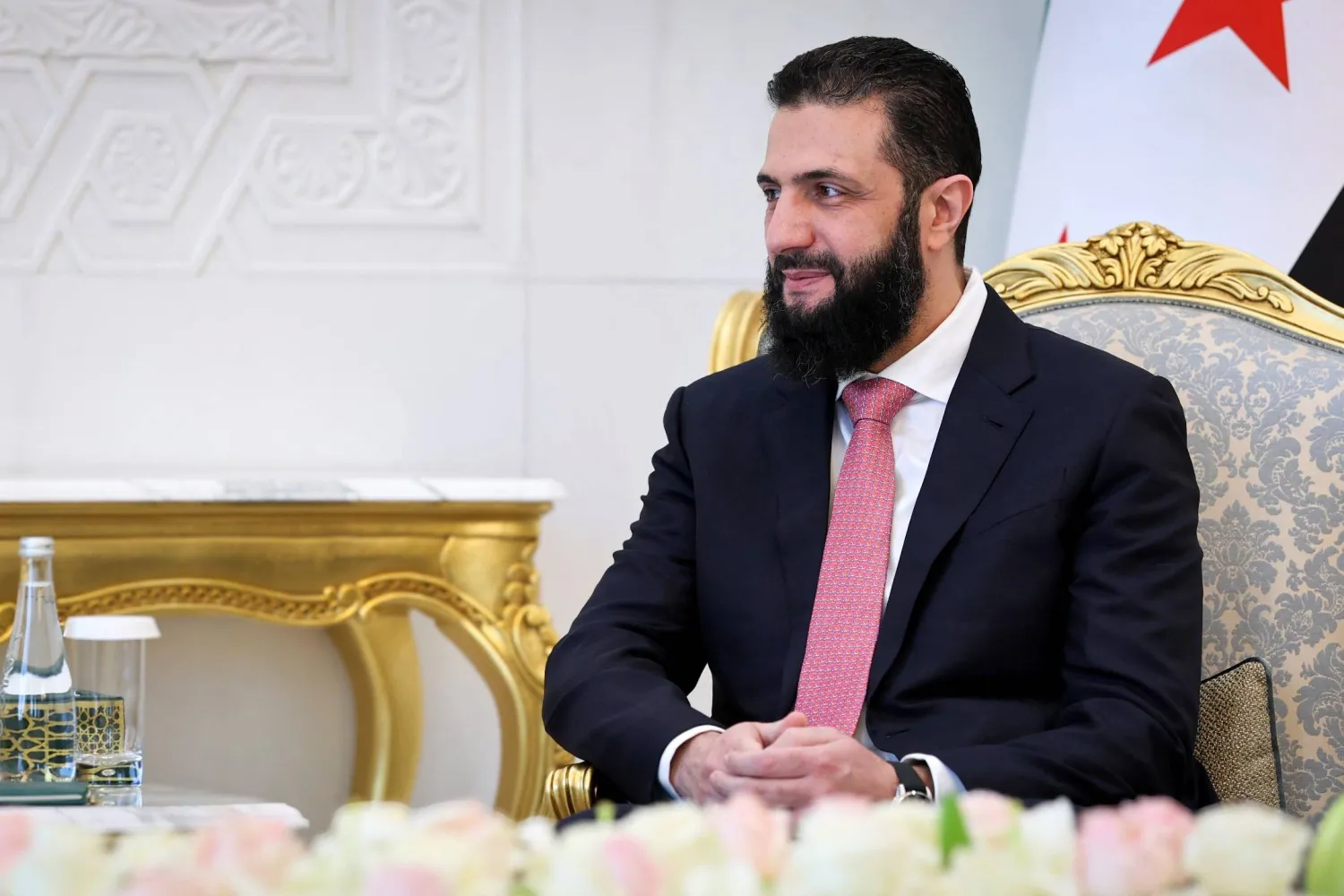
This handout photo provided by Syria's SANA news agency's Telegram channel on May 9, 2026, shows Syrian President Ahmed al-Sharaa meeting with the Lebanese Prime Minister (unseen) at the People's Palace in Damascus. (SANA / AFP)
TT

Syria Sets First Cabinet Reshuffle Since Assad Ouster, State Media Reports

This handout photo provided by Syria's SANA news agency's Telegram channel on May 9, 2026, shows Syrian President Ahmed al-Sharaa meeting with the Lebanese Prime Minister (unseen) at the People's Palace in Damascus. (SANA / AFP)

Syrian interim President Ahmed al-Sharaa announced a series of government changes in late-night presidential decrees published by state news agency SANA.

Sharaa appointed Khaled Zaarour as information minister, replacing Hamza Mustafa, who was moved to the foreign ministry. As agriculture minister, he named Bassel Sweidan, ‌who also ‌heads a committee tasked with ‌reaching ⁠settlement agreements with business ⁠tycoons linked to the Assad-era elite.

Sharaa replaced governors in the provinces of Homs, al-Quneitra and Deir Ezzor, the eastern province where most of Syria’s oil ⁠fields are located.

The reshuffle ‌is the ‌first since the ouster of former President ‌Bashar al-Assad and comes around ‌a year and a half into the five-year transitional period set out in Syria’s constitutional declaration.

No official reason was ‌given for the changes, but protests and social media campaigns ⁠have ⁠emerged in recent months over worsening economic conditions and what critics describe as poor government performance.

Sharaa also appointed a new secretary-general for the presidency, a post previously held by one of his brothers, a move that had drawn criticism from opponents who accused the administration of favoring nepotism over merit.


Yemeni Minister to Asharq Al-Awsat: Houthis Lose Foreign Commanders as Military Setbacks Mount

Yemeni army fighters in the Houthi-besieged city of Taiz. (AFP)
TT

Yemeni Minister to Asharq Al-Awsat: Houthis Lose Foreign Commanders as Military Setbacks Mount

Yemeni army fighters in the Houthi-besieged city of Taiz. (AFP)

The Houthis have lost numerous foreign commanders involved in directing military operations and developing offensive capabilities, a senior Yemeni official said, as the group faces mounting battlefield losses and internal divisions.

Walid al-Qudaimi, Yemen's minister of state, told Asharq Al-Awsat that airstrikes and battlefield operations had killed key foreign commanders fighting alongside the Houthis, as well as senior Houthi figures whose deaths the group has yet to disclose.

He said airstrikes and fighting across several fronts had weakened the militia's military capabilities, inflicting heavy losses in personnel, leadership and equipment.

Foreign commanders involved in directing operations and launching missile and drone attacks on government-held areas and Saudi Arabia were among those hit, he added.

Despite efforts to develop weapons and military technology, the Houthis were facing mounting setbacks and internal disintegration, al-Qudaimi said.

He said tribal leaders, sheikhs and ordinary Yemenis were increasingly recognizing the militia's agenda and refusing to send their sons into battle amid heavy casualties and growing numbers of missing fighters whose fate remained undisclosed.

Al-Qudaimi said Yemeni forces were fighting under a unified command through the joint forces, adding that Operation Dawn of Yemen would continue with Saudi support and under the direct supervision of the chairman of Yemen's Presidential Leadership Council until its objectives were met.

He said Yemenis increasingly understood the Houthis' ties to Iran and their role as one of Tehran's regional instruments, expressing his belief that large segments of the population were awaiting the group's removal and the restoration of state institutions.

The conflict extended beyond the Houthis because of the military and logistical support they received from foreign parties, al-Qudaimi said.

He stressed the importance of Yemeni diplomatic efforts to confront countries facilitating Houthi activities or providing assistance, saying such support violated diplomatic and political relations and harmed those countries' ties with Yemen.

His remarks came as Yemeni forces pressed ahead with military operations, intensifying airstrikes, drone attacks and artillery fire against Houthi positions, movements and reinforcements.

Government forces also made fresh gains in Al-Jawf province, while fighting continued on several fronts in Taiz, Dhale and Marib.

Turning to Taiz, al-Qudaimi called the city "an important key to victory over the Houthi militia," saying its residents' resistance reflected Yemenis' determination to confront the group.

He said repeated Houthi attempts to defeat the city militarily had failed despite the deployment of extensive manpower and military resources following the group's seizure of coastal areas.

Al-Qudaimi expressed hope that the Yemeni army would launch further operations to break the siege of Taiz and restore freedom of movement and access to besieged areas.

He also accused the Houthis of hypocrisy, saying they proclaimed solidarity with Gaza and the Palestinian people while besieging fellow Yemenis in Taiz and denying them basic rights to movement and daily life.


More Than One Million in Lebanon Face Acute Food Insecurity, UN Says

 A woman holds her daughter's hand as they walk through a neighborhood where homes were destroyed in Israeli strikes near Tebnin Citadel in southern Lebanon, October 3, 2026. (Reuters)
A woman holds her daughter's hand as they walk through a neighborhood where homes were destroyed in Israeli strikes near Tebnin Citadel in southern Lebanon, October 3, 2026. (Reuters)
TT

More Than One Million in Lebanon Face Acute Food Insecurity, UN Says

 A woman holds her daughter's hand as they walk through a neighborhood where homes were destroyed in Israeli strikes near Tebnin Citadel in southern Lebanon, October 3, 2026. (Reuters)
A woman holds her daughter's hand as they walk through a neighborhood where homes were destroyed in Israeli strikes near Tebnin Citadel in southern Lebanon, October 3, 2026. (Reuters)

More than one million people in Lebanon face acute food insecurity, the United Nations warned on Wednesday, following years of war and economic crisis.

Lebanon has endured two successive wars with neighboring Israel since 2023 and remains mired in an unprecedented economic collapse triggered seven years ago.

Nearly a quarter of the population face crisis levels of acute food insecurity or worse, said a joint statement by the UN's Food and Agriculture Organization, the World Food Program and the Lebanese agriculture ministry.

They called for "urgent action" to alleviate the situation.

The number is expected to rise to 1.15 million by the middle of next year, they added.

"Employment opportunities remain limited, savings have been depleted and debt remains high, while the cost of food, fuel and other essentials continues to strain household budgets," the UN bodies said.

The UN defines such levels of food insecurity as households facing malnutrition, or only being able to meet minimum needs through emergency measures such as selling assets.

Of most concern are conditions in conflict-affected areas of south Lebanon, as well as in impoverished regions in the north and east, they said.

Lebanon's authorities estimate that the cost of two wars between Israel and Lebanese group Hezbollah since October 2023 amounts to around $27 billion.

The last war, launched in March in support of Hezbollah's patron Iran, displaced more than one million people in Lebanon. That number has fallen to around 300,000 since violence subsided in June.

The fighting broke out as Lebanon struggled to recover from its worst ever economic crisis, which began in 2019.

Beirut has been seeking a bailout from the International Monetary Fund but has yet to implement reforms demanded by the institution to release the aid.


Netanyahu Dismisses Claims That Israel Is Blocking Supplies to Gaza

A Palestinian child sits beside a pool of rainwater at a camp for displaced people in Deir al-Balah in the central Gaza Strip, Saturday, Nov. 7, 2026. (AP)
TT

Netanyahu Dismisses Claims That Israel Is Blocking Supplies to Gaza

A Palestinian child sits beside a pool of rainwater at a camp for displaced people in Deir al-Balah in the central Gaza Strip, Saturday, Nov. 7, 2026. (AP)

Netanyahu said Israel was not to blame for the worsening conditions for Palestinians in Gaza’s tent camps that have been hit with severe winter floods.

His remarks came after the US-created Board of Peace — established under US President Donald Trump's plan to end the Israel-Hamas war and oversee Gaza’s recovery — said Monday that Israel's delaying of the entry of winter supplies into Gaza had “exacerbated the consequences of a foreseeable humanitarian challenge.”

Torrential rain has battered the war-torn enclave in recent days, damaging tens of thousands of makeshift tents. Four people, including three children, were killed on Sunday when a large sandstone slab collapsed onto tents during the rains.

Netanyahu said the Palestinian group Hamas is to blame because it continues to refuse to disarm, a condition of the deal announced by Trump, and seizes humanitarian aid in order to use it for military purposes.

“Hamas alone is responsible for the suffering of the people of Gaza, and it is now cynically exploiting that suffering to shift blame onto Israel once again,” he said Tuesday.

British Foreign Secretary Ed Miliband said the situation in Gaza was “intolerable” and demanded Israel end “arbitrary restrictions” on aid.

In Washington, Sen. Brian Schatz of Hawaii, the top Democrat on the Senate's foreign spending subcommittee, called for Israel to immediately allow winter gear into Gaza.

“There are a lot of challenges when it comes to Israel and Palestine that are complicated, and fraught, and contentious,” Schatz said on the Senate floor on Tuesday. “But we should all be able to agree that repairing torn tents and helping people to dry out, and providing warmth to freezing children is a basic human obligation.”