


‘Utter Rubbish’ Says Erdogan Rival as Spying Trial Opens

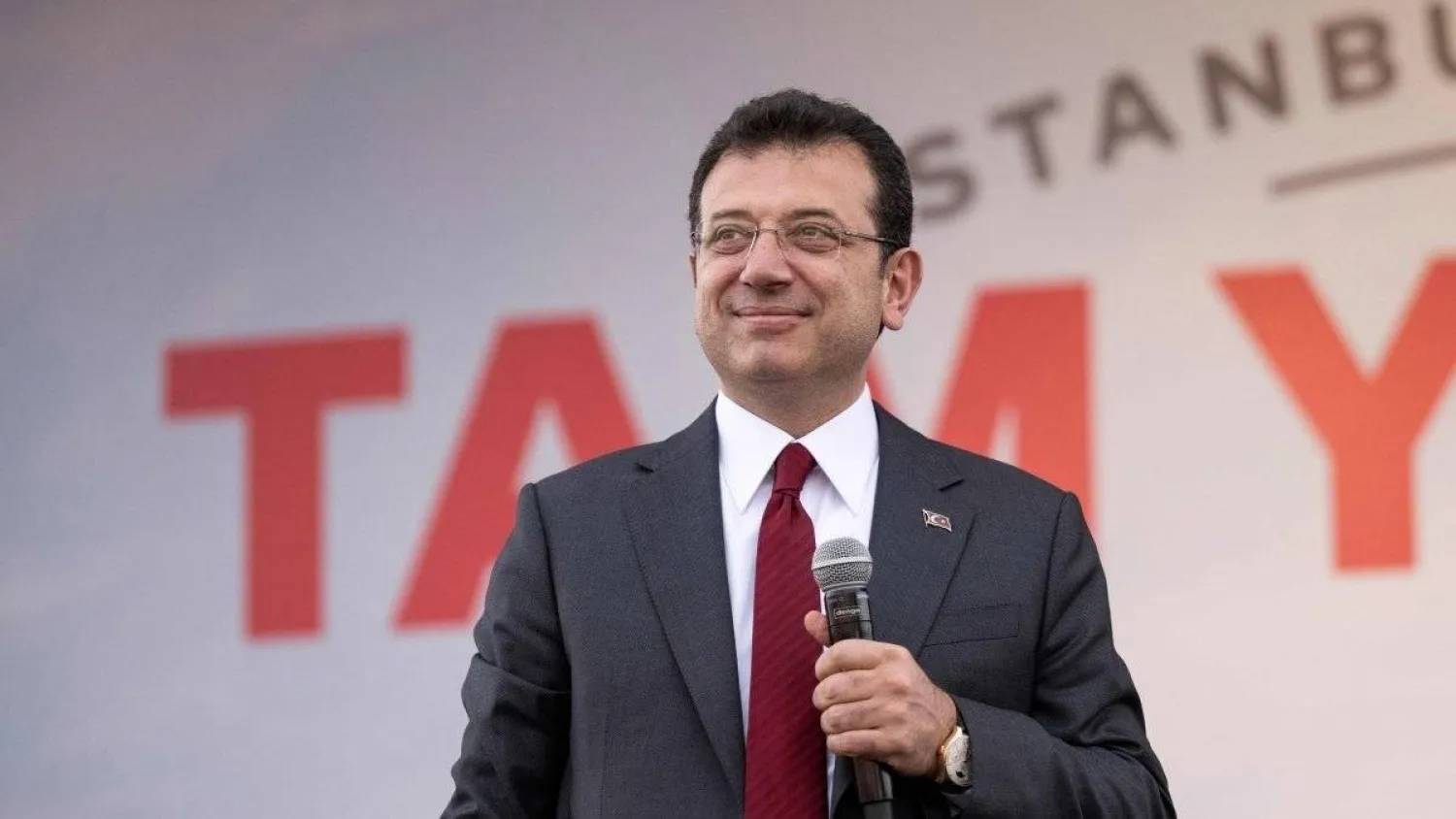
Former Istanbul Mayor Ekrem Imamoglu of the main opposition Republican People's Party (CHP) addresses supporters on the eve of the municipal elections, Istanbul, Türkiye, March 30, 2024. (AFP)
TT

‘Utter Rubbish’ Says Erdogan Rival as Spying Trial Opens

Former Istanbul Mayor Ekrem Imamoglu of the main opposition Republican People's Party (CHP) addresses supporters on the eve of the municipal elections, Istanbul, Türkiye, March 30, 2024. (AFP)

"It's all utter rubbish," Istanbul's jailed mayor Ekrem Imamoglu told an Istanbul court of the spying charges against him at a new trial on Monday, his words conveyed by lawyers and journalists.

"This indictment is a complete travesty of justice," said the 54-year-old, waving a copy of the indictment as the latest case against him opened at a court linked to the prison where he has been held for more than a year.

His remarks were posted on X by the MLSA rights group that is observing the trial.

Imamoglu was arrested and jailed as part of a graft probe in March last year, although the charges against him -- which include allegations of espionage and terror ties -- have continued to pile up.

"I will not defend myself against such an absurd charge as espionage," said Imamoglu, who is widely seen as one of the only politicians capable of defeating President Recep Tayyip Erdogan at the ballot box.

His arrest came just days before the main opposition CHP named him as its candidate for the next presidential race, due by mid-2028.

According to the indictment, Imamoglu and three other suspects -- one a journalist -- are accused of sharing the details of millions of Istanbul residents with foreign intelligence services in an alleged crime of "political espionage".

"If there is espionage, let the MIT (intelligence service) and all relevant intelligence units come forward and show the nation a single piece of concrete evidence," he said, according to supporters observing the trial.

"The indictment is 159 pages long. All of it is utter rubbish! ... Shame on you, Mr. President, members of the jury," he told the presiding judge, saying he had not read "a single page" of the charges against him, and would not do so.

Imamoglu was elected mayor of Türkiye's largest city in 2019, and re-elected in 2024 when the CHP won a huge victory over Erdogan's ruling AKP in the local elections.

"Is it a crime to win the election in Istanbul, or to have a say in our country's politics, starting with Istanbul, Mr. President?" he asked.

"Who will call this a case of espionage? This is a political case, Mr. President, brought by those who are afraid of facing me at the ballot box."

The espionage charges were brought against him in October, with the trial running in parallel to a sweeping graft case which opened on March 9 in which prosecutors want him jailed for 2,430 years.



UN Calls for ‘Urgent Action’ to Rein in AI in Face of ‘Unprecedented Risks’

UN High commissioner for Human Rights Volker Turk looks on during the 63rd session of United Nations (UN) Human Rights Council, in Geneva, on September 7, 2026. (AFP)
TT

UN Calls for ‘Urgent Action’ to Rein in AI in Face of ‘Unprecedented Risks’

UN High commissioner for Human Rights Volker Turk looks on during the 63rd session of United Nations (UN) Human Rights Council, in Geneva, on September 7, 2026. (AFP)

The United Nations rights chief called Monday for countries and "frontier" artificial intelligence companies to act urgently to rein in a technology he warned posed "unprecedented risks".

In a letter sent to countries and AI developers and shared with the media, Volker Turk cautioned that the world was "on the cusp of irreversible change, affecting not just us but generations of humanity to come".

"The current race towards ever more powerful AI is a step change towards greater existential risks to every aspect of our lives."

"I call on states and companies to mobilize urgently through multilateral fora to chart a path for action to govern advanced, frontier Al models, grounded in international human rights law."

He sent the letter as a fierce debate rages over whether the development of AI should be slowed. US President Donald Trump and key allies have pushed back against calls to slow the development of AI.

A furor erupted this month after a researcher publicly resigned from Anthropic over fears that the technology could escape human control.

Another Anthropic employee, who did not resign, stated publicly that "we really do earnestly believe AI could kill all humans", and that he thought the chances were greater than "10 percent within the next decade".

Amid the outcry, Anthropic CEO Dario Amodei called Saturday for AI companies to "pace the frontier" -- or coordinate a slowdown in the technology's development, with his chief competitors, xAI's Elon Musk and OpenAI's Sam Altman, publicly supporting him.

The UN rights office said those companies were among 10 AI developers, also including Meta, Microsoft and Google, who received Turk's letter.

- AI 'accelerating' warfare -

"In today's world, we are almost entirely reliant on a small number of powerful companies to make the right choices on Al development for all of humanity," the rights chief wrote.

"Industry co-regulation is an urgently needed first step, but on its own, it is nowhere near sufficient," he said.

The rights chief warned of the "unprecedented risks" posed by the emergence of increasingly capable AI agents.

"Entire populations could be cut off from clean water, heating, and financial services, and agentic AI is already accelerating the pace and reach of warfare and eroding safeguards that stand between us and the launch of weapons of mass destruction," he said.

"The companies that are at the forefront of developing frontier Al, based mainly in the People's Republic of China and in the United States of America, have both the responsibility and the ability to move immediately to reduce risks," Turk said.

He stressed though the need for international cooperation, insisting that "no country can govern this technology alone (and) no company should be able to decide by itself which risks the world must accept".

"No person should be required to surrender their human rights in exchange for claims of technological progress."


Universities Slam Belgian Refusal to Evacuate Gaza Students

Young Palestinians amid the rubble of buildings destroyed during the war, at Jabalia refugee camp in the northern Gaza Strip, August 5, 2026. (Reuters)
TT

Universities Slam Belgian Refusal to Evacuate Gaza Students

Young Palestinians amid the rubble of buildings destroyed during the war, at Jabalia refugee camp in the northern Gaza Strip, August 5, 2026. (Reuters)

Belgium's top universities condemned on Monday the government's refusal to help 13 students from war-torn Gaza who received scholarships at Belgian universities reach the country.

Brussels set aside plans to evacuate the Palestinian students last week in a case that has split the coalition government.

The rectors of the European country's top 10 universities expressed their "dismay" at the move in a letter, accusing the administration of using the students as "bargaining chips" in a "disgraceful political horse-trading".

Centrist Foreign Minister Maxime Prevot has advocated in favor of evacuating the students but has faced opposition from the Flemish conservatives party of Prime Minister Bart De Wever, according to a government source.

Prevot said one member of the five-party coalition demanded concessions on migration, including the creation of deportation centers, in return for greenlighting the evacuations.

"They must not be treated as bargaining chips or as variables to be adjusted in political debates on migration," the rectors wrote of the Gaza students.

"Their cases must be assessed for what they are: those of students and researchers who have been awarded scholarships on the basis of their academic merit and who have all expressed their intention to return to their home countries to contribute to their reconstruction."

The students are among about 1,500 Palestinians in Gaza currently waiting to reach Belgium, having been granted the right to do so, mainly under family reunification rules, according to several NGOs.

Yet, evacuations from the Palestinian territory at war with Israel are proceeding at a trickle, with activists and now the universities accusing the government of deliberately slowing down the process.

"Discussions in recent weeks also show that the obstacles cited do not stem from insurmountable constraints but rather from a lack of political will," the university chiefs wrote.

The case is not isolated, with Palestinian students hoping to study in Italy, Türkiye, the Netherlands, Germany also reporting delays in recent months.

Palestinian group Hamas launched an attack on Israel on October 7, 2023, which killed 1,221 people, according to official Israeli figures.

Israel's offensive has since claimed at least 73,470 lives in Gaza, according to the Gaza health ministry, which operates under Hamas.


China’s Spy Chief Warns of National Security Risks from AI

People visit the World Artificial Intelligence Conference (WAIC) in Shanghai, China, July 18, 2026. (Reuters)
TT

China’s Spy Chief Warns of National Security Risks from AI

People visit the World Artificial Intelligence Conference (WAIC) in Shanghai, China, July 18, 2026. (Reuters)

The head of China's spy agency has warned that artificial intelligence endangers the country's national security, with foreign powers potentially using the technology to threaten social order.

"Hostile forces" were abusing generative AI technologies to "fabricate political rumors and spread harmful information", Minister of State Security Chen Yixin wrote in an article published online on Sunday.

"They launch public opinion wars and cognitive warfare against China, directly threatening our political security, institutional security and ideological security," he said.

The warning comes as Chinese leader Xi Jinping is due to meet US President Donald Trump in Washington this month, with AI governance and safety set to be part of their discussions as calls mount for greater oversight of the technology.

US tech leaders have also called for slowing AI advances.

Anthropic CEO Dario Amodei warned on Saturday of the "reckless" speed of AI technology development, as worries mount over the risks of superintelligent computer systems.

OpenAI boss Sam Altman said he agreed with Amodei's assessment.

But Chen warned that AI was now "the main battleground for global technological competition and a new track for major power strategic rivalry".

He did not mention existential risks or putting the brakes on technological advances, but singled out Anthropic's Claude Mythos and OpenAI's ChatGPT-5.5-Cyber for their advanced hacking capabilities that potentially "pose serious risks to China's critical information infrastructure".

"Foreign intelligence agencies are deeply using technologies such as intelligent web crawlers, intelligent data mining, and intelligent profiling analysis to extensively collect and acquire sensitive information such as key national data, trade secrets, and citizens' personal privacy," Chen said.

The US-Iran war has also demonstrated AI's key role in the military, with better technology offering battlefield advantages, he said.

China must "ensure independent control of key core technologies" -- including the advanced computer chips vital to training AI models -- to secure its technology sovereignty, Chen wrote.