


Tens of Millions Risk Hunger as Hormuz Standoff Blocks Fertilizer, UN Official Says

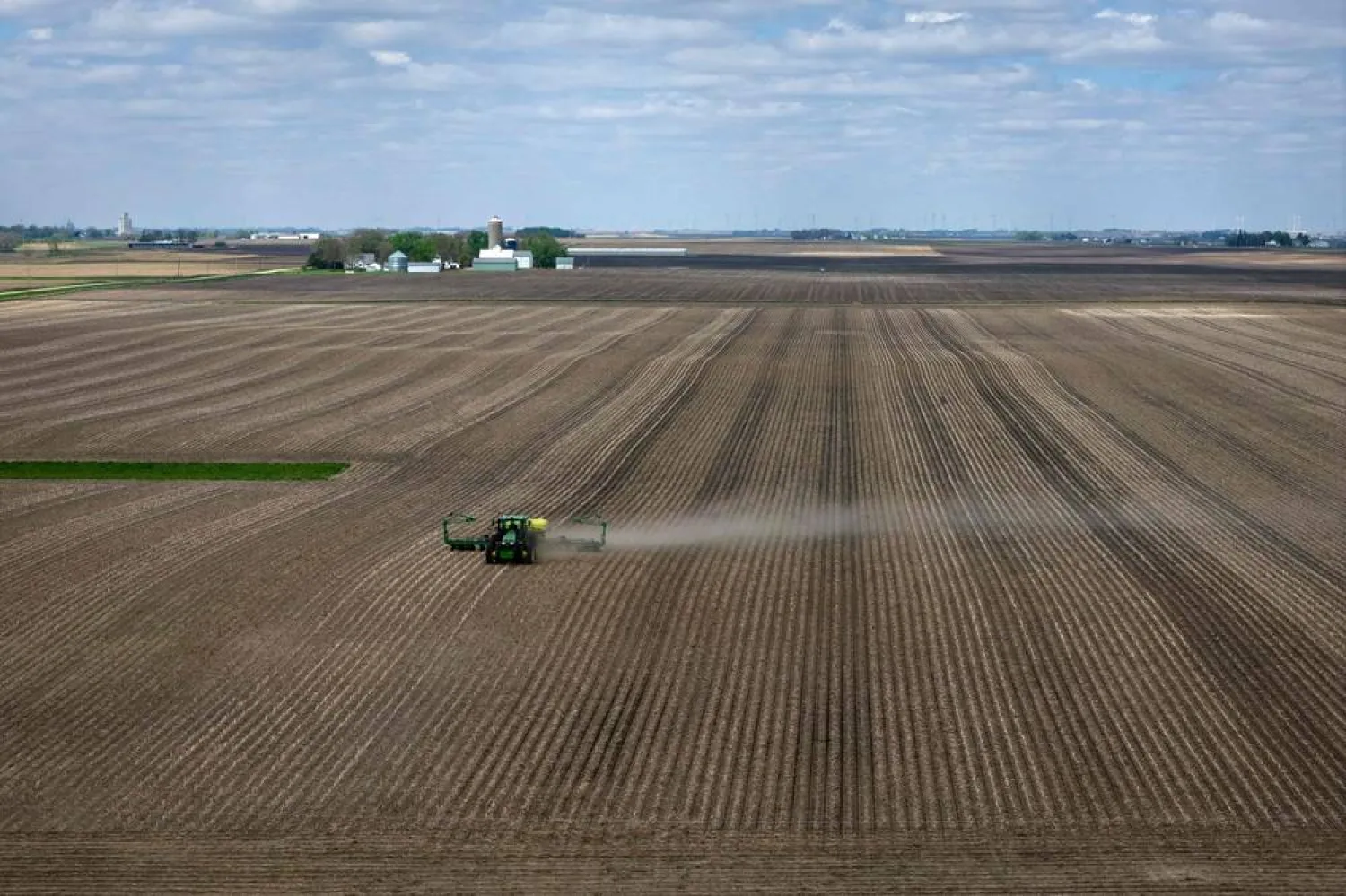
An aerial view shows Jerry Fuerstenau planting a farm field on May 06, 2026 near West Bend, Iowa. (Getty Images/AFP)
TT

Tens of Millions Risk Hunger as Hormuz Standoff Blocks Fertilizer, UN Official Says

An aerial view shows Jerry Fuerstenau planting a farm field on May 06, 2026 near West Bend, Iowa. (Getty Images/AFP)

Tens of millions of people could face hunger and starvation if fertilizers are not soon allowed through the Strait of Hormuz, the head of a UN task force aimed at averting a looming humanitarian crisis told AFP on Monday.

Iran has had the strategic waterway -- through which a third of the world's fertilizers normally pass -- in a chokehold for months in retaliation for the war launched by the United States and Israel on February 28, disrupting a trade critical for farmers around the world in a race against the end of planting seasons.

"We have a few weeks ahead of us to prevent what will likely be a massive humanitarian crisis," Jorge Moreira da Silva, executive director of the United Nations Office for Project Services (UNOPS) and leader of the task force, told AFP in an interview in Paris.

"We may witness a crisis that will force 45 million more people into hunger and starvation."

The UN secretary general created the task force in March to spearhead a mechanism to allow fertilizers and related raw materials such as ammonia, sulphur and urea through the strait.

For weeks, Moreira da Silva has been working to convince the belligerent parties to allow even a few ships through, and has met with "more than 100 countries" to rally UN member state support around the mechanism.

While the ultimate hope is for a "lasting peace" deal in the region and "freedom of navigation for all commodities" through the strait, "the problem is the planting season can't wait", Moreira da Silva said, with some ending in African nations within weeks.

Global focus has been on the economic impacts of the throttled oil and gas trade, but the United Nations has been sounding the alarm of the threat the blockade poses to the world's food security, with countries in Africa and Asia likely to be particularly hard hit.

- 'Political will' -

Moreira da Silva said the United Nations could have the mechanism up and running in seven days but even if the strait were to reopen now, it would take three to four months to return to normality.

"It's just a matter of time. If we don't stop the origin of the crisis soon, we will have to deal with the consequences through humanitarian aid."

While food prices have not exploded yet, Moreira da Silva said, there has been a "massive increase" in fertilizer costs, which experts say would likely lead to a drop in agriculture productivity and send food prices soaring.

Moreira da Silva said moving just an average of five vessels a day of fertilizers and related raw materials through the strait would head off the crisis for farmers.

What's missing, he said, is "the political will".

"We can't procrastinate on what is possible to do, and what is urgent to do -- which is let the fertilizers cross the strait and, through that, minimize the risk of massive food insecurity at the global level."



Nepal Flood Reconstruction Bill to be $4.78 Bn

A man carrying his belongings walks past a damaged house in the aftermath of flash floods at Trishuli in Nepal's Nuwakot district on September 11, 2026. (Photo by Prakash MATHEMA / AFP)
TT

Nepal Flood Reconstruction Bill to be $4.78 Bn

A man carrying his belongings walks past a damaged house in the aftermath of flash floods at Trishuli in Nepal's Nuwakot district on September 11, 2026. (Photo by Prakash MATHEMA / AFP)

The reconstruction bill after deadly floods sparked by a glacial mountain collapse that hit Nepal last month would amount to $4.78 billion, the foreign ministry said on Friday.

"The total estimated requirement for reconstruction is approximately $4.78 billion," foreign ministry spokesman Lok Bahadur Chhetri told reporters.

Nepali rescuers clung to hopes of finding survivors trapped in hydropower tunnels on Wednesday.

The August 26 tsunami-like surge of water, mud and debris, which began on the China-Nepal border, has killed more than 1,410 people and left 5,651 missing.

"The rescue and search work in the tunnels at Trishuli 3A, 3B and Chilime hydropower projects is ongoing," Nepal Army spokesman Raja Ram Basnet told AFP.

In Nepal, 1,367 bodies have been recovered and 5,132 people are missing, its disaster authority said on Wednesday.

In China, 43 people are dead and 519 are missing, according to state media.

Hundreds of foreigners are among the missing, as well as hundreds of hydropower workers.


China, Iran Among Countries That Have Used AI to Aid Spying, Anthropic Says

The Anthropic logo in this illustration taken June 5, 2026. (Reuters)
TT

China, Iran Among Countries That Have Used AI to Aid Spying, Anthropic Says

The Anthropic logo in this illustration taken June 5, 2026. (Reuters)

Anthropic said Thursday it shut down multiple cases of state-sponsored surveillance operations that used its artificial intelligence (AI) models, and warned that governments and state-aligned actors are increasingly using AI to spy on ethnic minorities and dissidents.

The incidents were found and disrupted between January and July, and they originated in China, Iran and west Africa, Anthropic said in a report about misuse of its models.

These surveillance campaigns "targeted the same diaspora and dissident communities these regimes have historically targeted. These include pro-democracy figures in Hong Kong, Tibetan and Falun Gong communities across Asia, and Iranian minority communities and opponents of the Iranian regime abroad," the report said.

In one case, Iranian actors developed a way to identify people through their social media accounts; in another, a contractor working for Malian national security authorities used Claude "to design the underlying software that enabled the intelligence gathering."

"AI is now being used in place of an engineering workforce," the report said.

Anthropic also disrupted efforts by users to design weapons, conduct questionable biological research, and create dating scams.

The San Francisco-based AI lab also accused Chinese developers of deceptively using Claude to produce responses to user queries while simultaneously "distilling" that data to improve their own models.

Distilling is an industry term that refers to a process where one AI model is used to train another one.

Chinese developers have previously been accused of using that technique without permission, essentially stealing resources from American labs such as Anthropic and OpenAI.

Now Anthropic alleges that China's Moonshot and DeepSeek have also secretly used Claude to generate answers given to its users.

"In one instance, over a ten-day period, Moonshot relayed almost 300,000 customer requests to Anthropic" through a "network of 5,380 fraudulent accounts, most of which appeared to be located in Singapore and Japan," the report said.

Some of that data contained sensitive user information, potentially in violation of privacy agreements.

"We do not know if Moonshot notified their customers that their requests were being rerouted to Anthropic and exposed to a third party," the report said.

DeepSeek used similar techniques.

When it comes to the research Anthropic detected and blocked that was related to biological weapons, the intent of the actors was less clear-cut and the AI lab did not identify them.

"The individuals implicated in these case studies are working scientists. We do not assert that they intended harm, and identifying them or their labs could expose them to harm," the report said.

The scientific research in those cases involved work around the mosquito-born chikungunya virus, a "highly-pathogenic" strain of the bird flu, a family of viruses that include smallpox and mpox, venoms and other toxins.


Iran is Reportedly Producing Ballistic Missiles Again in Underground Facilities

FILE PHOTO: A man walks next to a symbolic mockup of an Iranian missile and an Iranian flag at Imam Hussein Square in Tehran, Iran, July 12, 2026. Majid Asgaripour/WANA (West Asia News Agency) via REUTERS
TT

Iran is Reportedly Producing Ballistic Missiles Again in Underground Facilities

FILE PHOTO: A man walks next to a symbolic mockup of an Iranian missile and an Iranian flag at Imam Hussein Square in Tehran, Iran, July 12, 2026. Majid Asgaripour/WANA (West Asia News Agency) via REUTERS

Iran has resumed its production of ballistic missiles using stockpiled components and working in underground facilities, officials from the US and Middle East familiar with the matter said.

Despite heavy attacks on its missile sites and industrial facilities during the initial phase of the war, Iran has been busy assembling liquid-propellant missiles, which have to be fueled just before launch, as well as solid-propellant missiles, which can be stored ready to fire, some of the officials told The Wall Street Journal.

Intelligence points to activity at several underground sites, including the Khojir missile facility in southeastern Iran, those officials said. Iran is also attempting to build new underground assembly points to avoid getting struck again, the daily quoted them as saying.


A banner with a picture of US President Donald Trump next to an Iranian missile system at Azadi Square in Tehran, Iran, July 30, 2026. Majid Asgaripour/WANA (West Asia News Agency) via REUTERS

So far, Iran is mainly assembling the new missiles from existing components in more limited quantities than before the war, the US and regional officials said. The US and Israel damaged a number of industrial facilities needed to produce missile components and missiles themselves, and the naval blockade has complicated imports of parts and ingredients for solid fuel.

The renewed production underscores the difficulty of fully dismantling Tehran’s missile program, a goal of the war the US and Israel launched on Feb. 28.

“When there are no bombings of the facilities, you can replace damaged infrastructure, and you can buy new components from other countries and store them in the facilities,” said Tal Inbar, a senior analyst at the US-based Missile Defense Advocacy Alliance. “You have to be extremely naive to think that Iran is not rebuilding its missile-production capabilities.”

A White House official didn’t directly address the question of whether Tehran had resumed production of ballistic missiles but said that Iran’s nuclear facilities had been obliterated and its military forces severely degraded. “Iran is weaker now than ever before, and President Trump will never allow Iran to have a nuclear weapon,” the official said.

Sean Parnell, the Pentagon’s chief spokesman, said the US had “destroyed up to 90% of Iran’s drone, ballistic missile, and naval industrial base” and “significantly degraded” Iran’s ability to launch missiles and drones.