
What to Know About Trump-Xi Summit with Trade, Taiwan and Iran on the Agenda

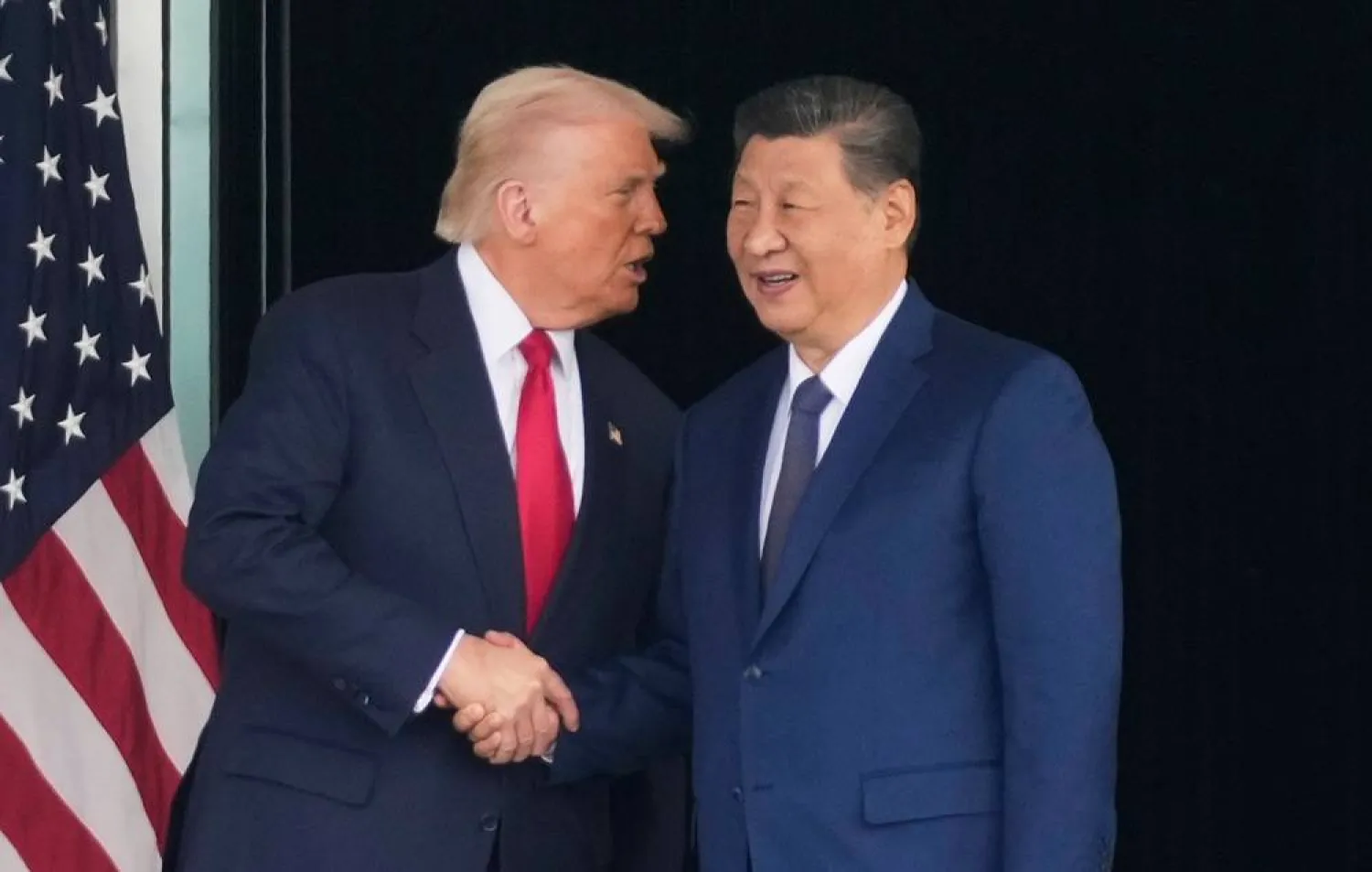
President Donald Trump, left, and Chinese President Xi Jinping, shake hands after their US-China summit talk at Gimhae International Airport Jinping in Busan, South Korea, Oct. 30, 2025. (AP)
TT

What to Know About Trump-Xi Summit with Trade, Taiwan and Iran on the Agenda

President Donald Trump, left, and Chinese President Xi Jinping, shake hands after their US-China summit talk at Gimhae International Airport Jinping in Busan, South Korea, Oct. 30, 2025. (AP)

As Presidents Xi Jinping and Donald Trump prepare for a highly anticipated summit, both China and the United States say their ties have been broadly stable in recent months and they are planning on keeping it that way.

But a long list of issues are at stake in one of the world’s most consequential relationship, with no easy end in sight.

Few expect major breakthroughs to the long-running frictions between China and the US, which range from competition in technology to the thorny question of Taiwan, whose main ally is the US. Ending the war with Iran is likely to be added to the agenda, with Beijing being one of the unofficial mediators in the conflict.

“On both sides there is a consensus that US-China stability is important,” said Henrietta Levin, senior fellow for the Freeman Chair in China Studies at the Center for Strategic and International Studies in Washington. “Once you get past the question of stability, the ‘what’s next’ in the relationship gets a little more complicated, and so for that reason, the most likely thing to come out of the meeting is very little.”

Here's what to know about the summit:

There may be a trade deal, but not a resolution

The China-US trade war started with Trump’s first term, but turned up a notch in April last year, on Trump’s so-called “Liberation Day,” when he announced 34% tariffs on all Chinese goods. China retaliated with counter tariffs and other measures, such as restrictions on rare earth exports. Tariffs reached as high as 145% in the escalating back and forth.

The two sides, realizing the sky-high tariffs weren’t sustainable, then called for a trade truce, halting many of the punitive economic measures. The two leaders met in South Korea in October and extended the truce for another year. China promised to purchase soybeans from American farmers, while the US dropped tariffs by more than half.

“China’s strategy was to promote stability by fighting back,” said Fudan University professor Zhao Minghao, an expert in international relations. “Both sides could very well issue a comprehensive trade agreement this time. But this doesn’t mean the war is over, and the agreement will have conditions.”

Last year’s trade truce did not resolve any of the bigger picture issues, and it did not mean a return to how things were. China now has a new export permit requirement for rare earth exports that it can tighten at any time.

Further, this time around, “there’s been a lack of the intensive type of engagement that has characterized past summits,” said Wendy Cutler, vice president of the Asia Society, and a former trade negotiator for the US.

China in April issued new regulations that built out a framework for identifying and countering foreign measures targeted at Chinese companies. Under the new rules, for example, China’s Ministry of Commerce told impacted companies, such as one petroleum refinery that bought Iranian crude oil, to ignore US sanctions.

Although some say the sides could announce a continuation of the trade truce, they note they have continued to take targeted actions. “It’s a fragile truce,” said Cutler.

The White House said Sunday they are also planning to discuss creating a new “Board of Trade” to keep their countries talking on economic issues.

China's ability to buy high-tech chips is still a thorny issue

The US imposed restrictions on exports to China of advanced computer chips and related tech, such as the machines to make the chips, as early as Trump’s first term in office.

Nvidia, a California company and the leading designer of advanced chips, has pressed Trump to allow it to export them to China. Nvidia founder Jensen Huang has argued that selling the chips will build reliance on American tech for Chinese AI firms.

But the increasing list of restrictions on chip exports may only push China deeper in its drive for self-reliance. “China’s attitude has changed subtly, it seems more focused on advancing its domestic chip industry rather than continuing to rely on advanced chips from the United States,” Zhao said in written comments.

China sees Taiwan as the ‘biggest risk’ in ties with the US

Two weeks before the meeting, Chinese Foreign Minister Wang Yi said in a call with US Secretary of State Marco Rubio that the bilateral relationship has remained generally stable, but Taiwan remains the “biggest risk” to their ties. China signaled again on Thursday that Taiwan would be a top priority for discussion.

Few expect a resolution to the Taiwan issue, lingering since China and Taiwan split in a civil war in 1949. While Beijing claims Taiwan, the island is a self-ruled democracy.

Tensions have only risen since Taiwan first elected Tsai Ing-wen as president in 2016. Her Democratic Progressive Party says Taiwan is functionally independent and its own sovereign state. Beijing has broken off communication with Taiwan’s government, and in recent years, started sending warplanes and warships closer to the island in almost daily drills.

The island’s current President Lai Ching-te is also from the DPP. Beijing has criticized Lai repeatedly, even depicting him as a “parasite” in propaganda imagery for its military exercises.

The US is required by law to ensure Taiwan can defend itself but officially maintains a position of what has been called strategic ambiguity, leaving it a question of whether the US would get involved militarily if China decided to reclaim Taiwan by force. Trump has also said recently that he discussed arms sales to Taiwan with Xi, which led to further questions of whether the US would support Taiwan.

“One possibility is that China and the US can take the strategy of a sort of ‘reciprocal restraint’, such as reducing the number of American arms sales to Taiwan, in exchange for fewer military exercises from the mainland aimed at Taiwan,” said Zhao.

The US wants China to put pressure on Iran

As the world awaits an end to the war in Iran that has shaken the global economy, the conflict is likely to surface in the talks.

China has openly criticized the United States and Israel over the war. In addition, given its close political and economic ties with Iran, it is seen by some as an unofficial mediator that could influence Tehran. So far, Beijing has remained cautious, preferring to not get deeply involved.

“I don’t think China has any interest in solving the problems the US has created for itself in the Middle East,” Levin, of the Center for Strategic and International Studies, said.

A few days before the trip, US Treasury Secretary Scott Bessent called on China to pressure Iran to open the Strait of Hormuz, and said that by buying Iranian oil, Beijing is funding terrorism.

“Let’s see if China — let’s see them step up with some diplomacy and get the Iranians to open the strait,” Bessent said on Fox News. “Iran is the largest state sponsor of terrorism, and China has been buying 90% of their energy, so they are funding the largest state sponsor of terrorism.”

What is Pickaxe Mountain, the Iranian Nuclear-linked Site Threatened by Trump?

A satellite view shows vehicles at an entrance to Pickaxe Mountain tunnels, of the Natanz nuclear facility, near Natanz, Iran, June 21, 2026. Vantor/Handout via REUTERS
TT

What is Pickaxe Mountain, the Iranian Nuclear-linked Site Threatened by Trump?

A satellite view shows vehicles at an entrance to Pickaxe Mountain tunnels, of the Natanz nuclear facility, near Natanz, Iran, June 21, 2026. Vantor/Handout via REUTERS

US President Donald Trump has threatened to attack a site linked to Iran's nuclear program known as Pickaxe Mountain, a fortified facility buried deep underground near one of Tehran's main nuclear sites.

"We're going to take out Pickaxe Mountain. Tell the Iranians to be ready," Trump said in a July 13 interview on the Hugh Hewitt Show.

The threat reflects escalating tensions as Tehran and Washington trade fire in the Gulf, setting back efforts to end the conflict.

Here's what we know about Pickaxe Mountain:

WHERE IS IT?

Pickaxe Mountain is located 220 km (140 miles) south of Tehran and 2 km (1.2 miles) from the Natanz nuclear complex.

The Natanz site, where two of Iran's uranium enrichment plants were located, was bombed during the war started by the United States and Israel on February 28, and during last year's 12-day war.

The tunnel facility under construction at Pickaxe Mountain wasn't targeted in either of those wars, according to the Institute for Science and International Security (ISIS), a US-based think-tank focused on nuclear non-proliferation.

The peak rises to some 1,600 meters above sea level. There were two enrichment plants in operation at Natanz - one above and one below ground.

The UN nuclear watchdog has said the above-ground one was destroyed. The other, underground one was likely at least badly damaged.

WHAT'S THE HISTORY OF THE SITE?

The site is ⁠linked to Iran's ⁠nuclear program, which has long caused tension between the West and Iran, which denies seeking an atomic bomb.

Construction of the facility at Pickaxe Mountain began in 2020, according to ISIS, following what Iranian authorities reported at the time as an explosion caused by an act of sabotage at the Natanz facility.

Iran said at the time the Natanz sabotage had caused significant damage that could slow the development of advanced uranium enrichment centrifuges.

In September that year, Iran's then-nuclear chief, Ali Akbar Salehi, said Iran had started building "a more modern, larger and more comprehensive hall in all dimensions in the heart of the mountain near Natanz" for making advanced centrifuges.

Rafael Grossi, the chief of the UN nuclear watchdog, in an ⁠interview with PBS Frontline in March, noted that Iran had previously announced its intention to have nuclear activity at Pickaxe Mountain.

"This was part of their quite systematic intention to put their most sensitive facilities underground," Reuters quoted him as saying.

FILE PHOTO: A satellite view shows tunnel entrances at Pickaxe Mountain, of the Natanz nuclear facility, near Natanz, Iran, June 30, 2026. Vantor/Handout via REUTERS

WHAT HAS IRAN BUILT THERE?

ISIS, which has analyzed satellite imagery of the site, says it features two pairs of entrances, which are assumed to lead to one facility estimated to be at least 100 meters under the mountain.

The physical defensive measures consist primarily of a large security perimeter and the extensive hardening of tunnel entrances, ISIS said in a July 14 report.

The pair of eastern tunnel portal entrances have been partially backfilled since the wars to obstruct ground vehicle access but they have not been sealed fully, the ISIS report said.

Sam Lair, a fellow at the Foreign Policy Research Institute, who also reviewed recent satellite imagery of the site, told Reuters that increasing the strength of the tunnel entrances would complicate "targeting with penetrating munitions like bunker busters.”

IS THE SITE FUNCTIONING AND WHAT COULD IT BE USED FOR?

Trump, in his July 13 ⁠remarks, said Washington was watching Pickaxe ⁠Mountain closely.

"We see no activity there. They're not doing well with their nuclear situation. Every time we hear about it, we blow it up. So they don't like talking about it. But we'll probably give Pickaxe a shot relatively soon," he said.

ISIS, in its report, said its assessment "is that the facility is not yet operational, but construction continues,” and that it was unclear when it could be operational, based on satellite imagery alone.

"It is also unclear if Iran still plans on installing a large-scale assembly facility, given the destruction of Iran’s centrifuge program, including Iran’s ability to make centrifuge components needed for an assembly plant.

"Nonetheless, if Iran starts to rebuild its centrifuge manufacturing capability, it could plan to install a smaller centrifuge assembly facility in Pickaxe Mountain able to serve a nuclear weapons program," ISIS said.

HOW MIGHT THE SITE BE ATTACKED?

Experts assess the deeply buried complex is beyond the reach of the most powerful bunker buster bombs in the US arsenal.

ISIS said the site "would be more suitable for ground forces to attack or sabotage.”

"However, vulnerabilities may also exist that can be exploited by deep earth penetrating weapons via aerial attacks," it said.

Lair said: “We can infer that there are ongoing activities at Pickaxe Mountain the Iranians wish to continue but are still concerned enough about a potential attack that they are taking steps to bolster their defenses.”


Andy Burnham, a Mayor from England’s North, Is Poised to Become Britain’s Next Prime Minister

Labour MP and challenger for leader of the Labour party, Andy Burnham, waves as he leaves after delivering a speech in Manchester, northern England, on June 29, 2026. (AFP)
TT

Andy Burnham, a Mayor from England’s North, Is Poised to Become Britain’s Next Prime Minister

Labour MP and challenger for leader of the Labour party, Andy Burnham, waves as he leaves after delivering a speech in Manchester, northern England, on June 29, 2026. (AFP)

Andy Burnham got to the top through a mix of patience and risk-taking.

A decade ago, Burnham abandoned a 20-year climb up the Labour Party ladder in London to head north and run for mayor of Greater Manchester. A month ago, he returned to Parliament by winning a risky special election. On Monday, he will become Britain’s 59th prime minister.

The sudden downfall of Prime Minister Keir Starmer after just two years in office has swept the 56-year-old Burnham into office — unelected and largely untested. He will enter No. 10 Downing St. carrying the heavy weight of expectation, and big questions about how he will shoulder it.

“A whole range of people across the Labour movement and in the country have projected onto Andy Burnham their hopes and their fantasies about how the country should be run and what Labour should stand for and what Andy Burnham stands for,” said Joshi Herrmann, founder of Manchester news site The Mill, who has covered Burnham for years.

“He has got lots of people’s hopes up.”

Burnham has made his name in Manchester, but he was born in Liverpool, and grew up in a commuter village between the rival northwest English cities.

His father worked as a British Telecom engineer and his mother as a receptionist, and he was raised in a close-knit Catholic family.

Burnham and his brothers were the first generation of their family to go to university. And not just any university — Burnham attended Cambridge, one of the country’s oldest and most prestigious institutions.

“He needed a lot of persuading to apply because he felt that as a working-class boy, going off to Cambridge wasn’t for him,” Stephen Harrington, Burnham’s former English teacher at St. Aelred’s Catholic High School, told the BBC. “He didn’t believe in himself. But he did it, and the rest is history.”

Burnham has said he felt out of place at Cambridge, where many of his classmates had gone to posh private schools in the more affluent south of England. But he got a degree in English and met his future wife, Dutch fellow student Marie-France Van Heel, now a marketing executive. The couple married in 2000 and have a son and two daughters.

After graduating, Burnham worked as a journalist at trade magazines before becoming a researcher and adviser to Labour politicians.

Elected to Parliament for the Manchester-area district of Leigh in 2001, he rose through the government ranks under Labour Prime Ministers Tony Blair and Gordon Brown. He served in Brown’s Cabinet between 2007 and 2010 as chief secretary to the Treasury, culture secretary and health secretary.

A formative experience came in 2009, when he was heckled at a commemoration of the 1989 Hillsborough Stadium disaster, when 97 Liverpool football fans were crushed to death. Bereaved families had fought for years to overturn a false narrative offered by police that unruly fans had been to blame.

Burnham became a champion for the families and helped push for a new inquest, an apology and a law that imposes a duty of candor on public officials to tell the truth about tragedies whatever the impact on their reputation.

After Labour lost power in 2010, Burnham ran for leadership of the party that year and in 2015, losing both times. He quit Parliament in 2017, a low ebb for Labour nationally, to run for mayor of Greater Manchester.

Being mayor played to his strengths: an ability to bring people together, a sharp eye for opportunities and a wide streak of pragmatism. His approach became known as “Manchesterism,” a brand of business-friendly socialism that aims to harness private and public money to invest in areas like transport, housing and infrastructure.

Manchester was a former manufacturing powerhouse — known as the birthplace of the Industrial Revolution — that had been hollowed out as British industry crumbled. During his tenure the city boomed, with skyscrapers blooming on vacant post-industrial sites. Burnham won praise for taking a piecemeal public transport system under public control and improving it.

He shed suit and tie for jeans and dark T-shirts, spoke about his love for Oasis, The Smiths and New Order and spent spare time playing football or spinning 1990s tunes during DJ battles.

During the COVID-19 pandemic, he harangued Conservative Prime Minister Boris Johnson over what he called a “London-centric” approach to the crisis that was punishing northern cities. That’s when he gained the nickname King of the North, a “Game of Thrones”-inspired nod both to his championing of his home region and his political ambition.

He has said he saw his work in central government as “unfinished business,” and got his chance when Starmer was pushed to resign by Labour colleagues alarmed at the party’s unpopularity.

But Burnham still needed a seat in Parliament. A Labour lawmaker agreed to resign, triggering a special election for the Manchester-area district of Makerfield. Burnham trounced the candidate from anti-immigration party Reform UK, cementing his credentials as a winner.

In the subsequent contest to replace Starmer as Labour leader, he was the only candidate.

He’s promising to restore hope Now he says he will deliver “a new politics based on unity and hope” and “an economy that works for everybody,” no matter where they live. A key plank is giving regional leaders more powers, and he plans to move part of the prime minister’s office to a “No. 10 North” in Manchester.

Herrmann said Burnham has clear strengths, especially an ability to tell a persuasive story and a sense of empathy that many politicians lack.

He added that the incoming prime minister has “a set of principles about trying to make the country fairer, trying to bring people out of poverty, that he really does believe in.”

Critics claim Burnham’s politics are vague on key points, such as where the money will come from to pay for his pledges. He will face many of the same political and economic challenges that stymied Starmer, including a sluggish economy, overstretched public services and a cost-of-living squeeze. He has little experience of foreign policy issues, from the Ukraine war to dealing with US President Donald Trump.

And running a country of 70 million is a lot different from overseeing a region of 3 million.

But Sacha Lord, a Manchester music entrepreneur who served as Burnham’s nighttime economy adviser, said the politician has a steely side that will help him rise to the occasion.

“He’s not scared of locking horns with people,” Lord said. “Everybody thinks Andy’s this nice, cheeky-chappy guy. But trust me, when he wants something ... he tends to get it.”


How the Yemeni Gov’t Handled Iran’s Sanaa Airport Escalation

Yemen’s armed forces claimed responsibility for targeting the runway at Sanaa airport to prevent the Iranian aircraft from landing. (EPA)
TT

How the Yemeni Gov’t Handled Iran’s Sanaa Airport Escalation

Yemen’s armed forces claimed responsibility for targeting the runway at Sanaa airport to prevent the Iranian aircraft from landing. (EPA)

Yemen’s leadership viewed an Iranian aircraft’s attempt to land at Sanaa airport last Monday as more than an aviation incident that could be overlooked to avoid further escalation.

It saw the attempted landing as a direct challenge to state sovereignty and an effort to impose a new political and military reality outside the country’s legitimate institutions at a time of unprecedented regional tension.

Unlike in previous crises, the government responded through a coordinated mix of calculated military action, organized political measures, and legal and diplomatic efforts. It also sought to avoid a wider confrontation that it believed Tehran wanted in order to turn Yemen once again into an arena for regional conflict.

From the first hours of the crisis, Yemen’s leadership emphasized a central message: defending sovereignty does not conflict with pursuing peace, and the state can enforce the law without abandoning its responsibility to protect civilians or preserve the prospects of a political settlement.

The targeting of Sanaa airport’s runway to prevent the Iranian aircraft from landing was therefore the final step in a long series of political and legal measures that preceded the use of force.

The government said it had exhausted all official channels to operate the airport and had offered alternatives to ensure the continuation of civilian flights via Yemenia Airways, the national carrier legally authorized to operate them.

What distinguished the government’s handling of the crisis was that it did not merely respond to the incident but also sought to shape the political narrative surrounding it.

From the outset, official statements stressed that the dispute was not over the operation of Sanaa airport or citizens’ ability to travel. It concerned an attempt to seize one of the state’s most important sovereign powers: control over its airspace and international ports of entry.

The Yemeni leadership repeatedly said the problem was not the aircraft itself, but the operation of international flights without the approval of the legitimate authorities, in violation of the Chicago Convention on International Civil Aviation and UN Security Council resolutions on Yemen.

The government also said it had proposed practical solutions before the escalation, including transporting the Houthi delegation from Tehran aboard an aircraft chartered by Yemenia Airways.

It said the group rejected the offer, strengthening the government’s argument before the international community that it had resorted to force only after exhausting other options.

Presidential Leadership Council (PLC) Chairman Rashad al-Alimi said the priority was to protect civilian lives and public property and avoid widening the confrontation in a way that would serve Iran’s goal of drawing Yemen into regional conflicts.

The message was intended to reassure the public and show that the military decision remained subject to careful political calculations rather than emotional reactions.

The government’s continuous meetings and the formation of a national crisis-management team also reflected a shift toward a unified approach combining military, political, diplomatic and media efforts.

This gave the official response greater coherence than in previous crises.

Domestic, International Support

Observers say the Yemeni government also succeeded in turning the crisis from a confrontation between itself and the Houthis into an issue concerning respect for the sovereignty of a UN member state.

Domestically, the House of Representatives, the Shura Council, the Consultation and Reconciliation Commission and the National Bloc of Political Parties and Components quickly declared their full support for the measures taken by the PLC.

They described the incident as a violation of Yemeni sovereignty rather than merely a political dispute.

The significance of this alignment was that it came from official institutions and political parties affiliated with the legitimate authorities, giving the leadership political cover against attempts to portray it as lacking internal consensus in its handling of the crisis.

Internationally, Yemen’s diplomatic efforts appeared to have preceded the UN Security Council meeting, after the government succeeded in persuading several major powers to adopt positions close to its account of the incident.

The United States described the Iranian landing as a violation of Yemeni sovereignty and linked it to the possible transfer of military experts and equipment to the Houthis, saying this would breach Security Council resolutions.

Britain said any flights conducted without the approval of the legitimate government constituted a violation of international law and called for an investigation through UN mechanisms.

France went further, linking the incident to what it described as Iran’s destabilizing conduct in the region.

It renewed its call for an end to the transfer of military equipment to the Houthis while reaffirming its support for Yemen’s unity and sovereignty.

Although the United Nations maintained its traditional call for de-escalation, it also stressed the need to respect Yemen’s unity, sovereignty and territorial integrity, giving the government additional political support in defending its position.

Multiple Messages

The legitimate Yemeni authorities’ handling of the Iranian aircraft crisis can be seen as an attempt to deliver three parallel messages.

The first was directed at Iran: Yemen was no longer an open arena where new realities could be imposed through air traffic or sovereign ports of entry, and any attempt to bypass state institutions would face practical measures, even as the government remained committed to peace.

The second message was aimed at the Houthis: using civilian suffering or Sanaa airport as political leverage would not lead to recognition of authorities operating in parallel to the state.

The government would not allow sovereign powers to be established outside its institutions.

The third message had an international dimension.

The government called on the Security Council to move from condemnation to deterrence by strictly enforcing sanctions and council resolutions, particularly resolutions 2140 and 2216.

It said continued tolerance of violations would encourage their repetition.

Despite the political and diplomatic gains achieved by the legitimate authorities, however, the crisis has not ended in practical terms.

It remains tied to the international community’s ability to translate condemnation into measures that prevent similar incidents and ensure respect for the Yemeni state’s sovereignty over all land, sea and air entry points.

The continuing efforts of UN envoy Hans Grundberg, alongside international positions supporting de-escalation, also reflect growing recognition that preserving the fragile truce requires addressing the roots of the crisis.

These include ending the Houthi coup and preventing humanitarian issues and sovereign ports of entry from being used as tools of conflict.

For the Yemeni government, observers say, the crisis was more a political test than a military one.

Through its response, it sought to establish a new equation: defending sovereignty does not contradict the pursuit of peace, and the state can combine restraint with resolve while respecting international law and asserting its authority.