


Global Fire Outbreaks Hit Record High as ‘Unprecedented’ Heat Extremes Loom, Scientists Say

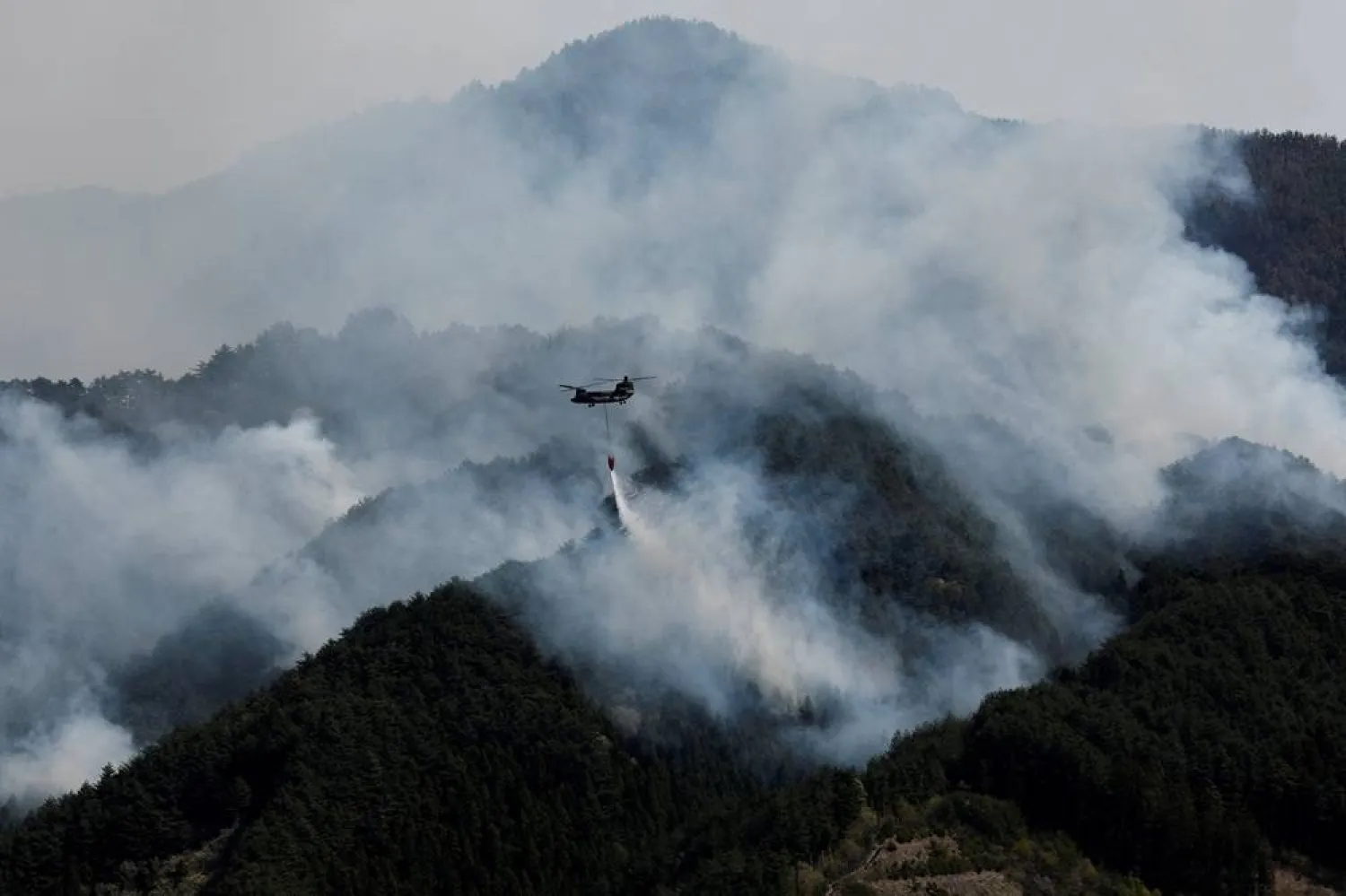
A helicopter conducts firefighting operations as wildfires continue in Otsuchi, Iwate Prefecture, Japan, April 26, 2026. (Reuters)
TT

Global Fire Outbreaks Hit Record High as ‘Unprecedented’ Heat Extremes Loom, Scientists Say

A helicopter conducts firefighting operations as wildfires continue in Otsuchi, Iwate Prefecture, Japan, April 26, 2026. (Reuters)

Climate change has driven record-breaking outbreaks of fire in Africa, Asia and elsewhere this year, with conditions expected to get worse as the northern hemisphere's summer approaches and El Nino weather patterns kick in, scientists warned on Tuesday.

Fires from January to April have already caused unprecedented levels of damage, burning more than 150 million hectares (370.66 million acres) of land, 20% more than the previous record, according to data compiled by World Weather Attribution, a research group that studies the role played by global warming in extreme weather events.

The researchers said temperature records ‌could be broken this ‌year, causing widespread drought as well as fires, with ‌the impact ⁠of human-induced climate ⁠change compounded by an especially strong "El Nino" effect.

"Whilst in many parts of the world the global fire season has yet to heat up, this rapid start, in combination with the forecast El Nino, means that we're looking at a particularly severe year materializing," said Theodore Keeping, a wildfire expert at Imperial College London and part of the WWA group.

As much as 85 million hectares of land have burned in Africa so far ⁠this year, 23% more than the previous record of ‌69 million hectares, he said.

The unusually high fire ‌activity in Africa is being driven by rapid shifts from extremely wet to extremely dry conditions, he ‌said.

High rainfall produced more grass during the previous growing season, creating an abundance ‌of fuel to feed the drought- and heat-induced savannah fires of the last few months.

EL NINO CONDITIONS DUE THIS MONTH

Asian fires have burned as much as 44 million hectares of land so far this year, nearly 40% more than the previous record year of 2014, ‌with India, Myanmar, Thailand, Laos and China among the worst hit, Keeping said.

He warned that wildfire risks could worsen later ⁠this year, with El ⁠Nino increasing the likelihood of severe heat and drought in Australia, Canada, the United States and the Amazon rainforest.

"The likelihood of harmful extreme fires potentially could be the highest we've seen in recent history if a strong El Nino does develop," he said. El Nino weather conditions, caused by the warming of sea surface temperatures in the Pacific Ocean, are expected to start in May, the World Meteorological Organization said last month.

It could cause droughts in Australia, Indonesia and parts of southern Asia as well as flooding in other regions, and may drive up temperatures, the UN agency warned.

"If there is a strong El Nino later this year, there is a serious risk that the effect of climate change and El Nino ... will result in unprecedented weather extremes," said Friederike Otto, climate scientist at Imperial College London and co-founder of World Weather Attribution.



Indonesian Wildfire Emissions Surge to World’s Highest, Data Shows

This aerial photo taken from a commercial aircraft shows haze from Indonesian forest fires blanketing a bridge in Kuching, the capital city of Malaysia's Sarawak state on the island of Borneo on September 5, 2026. (AFP)
TT

Indonesian Wildfire Emissions Surge to World’s Highest, Data Shows

This aerial photo taken from a commercial aircraft shows haze from Indonesian forest fires blanketing a bridge in Kuching, the capital city of Malaysia's Sarawak state on the island of Borneo on September 5, 2026. (AFP)

Indonesia is facing a surge in emissions from wildfires burning through parched stretches of forest and peatland on the islands of Borneo and Sumatra, with carbon dioxide readings currently the highest in the world, data showed on Wednesday.

Fire emissions from Indonesia from September 1 to September 7 reached 19.7 million metric tons, overtaking Russia this week and making up more than a third of the global total, according to Fire Emissions Watch, a portal developed by the European Union's Copernicus climate monitoring service.

Indonesia is one of the world's most fire-prone countries, but as "super-El Nino" weather conditions drive up temperatures and cause punishing droughts, the country is battling what authorities say is its most intense wildfire season in 11 years.

"We do expect to see some fires across the region at this time of year, but with El Nino, it clearly ‌just gives a ‌big enhancement to them," said Mark Parrington, senior scientist at the Copernicus Atmosphere Monitoring Service ‌in ⁠Bonn.

"It's much drier, ⁠it's hotter, and when there's ignition, these fires burn in a far more extreme way."

From September 1 to September 7, fire emission intensity exceeded 1,500 kg/sq km, more than 10 times the Russian level, with the highest concentrations in Kalimantan in Indonesia's part of Borneo and eastern parts of Sumatra, Copernicus data showed on Wednesday.

Emissions were 273% higher than the seasonal average, though still lower than the 21.7 million tons emitted in the same week of 2015, when Indonesia was battling similarly intense El Nino conditions.

Among the hardest hit areas has been the city of Pontianak in West Kalimantan, where the air quality index was ⁠394 on Wednesday, according to Swiss air quality monitoring firm IQAir. A reading of 300 ‌is considered hazardous.

Indonesia's environment ministry told Reuters in a statement that it ‌viewed the hazardous air quality readings in Kalimantan and elsewhere "with concern".

It said it was monitoring Copernicus's data, but added it "does not ‌directly reflect air quality conditions in a specific area", and other factors needed to be taken into account.

'BELOW THE ‌DETECTION LIMIT'

From January to July this year, fires burned around 202,000 hectares (780 square miles) of Indonesian land, about a third the amount over the same period in 2015, said Nisa Novita of the environmental group YKAN, which helps communities tackle fires.

"However, August data are estimated to show a significant increase of around 600,000 hectares, particularly in Kalimantan, Sumatra and South Papua," she said.

Indonesia lost a total ‌of 2.6 million hectares to fire in the whole of 2015, an area bigger than Wales.

The number of recorded hotspots from August 1 to September 8 reached ⁠13,443, compared to 9,454 over ⁠the same period of 2015, according to Indonesian forest ministry monitoring platform Sipongi, based on data from NASA's Terra and Aqua satellites.

A record monthly high for hotspots was recorded in October 2015, Sipongi data showed.

Fire Emissions Watch uses satellite observations to estimate concentrations of particulate matter, volatile organic compounds, greenhouse gases and other fire-fuelled pollutants, but Parrington said it could actually be underestimating the extent of the problem.

"One of the aspects with peat fires is if they're burning at low temperatures or underground, they'd be below the detection limit of the sensors, which means we're not actually seeing them," he said.

Studies have shown that fires in Indonesia in 2015 produced more emissions per day than the whole of the EU, and caused more than 100,000 excess deaths throughout Indonesia, Malaysia and Singapore.

"We have to remember that this is still the beginning of the season, and we expect the fires to continue and the emissions to keep increasing, potentially through to the end of October, which is what we saw in 2015," said Parrington.

"In two months we'll know how extreme this year has been, but the early indications are that it is at pace, if not slightly above those previous El Nino years."


Amusing or Addictive? The Algorithms Powering our Social Feeds

Australia could soon give citizens the choice to opt out of social media algorithms. Ishara S. KODIKARA / AFP
TT

Amusing or Addictive? The Algorithms Powering our Social Feeds

Australia could soon give citizens the choice to opt out of social media algorithms. Ishara S. KODIKARA / AFP

Social media algorithms are a powerful feature of online life, serving up content to users based on their browsing habits or personal data.

Australia could soon give citizens the choice to opt out of them under new legislation that also threatens big tech companies with fines if they fail to protect young users from harmful content, reported AFP.

Here's what algorithms do, and the arguments around their effects.

- What is an algorithm? -

Open TikTok, Facebook, Instagram, YouTube or other platforms and you'll see a scrolling feed or recommendations bar showing content targeted to your interests.

These posts are selected for users based on programming rules called algorithms that predict what you will engage with -- whether it's something you like, or that riles you.

Broadly speaking, the recommendations are based on what the machine knows about you: what you've interacted with or posted about online, or information such as your age, job, location and marital status.

Social media giants usually keep the coding behind these algorithms -- the so-called "secret sauce" that drives traffic to their platforms -- closely guarded.

- Are they addictive? -

It's a familiar pattern for many -- open your phone on a break and before you know it an hour has passed and you're still scrolling.

That's by design, researchers and activists say.

"These platforms have engineered addictive features that keep children and adults online longer than they intend, often at the expense of sleep, wellbeing and real-world connection," Mark Williams, honorary professor of cognitive neuroscience at Macquarie University, said.

In a landmark trial in Los Angeles this year, tech giants were accused of creating "addiction machines".

Experts point to strategies companies use to encourage scrolling, like never-ending feeds, intermittent rewards and time-sensitive notifications.

"This unpredictability triggers the dopamine system, creating a compulsive cycle of seeking and anticipation," University of Leicester lecturer Quynh Hoang wrote.

This can create dependence similar to substance addiction, research published in online medical journal Cureus last year found.

- What are the dangers? -

By pushing people to content they respond to emotionally, many say social media can drive us into "rabbit holes" that are difficult to escape.

The recommendations "are designed to hold our attention, and too often that means privileging provocative and extreme content because outrage drives engagement and engagement drives profit", Steven Roberts at Monash University said.

Algorithms have been accused of pushing teenage boys towards the "manosphere" -- communities and influencers that promote misogyny and violence against women.

Research from Melbourne-based men's health charity Movember found that social media guided young men to that content whether they wanted it or not, a path leading from innocuous posts about working out and sports to violent, extreme content.

"We can already see the consequences in Australian schools," where "misogyny is rife", Roberts said.

"Our national survey of more than 2,600 teachers found that... 70 per cent had frequently or occasionally seen the impact of manosphere social media influencers present on student attitudes and behavior."

- What is Australia proposing? -

Under Australia's new rules, social media giants must allow users to "opt out" of the algorithm.

It also holds the firms responsible for protecting under-18s from pornography, online bullying, and content that glorifies crime or encourages eating disorders.

The "my feed, my way" initiative aims to bring social media back to basics -- a feed focused on updates from friends, family and pages you follow.

"The government has handed Australians a switch. Whether anyone flips it is another matter," Lisa Harrison, a lecturer in communication and media at Flinders University, said.

In a 2025 survey of over 6,000 people in six countries, only one in five said they would switch off personalized recommendations if they could, she noted.

"The algorithm is good at its job, and the minority who do opt out will find a feed of friends and creators feels quieter than the one they left."


Tylenol Use in Pregnancy May Be Linked with Uterus, Ovary Changes in Daughters

An illustration photo shows Tylenol in Schwenksville, Pennsylvania, US September 24, 2025. (Reuters)
TT

Tylenol Use in Pregnancy May Be Linked with Uterus, Ovary Changes in Daughters

An illustration photo shows Tylenol in Schwenksville, Pennsylvania, US September 24, 2025. (Reuters)

Female reproductive organ development may be impacted by a mother's use of Tylenol during pregnancy, according to researchers who emphasize that their study does not prove the pain medicine is to blame and does not indicate any effect on the girls’ future fertility.

Whether the differences observed in the study of infants have implications for fertility later in life and age at menopause will require long-term follow-up, study leader Margit Bistrup Fischer of Rigshospitalet in Copenhagen said in a statement.

Women who during pregnancy have used Tylenol — also sold as acetaminophen, or paracetamol outside the US — should not be alarmed by the findings, Fischer said.

Her team studied 302 three-month-old baby ‌girls whose mothers' Tylenol ‌use had been tracked during pregnancy.

Ninety-two of the infants were first ‌exposed ⁠to Tylenol in utero ⁠before 17 weeks of pregnancy, 67 were first exposed after 17 weeks, and 143 were born to mothers who had not used the drug.

Tylenol exposure was assessed based on urine samples provided by the women at regular intervals. The mothers took relatively low amounts, and none exceeded the recommended daily maximum dose of 4,000 milligrams. Most took it for headaches or musculoskeletal pain.

On average, infants exposed in utero had smaller ovaries, fewer ovarian follicles, which are the structures that contain immature eggs, smaller uteruses and lower levels of reproductive hormones, researchers reported on Wednesday ⁠in Human Reproduction Open.

A woman’s reproductive function and window are established while she’s still ‌in the womb, the researchers explained, and girls are born with ‌all the eggs they will ever have.

Animal studies have suggested that fetal exposure to Tylenol, the most commonly ‌used drug in pregnancy, might affect ovarian egg reserve and later reproductive function, but no one has reported ‌similar findings in humans until now.

US President Donald Trump has linked the use of Tylenol during pregnancy to autism, a claim that has been widely dismissed by the medical community and major health organizations as lacking scientific backing.

MEASURING IMPACT ON OVARIES AND UTERUS

The three-month-old girls in the study who were exposed to Tylenol in utero had, on average, ‌a 40% smaller ovarian volume, a 13% smaller uterine volume and 23% fewer ovarian follicles, the researchers found.

Babies exposed early in pregnancy – before 17 weeks – ⁠also had lower levels of ⁠Anti-Müllerian hormone, an indicator of the amount and quality of eggs in the ovaries.

The researchers also looked at a separate group of 1,210 girls who were followed from infancy to adolescence and whose mothers had reported Tylenol use during pregnancy. In this group, fetal exposure was associated with smaller uteruses at puberty and smaller ovaries during adolescence.

The study cannot predict outcomes for any individual woman or child, Fischer said, noting that many women who used Tylenol during pregnancy had daughters whose ovarian measurements were similar to those of daughters born to women who did not use the drug.

Current guidelines continue to recommend Tylenol as safe for treating pain and fever during pregnancy. Untreated high fever or severe pain can themselves pose risks to the mother and the fetus, Fischer said.

In an accompanying commentary, Dr. Christian De Geyter, a reproductive medicine specialist at the University Hospital of Basel, Switzerland, said the researchers’ findings fit well with data from research in animals.

Follow-up of girls exposed to Tylenol in utero should extend into menopause, he said, adding that recommendations on its use during pregnancy should be reconsidered.