

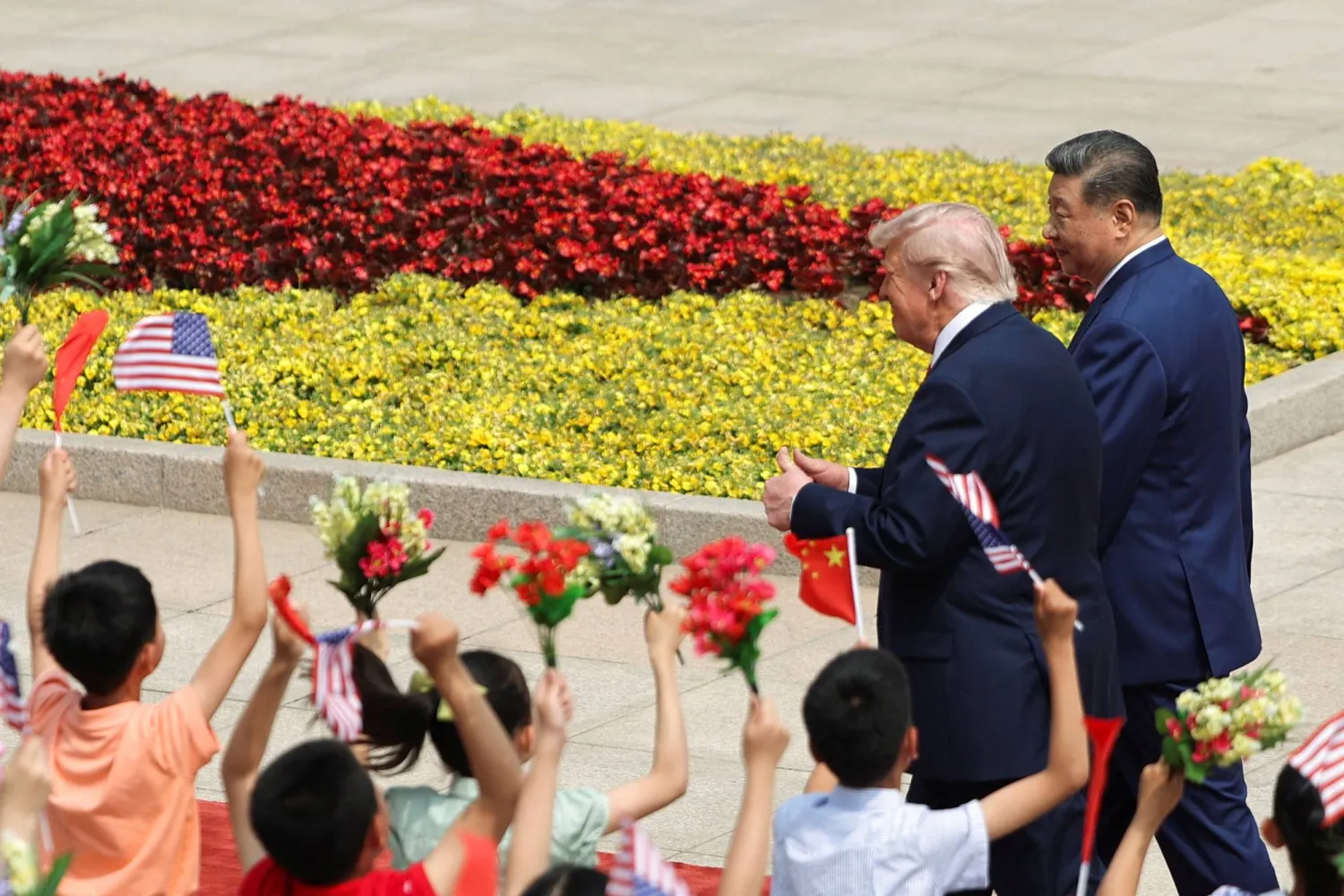

Xi and Trump Meet in High-profile Summit in Beijing

Children hold Chinese and US flags, as US President Donald Trump participates in a welcome ceremony with Chinese President Xi Jinping at the Great Hall of the People in Beijing, China, May 14, 2026. REUTERS/Maxim Shemetov/Pool
TT

Xi and Trump Meet in High-profile Summit in Beijing

Children hold Chinese and US flags, as US President Donald Trump participates in a welcome ceremony with Chinese President Xi Jinping at the Great Hall of the People in Beijing, China, May 14, 2026. REUTERS/Maxim Shemetov/Pool

Presidents Xi Jinping and Donald Trump on Thursday wrapped up a meeting in Beijing after about two hours of discussions focusing on trade, Taiwan and other differences in the US-China relationship.

In a closed-door meeting, Xi told Trump that if Taiwan is handled well, US-China relations “will enjoy overall stability,” according to a readout of their bilateral talks published by the official Xinhua news agency.

If not, however, the two countries risk “clashes and even conflicts, putting the entire relationship in great jeopardy,” Xi was reported to have said.

The US and China should be “partners rather than rivals,” Xi told Trump ahead of their bilateral talks.

“I always believed that the common interests between China and the US outweigh their differences,” Xi said. “Cooperation benefits both sides, while confrontation harms both.”
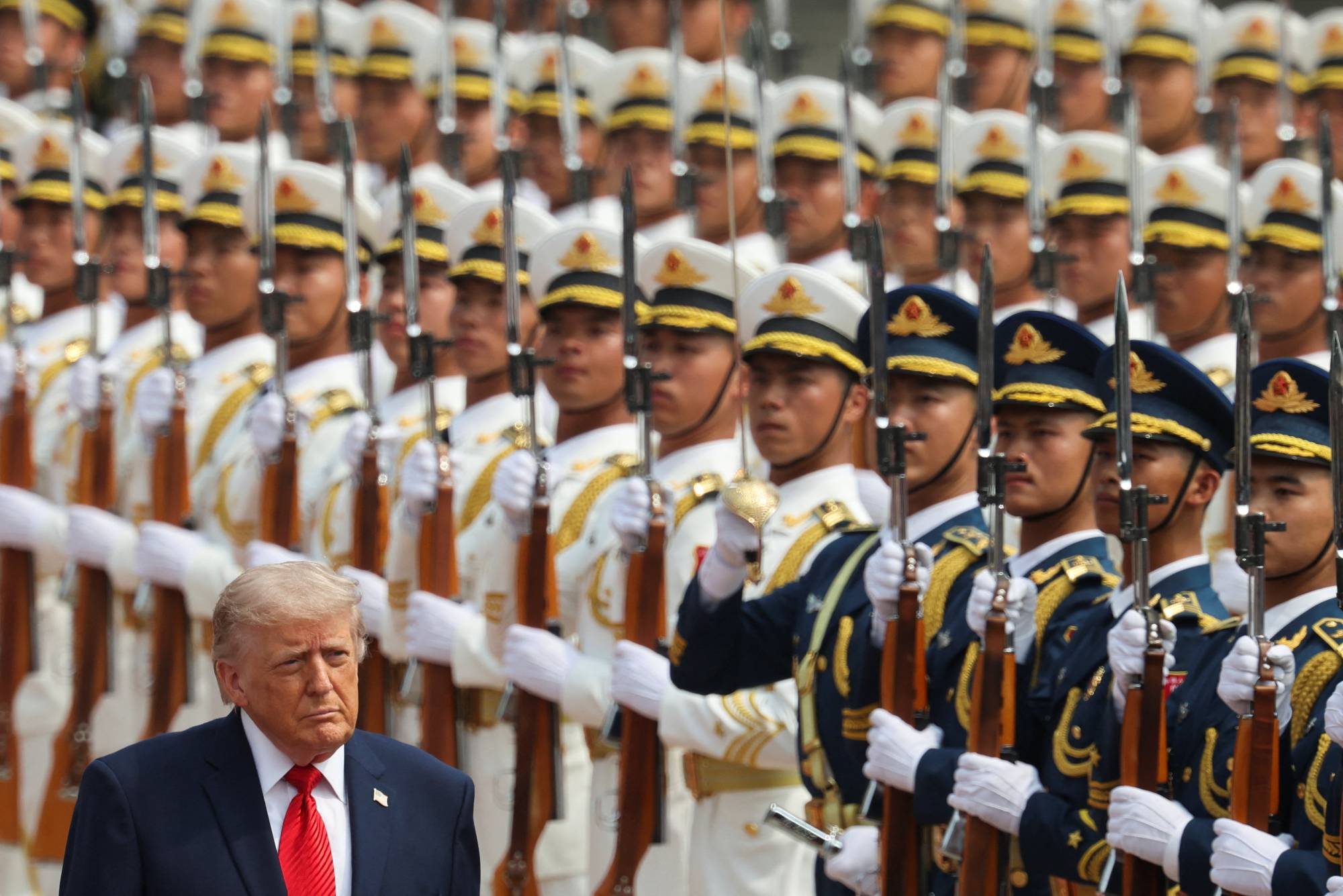
US President Donald Trump inspects an honor guard during a welcome ceremony at the Great Hall of the People, in Beijing, China, May 14, 2026. REUTERS/Maxim Shemetov/Pool

The leaders offered warm words about each other and hope for the future of US-China relations as they opened their bilateral talks.

But Xi sounded more cautionary about what lies ahead for the world’s biggest economic powers.

“Cooperation benefits both sides, while confrontation harms both,” Xi said. “The two countries should be partners rather than rivals, achieve success together and pursue common prosperity, and chart a correct path for major-country relations in the new era.”

In remarks welcoming Trump, Xi name-checked an ancient Greek historian to express his hopes that the US and China can avoid conflict, saying that history, the world and its people were asking “whether the two countries can transcend the “Thucydides Trap” and forge a new model for relations between major powers.

“He was using a term that’s popular in foreign policy studies, referring to the idea that when a rising power threatens to displace an established power, the result is often war.

It comes from Thucydides’ account of the destructive Peloponnesian War between Athens and Sparta, in which he remarked that “It was the rise of Athens, and the fear that rise engendered in Sparta, that made war inevitable.”

The Chinese leader in his opening remarks at the summit underscored the importance of the moment for the two world powers and said the question before China and the United States is “whether the two countries can work together to meet challenges and bring greater stability to the world.”

“Can we, in the interest of the well-being of our two peoples and the future of humanity, build a brighter future together for our bilateral relations?” Xi said.

Trump only made glancing allusion to past difficulties in his yearslong relationship with Xi.

Those include two trade wars, tensions over US support for Taiwan — and Trump's impatience with Beijing over the flow precursor chemicals used to make fentanyl.



New Labour Leader Burnham Vows to Renew Hope as Next UK PM

Andy Burnham speaks after being confirmed as the Labour Party's new leader and the country's next prime minister during "Labour’s Special Conference" in central London, Britain, 17 July 2026. (EPA)
TT

New Labour Leader Burnham Vows to Renew Hope as Next UK PM

Andy Burnham speaks after being confirmed as the Labour Party's new leader and the country's next prime minister during "Labour’s Special Conference" in central London, Britain, 17 July 2026. (EPA)

Andy Burnham vowed Friday to restore "hope" to the British people as he officially became the ruling Labour party's new leader, and incoming UK prime minister.

Nicknamed the "King of the North" for a nine-year spell as Manchester mayor, Burnham pledged to work to improve living standards in every region of the United Kingdom.

"People and places ... have been waiting too long for politics to let them hope again ... We're going to give them hope back," he promised at a special party conference.

"I am for us, for all of us," Burnham told cheering delegates.

The 56-year-old takes over from Keir Starmer, who resigned last month after months of political turmoil, scandal and domestic policy missteps.

Centre-left Labour retains an overwhelming majority in parliament after the 2024 general election. As the leader of the largest party he becomes the country's prime minister, without having to call new polls.

Burnham will enter Downing Street on Monday after meeting King Charles III, becoming the UK's seventh prime minister in a decade.

It is only four weeks since Burnham sensationally returned as a member of parliament following a nine-year absence, determined to replace Starmer.

Labour MPs reckon he is their best chance of reining in Nigel Farage's anti-immigrant Reform UK party, tipped in the polls to win the next general election, expected in 2029.

Burnham's flagship idea is devolving powers to cities and regions, including by setting up a "Number 10 North" office.

Hailing from the party's so-called soft left, he favors more public control of services, such as water, and reindustrialization.

"If we want an economy and a country that works for all people and places ... then it requires a new path to the one we've been on for the last 40 years," he said.

Burnham has pledged to boost the construction of public housing to try to resolve the homelessness crisis, and pump resources into social care.

After facing no challengers, he becomes leader at his third attempt, following failed bids in 2010 and 2015.

Burnham was an MP between 2001 and 2017, serving as a minister in Tony Blair and Gordon Brown's governments.

He has since reinvented himself as a man of the people, melding a relaxed folksy style with slick social media videos.

Labour MPs see him as a better communicator than Starmer and hope will take a more radical approach to reforming Britain's battered public services.

"It feels like a fresh start. There's reason to be hopeful," Labour MP Richard Baker told AFP after Burnham's speech.

- New leader, old problems -

Starmer returned Labour to power after 14 years in opposition in July 2024 with a landslide victory over the Conservatives, who had churned through five prime ministers in the tumult unleashed by the 2016 Brexit referendum.

But his premiership quickly became characterized by domestic policy missteps and controversies, including his appointment of ex-Jeffrey Epstein associate Peter Mandelson as ambassador to Washington.

Disastrous local and regional election results in May heaped further pressure on Starmer, which became impossible to withstand after Burnham won a parliamentary by-election on June 18, allowing him to run for leader.

Burnham, regularly seen in his trademark dark T-shirt and casual jacket, secured the backing of 379 of Labour's 403 MPs, with no one mustering the 81 nominations required to challenge him.

He will face the same unenviable challenges that beset Starmer: a tepid economy, high government borrowing costs, a ballooning welfare bill and irregular migrants arriving in small boats that have fueled support for Reform.

Unpredictable energy prices due to the US-Iran war and a volatile American president in Donald Trump also threaten to buffet his premiership.

Burnham has vowed not to raise the country's main taxes, but will need to fill a £4.7-billion ($6.3-billion) gap over four years in the country's defense investment plan.

"Most of what's been said by Burnham and his supporters so far has been pretty vague," politics professor Tony Travers told AFP.

"He's going to have to come out with a visible plan and policies people understand ... pretty quickly," or he risks "losing momentum," Travers added.


Magnitude 7.4 Quake Hits Mexican Coast Near Guatemala, Triggers Tsunami Threat

People evacuate a building after a powerful 7.4-magnitude earthquake struck off the coast of Mexico's southern state of Chiapas, triggering a tsunami warning and shaking buildings in neighboring Guatemala and El Salvador, in San Salvador, El Salvador, July 17, 2026. (Reuters)
TT

Magnitude 7.4 Quake Hits Mexican Coast Near Guatemala, Triggers Tsunami Threat

People evacuate a building after a powerful 7.4-magnitude earthquake struck off the coast of Mexico's southern state of Chiapas, triggering a tsunami warning and shaking buildings in neighboring Guatemala and El Salvador, in San Salvador, El Salvador, July 17, 2026. (Reuters)

A powerful 7.4 magnitude earthquake struck near the coast of Mexico's southern state of Chiapas on Friday, triggering a tsunami warning and shaking buildings in neighboring Guatemala and El Salvador.

No damage was immediately reported by authorities.

The quake, which struck near the Mexican ‌town of ‌Puerto Madero, was at a ‌shallow ⁠depth of 10 ⁠km (6 miles), the US Geological Survey (USGS) said.

Following the tremor, the US Tsunami Warning System warned that hazardous tsunami waves were possible along coasts located within 300 km (186 miles) ⁠of the epicenter.

In Guatemala ‌City, the ‌earthquake shook buildings and prompted some residents to ‌dash from their homes on ‌to the street, according to a Reuters witness.

Local media in Guatemala showed footage of staff evacuating a government ‌building as security protocols were activated.

The tremor was also felt ⁠in ⁠El Salvador, another Reuters witness said.

In the southern Mexican state of Oaxaca, Governor Salomon Jara said on social media that the earthquake was felt with moderate intensity in the state's capital, but no serious damage was immediately reported.


France, Germany Expand Defense Partnership as Europe Seeks More Military Autonomy

 German Chancellor Friedrich Merz and French President Emmanuel Macron shake hands after a press conference at Schloss Augustusburg in Bruehl, Germany, July 17, 2026. (Reuters)
German Chancellor Friedrich Merz and French President Emmanuel Macron shake hands after a press conference at Schloss Augustusburg in Bruehl, Germany, July 17, 2026. (Reuters)
TT

France, Germany Expand Defense Partnership as Europe Seeks More Military Autonomy

 German Chancellor Friedrich Merz and French President Emmanuel Macron shake hands after a press conference at Schloss Augustusburg in Bruehl, Germany, July 17, 2026. (Reuters)
German Chancellor Friedrich Merz and French President Emmanuel Macron shake hands after a press conference at Schloss Augustusburg in Bruehl, Germany, July 17, 2026. (Reuters)

The leaders of Germany and France pledged on Friday to deepen defense cooperation and counter intense economic competition from China, which they said was exerting drastic pressure on Europe through overcapacity and an undervalued currency.

German Chancellor Friedrich Merz and French President Emmanuel Macron met as part of a regular series of joint cabinet meetings, looking to get past tensions over the collapse of a much-touted joint fighter jet project earlier this year.

"We are doing what is necessary to safeguard our freedom, our security and ‌our collective defense," ‌Merz told a joint press conference at which ‌the ⁠two outlined a ⁠list of objectives including missile defense and long-range strike systems.

Both leaders took aim at China, which they said was not respecting the rules of international trade by offering at least eight times the level of state support to its industry seen in other countries in the Organization for Economic Co-operation and Development (OECD).

"We are by no means anti-Chinese, either in ⁠our diplomacy or in our economy, but we take ‌a clear-eyed view," Macron said, adding that ‌Europe ran up a trade deficit with China amounting to 1 billion ‌euros ($1.14 billion) a day.

COOPERATION ON NUCLEAR DETERRENCE

The two leaders had ‌already outlined proposals for France to cooperate on nuclear deterrence with Germany, following increasingly clear signs from Washington that the United States was looking to reduce its defense commitments in Europe.

"We're taking a step-by-step approach here, and it may ‌well end up resulting in a new doctrine, but it’s far too early to say that today," ⁠Merz said, adding ⁠that any cooperation would complement existing arrangements within the NATO alliance.

Macron made clear that France would maintain full responsibility for paying for its nuclear deterrent.

"The funding for the French nuclear program will always be provided by France," he said when asked whether France was considering having Germany contribute to co-fund the program.

The so-called Future Combat Air System (FCAS) is set to continue despite the decision to abandon plans for a common fighter aircraft, with further development on the cloud-based information systems at the heart of the project.

"The remaining projects, including those relating to the cloud and other areas, are continuing to progress between our manufacturers," Macron said.