


Somalia is in a Deadly Drought again. Most Humanitarian Aid Isn't there this Time

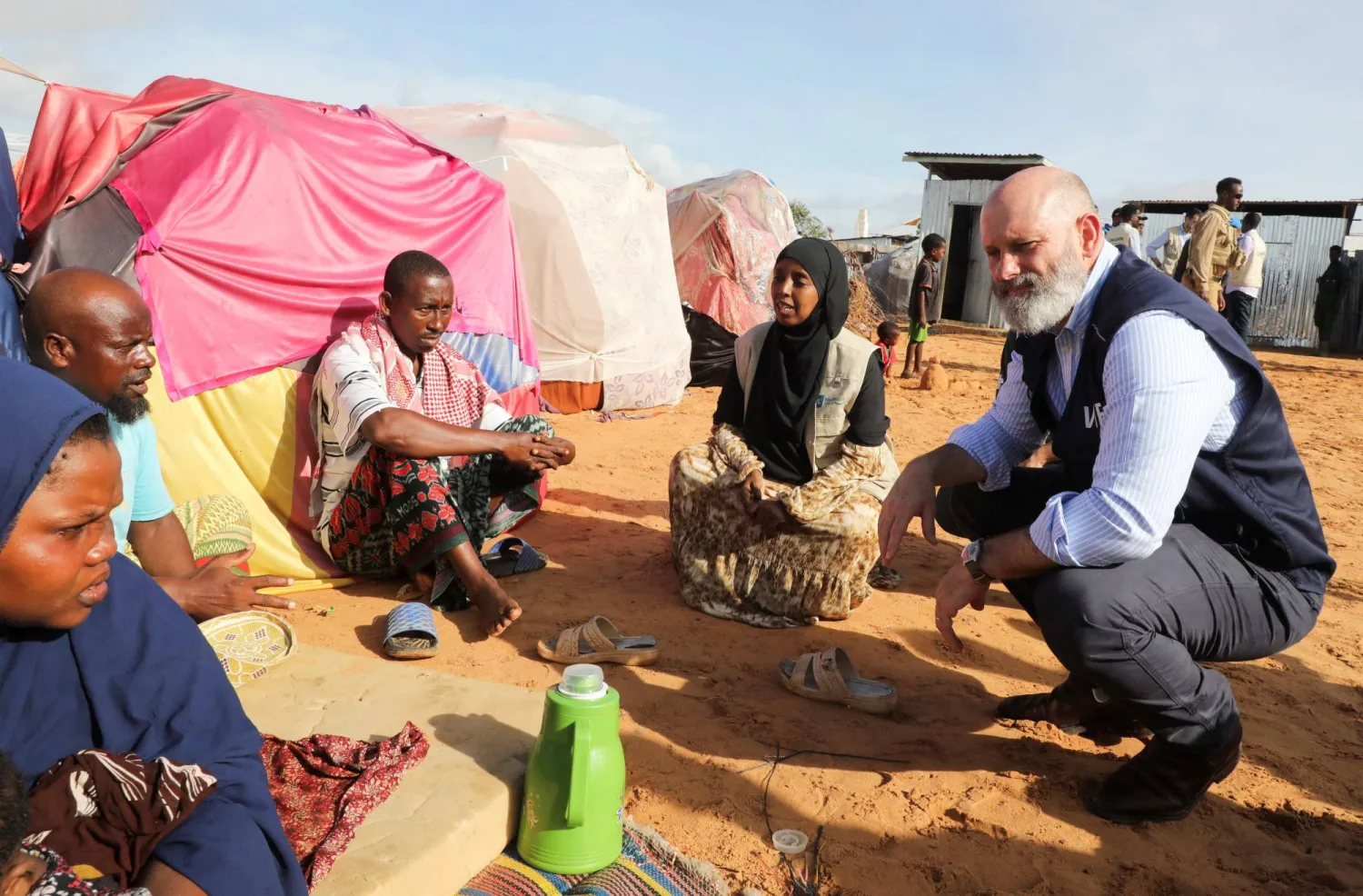
The World Food Program’s Assistant Executive Director for Program Operations, Matthew Hollingworth, talks to civilians during his visit to a camp for the internally displaced people to assess the knock on effects from the escalation in the Middle East, alongside drought and sharp cuts in humanitarian funding that are worsening hunger, in Kahda district of Mogadishu, Somalia May 7, 2026. REUTERS/Feisal Omar
TT

Somalia is in a Deadly Drought again. Most Humanitarian Aid Isn't there this Time

The World Food Program’s Assistant Executive Director for Program Operations, Matthew Hollingworth, talks to civilians during his visit to a camp for the internally displaced people to assess the knock on effects from the escalation in the Middle East, alongside drought and sharp cuts in humanitarian funding that are worsening hunger, in Kahda district of Mogadishu, Somalia May 7, 2026. REUTERS/Feisal Omar

Most of Abdi Ahmed Farah’s hundreds of goats have died. It has not rained steadily in this part of Somalia for three years, something the 70-year-old never thought possible.

He is in debt from buying water. The reservoir outside his tent is nearly empty. His family is down to one meal a day: rice with sugar and oil. The youngest of his 22 children was born three weeks ago and his wife produces only occasional drops of breast milk.

“I have considered abandoning my family because I cannot provide for them,” said Farah, sitting in front of dwindling food supplies, as if on guard.

Yet another drought is affecting millions of people across Somalia, one of the world's most vulnerable countries to climate shocks. Some rivers are dry. Crops have withered. Experts say the drought could be among the worst in Somali history, The Associated Press said.

The crisis is compounded by aid cuts, most dramatically by the Trump administration, and rising prices from the Iran war. Somalia buys most of its fuel from the Middle East, and 70% of its food is imported.

Production of staple crops of maize and sorghum in the October-December rainy season was the lowest on record in Somalia, according to the UN Food and Agriculture Organization.

Food security experts warn that nearly a half-million children might face severe acute malnutrition, the harshest kind. That would be higher than the number of children requiring treatment for it during droughts in 2011 and 2022, according to UNICEF.

‘It’s a repeated climate shock' "2026 is the worst year on record for Somalia in terms of drought,” said Hameed Nuru, the UN World Food Program director for Somalia. “Children have started dying.”

The Somali government and United Nations estimate that 6.5 million people face crisis levels of hunger, representing a third of the country’s population and a 25% increase since January.

Aid agencies are trying to maximize resources, and the Somali diaspora is sending money to help, but humanitarian workers warn it is not enough.

“This drought is not just another cycle of dry season. It’s a repeated climate shock with shrinking humanitarian support,” said Mohamed Assair, a manager with Save the Children in Puntland, a semi-autonomous region.

People drank dirty rainwater and got sick

Farah once had 680 goats, but a lack of food and water as well as diseases exacerbated by drought have claimed all but 110 of them, barely clinging to life.

“There is no market for my goats because they are so thin. Previously we would trade them for rice, but now we can’t,” he said. Farah’s family has been at a site outside Usgure village for 10 days. Almost a dozen goat carcasses lie nearby.

In Usgure, home to 700 families, community leader Abshir Hirsi Ali said the local economy has collapsed because they rely on pastoralists like Farah. Shops have closed and food rations have run low.

A recent, brief shower brought puddles of dirty rainwater. “Some families were so desperate they drank it ... now there is a high number of people with fever,” Ali said.

Save the Children occasionally brings free water to Usgure, but private water trucks have quadrupled their prices and the cost of a 50-kilogram (110-pound) bag of flour has increased by a third, to $40.

“I’m not only afraid for my family but the future of the whole village,” said Muhubo Tahir Omar, a 47-year-old mother of 11 children.

Omar, like other parents, had sold her goats to pay for school fees, “but when we didn’t pay, the teachers left.” Her last goat is now sick.

‘Conflict made our situation even worse’ Decades of conflict in Somalia have displaced millions of people. The drought has displaced another 200,000 this year, the UN estimates.

Some families flee across harsh landscapes with limited supplies.

“People are on the move ... and when people move, people die,” said Kevin Mackey, the Somalia director for humanitarian group World Vision. He recently met people who had walked for nine days to get aid in Dollow in the south.

Around 80 families live in a displacement camp outside Shahda village in Puntland.

Shukri, a 20-year-old mother of four, usually can eke out one meal a day from handouts. Now there is nothing to eat and limited access to clean water.

“The children got diarrhea (from dirty water) and malnourishment worsened,” said Shukri, who gave only her first name. “I know a few people who have died.”

Many people head to Mogadishu, the capital, where food also remains scarce.

Fadumo, a 45-year-old mother of seven, moved there from Lower Shabelle, where livelihoods were already threatened by al-Qaeda-linked al-Shabab militants.

“The water sources we depended on for farming, including the river, dried up,” Fadumo said. “Conflict made our situation even worse, forcing us to flee."

‘The outlook is deeply concerning’ Drought ravaged Somalia in 2022 and an estimated 36,000 people died, according to the UN. Now the kind of aid that was rushed to respond to such crises is shrinking.

“Unless there is a sudden and substantial response from donors, the outlook is deeply concerning. A drought of similar severity in 2022 received a response five times greater than what we are seeing,” said Antoine Grand, head of the International Committee of the Red Cross in Somalia.

Aid funding to Somalia dropped to $531 million in 2025 in large part because of aid cuts by the United States, which had been Somalia's top donor. In 2022, aid funding was nearly five times as much at $2.38 billion.

WFP said it intended to help 2 million people with food aid this year but has reached only 300,000 because of funding gaps.

A center at the hospital in Qardho, Puntland, treats children with severe acute malnutrition. But therapeutic milk is now rarely in stock, and nurses resort to homemade alternatives such as cow's milk, said director Shamis Abdirahman.

The center receives around 15 children a month, but they expect more as displaced people arrive.

One 4-year-old, Farhia, weighs a scant 7.5 kilograms (16.5 pounds). Her eyes are sunken and her bones are prominent under her skin.

Her family fled to Qardho when all of their goats died, said her mother, Najma.

“I don’t know what to hope for, or see how we can get back to what we had,” she said.


Israel Rejects Lebanon Withdrawal, Presses on With Destruction in South

Rubble of homes in the town of Mayfadoun, with traces of a large explosion that struck in southern Lebanon seen in the background (Asharq Al-Awsat)
TT

Israel Rejects Lebanon Withdrawal, Presses on With Destruction in South

Rubble of homes in the town of Mayfadoun, with traces of a large explosion that struck in southern Lebanon seen in the background (Asharq Al-Awsat)

Israel has hardened its stance against Lebanese demands for a withdrawal, insisting it will remain in a “security zone” it has carved out inside Lebanon covering about 700 square kilometers.

Israeli Defense Minister Israel Katz summed up the policy bluntly: “We destroy there and build here,” referring to Lebanon and Israel.

The position poses a major challenge to Lebanon and to US-led mediation aimed at securing an Israeli withdrawal and placing all weapons across Lebanese territory exclusively under state control.

US General Joseph Clearfield, head of the Military Coordination Group for Lebanon (MCG4L), is visiting Tel Aviv with Lebanese proposals for a mechanism to inspect designated pilot zones and plans to expand them.

He is due back on Friday to discuss with the Lebanese army the proposed arrangements and missions for implementing the “framework agreement.”

Lebanese President Joseph Aoun and Prime Minister Nawaf Salam discussed developments in the south, particularly continued Israeli attacks and the destruction and demolition of homes and property in several villages and towns.

They also discussed Clearfield’s visit and reviewed items on the cabinet meeting agenda, the Lebanese presidency said.

Three-pronged destruction plan

Israel is pressing ahead in the border area with a three-pronged destruction campaign: bulldozing homes and civilian structures, burning buildings still standing, and blowing up tunnels, homes and other civilian facilities.

Security sources in southern Lebanon told Asharq Al-Awsat that what Lebanese observers could see in the occupied area was “the destruction of all urban infrastructure and the obliteration of the manifestations of life.”

They said Israel was also building military positions and raising mounds over the ruins of homes and villages.

The work was advancing “at a rapid pace,” the sources said, with explosions intensifying over the past two weeks alongside military measures, deployments across towns along the Yellow Line and incursions toward nearby villages.

Ministerial sources told Asharq Al-Awsat that the most dangerous Israeli action in the south was the reshaping of border towns and villages.

The villages no longer resemble what they once were, the sources said, citing changes to the geography of towns and neighborhoods, the opening of new roads and the razing of homes and orchards.

Some villages had not originally been fully surveyed topographically, they added, deepening the impact of the changes underway.

Salam on Wednesday condemned the Israeli bulldozing and demolitions.

“Attempts to justify the razing and destruction on the grounds that military facilities are being targeted are contradicted by the nature of what is actually being struck on the ground,” he said.

“Lebanon’s sovereignty, the security of its people and the right of southerners to return to their land and rebuild their villages are not matters open to compromise.”

After the post was published, Salam’s account on X was hacked and the statement deleted. He later reposted it.

Bulldozing reaches Bani Hayyan

After carrying out hundreds of explosions and bulldozing operations in the border area, the Israeli army on Thursday began razing homes in Bani Hayyan, about 10 kilometers from the border.

The move came two days after a large explosion in the town and marked the first incursion by Israeli bulldozers there.

Local media reported Israeli sweeping operations in Bani Hayyan alongside shelling and the burning of several homes. Israeli military vehicles were also seen moving around the town.

An Israeli infantry force was also reported moving between Aita al-Jabal and Beit Yahoun in the Bint Jbeil district.

Systematic destruction

The repeated explosions and bulldozing point to a systematic Israeli strategy of destruction, one Katz described openly on Thursday after touring southern Lebanon a day earlier and highlighting the scale of the damage caused by Israeli forces.

He said he had seen “the homes of dozens of villages, the Lebanese border villages, that were destroyed, demolished and turned into ruins,” claiming they had been “Hezbollah positions in every sense of the word.”

“Here we build, and there is ruin,” Katz said, adding that Israel had “removed once and for all” the threat he said those areas had posed.

Katz said the Israeli army now controls about 700 square kilometers of what Israel calls a “security zone” inside Lebanon, stretching “from the sea area in the west to al-Shaqif and the outskirts of the summit of Mount Hermon in the east.”

He described the area as “empty of residents” and said Israeli troops were deployed there while what he called Hezbollah infrastructure above and below ground was being destroyed.

Long-term occupation

Katz said Israel would not withdraw from the territory it occupies in southern Lebanon until Hezbollah was disarmed and what he called its “threat” eliminated across the country.

He said he had ordered the military to prepare for a “long-term presence” there.

“This position is clear and we stand behind it, the prime minister and I, whether in direct talks with the US leadership or in practice and everywhere,” Katz said.

He said he had instructed the army “to prepare for a prolonged presence in the area in order to protect the fighting forces and the communities until this goal is fully achieved.”

“We promised the residents of the north security, and that is exactly what we have done and what we will do,” he added.

Katz also said on Thursday that Israel’s position on remaining in Lebanon had been raised “in direct talks with the US leadership,” underscoring the continuing dispute over how the framework agreement should be interpreted and the conditions for withdrawal.

A senior US State Department official had said that “a permanent Israeli military presence in southern Lebanon is inconsistent with the commitments made under the framework agreement and is not compatible with long-term peace and security for both countries.”

The official said Washington remained committed to the agreed path for the gradual redeployment of Israeli forces, alongside steps to verify Hezbollah’s disarmament and the destruction of its military infrastructure.


Yemeni Forces Repel Houthi Attacks on Multiple Fronts

Yemeni Forces repel Houthi attacks on several fronts - Military Media
TT

Yemeni Forces Repel Houthi Attacks on Multiple Fronts

Yemeni Forces repel Houthi attacks on several fronts - Military Media

The Iran-backed Houthi group has intensified attacks across several fronts in Yemen, striking civilian areas and facilities in Taiz as government forces said they had repelled assaults and infiltration attempts in Taiz, Shabwa and Dhale and inflicted losses on the group.

Military and local sources said the Houthis had attacked military positions and civilian areas in several locations in recent hours, pointing to a widening of fighting across multiple fronts.

In the southwestern province of Taiz, Houthi mortar fire struck a mosque and a school in Maqsab village in the al-Atqa area of Mawza district, damaging both buildings but causing no casualties, local sources said.

The attack on the mosque came hours after the Houthis shelled al-Jeel al-Jadeed school in the same area.

The sources said the strikes were part of continuing Houthi attacks on places of worship, schools, civilian facilities and residential neighborhoods in the province.

On the northeastern front of Taiz city, the Houthis shelled government positions at Tabbat al-Wakeel and Tabbat al-Mawshki with medium weapons and projectiles, causing no casualties among the troops, a military source was quoted by Yemen’s Saba news agency as saying.

Government forces returned fire on Houthi positions near the Sofitel and International Hospital sites, silencing the sources of fire as clashes continued.

Fighting spreads across fronts

Clashes also spread to the Hayfan front southeast of Taiz, where the two sides fought in Ayrim, al-Mafalis, Tabbat Saeed Taha, al-Abliya and al-Manzara with light, medium and heavy weapons.

Local and military sources said government forces repelled a Houthi attack and forced the fighters to retreat, while continuing to target their firing positions. The forces said they remained ready for further attacks.

In Shabwa province, government troops thwarted Houthi attacks and infiltration attempts on fronts in Harib, Ain, Bayhan and Upper Markha districts.

A military source said forces deployed in the province foiled the infiltration attempts and inflicted losses in personnel and equipment. Government drones then struck Houthi positions and reinforcements in response, the source said.

In Dhale province, artillery fire hit Houthi gatherings and reinforcements near al-Fakher market west of Qataba as the fighters prepared to attack government positions, killing or wounding a number of them. Drone strikes also targeted the reinforcements.

Houthi media report 84 dead in a week

Houthi media acknowledged the deaths of 84 fighters over roughly a week, including 28 field commanders, in an indication of the scale of the group’s reported losses.

The toll included 47 fighters whose funerals were held over two days, among them 14 officers.

Forty of those reported killed were from Sanaa province, while others came from Dhamar, Amran, Hajjah, Saada, Mahwit and Ibb.

The figures announced by Houthi media suggest the losses extended into the group’s field command and were spread across several areas under its control.

The escalation comes as Rashad al-Alimi, Chairman of Yemen’s Presidential Leadership Council, said the state’s position toward the Houthis had changed and that any attack by the group would face a coordinated response and deterrence.

Al-Alimi said the armed forces were now operating through a single operations room and were better prepared to protect civilians, facilities and national institutions.

He said the state’s strategic goal was to restore its institutions and end the coup.

Al-Alimi said the government’s experience over recent years had shown that the Houthis used truces to rebuild their military capabilities and prepare for renewed fighting.

The government, he said, did not want another truce that repeated previous experiences, but a lasting peace based on a state that held sole authority over arms and sovereignty.

He said Houthi attacks on oil facilities and international shipping, along with threats to regional security, had helped shift international perceptions of the group.

The international question, in his view, was increasingly how to protect the Yemeni state, waterways and international peace and security rather than merely how to accommodate the Houthis.

Al-Alimi said the most significant military development was the growing unity and coordination among the fronts, citing simultaneous activity in Marib, Taiz, Shabwa, Dhale, Lahj, Hajjah, Saada and elsewhere.

He urged Yemen’s armed forces to protect civilians and respect the law, saying the strength of the state rested not only on weapons but also on the values and institutions it sought to restore.

Addressing the Houthis, Al-Alimi said the group still had an opportunity to lay down its weapons, enter political life and compete through the ballot box.

Yemen, he said, had room for everyone under the authority of the state and the law.


Israeli Strikes in Gaza Kill Two Including Senior Policeman

Palestinian firefighters attempt to extinguish a fire after an Israeli military strike targeted a vehicle belonging to Gaza Police Chief Jamal Abu Kamil south of Gaza City, 13 August 2026. (EPA)
TT

Israeli Strikes in Gaza Kill Two Including Senior Policeman

Palestinian firefighters attempt to extinguish a fire after an Israeli military strike targeted a vehicle belonging to Gaza Police Chief Jamal Abu Kamil south of Gaza City, 13 August 2026. (EPA)

Israeli strikes in Gaza killed two people including a senior police officer on Thursday, health officials said, the second straight day of bombardment after a lull due to a US peace push.

The Israeli military said it struck a Hamas commander in the Khan Younis area who it said had been planning attacks against troops, in the second such targeting in as many days.

"The terrorist was struck in an aerial strike in order to remove the threat to Israeli troops," the military said, adding that "steps were taken to mitigate harm to civilians."

Gaza's civil defense agency, which operates as a rescue service under Hamas, said an airstrike west of Khan Younis killed one person, with the city's Nasser Hospital confirming the arrival of a body following the attack.

In a separate incident in Gaza City, the civil defense said one person was killed and several others injured in an Israeli strike on a vehicle in the Sheikh Ajlin neighborhood.

Al-Shifa Hospital said it had received the body of Gaza City's police governor Jamal Abu Kamil.

Gaza's interior ministry confirmed Abu Kamil "was assassinated in an Israeli airstrike targeting his vehicle on Al-Rashid Street, southwest of Gaza City".

When contacted by AFP, the Israeli military said it was checking the reports.

Israel on Wednesday carried out its first airstrike in Gaza since August 3.

The hiatus in airstrikes came after US President Donald Trump's announcement of a "major milestone" in his plan to end the war.

Hamas had announced that it would disarm by giving its weapons to a nascent Palestinian governing committee.

Trump's Board of Peace, in charge of implementing the ceasefire deal, had initially announced that Israel in turn would start a phased withdrawal from much of the Gaza Strip.

But Prime Minister Benjamin Netanyahu on Sunday publicly rejected the deal and vowed no Israeli pullout, even after the Board of Peace reassured him that Israel would not have to withdraw until complete Hamas disarmament.

Israeli operations in Gaza have killed 1,260 Palestinians since the ceasefire, according to the territory's health ministry, which operates under Hamas authority and whose figures are considered reliable by the United Nations.

The Israeli army has reported five deaths in its ranks during the same period.
