

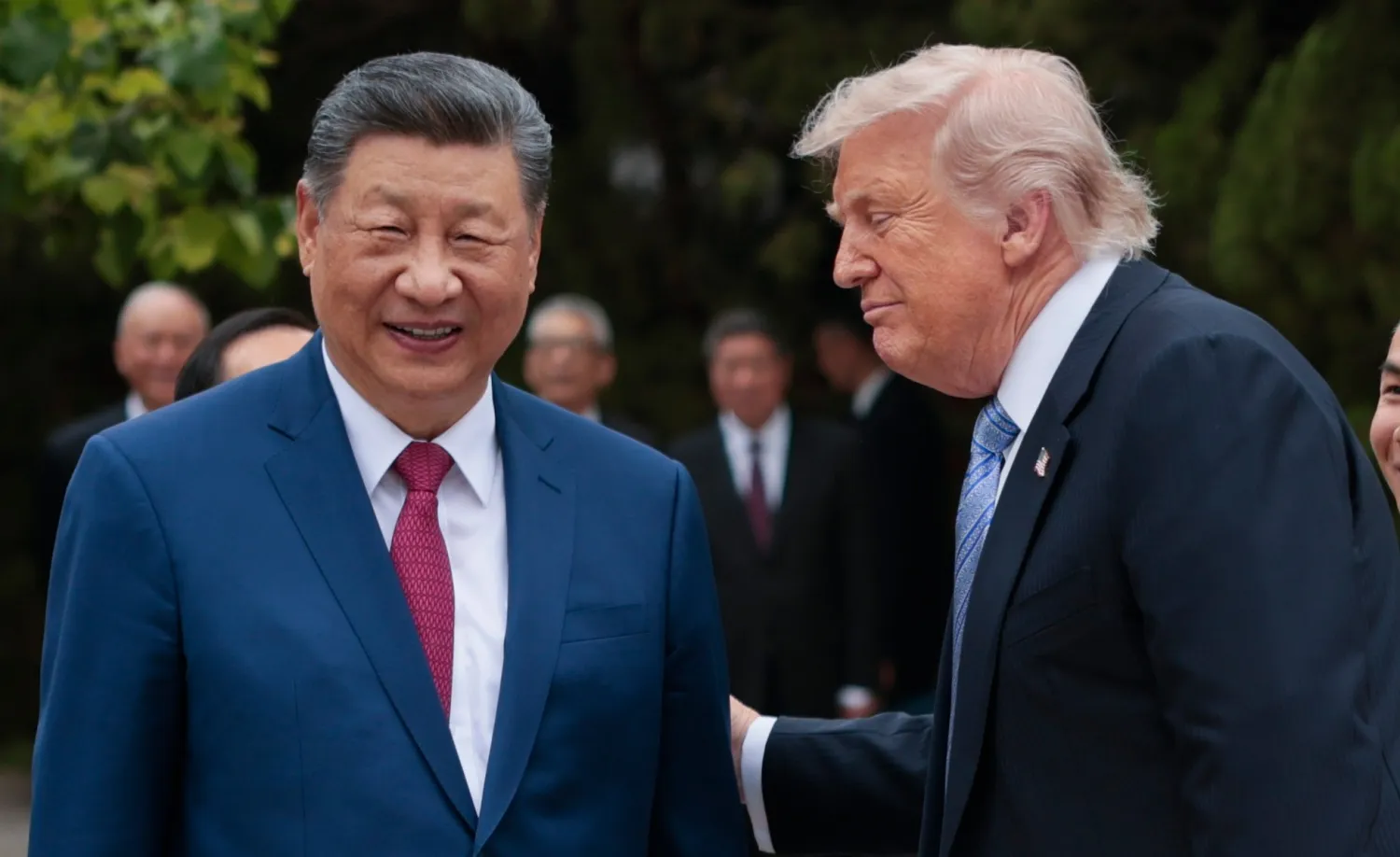

Trump Says He and China’s Xi Agree Iran Cannot Have Nuclear Weapons

US President Donald Trump, right, speaks with Chinese President Xi Jinping while leaving after a visit to the Zhongnanhai Garden in Beijing, Friday, May 15, 2026. (Evan Vucci/Pool Photo via AP)
TT

Trump Says He and China’s Xi Agree Iran Cannot Have Nuclear Weapons

US President Donald Trump, right, speaks with Chinese President Xi Jinping while leaving after a visit to the Zhongnanhai Garden in Beijing, Friday, May 15, 2026. (Evan Vucci/Pool Photo via AP)

US President Donald Trump said his patience with Iran is running out and he had agreed in talks with Chinese President Xi Jinping that Tehran cannot be allowed to have a nuclear weapon and must reopen the Strait of Hormuz. 

"We’ve settled a lot of different problems that other people wouldn’t have been able to solve," Trump said on Friday after he met Xi in Beijing on the second day of talks which included the Iran war, Taiwan, trade and other issues. 

Iran effectively shut the strait to most shipping traffic in response to US-Israeli attacks which began on February 28, causing an unprecedented disruption to global energy supplies. China is close to Iran and the main buyer of its oil. 

The US paused its attacks on Iran last month but began a blockade of the country's ports. Talks aimed at ending the conflict have stalled with Iran refusing to end its nuclear program or relinquish its stockpile of enriched uranium. Tehran denies it intends to build a nuclear weapon. 

Xi did not comment on his discussions with Trump about Iran, although China's foreign ministry issued a blunt statement outlining Beijing's frustration with the Iran war. 

"This conflict, which should never have happened, has no reason to continue," the ‌ministry said. 

Trump said of ‌Iran in an interview aired on Thursday night on Fox News' "Hannity" program: "I am not going to be ‌much more patient. ⁠They should make ⁠a deal." 

On the key issue of Iran's hidden stockpile of enriched uranium, Trump suggested it only needed to be secured by the US for public relations purposes. 

"I don't think it's necessary except from a public relations standpoint," Trump said in the interview. 

"I just feel better if I got it, actually. But it's, I think, it's more for public relations than it is for anything else." 

After talks between Trump and Xi on Thursday, the White House said the leaders had agreed that the strait should be open and that Xi made clear China's opposition to the militarization of the waterway and any effort to charge a toll for its use, as Iran has threatened to do. 

Trump said Xi also promised not to send Iran military equipment. "He said he’s not going to give military equipment, that’s a big statement," Trump said ⁠on "Hannity". 

Xi also expressed interest in purchasing more American oil to reduce China's future dependence on the strait, the ‌White House readout of the talks said. 

DIPLOMACY ON HOLD 

Trump is keen to elicit Chinese support to ‌end a war that has become an electoral liability as it drags on towards key US midterm elections in November. But analysts doubt Xi will be willing to push ‌Iran hard or end support for its military, given its value as a strategic counterweight to the US. 

In an interview with CNBC from Beijing ‌on Thursday, US Treasury Secretary Scott Bessent said he believed China would "do what they can" to help open the strait, something "very much in their interest." Before the war, about a fifth of global oil and liquefied natural gas supplies passed through the waterway. 

But diplomacy has been on hold since last week when Iran and the US each rejected the other's most recent proposals. 

In the latest incidents in the strait, an Indian cargo vessel carrying livestock from Africa to the United Arab Emirates was sunk on Wednesday in ‌waters off the coast of Oman. India condemned the attack and said all 14 crew members had been rescued. 

Vanguard, a British maritime security advisory firm, said the vessel was believed to have been hit by a ⁠missile or drone which caused an explosion. 

LEBANON TALKS 

Thousands of Iranians were killed in the US and Israeli air strikes in the first weeks of the war, and thousands more have been killed in Lebanon since the war re-ignited fighting between Israel and the Iran-backed group Hezbollah. 

Talks between Lebanese and Israeli officials on Thursday in Washington were productive and positive, according to a senior State Department official, who said they were set to continue on Friday. 

Trump said his aims in starting the war were to destroy Iran's nuclear program, end its ability to attack neighbors and make it easier for Iranians to overthrow their government. 

A senior US admiral told a US Senate committee on Thursday Iran's ability to threaten its neighbors and US regional interests had been "significantly degraded". 

But Admiral Brad Cooper declined to directly address reports by Reuters and other news organizations that Iran had retained significant missile and drone capabilities. 

Iran's rulers, who used force to put down anti-government protests at the start of the year, have faced no organized opposition since the war began. Their grip on the strait has given them additional leverage in negotiations. 

Iran is seeking the lifting of sanctions, reparations for war damage and acknowledgment of its control over the strait. 


US Congress Passes Symbolic Iran War Rebuke to Trump

US Senator Chuck Schumer, the Senate Minority Leader, speaks during the weekly Senate Democrat Leadership press conference after luncheons, at the US Capitol, in Washington, DC, US, 23 June 2026. (EPA)
TT

US Congress Passes Symbolic Iran War Rebuke to Trump

US Senator Chuck Schumer, the Senate Minority Leader, speaks during the weekly Senate Democrat Leadership press conference after luncheons, at the US Capitol, in Washington, DC, US, 23 June 2026. (EPA)

The US Senate passed a largely symbolic resolution Tuesday calling for an end to President Donald Trump's war with Iran, delivering a fresh rebuke to the White House as it tries to negotiate a lasting settlement with Tehran.

The House-passed measure, adopted by the Senate in a 50-48 vote, directs Trump to remove US forces from hostilities with Iran unless Congress explicitly authorizes military action.

Because the measure is a "concurrent resolution," it does not go to Trump's desk for signature and carries disputed legal force.

But its passage still puts both chambers of Congress on record against a conflict that began with US and Israeli strikes on Iran in late February, rattled global energy markets and opened a broader regional war involving Lebanon and Gulf states.

During Trump's first term, Congress passed War Powers bills in 2019 and 2020 against military action in Yemen and Iran, respectively, but both were vetoed by Trump and the Senate failed override them.

Trump slammed the vote later Tuesday on his Truth Social platform, calling it "poorly timed and meaningless."

"These Senators have just made my job more difficult, but I will get it done, one way or the other, because I always get it done!" Trump said.

The vote came as the Trump administration pursued a 60-day diplomatic push to turn a preliminary memorandum of understanding with Iran into a final agreement covering Tehran's nuclear program, sanctions relief and the Strait of Hormuz.

Senate Democratic leader Chuck Schumer forced the vote to put Republicans on record after several Trump allies voiced alarm over both the war and the president's deal to end it.

"Republicans can complain about Trump's war, his secrecy, and his disastrous deal with Iran all they want behind closed doors, but the only way to ensure this war ends once and for all is for Republicans to act," Schumer said in a floor speech ahead of the vote.

The resolution earlier cleared the Republican-controlled House after four Republicans joined every Democrat in backing it, a rare break with Trump on matters of war and national security.

Democrats say Trump violated the Constitution by launching military operations against Iran without congressional approval.

- 'Dangerous prospect' -

Under the 1973 War Powers Act, presidents must obtain authorization from Congress within 60 days of introducing US forces into hostilities, though administrations of both parties have often contested how the law applies.

The White House has argued that resolutions seeking to curb Trump's powers to wage war in Iran are unconstitutional and says the conflict had already ended under an April ceasefire ordered by Trump.

It has also warned that restricting the president's authority could weaken Washington's leverage as negotiators seek to lock in a final deal with Iran.

Speaker Mike Johnson, a Trump ally, said before the House vote that limiting the commander-in-chief during negotiations was a "very dangerous prospect."

But Democrats and some Republicans say the fighting continued well beyond the legal deadline and that Trump has repeatedly threatened renewed strikes.

The vote also reflects growing unease in Congress over the cost of the war, which disrupted trade routes, drove up energy prices and placed new strain on US voters already worried about inflation ahead of November's midterm elections.

The administration's diplomacy with Tehran has moved quickly since Trump and Iranian President Masoud Pezeshkian signed the preliminary agreement, which was meant to halt the wider regional conflict and reopen the Strait of Hormuz.

But major disputes remain.

Iran said Tuesday that the UN nuclear watchdog would not be allowed to inspect nuclear sites bombed by the United States and Israel last year, rejecting Vice President JD Vance's claim that Tehran had agreed to allow inspectors back in.

Trump later insisted on social media that Iran had accepted "the highest level" of nuclear inspections.

Meanwhile, Tehran's top negotiator Mohammad Bagher Ghalibaf said the Strait of Hormuz would "never return" to the days of free passage before the war, despite new communication lines aimed at keeping the vital shipping route open.


New York Mayor Mamdani Sends Message to Democratic Establishment

New York City Mayor Zohran Mamdani speaks during a primary-night watch party for NYC Congressional candidate Claire Valdez at 99 Scott Studio on June 23, 2026 in the East Williamsburg neighborhood of the Brooklyn borough in New York City. (Getty Images/AFP)
TT

New York Mayor Mamdani Sends Message to Democratic Establishment

New York City Mayor Zohran Mamdani speaks during a primary-night watch party for NYC Congressional candidate Claire Valdez at 99 Scott Studio on June 23, 2026 in the East Williamsburg neighborhood of the Brooklyn borough in New York City. (Getty Images/AFP)

New York City Mayor Zohran Mamdani scored three major primary wins in his attempt to remake the Democratic Party into a democratic socialist force on Tuesday.

Mamdani-endorsed former city Comptroller Brad Lander defeated two-term Representative Dan Goldman, while Assemblymember Claire Valdez beat Brooklyn Borough President Antonio Reynoso for an open congressional seat and activist Darializa Avila Chevalier narrowly defeated five-term Representative Adriano Espaillat, chair of the Congressional Hispanic Caucus.

Taken together, those constitute big wins for the 34-year-old mayor, who shocked the political world with his 2025 election and is now consolidating his political power.

The results in New York come on the heels of democratic socialist mayoral candidates winning the primary in Washington, DC, and making the runoff in Los Angeles.

Mamdani's efforts to expand the democratic socialist base in the US follow a decade-long effort that was spurred on by Senator Bernie Sanders' surprisingly popular 2016 presidential campaign and his efforts to nurture a new generation of democratic socialist leaders.

But some analysts and former officials say it is also in response to progressive ‌Democratic voters' anger ‌at President Donald Trump's agenda and governing style, and at the Biden administration's backing of Israel's war ‌in Gaza ⁠following a Hamas-led attack. ⁠Israel's response has killed more than 73,000 Palestinians.

"Energy on the far right ignites energy on the far left. Politics is reactive," said Steve Israel, a former US House member from New York who late in his congressional career ran an operation to elect more Democrats.

DEMOCRATIC PARTY TENSIONS RUN HIGH

For months after Mamdani won his 2025 primary election, House Democratic Leader Hakeem Jeffries was dogged by reporters asking whether he would endorse his fellow New Yorker. Jeffries did so, but kept everyone guessing until just 11 days before the general election.

Meanwhile, Senate Democratic Leader Chuck Schumer of New York remained silent on Mamdani throughout the campaign.

The rub is that Jeffries is positioned to ascend to US House speaker and thus second in line for the presidency if Democrats win ⁠November's midterm elections.

The path to victory does not run through "blue," solidly Democratic congressional districts. Instead, it's ‌the "purple" swing districts where Democrats need to beat Republicans.

Nonetheless, the defeat of five-term Democratic Representative Adriano ‌Espaillat by Mamdani-backed democratic socialist Darializa Avila Chevalier carries national implications that could complicate Jeffries' task.

"If a DSA member could knock off the chair of the Congressional ‌Hispanic Caucus, that could matter," said Matt Bennett, co-founder of Third Way, a centrist Democratic consultancy.

Even more relevant could be stances Avila Chevalier ‌has touted in past social media postings, such as calling for abolishing police and border controls and raising questions about Israel's right to exist.

"This is precisely the kind of person that they (Republicans) love to use to weaponize against other Democrats" running for office in competitive races, Bennett said.

Former Representative Israel agreed and said in an interview: "I do worry that the strength of democratic socialists in places like New York and California will be misread as the center of gravity for Democrats across ‌the country" this November or in the 2028 presidential election.

Avila Chevalier has since deleted her social media posts and apologized for some of the language she used. But in an interview with a consortium ⁠of editors last week, Avila Chevalier ⁠said: "I think that we just should not have a system that allows (migrant) deportation to happen at all," saying it "is rooted in deeply racist ideology."

In response to her views, Espaillat said Avila Chevalier "can't just sweep things under the rug."

"Darializa has taken very extreme positions as reflected in her comments on social media not too long ago," he said in a June 16 posting on X. "She is unfit for office and voters are smart enough to see that."

DEMOCRATIC SOCIALISTS AGAINST DEMOCRATS

Alex Jacquez, a progressive strategist who was a senior adviser to Sanders' 2020 presidential campaign, said in an interview that focus groups and opinion polls deliver the message that Democratic voters' level of dissatisfaction with their leaders runs deep.

"That is really where you are seeing the fault lines. Are you willing to take on the wealthy and take on corporations and take on the status quo to deliver results. Or are you not," he said of the populist message democratic socialists are trying to win on this fall and through the 2028 elections and beyond.

Meantime, outside of deep-blue districts of New York, California and other Democratic strongholds, the party is running women with strong military backgrounds in places like Florida and Colorado for example.

"Most of the competitive districts for Democrats are red and pink districts that you can only win as a Democrat in ... where more moderate stances resonate in races against incumbent Republicans," Israel said.

A presidential election is not won in blue states, he added. "It's won in seven moderate battleground states."


UN Nuclear Agency Boss Says Inspectors Will Visit Iran’s Nuclear Sites Under Iran-US Interim Deal

An Iranian woman walks past an anti-US mural next to the former US embassy in Tehran, Iran, 22 June 2026. (EPA)
TT

UN Nuclear Agency Boss Says Inspectors Will Visit Iran’s Nuclear Sites Under Iran-US Interim Deal

An Iranian woman walks past an anti-US mural next to the former US embassy in Tehran, Iran, 22 June 2026. (EPA)

The head of the UN's nuclear agency signaled Wednesday that Iranian nuclear enrichment sites would be visited by his inspectors, a key component in the interim deal between the United States and Iran to reach an end to the war.

The comment by International Atomic Energy Agency head Rafael Mariano Grossi was the firmest yet from the United Nations agency, which is viewed as key in determining the status of Iran's nuclear stockpile.

Since Israel launched a 12-day war on Iran in 2025, the IAEA has been blocked by Tehran from visiting enrichment sites where the country is believed to store enough highly enriched uranium to potentially build as many as 10 nuclear weapons, should it choose to rush for the bomb.

Iran long has maintained that its program is peaceful, though it is the only country in the world to have uranium enriched up to 60% purity without a weapons program.

The US and Iran offered contradictory remarks Tuesday about whether those sites would be inspected.

Inspections are ‘going to happen’

“I can understand political statements, they are part of the reality, but the fundamental thing I would like to remind you and draw your attention to is that there has been a Memorandum of Understanding, signed by both presidents,” Grossi told journalists at a news conference at the tsunami-hit Fukushima Daiichi nuclear power plant.

The accord “says explicitly that the nuclear activities that are going to be carried out with the regards to the nuclear material facilities will be supervised by the IAEA — in all letters,” he said.

Grossi added: “Obviously, to do that, we will have to inspect. Whether this happens the day after tomorrow or in one week or in 10 days, it’s important, but not essential. This is going to happen.”

Those inspections are key for the deal, which calls for Iran’s stockpile of uranium to be “downblended” from highly enriched levels.

There was no immediate reaction from Iran.

On Tuesday, Iran’s Foreign Ministry spokesperson Esmail Baghaei told reporters in Tehran that UN inspectors were not scheduled to examine nuclear sites bombed by the US last year, rejecting comments made a day before by US Vice President JD Vance.

IAEA blocked from seeing bombed sites

The IAEA has been allowed to visit other nuclear sites in Iran since the 12-day war in 2025, such as the Bushehr nuclear power plant. But without accessing the enrichment sites, the IAEA says it is unable to verify the status of Iran's stockpile or check the cascades of centrifuges used to enrich uranium.

Both Iran and the IAEA say Tehran hasn't been enriching uranium, but nonproliferation experts worry that Iran may be moving its stockpile to undeclared areas.

The US and Iran agreed to a deal last week that calls for Tehran to dilute its stockpile of enriched uranium and waives US-backed sanctions on the country while giving each side 60 days to hammer out broader agreements.

But the uneasy ceasefire already has been tested by Iran saying it closed the strait again over fighting between Israel and the Iranian-backed Hezbollah in Lebanon. Violence again broke out in Lebanon on Tuesday, but it did not escalate.
