


Ministers Adopt New Interpretation of Migrants’ Rights in European Legal System

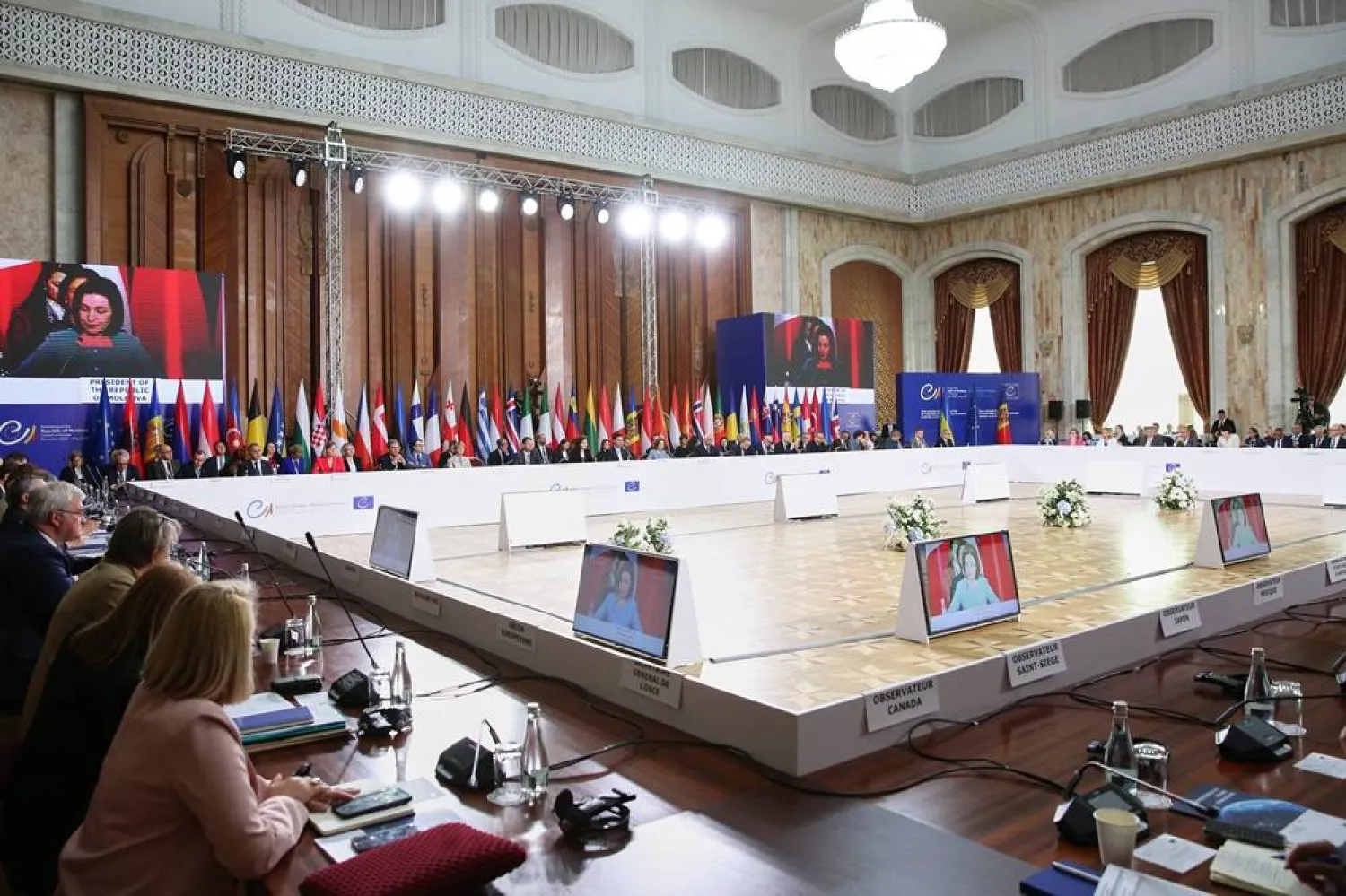
Participants attend the opening session of the 135th Ministerial Session of the Committee of Ministers of the Council of Europe in Chisinau, Moldova, Friday, May 15, 2026. (AP)
TT

Ministers Adopt New Interpretation of Migrants’ Rights in European Legal System

Participants attend the opening session of the 135th Ministerial Session of the Committee of Ministers of the Council of Europe in Chisinau, Moldova, Friday, May 15, 2026. (AP)

European ministers adopted ‌a new interpretation of the European Convention on Human Rights on Friday that could facilitate some migrant deportations, including to third country "return hubs", but which critics say will weaken human rights protections.

The declaration comes amid complaints from member states in recent years that the European Court of Human Rights has prevented governments from forcibly removing foreign nationals convicted of crimes or refused asylum seekers.

The declaration adopted at the annual session of the Council of Europe's Committee of ministers in Moldova qualifies the rights under article 3 and article 8 of the convention, which relate to protection ‌from torture and ‌inhuman and degrading treatment and the right to ‌a ⁠private and family ⁠life.

It approves cooperation with third countries on immigration, including on "return hubs", provided that the countries respect the human rights convention.

It states that prohibition from torture and inhuman or degrading treatment is absolute, but that "the assessment of the minimum level of severity of the ill-treatment that constitutes inhuman or degrading treatment or punishment is relative and depends on all the circumstances ⁠of the case".

Veronika Fikfak, Professor of Human Rights ‌and International Law at University College London, ‌said that the declaration's interpretation of article 3 was a significant development and would ‌dilute protections from torture.

"It says (prohibition of torture and inhuman or ‌degrading treatment) is absolute, but then they use words to balance and offer a relative interpretation, but this is inconsistent with the heart of Article 3 - an absolute right cannot contain any element of relativity or balance," she said.

On ‌article 8, the declaration said states can expel foreign nationals in spite of their right to a ⁠private and ⁠family life so long as it is balanced with a legitimate aim, such as national security, and that the European Court of Human Rights would require "strong reasons" to override a state's decision.

The 46-member Council of Europe was set up after World War Two to uphold human rights and the rule of law.

Council of Europe Secretary General Alain Berset welcomed the declaration and said it would guide the work of the council and of national authorities and domestic courts.

"We have been able to bring together countries across Europe, with different views and experiences to agree a common position on how the system should work best, notably in the challenging context of migration," he said in a statement.



Türkiye Must Be ‘Included’ in Europe Security Structures, Says Erdogan

Turkish President Recep Tayyip Erdogan speaks during the opening ceremony of Antalya Diplomacy Forum in Antalya, Türkiye, April 17, 2026. (Reuters)
TT

Türkiye Must Be ‘Included’ in Europe Security Structures, Says Erdogan

Turkish President Recep Tayyip Erdogan speaks during the opening ceremony of Antalya Diplomacy Forum in Antalya, Türkiye, April 17, 2026. (Reuters)

Türkiye must be included in all of Europe's defense structures and defence trade restrictions between NATO members must be removed, President Recep Tayyip Erdogan said Monday ahead of a key NATO summit.

His remarks come as Europe revamps its defenses to counter Russia and the risk of a US pullback from NATO, which is to hold a summit in the Turkish capital Ankara on July 7-8.

"Türkiye's indispensable contributions to European security are sometimes overlooked," Erdogan told parliamentary delegates from all 32 NATO member states in Istanbul. He said Türkiye wanted "to participate in all defense and security initiatives" on the continent.

At issue is Türkiye's access to the European Union's 150-billion-euro ($176-billion) Security Action for Europe (SAFE) initiative, intended to strengthen European defense capabilities.

"We expect your support, lawmakers, for Türkiye's inclusion in the defense and security initiatives announced by the European Union," Erdogan told them.

Within SAFE, firms from non-EU countries such as Türkiye, Britain and the United States can only supply up to 35 percent of the component costs of weaponry funded by the scheme.

If Türkiye wants its companies to be able to tap a bigger part of the funds Ankara needs to sign a security partnership with the EU and then negotiate special access with Brussels -- a process that would require approval from all 27 EU members. Greece has threatened to block such a move.

"Under SAFE, any third country can participate in a defense project up to a level of 35 percent. Any negotiations with a view to potentially increasing or lifting this 35 per cent cap ... would require a bilateral agreement," said Thomas Regnier, a European Commission spokesperson.

"For now, this is not an agreement we have concluded with Türkiye."

- 'Remove the obstacles' -

Erdogan also urged NATO to remove all barriers blocking defense industry trade between alliance members.

"If we want to overcome the challenges we face, we need to remove obstacles to defense industry trade while ensuring a balanced and fair burden-sharing among allies," he said.

Türkiye has the second-biggest army of the alliance after the United States and a burgeoning defense industry which has gone from strength to strength fueled by bilateral defense deals.

But its defense industry has been hit by US sanctions imposed over Ankara's purchase of an S-400 Russian surface-to-air missile defense system. Washington also booted Türkiye out of its F-35 program, in a move that has soured relations between the NATO allies.

Although Washington has expressed a desire to draw a line under the dispute, lifting the sanctions requires Congressional approval. Observers say there is little chance the showdown would be resolved before the summit.

US President Donald Trump has however pledged to give Erdogan something that would make him "very happy" when he flies in next week for the NATO gathering.

Analysts said it was likely to be a delivery of several dozen US-made F110 engines Türkiye needs for its fifth-generation KAAN fighter jets that are under development. Delivery of the engines had been blocked since the imposition of the US sanctions.


Trump Says Iran Requested Meeting to be Held in Doha Tuesday

US and Iran flags are seen in this illustration taken June 18, 2025. REUTERS/Dado Ruvic/Illustration/File Photo
TT

Trump Says Iran Requested Meeting to be Held in Doha Tuesday

US and Iran flags are seen in this illustration taken June 18, 2025. REUTERS/Dado Ruvic/Illustration/File Photo

US President Donald Trump said that Iran has requested a meeting that will be held in the Gulf state of Qatar on Tuesday, despite an earlier denial from Tehran that talks were planned.

"IRAN HAS REQUESTED A MEETING. IT WILL TAKE PLACE TOMORROW IN DOHA!" Trump posted on his Truth Social platform on Monday.

Shortly afterwards, White House spokesperson Karoline Leavitt said US negotiators Jared Kushner and Steve Witkoff would be "flying to Doha for high level meetings this week".

Iran's foreign ministry earlier on Monday denied reports that Iranian and American technical teams will meet this week to discuss the implementation of the deal to end the Middle East war.

Uncertainty over the talks followed renewed tit-for-tat attacks between the United States and Iran in recent days despite an April ceasefire and a memorandum of understanding, brokered by Pakistan and Qatar, aimed at permanently ending the war.

A diplomat with knowledge of the talks confirmed to AFP on Monday that officials from the US and Iran are to meet in Doha to discuss the accord.

"Technical teams working on the implementation of the MoU are scheduled to meet in Doha in the coming days," the diplomat said on condition of anonymity to discuss the sensitive talks.

The diplomat added "communications channels created to de-escalate any incidents are in place," following strikes between the US and Iran.


Iran Says No Technical Meeting Expected with US in Coming Days

Iranian girls walk past an anti-US mural (depicting an Iranian and US negotiation table) next to the former US embassy in Tehran, Iran, 22 June 2026. EPA/ABEDIN TAHERKENAREH
TT

Iran Says No Technical Meeting Expected with US in Coming Days

Iranian girls walk past an anti-US mural (depicting an Iranian and US negotiation table) next to the former US embassy in Tehran, Iran, 22 June 2026. EPA/ABEDIN TAHERKENAREH

Iran's foreign ministry on Monday denied reports that Iranian and American technical teams will meet in the coming days to discuss the implementation of the deal to end the Middle East war.

Both sides have traded fire in the Gulf in recent days, testing their fragile ceasefire, said AFP.

"No technical meetings of the working groups are planned for this week," Deputy Foreign Minister Kazem Gharibabadi said, quoted by state TV, referring to the Iranian week ending on Friday.

Citing US officials, American news site Axios reported on Sunday that Tehran and Washington would hold a meeting in Qatar on Tuesday to resolve their dispute over the strategic Strait of Hormuz.

CNN reported similar comments from a Trump administration official, though the White House has not issued an official statement.

Qatar, alongside Pakistan, has acted as a mediator in talks between Iran and the United States aimed at ending the war in the Middle East.

The most recent discussions between Tehran and Washington took place in Switzerland on June 21 with the attendance of delegations from all four countries.

Qatar -- located across the Gulf from Iran -- is playing a key role in the financial aspects of the negotiations.

Iran holds assets there that have been frozen due to US sanctions.

Iranian President Masoud Pezeshkian stated on Monday that the necessary steps to unfreeze these funds were "underway".

"In accordance with established plans, $6 billion out of the total $12 billion held in Qatar will be released and returned to the country," he said, quoted by the presidency.