
‘Happiest Day of Our Lives’: Gazans Hold Mass Wedding Among Ruins

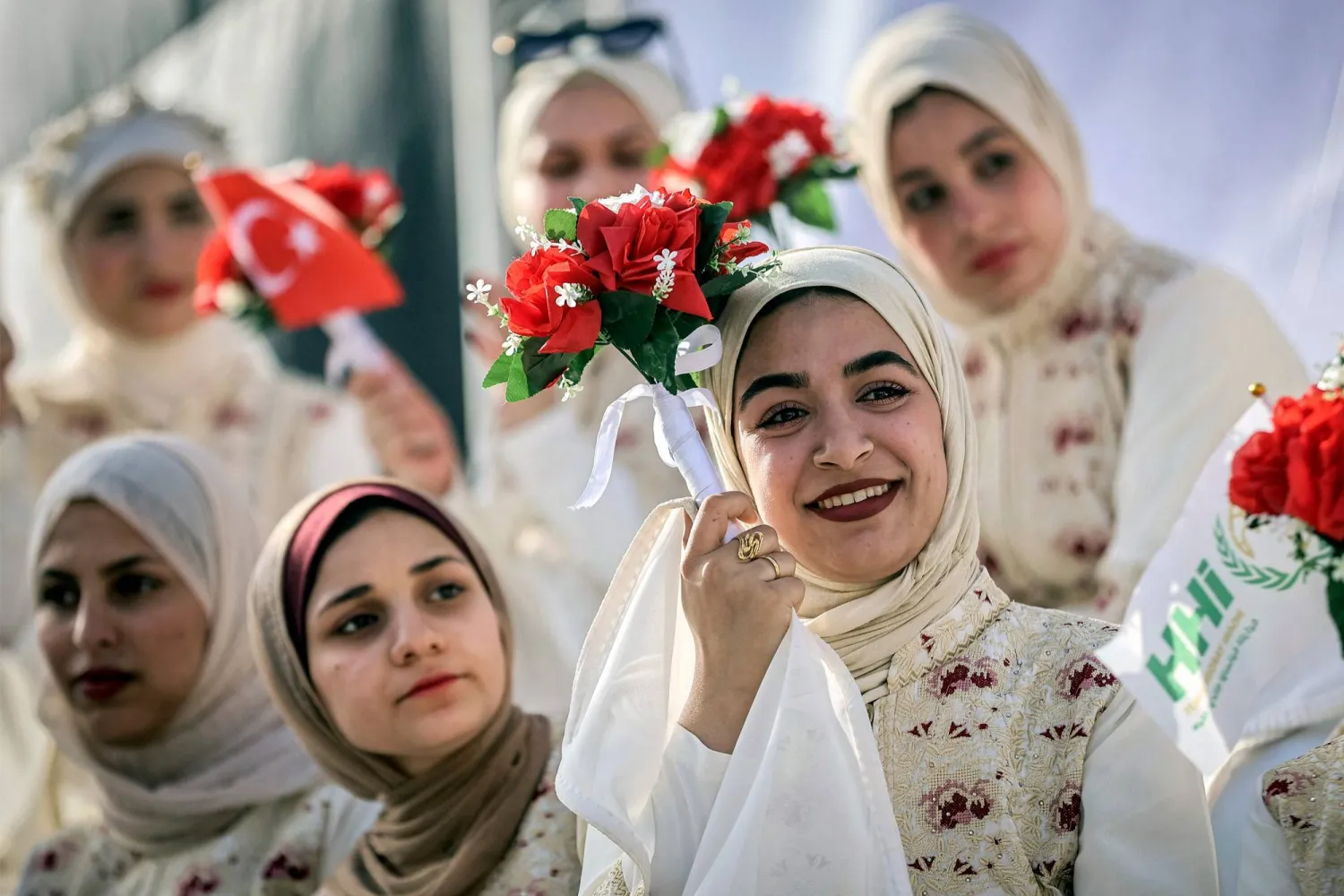
 Brides waiting to be wed look on during a mass-wedding celebration for Palestinian couples organized by the Turkish Humanitarian Relief Foundation (IHH) in Gaza City on May 11, 2026. (AFP)
Brides waiting to be wed look on during a mass-wedding celebration for Palestinian couples organized by the Turkish Humanitarian Relief Foundation (IHH) in Gaza City on May 11, 2026. (AFP)
TT

‘Happiest Day of Our Lives’: Gazans Hold Mass Wedding Among Ruins

 Brides waiting to be wed look on during a mass-wedding celebration for Palestinian couples organized by the Turkish Humanitarian Relief Foundation (IHH) in Gaza City on May 11, 2026. (AFP)
Brides waiting to be wed look on during a mass-wedding celebration for Palestinian couples organized by the Turkish Humanitarian Relief Foundation (IHH) in Gaza City on May 11, 2026. (AFP)

Wearing traditional Palestinian dresses, the white fabric intricately embroidered in a rainbow of colors, dozens of smiling brides clutched red bouquets as they walked with their grooms past the tents and ruined buildings of Gaza City.

To the tune of popular songs played from loudspeakers in a city square, the couples whose marriages had been long-delayed by war and displacement, sat on stage with joy written across their faces.

Thousands turned out to watch the mass wedding against the backdrop of buildings gutted by Israeli strikes over the course of the devastating two-year war.

Attendees clapped and smiled as a troupe performed the dabke, an Arabic folk dance, while women's ululations echoed through the crowd.

"I can't quite believe that I'm finally getting married," Ali Mosbeh told AFP at the start of the ceremony.

"I was sitting in the tent when my phone rang... I couldn't believe it. I'm still in shock," he said, recounting the moment he received the call informing him that he was among the 50 young men selected.

The mass wedding is one of many to have been organized since a ceasefire took effect in Gaza in October. This particular event was organized and funded by the Turkish humanitarian organization IHH.

The smartly-dressed grooms wore traditional Palestinian kuffiyeh scarves adorned with the Turkish organization's logo, while the brides' bouquets were dotted with small Turkish flags.

For Mosbeh and his bride Huda al-Kahlout, the high cost of weddings had also posed an obstacle to tying the knot.

"I never imagined I'd get married in such circumstances," he said.
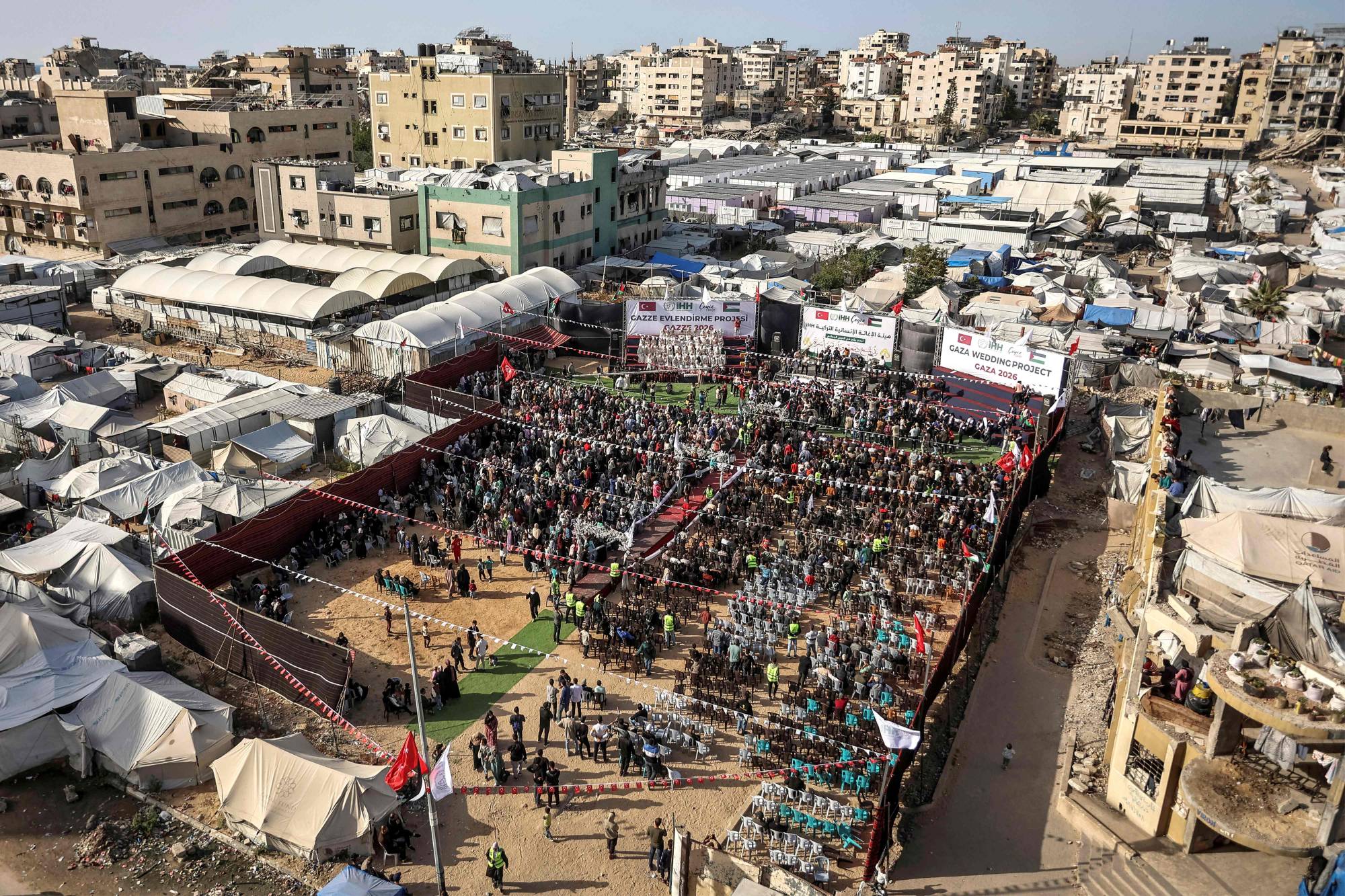
People gather during a mass-wedding celebration for Palestinian brides and grooms organised by the Turkish Humanitarian Relief Foundation (IHH) in Gaza City on May 11, 2026. (AFP)

- 'Carry on living' -

Most of Gaza's population was displaced at least once during the war between Israel and Hamas, with hundreds of thousands still living in tents or makeshift shelters.

Mosbeh said he would now share a tent with his wife while hoping to find a job -- something that has become near impossible in Gaza.

"Our future is uncertain; we depend on aid to survive," admitted Kahlout, but said that despite "war, loss and death... Marriage remains a beautiful milestone for us young people".

"Most of the buildings around the venue have been destroyed and reduced to rubble, with the martyrs buried beneath them," said fellow bride, Fayqa Abu Zeid.

But she added: "We are trying, despite everything, to find joy and carry on living."

Before the war, "the newlyweds would move into a flat with new furniture. Today, we move into a tent, if there is one," she said.

But despite the devastation, her husband Mohammed al-Ghossain was smiling.

"We are very happy," he said. "It is the happiest day of our lives."


'Currently Impossible': North Korea Defections in Freefall

Visitors look towards North Korea, which has worked to seal off links to the outside world. Lillian SUWANRUMPHA / AFP
TT

'Currently Impossible': North Korea Defections in Freefall

Visitors look towards North Korea, which has worked to seal off links to the outside world. Lillian SUWANRUMPHA / AFP

A building-sized North Korean flag waves from a tower on the de facto border with South Korea, marking territory that experts say has become nearly impossible to escape.

The combined total of North Koreans to reach South Korea in the past six years is less than the number that typically defected each year for decades -- and appears to be declining further in 2026, said AFP.

The main cause is leader Kim Jong Un's aim to preserve his family dynasty by sealing the country off from the outside, keeping people in and information out, experts say.

"As I understand it, bringing family members directly from North Korea is currently impossible," 29-year-old Chae Yoon-seo, who fled in 2019, told AFP.

She swam across a river into China at night with a smuggler's help, and travelled through Laos, Vietnam and Thailand before finally flying to South Korea.

Defections to the South hit a peak of more than 2,900 in 2009 and stayed well above 1,000 per year for the next decade.

But there were just 63 in the first half of this year -- down by over a third from the same period in 2025, said Seoul's Unification Ministry.

- 'Soviet-style border' -

Arrivals have fluctuated over the decades, but plunged sharply during the Covid pandemic when many nations shut their borders.

A key change in North Korea, however, started years before.

After taking power in 2011, Kim began restricting the informal trade and migration links along the roughly 1,415-kilometer (880-mile) northern border with China.

In addition to being an economic lifeline, the Chinese border region has also been the first step in most defectors' escapes.

The long frontier was relatively porous, unlike the heavily mined, fenced and surveilled Demilitarized Zone (DMZ) that serves as the Koreas' de facto border.

Along the boundary with China, Kim's government has erected fences and installed cameras as well as strips of sand that preserve the footprints of anyone who crosses.

"North Koreans built a real Soviet-style border security system," said Andrei Lankov, an expert on the North at Kookmin University in Seoul.

Beijing has helped too, said Lankov, noting China's preference to keep the status quo of the Kim dynasty by opposing potential instability from defectors or their supporters.

As part of its efforts, China reportedly has put in place hundreds of facial recognition cameras, noted Rachel Minyoung Lee, senior fellow with the Stimson Center's 38 North.

She added that Beijing also added more patrol boats and new or planned deportation facilities along its northeastern border.

- Ousted, killed or exiled -

The roughly 34,500 defectors to reach the South since 1998 are a fraction of North Korea's 26.6 million people, UN figures show, but the plunging number of escapes has consequences.

"Defectors are the main source of information about the North," said Fyodor Tertitsky, lecturer at Seoul's Korea University, noting both South Korean intelligence and researchers interrogate them.

Though some people still do get out.

Defector Gyuri Kang's 2023 escape by boat with her mother and aunt -- across the maritime border with the South, an extremely rare feat -- was a "miracle", she told a UN hearing.

She is also a case in point for why North Korea has made great efforts to seal itself off.

Kang noted the influence of South Korean dramas smuggled in on USB drives, finding them "so refreshing and more credible than North Korea state propaganda".

"North Korean authorities are keenly aware of the impact of outside media," she said.

In 2020, North Korea made possessing foreign media a crime punishable by years-long forced labor terms -- and potential death sentences for large-scale distribution, according to Amnesty International.

Lankov, from Kookmin University, said external information is the greatest threat to the long-term survival of North Korea's leadership.

"If they let their people interact with the outside world, they are highly likely to be overthrown, and maybe killed or driven into exile," he added.

Chae, the defector, said her hope was that the North's isolated people are not one day simply forgotten by the outside world.

"These days, there are a lot of cynical reactions on helping other countries, so I am a bit worried that one day, interest in North Korean human rights might fade away as well," she added.


How Israel’s Regional Neighbors See Its Upcoming Elections

 Israeli right-wing activists supporting Prime Minister Benjamin Netanyahu gather for the Jewish holiday of Sukkot, the Feast of the Tabernacles, in a field outside Kibbutz Nir-Am by the Israel-Gaza border on September 27, 2026. (AFP)
Israeli right-wing activists supporting Prime Minister Benjamin Netanyahu gather for the Jewish holiday of Sukkot, the Feast of the Tabernacles, in a field outside Kibbutz Nir-Am by the Israel-Gaza border on September 27, 2026. (AFP)
TT

How Israel’s Regional Neighbors See Its Upcoming Elections

 Israeli right-wing activists supporting Prime Minister Benjamin Netanyahu gather for the Jewish holiday of Sukkot, the Feast of the Tabernacles, in a field outside Kibbutz Nir-Am by the Israel-Gaza border on September 27, 2026. (AFP)
Israeli right-wing activists supporting Prime Minister Benjamin Netanyahu gather for the Jewish holiday of Sukkot, the Feast of the Tabernacles, in a field outside Kibbutz Nir-Am by the Israel-Gaza border on September 27, 2026. (AFP)

Israel's upcoming elections are being followed closely by its regional neighbors, who are aware that any outcome will have ramifications far beyond the country's borders.

In his Likud party's campaign launch this month, Prime Minister Benjamin Netanyahu repeated his refrain that he "has changed the face of the Middle East" and vowed to continue doing so.

He has been unapologetic about keeping Israeli troops in neighboring Lebanon and Syria, while his ministers tout plans to displace Palestinians from the West Bank and Gaza, creating a refugee crisis for Jordan and Egypt and making a future Palestinian state impossible.

Opinion polls show the October 27 elections are likely to be close. The bloc led by Netanyahu and his far-right and ultra-Orthodox allies are squaring off against that of his main opponent, centrist Gadi Eisenkot.

AFP correspondents around the region take a look at how different countries are following the contest:

- Jordan -

While Netanyahu has stopped short of formally annexing the West Bank, observers say unofficial annexation is creeping in, as his government -- the most right-wing in Israel's history -- approves an unprecedented number of settlements.

Government officials repeatedly call for the expulsion of over three million Palestinians across the Jordan River, posing "an existential threat" to the Hashemite kingdom, according to Oraib Rantawi, founder of Amman's Al-Quds Center for Political Studies.

At the UN on Tuesday, King Abdullah II said "the Israeli government's expansionist appetite is now a regional threat".

"In the medium and long term, Jordan and Israel are on a collision course," Rantawi said, as right-wing politicians try to push responsibility for "dealing with the Palestinian population" onto Amman.

Jordan signed a peace treaty with Israel in 1994, and "is maintaining a minimum level of political engagement" Rantawi said is unlikely to change, no matter the outcome.

- Egypt -

Israel's other neighbor, most often threatened by what Israeli ministers describe as "voluntary emigration", has kept a "cold peace" since it first recognized Israel in 1978.

Cairo maintains extensive security collaboration, but ties have been increasingly strained as Egypt says it has had to resist repeated efforts to force more than two million Palestinians into its territory.

The best-case scenario is "a government that is less ideologically driven and more focused on security, which could help lower the temperature around Gaza, even without changing the fundamental Israeli position," said former ambassador El-Sayed Shalaby.

Asked by AFP, Foreign Minister Badr Abdelatty said Egypt "will deal with any government that is coming," before blaming Netanyahu for obstructing the Trump ceasefire plan, which Egypt brokered.

- Lebanon -

Israel's attacks on and invasion of southern Lebanon have killed more than 4,300 people and left 329,000 displaced since March, while Beirut pursues gradual talks with Israel centered on the disarmament of Hezbollah.

Parliament Speaker Nabih Berri said this month that Israel "is turning southern Lebanon, its people and their properties into a ballot box soaked in blood" ahead of the vote.

"We are not optimistic," a former Lebanese minister and diplomat told AFP on condition of anonymity.

"The style may change... perhaps Eisenkot has a less radical discourse, but on the ground, the policy will remain unchanged. It is the far right that remains in power."

In an interview with AFP, Lebanese President Joseph Aoun said the elections were an internal matter.

"But the question we want to ask the Israeli people, the State of Israel and all future governments is the following: do they want stability, security and no wars on their border, or not?" he said.

- Syria -

Since the December 2024 ousting of longtime ruler Bashar al-Assad, Israel has launched hundreds of strikes into Syria, sent troops into a UN-patrolled buffer zone on the Israeli-annexed Golan Heights and carried out regular incursions.

"For Damascus, the stakes are not whether the Israeli elections will completely change the rules of the game, but whether they will produce a government that is less inclined toward escalation and more willing to listen to Washington," a Syrian diplomatic source told AFP.

"A more centrist government, or a right-wing government that does not revolve around Netanyahu... could be less inclined to make political capital out of escalation," and work towards gradual security understandings.


From Jeddah to New York: Why Do Sudan's Truces Fail?

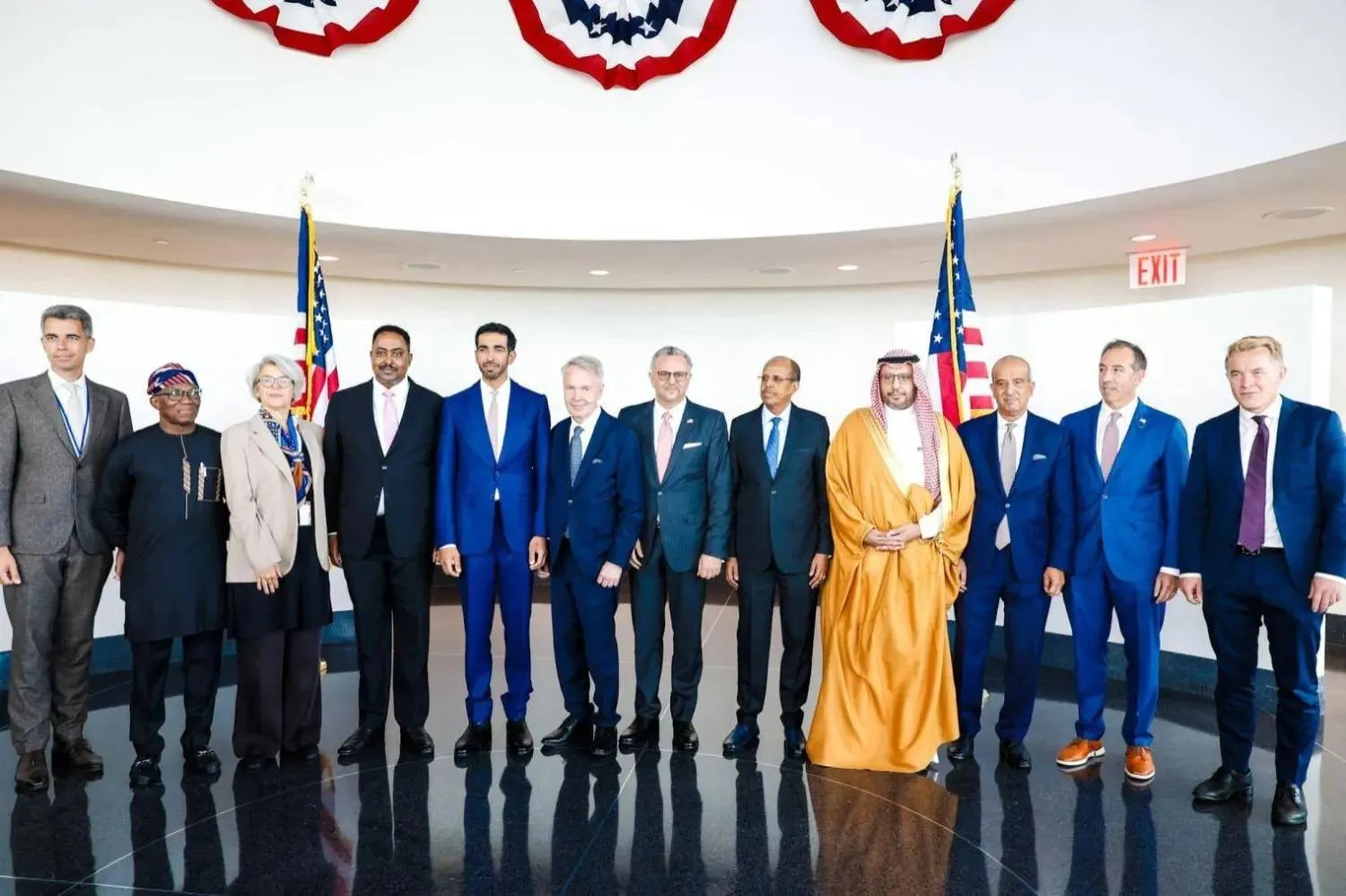
Members of the Quintet and Quad after their first joint meeting on Sudan. (African Union)
TT

From Jeddah to New York: Why Do Sudan's Truces Fail?

Members of the Quintet and Quad after their first joint meeting on Sudan. (African Union)

Sudanese doctor "S" needed a truce to get out of a health center where she and her colleagues were trapped in the first days of the war. She took a long route from Nile Street, crossing the Fiteihab and Halfaya bridges, until she reached her family in Kober.

She said she found bullet holes in the walls of her bedroom. Her siblings were waiting for her so they could leave together. The family fled and remains displaced today.

A brief halt in fighting in May 2023 allowed S to escape, but it did not last long enough for her family to remain in their home. Since that brief truce, initiatives and agreements have followed, while the hardest question has remained: How can mediators bring the two sides to agree to a cessation of fighting that is implemented and sustained?

The question returned to the fore on Sept. 23, when the Quad and Quintet met together for the first time in New York, under the co-chairmanship of the African Union and the United States. Participants called for a humanitarian truce and an end to hostilities.

They agreed to coordinate efforts to protect civilians and prepare to monitor and verify the implementation of any agreement. But the meeting's statement announced no agreement with the army or the Rapid Support Forces (RSF), and set no date for talks between them.

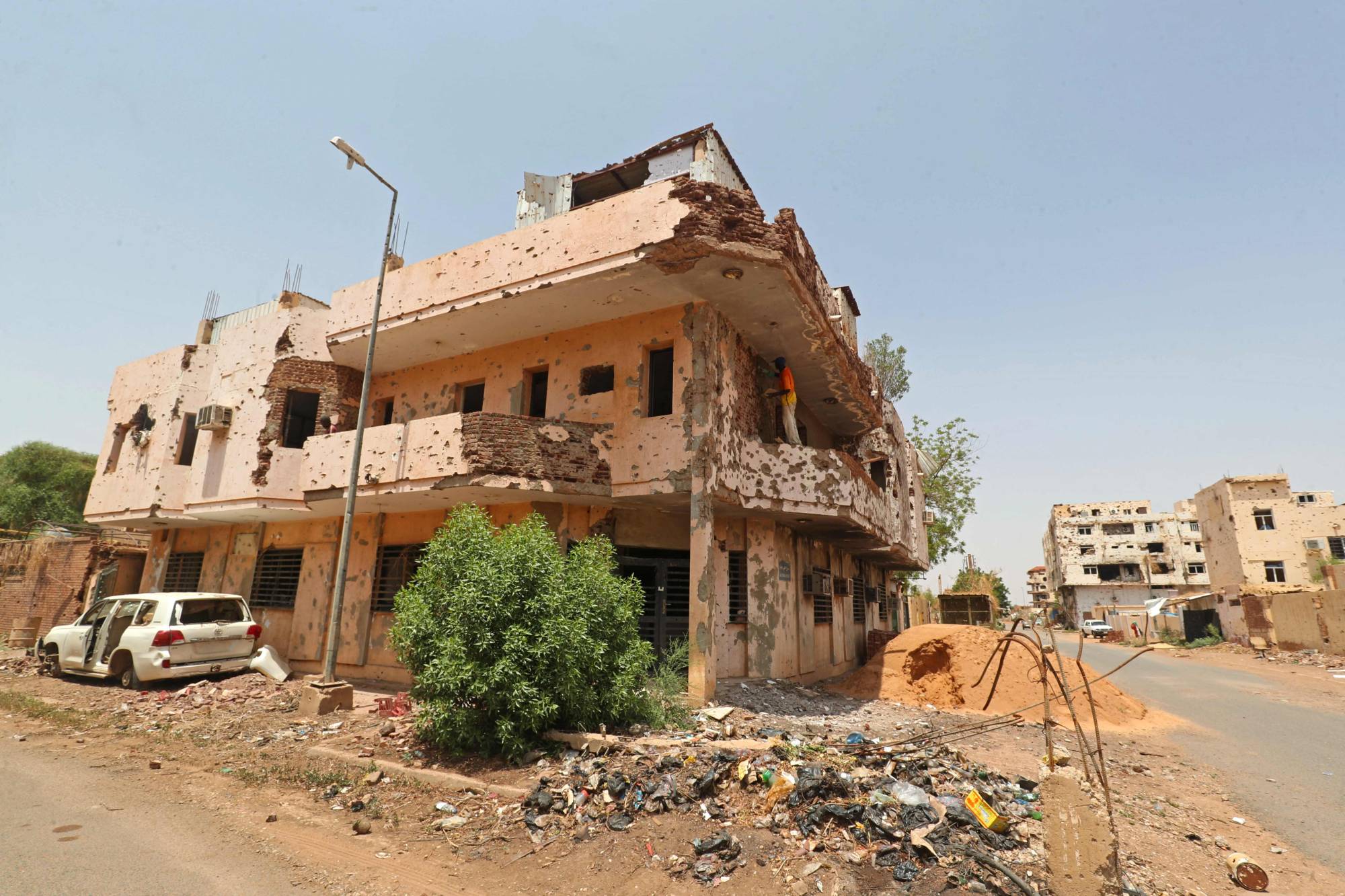
A worker repairs a damaged building in Khartoum on September 20, 2026 (Photo by Ebrahim HAMID / AFP)

The sticking point lies in the terms of the truce itself. According to Reuters, the army-led government accepted most of a US proposal for a 90-day truce but rejected a provision that would limit the RSF's withdrawal to specified areas.

It demanded that the RSF withdraw from all cities it had seized. Sudan's Foreign Ministry said this week that it rejected any negotiating process it believed would legitimize a reality imposed by the RSF through force. The RSF, meanwhile, welcomed the truce proposal, but the fighting continued.

Even when the two sides signed an agreement, it did not guarantee its implementation. In Jeddah, Saudi Arabia, the army and the RSF signed a declaration committing them to protecting civilians on May 11, 2023. On May 20, they signed an agreement on a short ceasefire and humanitarian arrangements.

But the ceasefire did not hold. In June, the army suspended its participation in the talks, accusing the RSF of violating the agreement.

Other efforts faced different obstacles. In December 2023, the Intergovernmental Authority on Development (IGAD), a regional organization involved in peace efforts in the Horn of Africa, announced that army chief Abdel Fattah al-Burhan and RSF leader Mohamed Hamdan Dagalo, known as Hemedti, had agreed to meet face to face under its auspices. IGAD renewed the invitation in January, but the meeting never took place.

In Manama, Bahrain, a document titled "Principles and Foundations for a Comprehensive Solution to the Sudanese Crisis" was initialed on Jan. 20, 2024, in the names of Shams al-Din Kabbashi for the army and Abdel Rahim Dagalo for the RSF, according to the published text. But the initialing was not followed by a final agreement or a sustained negotiating process. Dagalo accused Kabbashi of backing away from the document, while Kabbashi did not comment on the reasons for the process coming to a halt.

In August 2024, the absence of one of the warring sides prevented direct ceasefire talks in Switzerland, shifting the focus to facilitating the delivery of aid and protecting civilians.

Rosalind Marsden, a researcher at Chatham House, wrote in an analysis published by the institute on Sept. 18, 2024, that the main reason the August 2024 ceasefire talks in Switzerland failed was that both the army and the RSF continued to seek a military victory. Their continued hopes of making military gains were a major reason for the negotiations' failure to make progress, despite limited progress in delivering aid to Darfur.

In September 2025, the Quad proposed a roadmap beginning with a three-month humanitarian truce, during which aid would reach areas across Sudan, followed by a permanent ceasefire and a political transition.

But the Quad's roadmap remained a proposal by the mediators and did not become an agreement between the warring parties. The dispute over withdrawal in the latest US proposal shows that the two sides have yet to agree on the terms under which a new truce could be tested.

Researcher Ahmed Soliman says the multiplicity of mediation groups and weak coordination among them make it necessary to link ceasefire efforts to a Sudanese political process led by civilian forces.

Hubert Kinkoh, a researcher at Chatham House, argued in an analysis published by the institute on Feb. 13, 2026, that the multiplicity of mediation tracks on Sudan, along with the absence of clear leadership and effective coordination among them, had allowed the army and the RSF to resist making serious concessions.

The New York meeting may help address the fragmentation of mediation efforts. Its real value, however, will become clear if it can bring the warring parties to a clear agreement and establish a mechanism to monitor compliance and address violations.

A brief truce allowed S to reach her family, but the family was then forced to leave their home. The truce that displaced people and refugees are waiting for today would allow aid to reach them and mark the beginning of a lasting end to the fighting, making a safe return to their homes and communities possible.