US Will Replenish Every Barrel of Oil It Releases from Strategic Petroleum Reserve, Energy Secretary Says

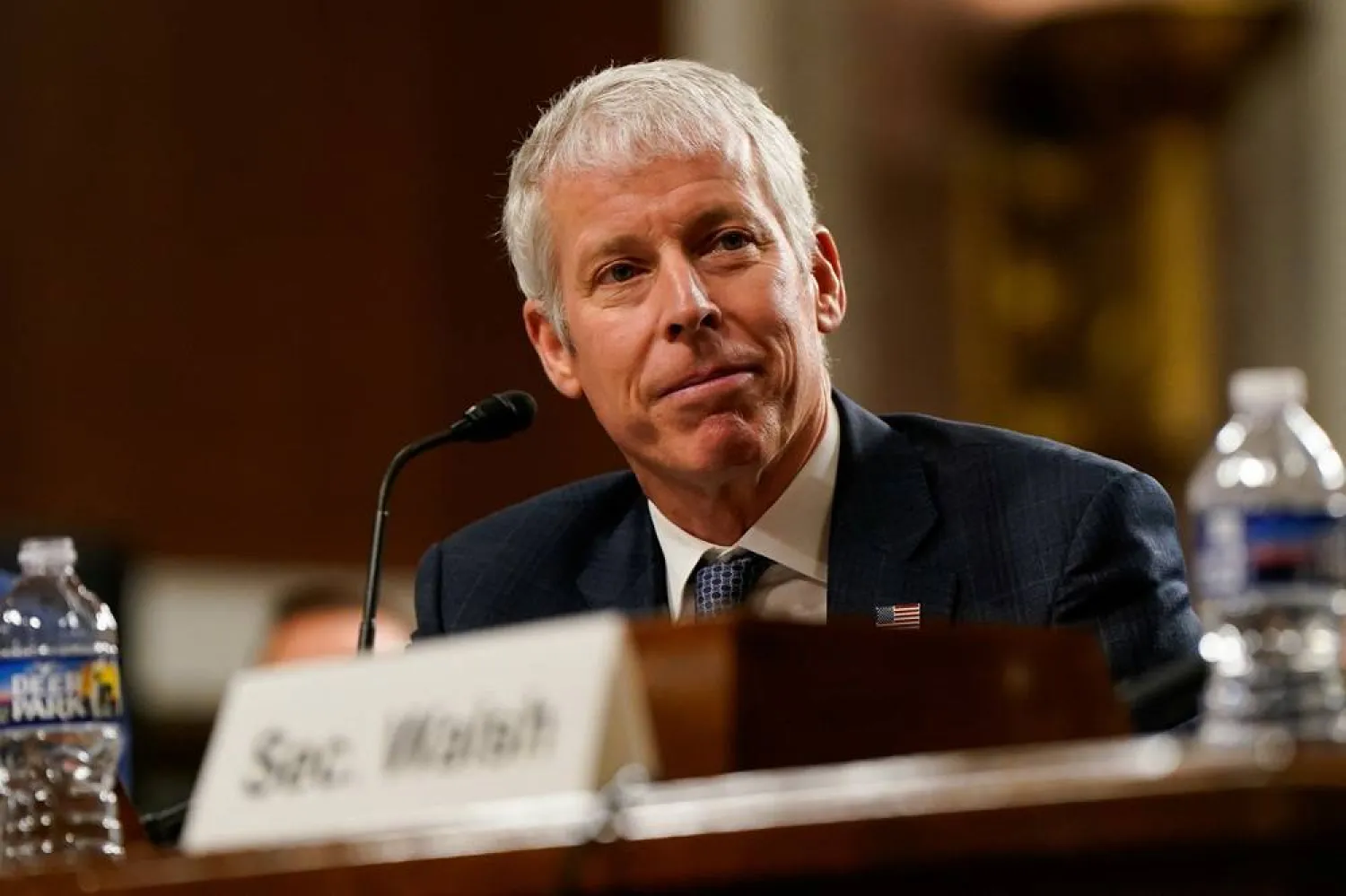
US Secretary of Energy Christopher Wright testifies during a US Senate Armed Services Committee hearing on Capitol Hill in Washington, DC, US, May 13, 2026. (Reuters)
TT

US Will Replenish Every Barrel of Oil It Releases from Strategic Petroleum Reserve, Energy Secretary Says

US Secretary of Energy Christopher Wright testifies during a US Senate Armed Services Committee hearing on Capitol Hill in Washington, DC, US, May 13, 2026. (Reuters)

The US will replenish every barrel of oil it releases from the Strategic Petroleum Reserve, Energy Secretary Chris Wright ‌said Friday ‌at an event in Sabine ‌Pass, ⁠Texas.

"We're releasing oil ⁠now, and for each barrel we're releasing, we're going to get at least 1.2 barrels of oil back into the reserve. We'll leave it fuller than when we started," he said.

The Trump administration wants to ‌do everything it ‌can to lower gasoline prices, Wright said.

"We ‌understand Americans today are paying higher ‌prices than they would like, higher prices than we would like to see, but it's simply essential to end Iran's ability to ‌get a nuclear bomb," he said.

"It's causing some short-term disruption. ⁠This ⁠will pass and gasoline prices will come right back down," he said.

Wright said that the US could "easily" double its natural gas exports without increasing the domestic price.

"There's just an enormous, simply astounding amount of natural gas," he said, noting that the country currently exports about 20% of the natural gas it produces.


China Signals Tariff Cuts, Advances in Farm Market Access After Trump-Xi Summit

An aerial view of newly imported cars parked at the automobile terminal at the Port of Los Angeles on May 08, 2026 in Wilmington, California. (Getty Images/AFP)
TT

China Signals Tariff Cuts, Advances in Farm Market Access After Trump-Xi Summit

An aerial view of newly imported cars parked at the automobile terminal at the Port of Los Angeles on May 08, 2026 in Wilmington, California. (Getty Images/AFP)

China and the United States have agreed to expand agricultural trade through tariff reductions and tackle non-tariff barriers and market access issues, China's commerce ministry said on Saturday after this week's summit in Beijing.

The agreements are "preliminary" and will be "finalized as soon as possible," the ministry said following US President Donald Trump's visit.

China's farm imports from the US still face an additional 10% levy after last year's rounds of tit-for-tat tariffs sharply curtailed trade, which fell 65.7% year-on-year to $8.4 billion in 2025, according ‌to US ‌Department of Agriculture data.

The commerce ministry said ‌both ⁠sides aim to ⁠promote two-way trade, including in agricultural products, through measures such as reciprocal tariff reductions across a range of goods. It did not specify which products.

China resumed purchases of some US farm goods after an October meeting, fulfilling a US-stated commitment to buy 12 million metric tons of soybeans by the end ⁠of February. It has also purchased some US ‌wheat cargoes and large ‌volumes of sorghum.

Market watchers expect a 10% cut in soybean tariffs, which could ‌allow private Chinese crushers to resume purchases that were ‌largely sidelined during last year's US harvest, when state crop traders were the only buyers.

"Tariff reductions on agricultural products would mark a normalization of China-US farm trade, allowing commercial buyers to re-enter the market," ‌said Johnny Xiang, founder of Beijing-based AgRadar Consulting.

The ministry said both sides agreed to "resolve or ⁠make substantive progress" ⁠on non-tariff barriers and market access issues.

China will work to address US concerns over registration of beef facilities and poultry exports from certain US states, it said.

Beijing on Friday granted five-year registration extensions to 425 US beef plants that had largely been shut out after their registrations lapsed last year, and approved new five-year registrations for 77 additional US facilities.

US Trade Representative Jamieson Greer said on Friday the US expects China to buy "double-digit billions" worth of US farm goods over the next three years, although neither side has yet released details on specific products, values or volume.


Mercedes Benz Mulls Diversification into Defense

President of the European Automobile Manufacturers' Association (ACEA) Ola Kallenius attends a press point in the European Parliament in Brussels, Belgium, 13 May 2026. (EPA)
TT

Mercedes Benz Mulls Diversification into Defense

President of the European Automobile Manufacturers' Association (ACEA) Ola Kallenius attends a press point in the European Parliament in Brussels, Belgium, 13 May 2026. (EPA)

The CEO of German automaking giant Mercedes-Benz has said he has not ruled out entering the defense industry.

"The world has become more unpredictable, and I think it is quite clear that Europe needs to strengthen its defense capabilities," CEO Ola Kaellenius said in an interview with The Wall Street Journal published Friday.

"If we are able to play a positive role in this area, we would be ready to do so," said Kaellenius, a German-Swedish national.

His remarks come amid Germany beefing up its military capacity in response to Russia's invasion of Ukraine in February 2022.

The German defense industry has locked onto that trend, as illustrated by the rise of arms maker Rheinmetall in recent years, with the group recently pushing into the naval and drone-making spheres.

In contrast, German automakers, such as Mercedes-Benz and Volkswagen, are battling crises, caught between tariffs and bitter Chinese competition.

In late March, the CEO of fellow German auto giant, Volkswagen, Oliver Blume, said he was "in contact" with defense companies, particularly those involved in missile defense, to convert a German factory to produce military transport equipment.

According to the Financial Times, discussions are under way with Rafael Advanced Defense Systems, the company that designed Israel's Iron Dome.

Asked by AFP to comment on Kaellenius's interview, a Mercedes-Benz spokesperson said the firm "has for many years been supplying chassis to specialized firms which equip and market them under their own responsibility and under their own brand for military applications".

"Our activities in the security and defense sector constitute a strategic development focus that we will continue to actively pursue, in collaboration with our partners," the spokesperson added.

In his Wall Street Journal interview, Kaellenius did not go into details on what kind of products Mercedes-Benz might manufacture.

He predicted that defense-related business would represent only a "minor part of Mercedes-Benz's operations" compared with auto and van manufacture.

But he added defense could be "a rapidly growing niche that could also contribute to the group's financial results."


Iraq Exported 10 Million Barrels of Oil Through Strait of Hormuz in April

 Vessels in the Strait of Hormuz, Musandam, Oman, May 15, 2026. (Reuters)
Vessels in the Strait of Hormuz, Musandam, Oman, May 15, 2026. (Reuters)
TT

Iraq Exported 10 Million Barrels of Oil Through Strait of Hormuz in April

 Vessels in the Strait of Hormuz, Musandam, Oman, May 15, 2026. (Reuters)
Vessels in the Strait of Hormuz, Musandam, Oman, May 15, 2026. (Reuters)

Iraq exported 10 million barrels of oil via the Strait of Hormuz in April, down from about 93 million barrels monthly before the Iran war, the country's new oil minister, Basim Mohammed, said at a press conference on Saturday. 

The closure of the Strait of Hormuz due to the Iran war has curtailed oil exports from the Gulf, sending prices sharply higher. 

"Exports through the Strait of Hormuz are low and depend on the arrival of ‌oil tankers, ‌which are not entering because of insurance", ‌he ⁠said in his ⁠first press conference after taking office. 

Iraq is currently producing 1.4 million barrels per day. 

The country's crude exports through the Kirkuk–Ceyhan oil pipeline resumed in March, after Baghdad and the Kurdistan Regional Government agreed on restarting flows. 

"We export 200,000 barrels through (Turkish) Ceyhan port, and we have a plan to increase it ⁠to 500,000 barrels", Mohammed said. 

PUSH TO BOOST PRODUCTION, ‌EXPORTS 

Baghdad is also in ‌talks with Ankara on a new cooperation agreement covering upstream and downstream ‌projects, expanding on a previous deal that was limited ‌to crude exports, Mohammed said. 

Iraq is in negotiations with US companies, including Chevron, ExxonMobil and Halliburton, on developing oil and gas projects, Mohammed said, urging the firms to sign contracts as soon as possible to ‌help secure significant revenues for Iraq. 

Iraq plans to engage with OPEC to boost the country’s production ⁠and export ⁠capacity, the minister said, adding that Baghdad aims to reach a production capacity of 5 million barrels per day through this dialogue. 

"We have a dialogue with OPEC to increase Iraq's export capacity. When exports increase and the ceiling opens up with OPEC, we will bring in significant financial revenues for Iraq," he added. 

Iraq has no intention of leaving OPEC or OPEC+, and supports a strong organization to ensure stable and acceptable oil prices, two Iraqi oil officials told Reuters in April after the United Arab Emirates decided to leave the group.