


Iraq’s Coordination Framework on Verge of Collapse after Zaidi’s Govt Approved by Parliament

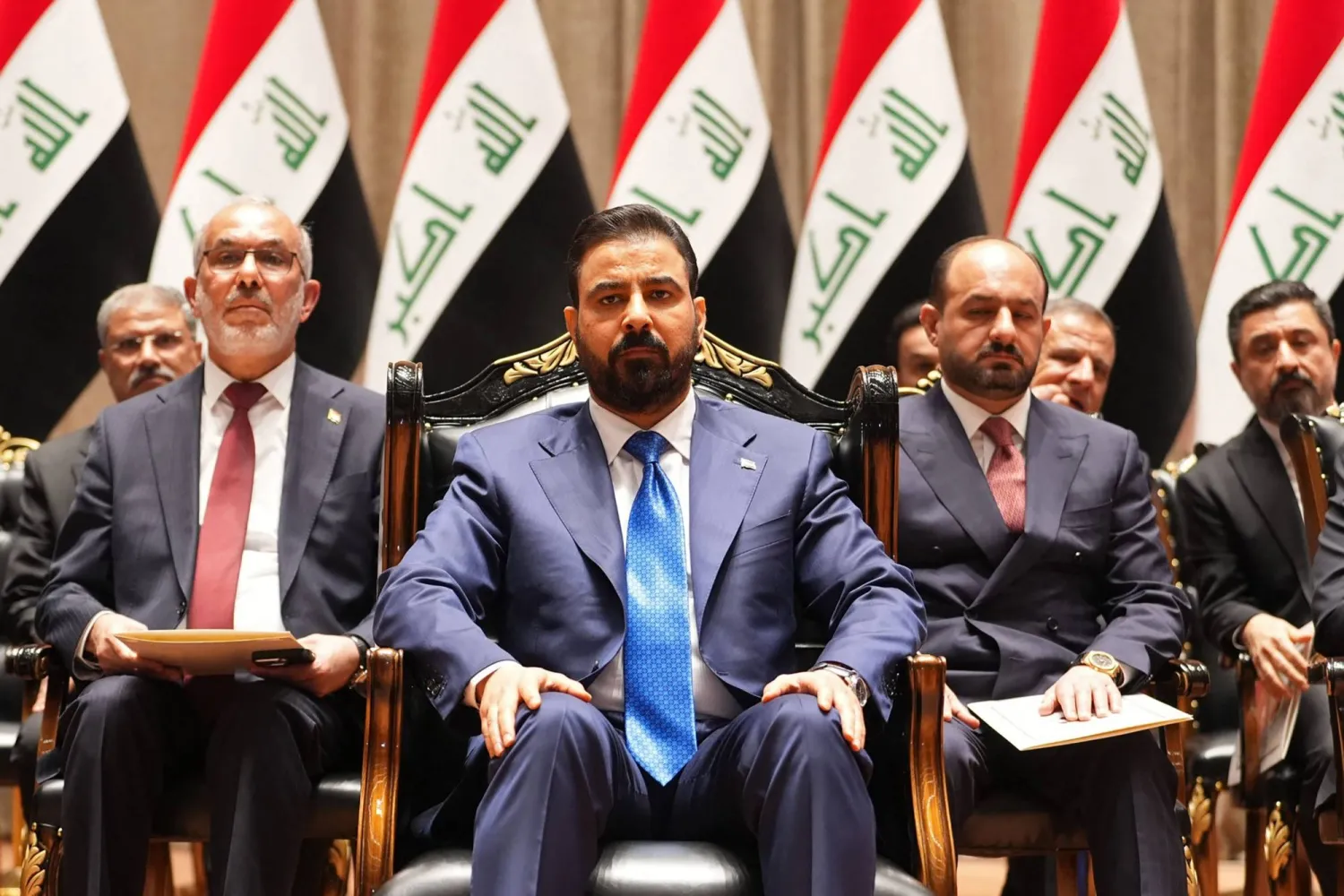
This handout picture released by the Iraqi Prime Minister's Press Office shows new prime minister-designate Ali al-Zaidi (C) sitting ahead of presenting his government to the parliament in Baghdad on May 14, 2026. (Iraqi Prime Minister’s Press Office / AFP)
TT

Iraq’s Coordination Framework on Verge of Collapse after Zaidi’s Govt Approved by Parliament

This handout picture released by the Iraqi Prime Minister's Press Office shows new prime minister-designate Ali al-Zaidi (C) sitting ahead of presenting his government to the parliament in Baghdad on May 14, 2026. (Iraqi Prime Minister’s Press Office / AFP)

Iraq’s ruling pro-Iran Coordination Framework appears to be on the verge of collapse after Prime Minister Ali al-Zaidi's government was approved by parliament on Thursday.

The PM submitted an incomplete lineup, but it still earned the vote of confidence. The parliament approved 14 ministers out of 23. Discussions on the remaining vacant portfolios, including notable ones such as interior and defense, have been postponed due to political disputes between Shiite, Sunni and Kurdish forces.

Thursday’s vote exposed evident differences in the Framework, which includes major parties, such as former PM Nouri al-Maliki's State of Law coalition, with other influential Shiite blocs over sovereign portfolios, especially the interior and higher education ministries, said lawmakers and political sources.

State of Law MP Ibtissam al-Hilali told the media that failure to include a candidate from her bloc in the lineup was an act of "deceit" against political agreements reached before the session.

Meanwhile, the National Contract bloc and the Sumerian Movement announced on Friday that they were quitting former PM Mohammed Shia al-Sudani's Construction and Development bloc, accusing the political leadership inside the alliance of violating agreements and seeking to marginalize members.

In a joint statement, they said the proceedings at parliament reflected "a violation of political agreements whereby individual interests were placed above national ones."

They said they would form a new parliamentary bloc in a move that would reshape alliances in the legislature.

Later on Friday, MP Ammar Youssef also announced he was leaving Sudani’s bloc but that he would remain in Faleh al-Fayyad's National Contract bloc.

These developments are seen as a realignment of Shiite political forces that are coming under mounting internal and foreign pressure.

Sudani, Zaidi’s predecessor, has slammed his allies in the Framework, saying: "No other government has come under such false accusations and misinformation." He accused "failed leaderships" of mounting these campaigns.
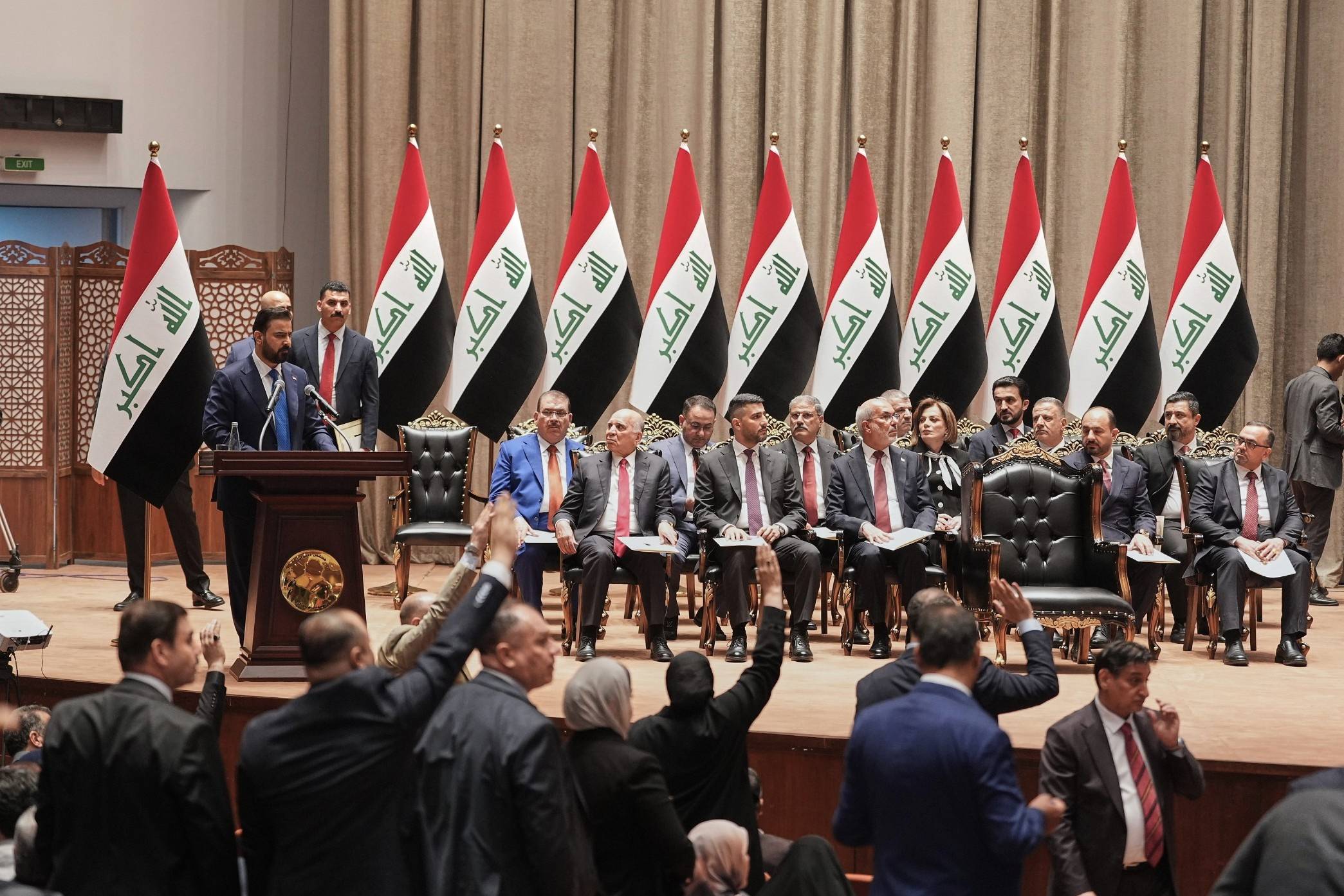
Iraqi lawmakers attend the session to approve the new government in Baghdad, Iraq, Thursday, May 14, 2026. (Iraqi Presidency Office via AP)

Zaidi, who is backed by the Framework, is Iraq's youngest prime minister at the age of 40. He was chosen to form the new government late last month.

His program includes "reforming the security apparatus by restricting weapons to state control and strengthening the capabilities of the security forces", state news agency INA quoted the parliament media office as saying.

He also vowed to ensure a state monopoly on weapons amid growing US pressure to dismantle Tehran-backed groups.

His nomination followed months of political wrangling after the United States vetoed the previous frontrunner, former premier Maliki.

Senior US diplomat Tom Barrack said his government was ready to work with Zaidi "to advance our shared goals of prosperity for the Iraqi people and the elimination of terrorism, which is always an impediment to the people's progress".

Iran's Foreign Minister Abbas Araghchi congratulated Iraq's new government following the approval from parliament. "Strengthening the friendly and brotherly relations between Tehran and Baghdad has always been at the top of the priorities of our foreign policy," he wrote on X.

The US has recently piled pressure on Baghdad to disarm Iran-backed groups, which it designates as terrorist organizations.

After the United States and Israel attacked Iran on February 28, those groups intervened in support of Tehran and hit US facilities in Iraq more than 600 times before a ceasefire was announced, according to a US official.

Recently, several powerful Iraqi politicians have also called for a state monopoly on weapons, revealing divisions over the sensitive issue.

While some armed groups showed readiness to cooperate, others remain adamant that the issue should not be discussed under US pressure.

Hussein Mounes, the head of a parliamentary bloc close to the Kataib Hezbollah group, criticized the "clear and direct American interference in shaping the political scene".

The new premier faces other daunting tasks.

His government will also need to repair Iraq's relations with Gulf countries, which have protested attacks by Tehran-backed groups on their territory during the war.

His program has also set economic reforms as a main priority, with an emphasis on diversification and investment, in a country where almost the entire economy relies on oil.

Iraq has lost significant income due to the disruption in the Strait of Hormuz, given that oil exports make up about 90 percent of the country's budget revenues.



Israel Military Says Striking Hezbollah Targets in Southern Lebanon

TOPSHOT - A photograph taken from the southern area of Tyre shows smoke rising from the site of an Israeli airstrike that targeted the area of Ras Al-Ain on May 12, 2026. (Photo by KAWNAT HAJU / AFP)
TT

Israel Military Says Striking Hezbollah Targets in Southern Lebanon

TOPSHOT - A photograph taken from the southern area of Tyre shows smoke rising from the site of an Israeli airstrike that targeted the area of Ras Al-Ain on May 12, 2026. (Photo by KAWNAT HAJU / AFP)

The Israeli military said it had launched new strikes targeting Hezbollah infrastructure across southern Lebanon on Saturday, the day after the two countries agreed to extend an existing ceasefire.

The military said that its forces “have begun striking Hezbollah infrastructure sites in several areas in southern Lebanon”.


Palestinian Ministry Says Israeli Forces Kill Man in West Bank Camp

 A member of the Israeli security forces aims his weapon while patrolling during a military raid in the Qalandia refugee camp, south of Ramallah in the Israeli-occupied West Bank, on May 11, 2026. (AFP)
A member of the Israeli security forces aims his weapon while patrolling during a military raid in the Qalandia refugee camp, south of Ramallah in the Israeli-occupied West Bank, on May 11, 2026. (AFP)
TT

Palestinian Ministry Says Israeli Forces Kill Man in West Bank Camp

 A member of the Israeli security forces aims his weapon while patrolling during a military raid in the Qalandia refugee camp, south of Ramallah in the Israeli-occupied West Bank, on May 11, 2026. (AFP)
A member of the Israeli security forces aims his weapon while patrolling during a military raid in the Qalandia refugee camp, south of Ramallah in the Israeli-occupied West Bank, on May 11, 2026. (AFP)

Palestinian health officials said Israeli forces killed a man on Saturday on the outskirts of the Jenin refugee camp in the northern occupied West Bank.

The health ministry in Ramallah identified the victim as 34-year-old Nour al-Din Kamal Hassan Fayyad, saying he was "killed by occupation forces' fire in the Jenin camp".

The Palestinian Red Crescent said its teams in Jenin received a man "with no signs of breathing or pulse from inside Jenin camp after he sustained a live bullet wound to the thigh".

The Israeli army did not immediately respond to a request for comment.

Israel launched a major military operation in mid-January in multiple northern Palestinian refugee camps, where the army says it is seeking to root out armed groups.

The operation, dubbed "Iron Wall", has targeted Jenin and Tulkarem camps and displaced nearly 40,000 Palestinians, according to the UN agency for Palestinian refugees UNRWA.

The Israeli military has sealed off Jenin camp, allowing displaced residents only limited access to check on their homes and belongings.

Refugee camps were created in the West Bank, Gaza and neighboring Arab countries after the first Arab-Israeli war for Palestinians who fled or were expelled from what is now Israel at the time of its creation in 1948.

Since the war in Gaza broke out in October 2023, near-daily violence has also rocked the West Bank, which Israel has occupied since 1967.

Israeli soldiers or settlers have killed at least 1,072 Palestinians since then, including many gunmen, according to an AFP tally based on Palestinian health ministry data.

Official Israeli figures show at least 46 Israelis have been killed in Palestinian attacks or during Israeli military operations in the same period.


Defector ‘Savannah’ Arrives in Khartoum, Deepening RSF Crisis

A circulated image shows defector Savanna among his troops during military operations before splitting from the Rapid Support Forces. 
TT

Defector ‘Savannah’ Arrives in Khartoum, Deepening RSF Crisis

A circulated image shows defector Savanna among his troops during military operations before splitting from the Rapid Support Forces. 

Former Rapid Support Forces (RSF) field commander Brigadier General Ali Rizqallah, known as “Savannah,” arrived in the Sudanese capital Khartoum days after announcing his split from the paramilitary force led by Mohamed Hamdan Dagalo (Hemedti), in a move observers say highlights growing divisions within the RSF leadership and field ranks.

When Savannah announced his defection last week, he stressed he would not side with either party in the conflict, saying only that he had “sided with the will of the people.” But his arrival in Khartoum was widely seen by observers as a practical indication that he had joined the Sudanese army, dealing another blow to the RSF, which has faced a growing wave of defections in recent months.

Media sources said Savannah arrived in Khartoum without official details about his next moves, but the timing of his arrival, amid escalating military operations on several fronts, reinforced speculation of significant internal shifts within the RSF structure.

Defected RSF Major General Al-Nour Ahmed Adam, known as “Al-Nour al-Qubba,” told local media that Savannah was among the RSF’s most prominent field commanders and that his defection had generated wide attention because of his military influence and standing within the force.

He described Savannah as “one of the strong men and men of principle,” predicting that his joining the army would represent “a real addition to the armed forces and the Sudanese people.”

Al-Qubba also hinted at further defections within the RSF, saying the coming days would witness new developments following Savanna’s move to the army, in remarks suggesting that other commanders could join the Sudanese armed forces.

Savannah emerged as one of the leading RSF field commanders in the Kordofan region after the outbreak of war in April 2023. He led several military operations against the army and helped expand RSF control across large parts of the region.

He is the fourth prominent commander to defect from the RSF in recent months after Abu Aqla Keikel, commander of the Sudan Shield forces, who joined the army in October 2024, followed by Major General Al-Nour Ahmed Adam al-Qubba and field commander Bashara al-Huwaira, who also defected and joined the armed forces.

Tribal leader Musa Hilal, the former head of the Janjaweed militia, had previously declared support for the army after relocating to Port Sudan following the RSF’s takeover of his hometown of Misterei in Darfur, in a development observers say contributed to growing unrest and divisions within the RSF.

Observers say RSF attacks on areas controlled by Musa Hilal and his forces affected tribal and military balances in Darfur and indirectly accelerated defections from the paramilitary group.

Neither the Sudanese army nor the RSF issued official comment on Savannah’s arrival in Khartoum. The RSF had previously described him in a Telegram statement as a “defeated general,” while pro-RSF platforms circulated videos showing fighters from his combat group rejecting his defection.

The war between the Sudanese army and the RSF has entered the first month of its fourth year, with humanitarian and security conditions continuing to deteriorate across the country.

The International Organization for Migration estimates that the conflict has displaced more than 14 million people, including nearly four million who fled to neighboring countries, while the United Nations has described the Sudan crisis as the world’s “largest humanitarian catastrophe.”

Unofficial estimates say the war has killed around 150,000 civilians, in addition to thousands of fighters from both sides, amid the absence of precise figures on military losses.