


Defector ‘Savannah’ Arrives in Khartoum, Deepening RSF Crisis

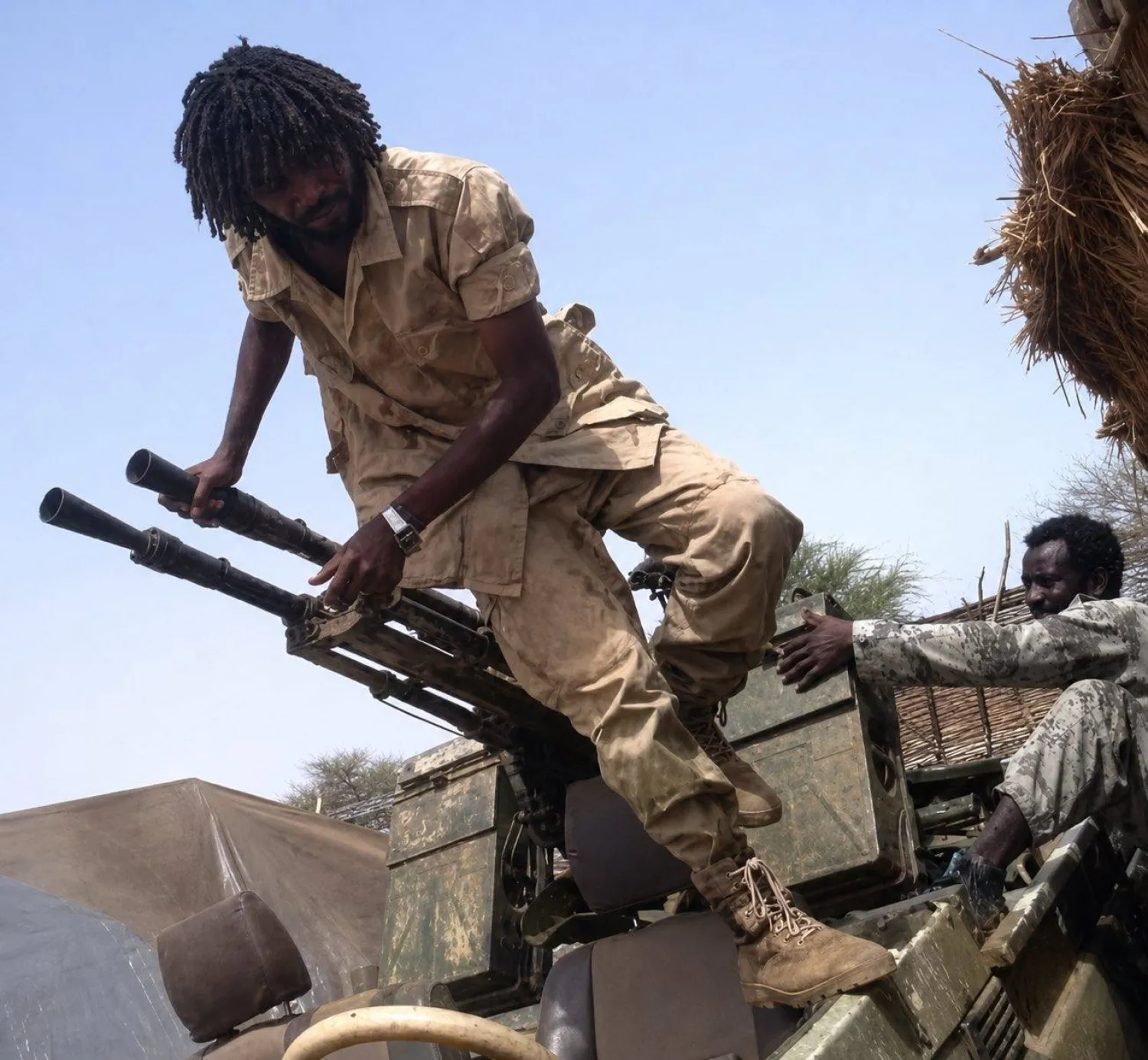
A circulated image shows defector Savanna among his troops during military operations before splitting from the Rapid Support Forces. 
TT

Defector ‘Savannah’ Arrives in Khartoum, Deepening RSF Crisis

A circulated image shows defector Savanna among his troops during military operations before splitting from the Rapid Support Forces. 

Former Rapid Support Forces (RSF) field commander Brigadier General Ali Rizqallah, known as “Savannah,” arrived in the Sudanese capital Khartoum days after announcing his split from the paramilitary force led by Mohamed Hamdan Dagalo (Hemedti), in a move observers say highlights growing divisions within the RSF leadership and field ranks.

When Savannah announced his defection last week, he stressed he would not side with either party in the conflict, saying only that he had “sided with the will of the people.” But his arrival in Khartoum was widely seen by observers as a practical indication that he had joined the Sudanese army, dealing another blow to the RSF, which has faced a growing wave of defections in recent months.

Media sources said Savannah arrived in Khartoum without official details about his next moves, but the timing of his arrival, amid escalating military operations on several fronts, reinforced speculation of significant internal shifts within the RSF structure.

Defected RSF Major General Al-Nour Ahmed Adam, known as “Al-Nour al-Qubba,” told local media that Savannah was among the RSF’s most prominent field commanders and that his defection had generated wide attention because of his military influence and standing within the force.

He described Savannah as “one of the strong men and men of principle,” predicting that his joining the army would represent “a real addition to the armed forces and the Sudanese people.”

Al-Qubba also hinted at further defections within the RSF, saying the coming days would witness new developments following Savanna’s move to the army, in remarks suggesting that other commanders could join the Sudanese armed forces.

Savannah emerged as one of the leading RSF field commanders in the Kordofan region after the outbreak of war in April 2023. He led several military operations against the army and helped expand RSF control across large parts of the region.

He is the fourth prominent commander to defect from the RSF in recent months after Abu Aqla Keikel, commander of the Sudan Shield forces, who joined the army in October 2024, followed by Major General Al-Nour Ahmed Adam al-Qubba and field commander Bashara al-Huwaira, who also defected and joined the armed forces.

Tribal leader Musa Hilal, the former head of the Janjaweed militia, had previously declared support for the army after relocating to Port Sudan following the RSF’s takeover of his hometown of Misterei in Darfur, in a development observers say contributed to growing unrest and divisions within the RSF.

Observers say RSF attacks on areas controlled by Musa Hilal and his forces affected tribal and military balances in Darfur and indirectly accelerated defections from the paramilitary group.

Neither the Sudanese army nor the RSF issued official comment on Savannah’s arrival in Khartoum. The RSF had previously described him in a Telegram statement as a “defeated general,” while pro-RSF platforms circulated videos showing fighters from his combat group rejecting his defection.

The war between the Sudanese army and the RSF has entered the first month of its fourth year, with humanitarian and security conditions continuing to deteriorate across the country.

The International Organization for Migration estimates that the conflict has displaced more than 14 million people, including nearly four million who fled to neighboring countries, while the United Nations has described the Sudan crisis as the world’s “largest humanitarian catastrophe.”

Unofficial estimates say the war has killed around 150,000 civilians, in addition to thousands of fighters from both sides, amid the absence of precise figures on military losses.


Countries Request Urgent UN Debate on Sudan's al-Obeid

Sudanese women make a wicker bowl at the al-Rahmaniyah camp for displaced people, near the city of El-Obeid in the South Kordofan region, on June 29, 2026. (Photo by AFP)
TT

Countries Request Urgent UN Debate on Sudan's al-Obeid

Sudanese women make a wicker bowl at the al-Rahmaniyah camp for displaced people, near the city of El-Obeid in the South Kordofan region, on June 29, 2026. (Photo by AFP)

The UN Human Rights Council has received a request for an urgent debate on the situation in Sudan's al-Obeid city, a spokesperson said on ⁠Tuesday.

"That will most ⁠likely take place on Friday," Pascal Sim, a spokesperson for the ⁠council, told a press briefing in Geneva.

The request was submitted by countries including Britain and Germany.

The UN has warned of "substantial" Rapid Support Forces troop movements around the city ahead of a possible ground assault, raising fears of a repeat of the atrocities seen in El-Fasher, the Darfur city which fell to the RSF last October in an attack the UN said bore "the hallmarks of genocide.”

After breaking a prolonged siege in February last year, the Sudanese army has struggled to stop the RSF from reimposing a blockade through repeated drone strikes targeting al-Obeid, its infrastructure and the main highway out.

Recent attacks have hit the main power station and fuel depots, plunged neighborhoods into darkness and shut down water pumps.


Egypt Moves to Step Up Fuel Supply Ahead of Rise in Power Demand This Summer

 Egyptian youths play football in an open area beside a mountain near Cairo, Egypt, June 29, 2026, as the country follows the FIFA World Cup. (Reuters)
Egyptian youths play football in an open area beside a mountain near Cairo, Egypt, June 29, 2026, as the country follows the FIFA World Cup. (Reuters)
TT

Egypt Moves to Step Up Fuel Supply Ahead of Rise in Power Demand This Summer

 Egyptian youths play football in an open area beside a mountain near Cairo, Egypt, June 29, 2026, as the country follows the FIFA World Cup. (Reuters)
Egyptian youths play football in an open area beside a mountain near Cairo, Egypt, June 29, 2026, as the country follows the FIFA World Cup. (Reuters)

Egypt's ‌electricity and petroleum ministers met on Tuesday to coordinate fuel supply and grid management ahead of a summer in which power demand is expected to rise 8% over last year's record peak of 40,000 megawatts, according to a joint ministry statement.

Electricity Minister Mahmoud Esmat and ‌Petroleum Minister Karim ‌Badawi said the two ‌ministries ⁠were working as "one ⁠team" to secure fuel supplies for power stations and stabilize the national grid during peak hours.

Esmat said the electricity sector planned to add 2,200 MW of renewable ⁠energy capacity and 1,300 MW ‌of battery ‌storage to the grid this year, and ‌had already cut fuel consumption ‌per kilowatt to below 170 grams.

Badawi said that LNG regasification vessels were operating at high efficiency to supplement gas ‌production, while the Damietta LNG export terminal was being used ⁠to ⁠store LNG cargoes to be used when needed.

Egypt suffered severe rolling blackouts in 2023 and had to rely on foreign funding to stabilize its grid in 2024.

Egypt's gas production stood at 3,214 million cubic meters in April, while imports were 2,190 million cubic meters, according to the Joint Organizations Data Initiative (JODI).


Arab League Secretary-General Condemns Israeli Attacks on Syria

A man holds an unexploded artillery shell that fell during reported overnight Israeli bombardment that hit the village of Abidin in Syria's southwestern Daraa province, close to the Israeli-occupied Golan Heights, on June 29, 2026. (AFP)
TT

Arab League Secretary-General Condemns Israeli Attacks on Syria

A man holds an unexploded artillery shell that fell during reported overnight Israeli bombardment that hit the village of Abidin in Syria's southwestern Daraa province, close to the Israeli-occupied Golan Heights, on June 29, 2026. (AFP)

Outgoing Arab League Secretary-General Ahmed Aboul Gheit strongly condemned on Tuesday the Israeli attacks and repeated incursions into Syrian territory, most recently the artillery shelling that targeted the governorates of Quneitra and Daraa.

He described these actions as a “blatant violation” of Syria's sovereignty and a “flagrant breach” of international law.

In a statement, Aboul Gheit warned that “the continued violations by the Israeli forces threaten to widen the scope of the conflict and undermine efforts to restore security and stability.”

He called on the United Nations Security Council “to fulfill its responsibilities by taking action to end these aggressive actions and ensure Israel's compliance with the 1974 Disengagement Agreement.”
