
Full Story of Al-Saadi’s Arrest; an Iraqi who Coordinated Attacks Across 3 Continents

A photo released by the US Justice Department shows Mohammed Baqer al-Saadi after his arrest (US Justice Department)
TT

Full Story of Al-Saadi’s Arrest; an Iraqi who Coordinated Attacks Across 3 Continents

A photo released by the US Justice Department shows Mohammed Baqer al-Saadi after his arrest (US Justice Department)

The arrest by the US authorities of Kataib Hezbollah figure Mohammed Baqer al-Saadi has drawn renewed attention to the faction’s role in cross-border operations. Many viewed it as the start of tougher US measures against individuals and figures linked to the Quds Force, the regional arm of Iran’s Revolutionary Guards, and what is known as the “Axis of Resistance.”

Because of the highly secretive environment in which Kataib Hezbollah has operated since it was founded by Abu Mahdi al-Muhandis - the former deputy head of Iraq’s Popular Mobilization Forces, who was killed in a US strike in 2020 - soon after the 2003 overthrow of late president Saddam Hussein, ambiguity and scarce information surround most of the group’s senior figures.

That secrecy is reinforced by their reluctance to appear in public, despite the faction’s local influence as one of the groups closest and most closely linked to the Revolutionary Guards.

Link to the Quds Force

Information obtained by Asharq Al-Awsat from factional sources indicates that al-Saadi had close ties to the Quds Force intelligence body. It also suggests he had close ties to a member of that Iranian body who was killed during the 11-day war between the United States and Iran, although some sources said he “liked to claim such ties.”

A review of his photo archive on X, where al-Saadi has been active since 2014, shows that he often appeared alongside Revolutionary Guards commanders. In one video clip, he appeared to exchange words and smiles with the late Iranian President Ebrahim Raisi.

According to the factional sources, al-Saadi “stepped up his visits to Lebanon after the killing of Lebanese Hezbollah leader Hassan Nasrallah in late September 2024, and was also active in moving between Lebanon and Syria during Bashar al-Assad’s rule.”

Sources said al-Saadi’s possession of a “service passport,” usually granted to senior military figures and official personnel, “gave him flexibility to move and travel to other countries.”

From this perspective, the sources explained his latest trip to Türkiye, where he was reportedly caught and arrested. It was also rumored that he was preparing to travel to a European country.

Al-Saadi appeared in more than one circulated photograph with former Iranian Quds Force commander Qassem Soleimani and other figures linked to armed factions and the Revolutionary Guards. Some sources said he preferred to add “Soleimani” to his name.
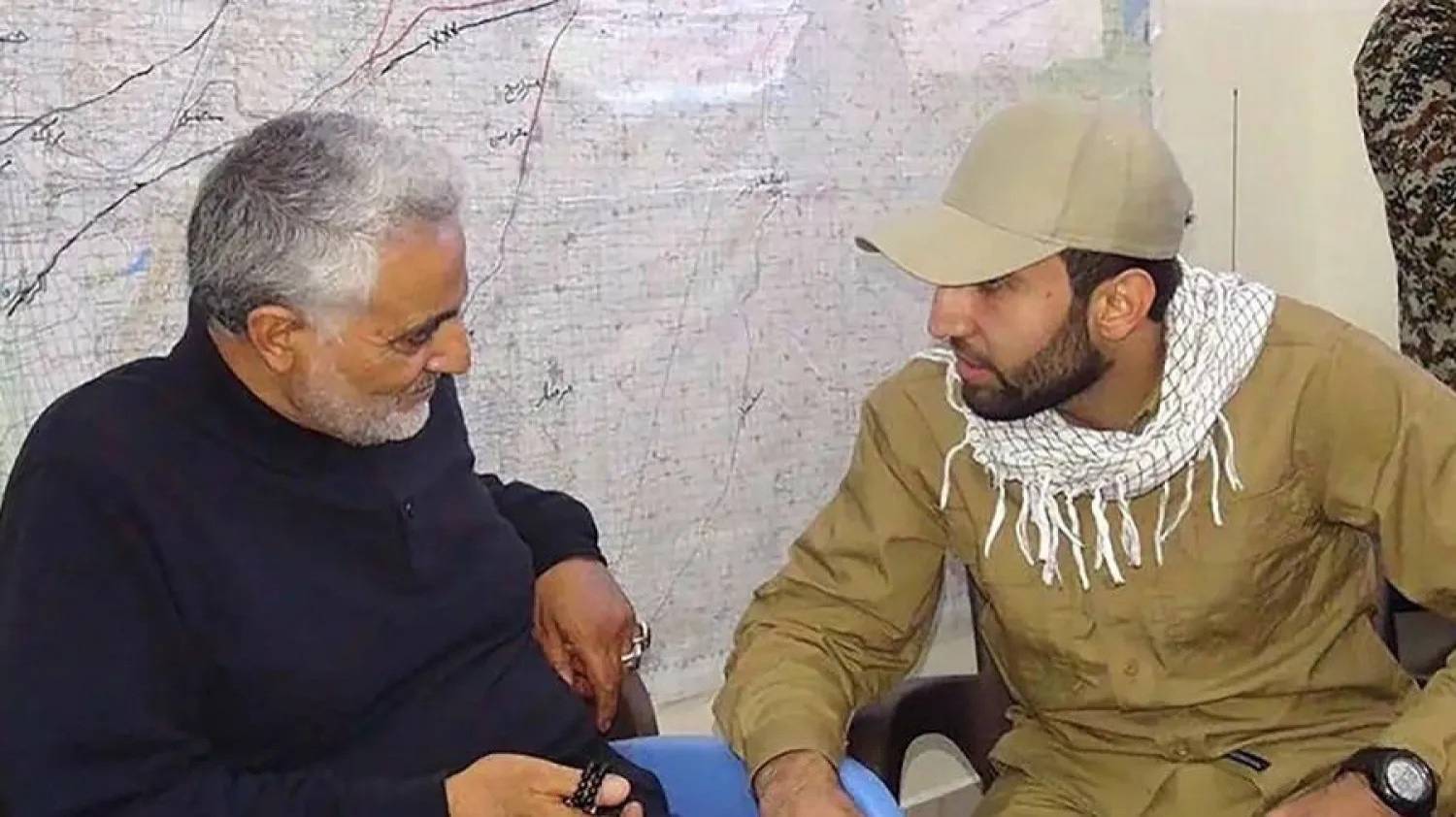
Mohammed Baqer al-Saadi with Qassem Soleimani (US Justice Department)

How was al-Saadi arrested?

According to most Western sources that reported al-Saadi’s arrest in Türkiye and transfer to the United States, he is accused of coordinating and planning at least 18 terrorist attacks in Europe targeting Americans and Jews, all in the name of ending the war in Iran.

After his arrest, al-Saadi appeared in a video message to his mother on a mobile phone screen, urging her to “be patient” and saying they “will not be broken.”

Western sources say he “directed and urged” others to attack US and Israeli interests in retaliation for the war Washington and Tel Aviv are waging against Tehran.

Al-Saadi is also accused of coordinating two additional attacks in Canada, directing others, and attempting to coordinate terrorist attacks inside the United States, including against a synagogue in New York City, according to prosecutors.

The US lists Kataib Hezbollah as a foreign terrorist organization and says al-Saadi has been involved with the group since 2017. Some sources say his father is linked to the Badr Organization, led by Hadi al-Amiri.

Last month, Washington offered a $10 million reward for information on Kataib Hezbollah leader Abu Hussein al-Hamidawi.

CNN had reported a link between Kataib Hezbollah and the group that claimed responsibility for a series of arson attacks targeting Jewish sites across Europe, including synagogues, schools and ambulances.

Al-Saadi faces several charges, including conspiracy to provide material support to a foreign terrorist organization, conspiracy to provide material support for terrorist acts, and conspiracy to bomb a public place.

He appeared in court on Friday in the Southern District of New York, where a judge ordered him detained without bail. He did not enter a plea during the hearing.

The potential repercussions of al-Saadi’s arrest for Kataib Hezbollah remain unclear, as does the nature of the information US agencies may obtain from him and whether it could expose the armed group, which is now at the center of US scrutiny.

According to al-Saadi’s defense lawyer, Andrew Dalack, who spoke to Western media, he was arrested in Türkiye by Turkish authorities, most likely at Washington’s request, and handed over to US authorities without being given a chance to challenge the legality of his detention or his transfer to the United States.

Al-Saadi faces numerous allegations and accusations, including an attempt to arrange the bombing of a prominent synagogue in New York City, as well as targeting two other sites in the United States, Jewish centers in Los Angeles and Scottsdale, Arizona.

Other allegations indicate that al-Saadi agreed to pay $10,000 to carry out the attack, but insisted that it be filmed. Investigators say he insisted the attack be carried out on April 6, and when it did not happen, he sent a text message to the undercover agent the following morning asking why.

Al-Saadi’s record on X

Al-Saadi appears to have been active on X for years, where he often sharply criticized the government of Iraqi Prime Minister Mohammed Shia al-Sudani, which filed a “defamation” lawsuit against him in 2024.

In July 2020, al-Saadi posted on his account a picture of the US Capitol destroyed, alongside images of slain commanders such as Soleimani, with the phrase: “Our revenge for the martyred commanders continues. No negotiations with the occupier.”

He also uses the platform to openly declare support for Iran and the “Axis of Resistance,” and to attack their opponents.

In 2023, al-Saadi posted a screenshot from a maps application of Indian Creek Island in the US state of Florida, a small fortified residential island in Miami-Dade County known in the media as the billionaires’ bunker, where a number of businesspeople, celebrities and politicians live.

Prominent residents include Jared Kushner and his wife Ivanka Trump.


UN Expert Condemns ‘Torture’ of Palestinian Prisoners in Israel

 Israeli soldiers stand guard during a weekly settlers' tour in Hebron, in the Israeli-occupied West Bank, May 16, 2026. (Reuters)
Israeli soldiers stand guard during a weekly settlers' tour in Hebron, in the Israeli-occupied West Bank, May 16, 2026. (Reuters)
TT

UN Expert Condemns ‘Torture’ of Palestinian Prisoners in Israel

 Israeli soldiers stand guard during a weekly settlers' tour in Hebron, in the Israeli-occupied West Bank, May 16, 2026. (Reuters)
Israeli soldiers stand guard during a weekly settlers' tour in Hebron, in the Israeli-occupied West Bank, May 16, 2026. (Reuters)

A United Nations expert on Tuesday raised alarm over the alleged "torture" of Palestinian prisoners and "potentially unlawful deaths" in Israeli prisons since October 2023.

The comments come as Israel faces growing scrutiny over detention conditions following the October 7, 2023 attack by Hamas inside Israel that sparked the Gaza war.

"Emergency measures introduced after 7 October 2023 exposed Palestinian detainees to torture, potentially unlawful deaths, incommunicado detention, and degrading conditions," said Alice Jill Edwards, the UN special rapporteur on torture.

Quoted in a UN statement seen by AFP, she argued the "number and cruelty of allegations" point to a "gross disregard by Israel of its duty to treat all detainees humanely".

Edwards said she had gathered information on 52 cases involving various forms of torture or ill-treatment, as well as 33 cases of sexual torture and other forms of sexual abuse.

Reported abuses include "severe beatings, stress positions, excessive restraints, electrocution, sleep deprivation, malnutrition and starvation" among many others.

She also expressed concern over reports of at least 94 deaths in custody since October 2023 that had not been investigated.

Autopsies in several cases revealed multiple rib fractures, skin hemorrhages and injuries to internal organs, including abdominal tears, she said.

"Behind every allegation is a human being who was wholly dependent on those exercising power over them," Edwards said, calling for "full, independent and transparent" investigations and accountability.

In a communication to Israeli authorities, she noted that none of the 1,680 complainants filed against Israeli intelligence services had led to indictments.

She urged Israel to review and revise its detention laws, policies and practices.

More than 9,000 Palestinians are currently held in Israeli jails, including 2,200 serving sentences.


Board of Peace Will Ask the UN Security Council to Press Hamas to Disarm

A Palestinian boy stands next to plastic containers on a trolley, as he and others collect portable drinking water for their displaced family living in shelters after homes were destroyed in Israeli bombardment, in the Bureij refugee camp, in the central Gaza Strip on May 18, 2026. (AFP)
TT

Board of Peace Will Ask the UN Security Council to Press Hamas to Disarm

A Palestinian boy stands next to plastic containers on a trolley, as he and others collect portable drinking water for their displaced family living in shelters after homes were destroyed in Israeli bombardment, in the Bureij refugee camp, in the central Gaza Strip on May 18, 2026. (AFP)

The body overseeing the US-brokered ceasefire in Gaza will ask the United Nations Security Council to press the Hamas group to disarm, according to a report seen by The Associated Press on Tuesday.

The report by the Board of Peace, an international body set up by US President Donald Trump and tasked with overseeing the fragile ceasefire between Hamas and Israel, is expected to be discussed by the Security Council on Thursday when it meets on the situation in the Middle East.

“At this stage, the principal obstacle to full implementation (of the ceasefire) remains Hamas’ refusal to accept verified decommissioning, relinquish coercive control, and permit a genuine civilian transition in Gaza,” the report said.

Hamas in a statement rejected the report and said it contains “fallacies.”

A diplomat familiar with the report confirmed its authenticity, speaking on condition of anonymity because it has not been made public.

Trump’s 20-point ceasefire plan calls on Hamas to surrender its weapons and destroy its vast network of tunnels. It also envisions Israeli forces withdrawing from Gaza, the arrival of a new technocratic Palestinian government, deployment of an international security force and the rebuilding of the battered Palestinian enclave after more than two years of war.

Board of Peace head has said the ceasefire has stalled

Last week, the head of the Board of Peace, former UN Mideast envoy Nickolay Mladenov, acknowledged that the truce had stalled since taking effect in October, saying the deadlock over disarming Hamas had paralyzed progress.

“Reconstruction cannot commence where weapons have not been laid down,” the board’s report to the Security Council says. “The critical variable — the single factor that unlocks every other element of the plan — is the conclusion of an agreement on the Roadmap for the full implementation of the plan that includes full decommissioning by Hamas and all armed groups in Gaza.”

The Palestinian group, which led the Oct. 7, 2023, attack on Israel that sparked the war in Gaza, has accused Israel of failing to meet its obligations under the first phase of the ceasefire and has sought to link any demilitarization to Israeli troop pullbacks. Israel’s military has expanded its control of Gaza since the truce took effect and now controls some 60% of the territory.

The new report calls on the Security Council to “reiterate publicly, clearly and consistently that the decommissioning of weapons in Gaza is not merely a requirement (of the UN’s resolution to end the war) but critical for reconstruction to begin, for a timebound Israeli forces withdrawal, and for a credible pathway to Palestinian self-determination and statehood to be pursued.”

The Security Council endorsed the Board of Peace in a resolution in November.

Hamas says the report tries to derail the ceasefire

Hamas said the report “contains a number of fallacies that absolve the occupying government of its responsibilities for the daily violations of the ceasefire agreement in Gaza.”

The group said the report ignored Israel’s “failure to uphold the majority of its commitments” in the ceasefire deal, including the continued restrictions on crossings into the Palestinian territory and preventing the entry of material and equipment needed to repair basic infrastructure and shelter for the largely displaced population.

“The report’s adoption of the occupation’s conditions regarding disarmament is a dubious attempt to muddy the waters and derail the ceasefire agreement,” Hamas said in a statement.

It called on the Security Council and Mladenov to compel Israel to fulfill its commitments under the ceasefire' deal's first phase, "foremost among them the cessation of the daily aggression against our Palestinian people in Gaza.”

The ceasefire has seen numerous violations The report noted near-daily ceasefire violations, “some of which are serious, and their human consequences — civilians killed, families living in fear, and continued impediments to humanitarian access — cannot be minimized.”

Israel’s military still carries out airstrikes in Gaza despite the ceasefire and has pushed deeper into the territory, where it now controls more than it was granted under the ceasefire agreement. Living conditions are dire, with most of the territory’s 2 million people living in tent camps lacking basic services.

Mladenov last week said his office is addressing violations by both sides on a daily basis. But he repeatedly cited the disarmament issue as a central sticking point, saying Hamas’ obligation to give up its arsenal is “not negotiable" and that progress on all other issues was being held up.


Israel Military Issues Fresh Evacuation Warnings for South Lebanon

Smoke rises from the site of an Israeli airstrike that targeted the southern Lebanese village of Burj el-Shmali on on May 19, 2026. (AFP)
TT

Israel Military Issues Fresh Evacuation Warnings for South Lebanon

Smoke rises from the site of an Israeli airstrike that targeted the southern Lebanese village of Burj el-Shmali on on May 19, 2026. (AFP)

The Israeli military on Tuesday warned residents of 12 towns and villages in southern Lebanon to immediately evacuate ahead of expected attacks against Hezbollah, the latest despite a ceasefire.

"Hezbollah's continued violations of the ceasefire compel the army to operate against it. The army does not intend to harm you. For your safety, we urge you to distance yourself from the area and immediately move at least 1,000 meters away," the military's Arabic-language spokesman Avichay Adraee posted on X.

Lebanon's state-run National News Agency reported a new series of Israeli strikes targeting several locations in southern Lebanon on Tuesday.

Meanwhile, Hezbollah said in a statement that it had targeted a gathering of soldiers and vehicles in northern Israel with "a swarm of attack drones."

The Iran-backed group also claimed responsibility for new attacks against Israeli forces operating inside Lebanese territory.

The Israeli military said that following sirens in several areas of northern Israel, a drone "that crossed from Lebanon to Israeli territory was intercepted".

Since the start of the ceasefire on April 17, Israel has continued to launch strikes, carry out demolitions and issue evacuation orders in south Lebanon, saying it is targeting the group.

Hezbollah has also continued operations against Israeli forces in southern Lebanon and northern Israel.

On Monday, the Lebanese health ministry said the death toll from Israeli strikes since the start of the war on March 2 had reached 3,020.

The Israeli military says it has lost 20 soldiers and one civilian contractor in southern Lebanon since the war began.