


IEA Chief Warns Commercial Oil Inventories Are Depleting Rapidly, Only Weeks Left

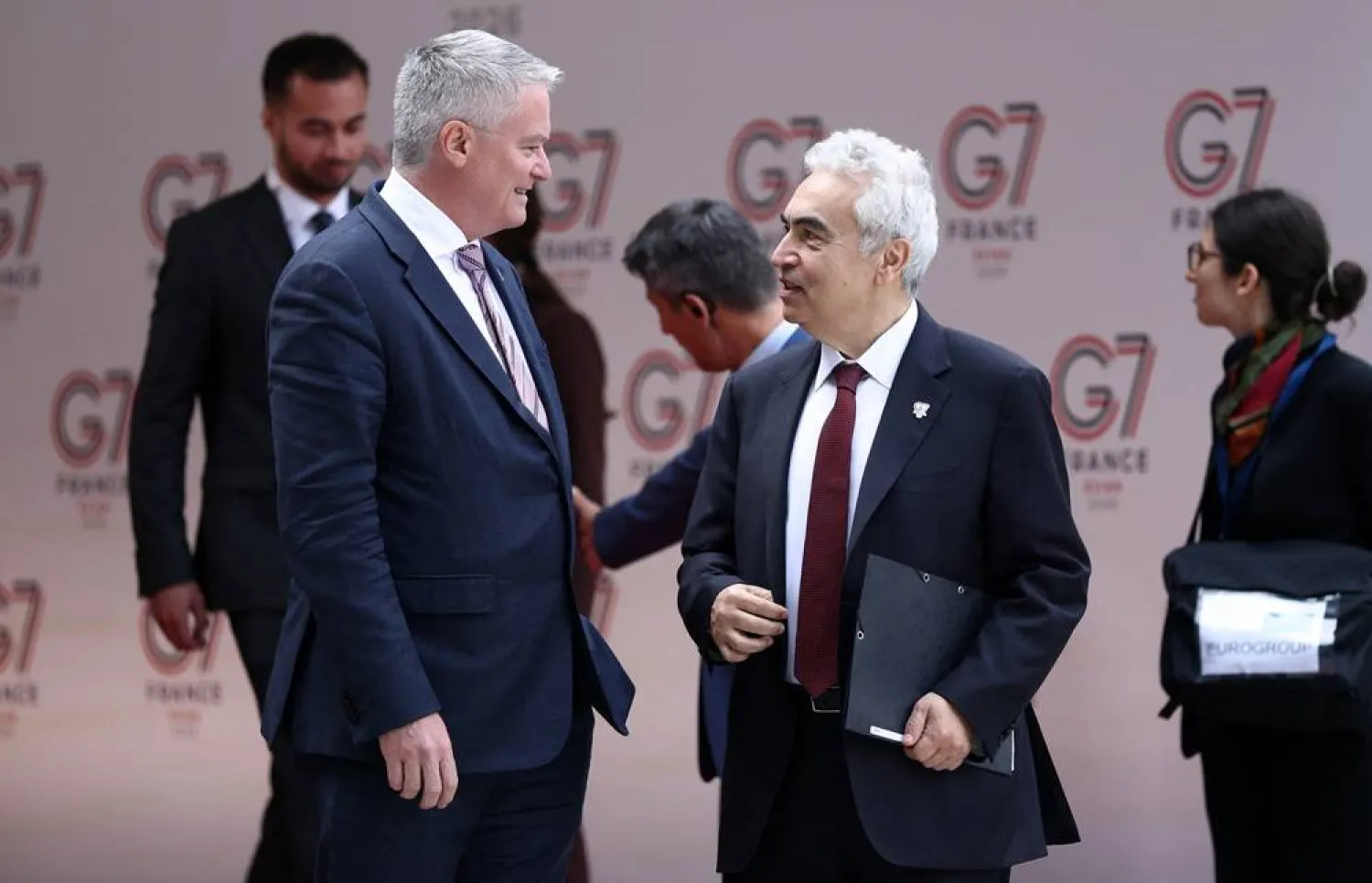
Organization for Economic Cooperation and Development (OECD) Secretary-General Mathias Cormann and International Energy Agency (IEA) Executive Director Fatih Birol talk on the day of a G7 finance ministers' and central bank governors' meeting in Paris, France, May 18, 2026. (Reuters)
TT

IEA Chief Warns Commercial Oil Inventories Are Depleting Rapidly, Only Weeks Left

Organization for Economic Cooperation and Development (OECD) Secretary-General Mathias Cormann and International Energy Agency (IEA) Executive Director Fatih Birol talk on the day of a G7 finance ministers' and central bank governors' meeting in Paris, France, May 18, 2026. (Reuters)

Fatih Birol, head of the International Energy Agency, said on Monday that commercial oil inventories were depleting rapidly with only a few weeks' worth left due to the Iran war and the closure of the Strait of Hormuz to shipping.

Birol, who is participating in the Group of Seven finance leaders meeting in Paris, told reporters that the release of strategic oil reserves had added 2.5 million barrels of oil per day to the market, but said these reserves "are ‌not endless".

The ‌onset of the spring planting and summer ‌travel ⁠seasons in the northern ⁠hemisphere will drain inventories more quickly as demand for diesel, fertilizer, jet fuel and gasoline increases, Birol added.

Asked about his comments in the G7 meeting, he said he described "a perception gap in the markets between the physical markets and the financial markets" for oil.

Birol said that before the US and Israel launched attacks on Iran at ⁠the end of February, there was a major ‌surplus in the oil markets, and ‌commercial inventories were very high. But the situation has rapidly shifted due to ‌the war.

He said commercial inventories would last "several weeks, but we ‌should be aware of the fact that it is declining rapidly".

Last week, the IEA said global oil supply will fall short of total demand this year as the Iran conflict wreaks havoc on Middle East oil ‌production, and inventories were being drained at an unprecedented pace. The IEA had previously forecast a surplus this ⁠year.

Global observed ⁠oil inventories fell at a record pace in March and April, dropping by 246 million barrels, the IEA said in its latest monthly oil market report.

The 32-member IEA coordinated the largest-ever release of stocks from strategic reserves in March, agreeing to withdraw 400 million barrels in a bid to calm markets.

Around 164 million barrels had been released by May 8, it said.

Overall global oil supply will fall by around 3.9 million barrels per day across 2026 due to the war, the agency said, slashing its previous forecast, which had projected a 1.5 million bpd drop.



Gold Slips on Rate-Hike Bets; Inflation Data in Focus

Gold jewelry is displayed at an exhibition in Kabul, Afghanistan, 03 September 2026. (EPA)
TT

Gold Slips on Rate-Hike Bets; Inflation Data in Focus

Gold jewelry is displayed at an exhibition in Kabul, Afghanistan, 03 September 2026. (EPA)

Gold slipped on Monday as strong US jobs data reinforced expectations for higher interest rates, while investors awaited key US inflation reports due later this week for further clarity on the Federal Reserve's policy path.

Spot gold was down 0.6% at $4,402.86 per ounce, as of 0420 GMT, after falling 1% on Friday.

US gold futures for December delivery were down 0.6% at $4,447.60.

Data ‌on Friday ‌showed US job growth accelerated sharply in August ‌while ⁠the unemployment rate ⁠held steady at 4.1%, suggesting an improvement in the labor market after recent struggles and keeping a rate increase this month on the table.

US producer price index (PPI) data is due on Thursday, followed by consumer price index (CPI) data on Friday.

"The jobs number delivered a clear upside surprise and put some pressure ⁠on the metal, but it wasn't a ‌complete slam dunk for a September ‌rate hike. The real missing piece of the puzzle arrives this ‌week with U.S. CPI," said Tim Waterer, chief market analyst ‌at KCM Trade.

"A strong inflation print would reinforce expectations of a Fed hike, lift yields further and weigh more heavily on gold."

Traders are pricing in a 58.4% chance of a rate hike ‌at the Fed's September 15-16 meeting, CME's FedWatch tool showed.

While gold is typically viewed as ⁠an inflation ⁠hedge, higher interest rates tend to weigh on the appeal of non-yielding bullion.

US President Donald Trump said on Friday that unless the Fed cuts interest rates, he would stop trading with countries with which the United States had a deficit.

On the Middle East front, Iran said it will step up efforts to tackle problems created by US sanctions that are crippling its economy, while a senior Iranian official warned of a "painful response" if it comes under further attack.

Among other metals, spot silver eased 0.6% to $65.80 per ounce, platinum lost 1.1% to $1,800.59 and palladium declined 0.5% to $1,394.00.


SEREDO 2026 Real Estate Expo Opens in Jeddah with Broad Participation

SEREDO 2026 real estate expo opens in Jeddah with broad participation. (SPA)
TT

SEREDO 2026 Real Estate Expo Opens in Jeddah with Broad Participation

SEREDO 2026 real estate expo opens in Jeddah with broad participation. (SPA)

Undersecretary of the Ministry of Municipalities and Housing for Stimulating Housing Supply and Real Estate Development Abdulrahman bin Abdullah Al-Tawil opened the fifth edition of the SEREDO Expo for Real Estate Development and Ownership 2026 at Jeddah Superdome.

Held under the ministry’s patronage, the event is bringing together government entities, real estate developers and financing companies, with broad participation from across the sector, the Saudi Press Agency reported on Sunday.

During the opening, Al-Tawil reviewed the key real estate and financing projects, products, and services offered by participating entities, as well as investment opportunities, solutions, and ownership options available to visitors and investors.

The expo brings together leading real estate entities and companies, providing a platform for industry stakeholders to connect, showcase their projects and products, and explore investment opportunities and ownership options available in the Saudi real estate market.

The opening ceremony also honored the event's patron, sponsors, and supporting partners in recognition of their contributions to SEREDO 2026 and their role in encouraging participation from across the real estate sector.

The exhibition runs through September 8, targeting real estate professionals, industry stakeholders, business leaders, and investors, as well as those interested in exploring projects and opportunities in real estate development, ownership, and investment.


Oil Extends Gains After US and Iran Strike Ships

A drone view shows the Imperial Oil refinery in Sarnia's Chemical Valley industrial corridor in Sarnia, Ontario, Canada, September 2, 2026. (Reuters)
TT

Oil Extends Gains After US and Iran Strike Ships

A drone view shows the Imperial Oil refinery in Sarnia's Chemical Valley industrial corridor in Sarnia, Ontario, Canada, September 2, 2026. (Reuters)

Oil prices extended gains on Monday as tit-for-tat strikes between the US and Iran on vessels sailing in the Strait of Hormuz and other areas heightened concerns of a prolonged supply disruption from the Middle East.

Brent crude futures climbed 79 cents, or 0.82%, to $97.07 a barrel by 0512 GMT while US West Texas Intermediate crude was at $92.28 a barrel, up 80 ‌cents, or ‌0.87%.

Brent rose 7.8% last week while WTI gained nearly ‌10% ⁠after the US and Iran ⁠resumed attacks and caused a reduction in oil flows through the Hormuz strait where a fifth of the world's oil supply used to transit.

US forces struck three Iranian oil tankers on Saturday, US Central Command said, including one off the coast of Kharg Island, near Iran's key oil export hub.

The navy of Iran's Revolutionary Guard Corps said on Saturday it targeted three oil tankers that were travelling through unauthorized routes in ⁠the Strait of Hormuz as well as three additional US vessels ‌in other areas.

The Saturday attacks represented a "major ‌escalation in the maritime conflict", maritime intelligence firm Marisks said.

"Commercial tankers are now being deliberately used ‌as instruments of reciprocal economic pressure, substantially weakening the previous distinction between military confrontation and ‌commercial shipping," it added.

An average of 10 commodity ships transited the Strait of Hormuz per day over the past 10 days, the lowest since May, data from analytics firm Kpler showed on Monday.

"If tanker traffic begins to slow materially, the market could price in a much ‌larger supply shock. And there are already signs that this is happening," said Priyanka Sachdeva, head of market insights at Phillip ⁠Nova.

A restricted zone ⁠will be announced outside the Strait of Hormuz in coming days, Mohsen Rezaei, the secretary of Iran's Supreme National Security Council, said on Sunday, according to state media.

OPEC+ kept its oil output policy unchanged for October at a meeting on Sunday, the producer group said in a statement, as it needs to agree new quotas before deciding its next output steps.

A prolonged standoff, punctuated by calibrated military action by the US and Iran, appeared to be the most likely scenario and was likely to delay the path to full recovery of Middle East supply, ANZ analysts said in a note.

"We then expect exports to remain constrained through the rest of 2026, before a gradual reopening late in Q4 2026," they said, adding that a return to pre-war throughput is not expected until late first quarter or early second quarter of 2027.
