


Iran Says Peace Proposal Includes Reparations for War Damage, US Troop Withdrawal

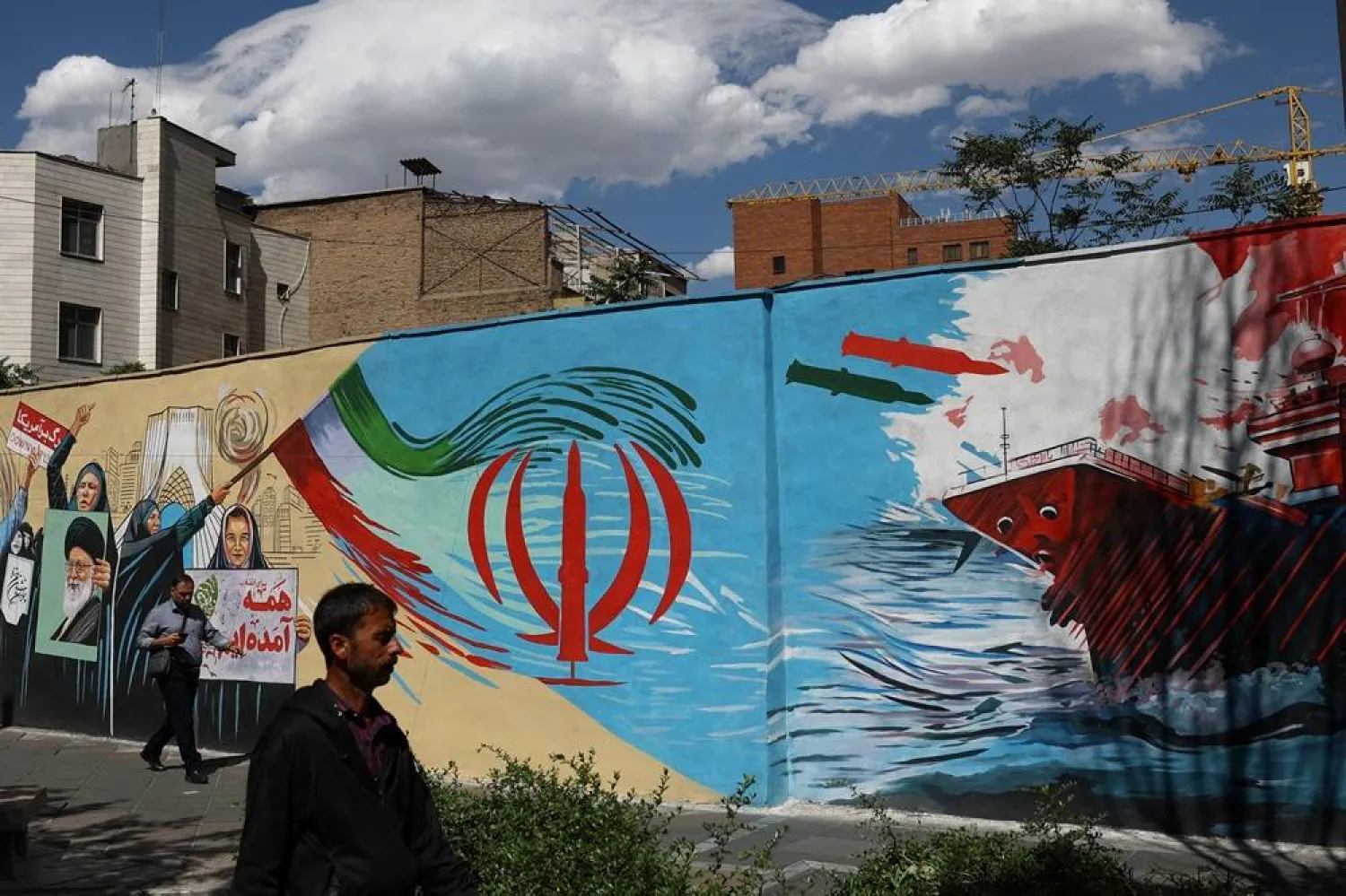
People walk on a street near a mural featuring an image of the late Supreme Leader of Iran, Ali Khamenei, in Tehran, Iran, May 18, 2026. Majid Asgaripour/WANA (West Asia News Agency) via Reuters
TT

Iran Says Peace Proposal Includes Reparations for War Damage, US Troop Withdrawal

People walk on a street near a mural featuring an image of the late Supreme Leader of Iran, Ali Khamenei, in Tehran, Iran, May 18, 2026. Majid Asgaripour/WANA (West Asia News Agency) via Reuters

Tehran's latest peace proposal to the United States involves ending hostilities on all fronts including Lebanon, the exit of US forces from areas close to Iran, and reparations for destruction caused by the US-Israeli war, state media reported on Tuesday.

In Tehran's first comments on the proposal, Deputy Foreign Minister Kazem Gharibabadi said Tehran also sought the lifting of sanctions, the release of frozen funds and an end to the US marine blockade on the country, according to IRNA news agency.

The terms as described in the Iranian reports appeared little changed from Iran's previous offer, which US President Donald Trump rejected last week as "garbage".

Trump said on Monday he had paused a planned resumption of attacks on Iran after Tehran sent a new peace proposal to Washington, and that there was now a "very good chance" of reaching a deal limiting Iran's nuclear program.

Reuters could not determine whether preparations had been made for ‌strikes that would ‌mark a renewal of the war Trump started in late February.

Under pressure to reach ‌an accord ⁠that would ⁠reopen the Strait of Hormuz - a key supply route for global supplies of oil and other commodities - Trump has previously expressed hope that a deal was close on ending the conflict, and similarly threatened heavy strikes on Iran if Tehran did not reach a deal.

In a social media post, Trump said the leaders of Qatar, Saudi Arabia and the United Arab Emirates had requested that he hold off on the attack because "a Deal will be made, which will be very acceptable to the United States of America, as well as all Countries in the Middle East, and beyond."

Speaking to reporters later on Monday, he said the United States would be satisfied ⁠if it could reach an agreement with Iran that prevented Tehran from obtaining a nuclear ‌weapon.

"There seems to be a very good chance that they can ‌work something out. If we can do that without bombing the hell out of them, I would be very happy," Trump told reporters.

A ‌Pakistani source confirmed that Islamabad, which has conveyed messages between the sides since hosting the only round of peace talks last ‌month, had shared the Iranian proposal with Washington.

The sides "keep changing their goalposts," the Pakistani source said, adding: "We don't have much time."

MIXED SIGNALS

Although neither side has publicly disclosed any concessions in negotiations that have been stalled for a month, a senior Iranian official suggested on Monday that Washington may be softening some of its demands.

The source said the US had agreed to release a quarter of Iran's frozen funds - totaling tens ‌of billions of dollars - held in foreign banks. Iran wants all the assets released.

And the source said Washington had shown more flexibility in agreeing to let Iran continue some ⁠peaceful nuclear activity under supervision ⁠of the International Atomic Energy Agency.

The US has not confirmed that it has agreed to anything in the talks.

A US official, speaking on condition of anonymity, denied a report by Iran's Tasnim news agency that Washington had agreed to waive oil sanctions on Iran while negotiations were under way.

The US-Israeli bombing killed thousands of people in Iran before it was suspended in a ceasefire in early April. Israel has killed thousands more and driven hundreds of thousands from their homes in Lebanon, which it invaded in pursuit of the Iran-backed Hezbollah. Iranian strikes on Israel and neighboring Gulf states have killed dozens of people.

The Iran ceasefire has mostly held, although drones have lately been launched from Iraq towards Gulf countries, including Saudi Arabia and Kuwait, apparently by Iran and its allies.

Trump and Israeli Prime Minister Benjamin Netanyahu said they launched the war to curb Iran's support for regional armed proxies, dismantle its nuclear program, destroy its missile capabilities, and create conditions for Iranians to topple their rulers.

But the war has yet to deprive Iran of its stockpile of near-weapons-grade enriched uranium or its ability to threaten neighbors with missiles, drones and proxies.

Iran's clerical leadership, which had faced a mass uprising at the start of the year, withstood the superpower onslaught with no sign of organized opposition.



EU Denounces New US Waiver of Russian Oil Sanctions

European Commissioner for Economy and Productivity, Valdis Dombrovskis, looks on ahead of a G7 finance ministers and central bank governors meeting in Paris, France, May 18, 2026. (Reuters)
TT

EU Denounces New US Waiver of Russian Oil Sanctions

European Commissioner for Economy and Productivity, Valdis Dombrovskis, looks on ahead of a G7 finance ministers and central bank governors meeting in Paris, France, May 18, 2026. (Reuters)

The European Union criticized Tuesday the latest US waiver of sanctions on Russian oil, announced while G7 finance ministers were meeting to reach a common response to multiple economic challenges.

Washington's move aims to help lower energy prices that have skyrocketed since the US and Israel launched attacks on Iran in February, effectively shutting the Strait of Hormuz to Gulf oil tanker traffic.

But EU economics commissioner Valdis Dombrovskis denounced the extensions, which have given Moscow a financial boost as it pursues its war against Ukraine.

"From the EU point of view, we do not think that this is a time to ease pressure on Russia," Dombrovskis told journalists while arriving for a second day of G7 talks in Paris.

"In fact, Russia is the one which is gaining from the war in Iran and the increase in fossil fuel prices," he said. "If anything, we would need to strengthen the pressure."

US Treasury Secretary Scott Bessent is in Paris for the Group of Seven talks hosted by France, which currently chairs the group's rotating presidency.

"Secretary Bessent was reassuring us that this is a temporary measure, but we know that it's already a second extension of the measure which initially was meant to last only 30 days," Dombrovskis said.

French Finance Minister Roland Lescure said a joint statement would nonetheless be made following talks that are to wind up Tuesday.

"We've had extremely frank discussions between people who do not necessarily agree on everything, but who are able to talk about everything," he told journalists.

The talks aim to keep dialogue open as trade feuds spurred by US President Donald Trump's tariff blitz compound geopolitical tensions.


Türkiye Arrests 110 on Suspicion of ISIS Ties

The arrests came during simultaneous raids across three provinces, centered in Istanbul. (AFP file)
TT

Türkiye Arrests 110 on Suspicion of ISIS Ties

The arrests came during simultaneous raids across three provinces, centered in Istanbul. (AFP file)

Turkish counter-terror police on Tuesday arrested 110 people on suspicion of activities in support of the ISIS group in an operation largely targeting Istanbul, the Anadolu state news agency said.

The suspects are accused of organizing classes in illegal associations, educating young children with ISIS ideology, collecting money for the group and seeking to recruit new ISIS members, in an operation coordinated by the Istanbul chief prosecutor's office.

The arrests came during simultaneous raids across three provinces, centered in Istanbul, with police seizing four rifles and 90 cartridges along with documents and digital materials.

Last week, police arrested another 324 people in raids targeting ISIS suspects across 47 provinces, the interior ministry said.

On April 7, a gunman was killed and two others were wounded in a shootout outside the Israeli consulate in Istanbul.

Interior Minister Mustafa Ciftci said one of them was linked to an "organization that exploits religion", which Turkish media reported was ISIS.

At the end of December, ISIS militants opened fire on police in the northwestern town of Yalova, killing three officers and wounding nine others.

Six ISIS militants were also killed in the hours-long gun battle that followed, with Türkiye rounding up more than 600 suspected members of the group in the following weeks.


WHO Chief Says ‘Deeply Concerned’ by ‘Scale and Speed’ of DR Congo Ebola Outbreak

A motorcycle taxi driver waits for clients in front of the entrance of CBCA Virunga General Hospital, in Goma on May 17, 2026. (AFP)
TT

WHO Chief Says ‘Deeply Concerned’ by ‘Scale and Speed’ of DR Congo Ebola Outbreak

A motorcycle taxi driver waits for clients in front of the entrance of CBCA Virunga General Hospital, in Goma on May 17, 2026. (AFP)

The World Health Organization chief voiced concern on Tuesday about the "scale and speed" of an Ebola outbreak in the Democratic Republic of Congo which has killed an estimated 131 people. 

The WHO has declared the surge of the highly contagious hemorrhagic fever an international health emergency and will hold an emergency meeting on the crisis on Tuesday. 

No vaccine or therapeutic treatment exists for the Bundibugyo strain of Ebola responsible for the latest outbreak of the disease, which has killed more than 15,000 people in Africa in the past half century. 

With the new outbreak largely concentrated in difficult-to-access areas, few samples have been laboratory-tested and figures are based mostly on suspected cases. 

"We have recorded roughly 131 deaths in total and we have around 513 suspected cases," Congolese Health Minister Samuel Roger Kamba said on national television early Tuesday. 

"The deaths we are reporting are all the deaths we have identified in the community, without necessarily saying that they are all linked to Ebola," he added. 

The previous figures from the outbreak, declared late last week in the country's east, gave a total of 91 dead out of 350 suspected cases. 

WHO chief Tedros Adhanom Ghebreyesus said the decision to declare the second-highest level of alert under international health regulations was not taken "lightly". 

"I'm deeply concerned about the scale and speed of the epidemic," he told the World Health Assembly in Geneva on Tuesday. 

The outbreak's epicenter is in northeastern Ituri province on the border with Uganda and South Sudan. 

As a gold-mining hub, it sees people regularly crisscrossing the region and has been plagued by clashes between local militias for years. 

The virus has already spread into neighboring provinces, as well as beyond the DRC's borders. 

- 'Mystical illness' - 

Suspected cases have been reported in the commercial hub of Butembo in neighboring North Kivu province, some 200 kilometers (125 miles) away from the epidemic's ground zero, Kamba said, without giving further details. 

Another case has been recorded in Goma, North Kivu's key provincial capital currently under the control of the Rwanda-backed M23 anti-governmental armed group. 

"Unfortunately, the alert was slow to circulate within the community, because people thought it was a mystical illness, and so, as a result, the sick were not taken to the hospital," Kamba said. 

The Africa Centres for Disease Control and Prevention (Africa CDC) has declared the outbreak a continental public health emergency. 

The step enables the Africa CDC, based in Ethiopia, to mobilize extra resources including emergency response teams and surveillance operations. 

Tedros said that 30 cases had been confirmed to be Ebola in Ituri province. 

"Uganda has also informed WHO of two confirmed cases in the capital of Kampala, including one death among two individuals who travelled from DRC," he told the annual meeting of the health agency's decision-taking body. 

A US citizen has tested positive for the virus following exposure related "to their work" in the DRC, the US Centers for Disease Control and Prevention said. 

The patient is due to arrive in Germany for treatment, the German health ministry said on Tuesday. 

The United States has announced it was bolstering precautions to prevent the spread of Ebola, including screening air passengers from outbreak-hit areas and temporarily suspending visa services. 

It is attempting to evacuate six additional people to monitor their health, the US Centers for Disease Control and Prevention (CDC) said on Monday. 

First identified in 1976 and believed to have originated in bats, Ebola is a deadly viral disease spread through direct contact with bodily fluids. It can cause severe bleeding and organ failure. 

The outbreak is the 17th in the central African country of more than 100 million people. 

The deadliest Ebola outbreak in the DRC claimed nearly 2,300 lives out of 3,500 cases between 2018 and 2020. 

The previous outbreak before the current one killed 45 people between September and December last year, the WHO said.