
Trump Says Negotiations with Iran in Final Stages, Warns of Attacks if Deal Fails

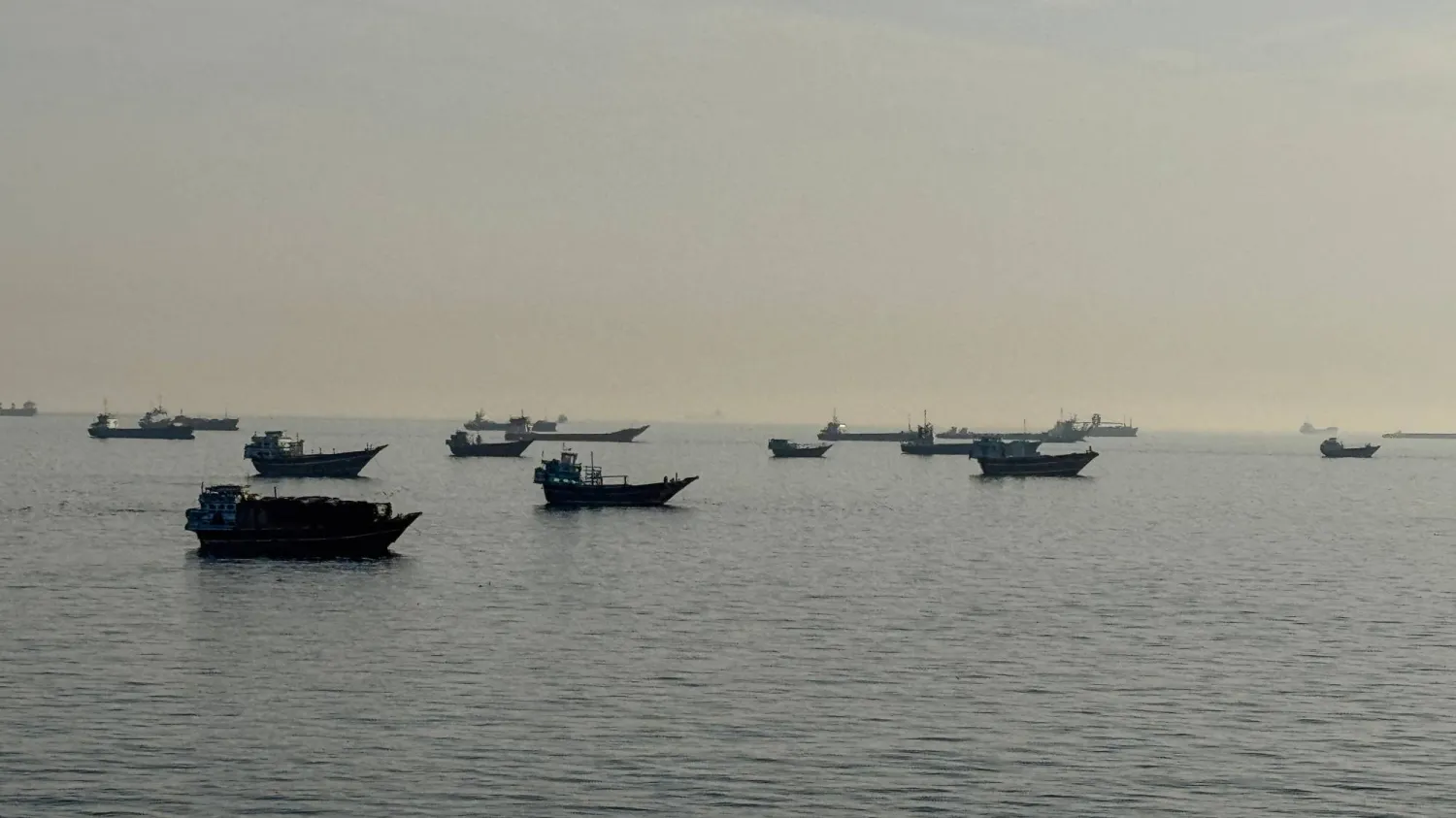
Vessels are seen anchored in the Strait of Hormuz, off the port city of Khasab on Oman's northern Musandam Peninsula on May 17, 2026. (AFP)
TT

Trump Says Negotiations with Iran in Final Stages, Warns of Attacks if Deal Fails

Vessels are seen anchored in the Strait of Hormuz, off the port city of Khasab on Oman's northern Musandam Peninsula on May 17, 2026. (AFP)

US President Donald Trump said on Wednesday that negotiations with Iran were in the final stages, while warning of further attacks unless Iran agrees to a deal. 

Six weeks since Trump paused Operation Epic Fury for a ceasefire, talks to end the war have shown little progress so far. Trump has said this week he came close to ordering more attacks, but held off to allow more time for negotiations. 

"We're in the final stages of Iran. We'll see what happens. Either have a deal or we're going to do some things that are a little bit nasty, but hopefully that won't happen," he told reporters on Wednesday. 

"We're going to give this one shot. I'm in no hurry," Trump said. "Ideally I'd like to see few people killed, as opposed to a lot. We can do it either way." 

Tehran, for its part, accused Trump of plotting to restart the war, and threatened to retaliate for any strikes with attacks beyond the Middle East. 

"If aggression against Iran is repeated, the promised regional war will extend beyond the region this time," the Revolutionary Guards said in a statement. 

Parliament Speaker Mohammad ‌Baqer Qalibaf, Iran's ‌top negotiator at peace talks, said in an audio message released on social media that "obvious and hidden moves by ‌the enemy" ⁠showed the Americans were ⁠preparing new attacks. 

PAKISTANI MINISTER IN TEHRAN IN LATEST DIPLOMATIC PUSH 

In the latest diplomatic push, the interior minister of Pakistan - which hosted the only round of peace talks so far and has since been the conduit for messages between the sides - was in Tehran on Wednesday. 

Iran submitted a new offer to the United States this week. Tehran's descriptions of the proposal suggest it largely repeats terms previously rejected by Trump, including demands for control of the Strait of Hormuz, compensation for war damage, lifting of sanctions, release of frozen assets and the withdrawal of US troops from the area. 

Trump has said he called off attacks this week at the last minute in response to requests from several of Iran's Gulf neighbors. On Tuesday he said he had been an hour away from ordering strikes. 

Saudi Arabia's Foreign Minister Prince Faisal bin Farhan bin Abdullah welcomed what he said ⁠was a decision by Trump to allow more time for diplomacy. 

CHINESE TANKERS CROSS STRAIT 

Iran has largely shut the Strait ‌of Hormuz to all ships apart from its own since the US-Israeli campaign began in February, causing ‌the biggest disruption to global energy supplies in history. The United States responded last month with its own blockade of Iran's ports. 

Iran says its aim is to reopen the ‌strait to friendly countries that abide by its terms to use it. That could potentially include fees for access, which Washington says would be unacceptable. 

Two giant Chinese ‌tankers laden with a total of around 4 million barrels of oil exited the strait on Wednesday. Iran had announced last week, while Trump was in Beijing for a summit, that it had reached agreement to ease rules for Chinese ships. 

South Korea's foreign minister said on Wednesday a Korean tanker was crossing the strait in cooperation with Iran. 

Shipping monitor Lloyd's List said at least 54 ships had transited the strait last week, around double the number from the week before. Iran said 26 ships had crossed in the ‌past 24 hours, still only a fraction of the 140 or so each day that typically crossed before the war. 

PRESSURE TO END WAR 

Trump is under pressure to end the war, with soaring energy prices hurting his Republican ⁠Party ahead of congressional elections in November. Since ⁠the ceasefire, his public comments have veered from threats to restart bombing to declarations that a peace deal was at hand, sometimes in the same breath. 

The fluctuating US stances have sent oil prices bouncing from hour to hour and day to day, though on a clear upward trend week by week. Benchmark one-month Brent crude futures eased about 2.75% on Wednesday morning to near $108 a barrel. 

"Investors are keen to gauge whether Washington and Tehran can actually find common ground and reach a peace agreement, with the US stance shifting daily," said Toshitaka Tazawa, an analyst at Fujitomi Securities. 

The US-Israeli bombing killed thousands of people in Iran before it was suspended in a ceasefire in early April. Israel has also killed thousands more and driven hundreds of thousands from their homes in Lebanon, which it invaded in pursuit of the Iran-backed Hezbollah party. Iranian strikes on Israel and neighboring Gulf states have killed dozens of people. 

This week saw a new volley of drones launched at Saudi Arabia and the UAE, which said they came from Iraq where armed factions allied to Iran operate. Jordan reported shooting down a drone on Wednesday. 

Trump and Israeli Prime Minister Benjamin Netanyahu said when they launched the war that their aims were to curb Iran's support for regional proxies, dismantle its nuclear program, destroy its missile capabilities and make it easier for Iranians to topple their rulers. 

But Iran has so far retained its stockpile of near-weapons-grade enriched uranium, and its ability to threaten neighbors with missiles, drones and proxy groups. Its clerical rulers, who put down a mass uprising at the start of the year, have faced no sign of organized opposition since the war began. 


Türkiye Eyes F110 Fighter Jet Engines as Trump Comes to Town

 Turkey and NATO flags wave ahead of the NATO summit, in Ankara, Türkiye, July 4, 2026. (Reuters)
Turkey and NATO flags wave ahead of the NATO summit, in Ankara, Türkiye, July 4, 2026. (Reuters)
TT

Türkiye Eyes F110 Fighter Jet Engines as Trump Comes to Town

 Turkey and NATO flags wave ahead of the NATO summit, in Ankara, Türkiye, July 4, 2026. (Reuters)
Turkey and NATO flags wave ahead of the NATO summit, in Ankara, Türkiye, July 4, 2026. (Reuters)

US President Donald Trump's visit to Ankara for the NATO summit could help secure Türkiye's acquisition of dozens of fighter jet engines, but won't resolve the F-35 dispute that has soured ties, analysts say.

The July 7-8 summit, which is being hosted by President Recep Tayyip Erdogan, will bring together leaders from the military alliance's 32 member states.

Last month, Trump promised to make Erdogan "very happy" when asked about Türkiye looking to secure F110 jet engines and being readmitted to the F-35 fighter jet program.

Analysts said it would likely mean freeing up fighter jet engines Türkiye wants to use in its flagship KAAN stealth fighter project.

"It's likely to be the green light for the F110 GE engines for the KAAN fighter plane, about 40 of them. There had been obstacles to that supply and very possibly those are now being removed," Sinan Ulgen, director of the Istanbul-based Edam think tank, told AFP.

"Türkiye has produced a couple of prototypes which are flying with the F110 engine, but it has been waiting for the supply of additional engines to increase the number of KAAN platforms," he said.

KAAN is a twin-engine stealth fighter being developed by Turkish Aerospace Industries (TAI) to replace the Turkish Air Force's fleet of F-16s as Ankara seeks to join the exclusive club of nations producing fifth-generation combat aircraft, notably the US, China and Russia.

Although Türkiye will eventually fit the fighter with its own domestically-produced engine -- the F110s lacking stealth capability -- that project is still in the preliminary design phase, Defense Minister Yasar Guler said in September.

Türkiye received a first batch of 10 F110s in September, and talks with the US government to acquire 80 more were "ongoing", he said.

- Indigenous defense systems -

But that's been held up by a lack of political clearance linked to Türkiye's 2017 acquisition of a Russian S-400 missile defense system, Foreign Minister Hakan Fidan said in September.

Infuriated, Washington expelled Türkiye from its F-35 fighter jet programe in 2019 and imposed CAATSA sanctions a year later, hampering Turkish defense projects and souring ties.

"The CAATSA issue must be resolved. The US needs to take steps both regarding the F-35 and the engines for KAAN. KAAN's engines are currently awaiting approval in the US Congress," Fidan said, his remarks raising eyebrows back home as Türkiye had said the KAAN would be entirely domestically produced.

Ankara's F-35 exclusion has forced it to refocus on self-sufficiency.

"Some argue we should not buy F-35s and invest that money into our own fifth-generation fighter jet program. And that's exactly what's happening with President Trump's decision to export jet engines," Ozgur Unluhisarcikli, head of the German Marshall Fund in Ankara said.

"Without those engines, Türkiye cannot produce the KAAN jet."

- F-35 deadlock drags on -

With a KAAN delivery date many years away, only Indonesia has placed an order, signing a $10 billion contract to buy 48 fighters, although the NATO summit could generate further interest, Ulgen said.

"Looking at the failure of the German-French FCAS initiative, there may be some interest. Spain could potentially become a partner... But there are more obstacles to be overcome for it to become a credible offer on the international stage," he said.

Experts expected little progress on the lingering F-35 dispute: for Congress to lift the CAATSA sanctions, Ankara would have to get rid of the S-400 -- but selling it to a third country would require Moscow's approval, and returning it to the Russians was not on the cards.

"The US administration might wish to... put this issue behind it and sell Türkiye some F-35, but that will go to Congress and changing the congressional decision won't be easy," said Professor Mustafa Aydin, an international relations expert at Istanbul's Kadir Has University.

But Matthew Bryza, a retired US envoy and former senior White House and State Department official, said Trump could move to resolve the matter as the F-35 was an executive decision which he could easily reverse.

"President Trump can certainly declare that the S-400/F-35 dispute is finished. It's the CAATSA sanctions that require congressional action. Whether he can persuade Congress to do that, depends on how much political capital he's willing to expend," he told AFP of a move that could be "politically costly in the lead up to the midterm elections" due to Türkiye's opponents in the Greek and Armenian diaspora.


Venezuela Quake Death Toll Rises to Nearly 3,000

 A drone view shows heavy machinery being used at the site of a damaged buildings in the aftermath of the June 24 earthquakes, in La Guaira, Venezuela, July 4, 2026. (Reuters)
A drone view shows heavy machinery being used at the site of a damaged buildings in the aftermath of the June 24 earthquakes, in La Guaira, Venezuela, July 4, 2026. (Reuters)
TT

Venezuela Quake Death Toll Rises to Nearly 3,000

 A drone view shows heavy machinery being used at the site of a damaged buildings in the aftermath of the June 24 earthquakes, in La Guaira, Venezuela, July 4, 2026. (Reuters)
A drone view shows heavy machinery being used at the site of a damaged buildings in the aftermath of the June 24 earthquakes, in La Guaira, Venezuela, July 4, 2026. (Reuters)

Venezuela's devastating twin earthquakes killed nearly 3,000, updated official figures showed on Saturday, as international rescue teams began winding down search operations for survivors in the rubble of the disaster.

Fatalities jumped by more than 300 from Friday to 2,954, following the June 24 disaster that has left thousands homeless in the streets and sheltering in camps.

Tens of thousands more are still reported missing. The government has not given any estimates, but the United Nations has estimated as many as 50,000 are unaccounted for following the 7.2 and 7.5 magnitude shocks.

One of Latin America's worst earthquake disasters hit hardest in the coastal La Guaira area north of the capital Caracas, where scores of residential complexes were flattened.

Ten days after the double shocks, which came just 38 seconds apart, rescue teams are starting to wrap up searches for survivors while families still try to recover bodies of loved ones from the wreckage.

The critical window for rescues in disasters like earthquakes usually ends after 72 hours, though a few people have been found alive this week.

In an apparent sign that rescue missions were closing up, interim President Delcy Rodriquez held a ceremony to hand out medals to international teams, including their rescue dogs.

Venezuela is experiencing "a profound grief gripping our people, where families still hold out hope of finding loved ones alive, people who have lost everything," Rodriquez said.

International disaster teams, including some US squads, and some South American teams were starting to finish up rescue operations, their members said on Saturday.

The Los Angeles County fire department rescue team is ending operations after its latest searches showed no signs of life, and teams from Florida and Virginia were packing up to leave this weekend, they said.

Many Venezuelans have expressed anger at what they see as their government's slow response to the disaster, saying families spent initial hours digging out loved ones themselves before international teams arrived.

Rodriguez has defended her government's response, saying thousands of troops and officials had been dispatched.

In La Guaira, workers with heavy machinery on Saturday were starting to knock down collapsed structures while in others, families were still trying to remove bodies of loved ones for funerals.

"We're still working, still searching for bodies. We're still going. It hasn't been easy," said Venezuelan volunteer Francisco Sasquia helping dig out a collapsed residence.

"We found two bodies that have already been released to their families."

- Economic fallout -

The United Nations has estimated that the twin earthquakes caused $6.7 billion in physical damage, equivalent to six percent of GDP for Venezuela, an oil exporting country.

Even before last week's disaster struck, Venezuela had struggled with decades of economic crisis and political upheaval that undermined its infrastructure and health services.

Maiquetia international airport in La Guaira, which serves Caracas, was also damaged in the quakes. It has reopened partially to allow humanitarian flights to land, but commercial flights are still suspended.

"We are in touch with some international partners, countries that will help in restoring the Maiquetia international airport," Rodriguez said at another event. "A plan will be ready next week."

For Víctor Colivert, the most important thing now was staying by the side of his nephew's body, recovered from a building's wreckage and now in a black body bag.

He fears losing it in the chaos. His family prevented forensic workers from taking the body away.

"If I have to go to China, to wherever, but I'm not leaving him alone," he said. "I'm going with him."


Xi Says Ready to Work with Kim for ‘Stable’ China-N. Korea Ties

Chinese President and Secretary General of the Communist Party of China, Xi Jinping applauds during the celebration of the 105th founding anniversary of the Chinese Communist Party, in Beijing, China, 01 July 2026. (EPA)
TT

Xi Says Ready to Work with Kim for ‘Stable’ China-N. Korea Ties

Chinese President and Secretary General of the Communist Party of China, Xi Jinping applauds during the celebration of the 105th founding anniversary of the Chinese Communist Party, in Beijing, China, 01 July 2026. (EPA)

China's President Xi Jinping said he was ready to work with North Korean leader Kim Jong Un to steer their bilateral relationship toward "long-term, sound and stable" development, Pyongyang's state media reported Sunday.

The exchange follows Xi's rare visit to North Korea last month, when the two leaders pledged to deepen ties as tensions rise on the Korean Peninsula and Pyongyang expands its military cooperation with Russia.

In a message dated July 1, Xi thanked Kim for his congratulatory message marking the 105th anniversary of the founding of China's Communist Party, according to the official Korean Central News Agency (KCNA).

Xi said Kim's message reflected the "deep and warm feelings" of the North Korean leader, the ruling Workers' Party and the North Korean people toward China.

"The Communist Party of China and the Workers' Party of Korea are the Marxist ruling parties," Xi said, adding that the two countries had stood together for national independence and had jointly advanced the socialist cause over generations.

"I am ready to guide the relevant sectors and regions of both sides to the full implementation of the important common understanding achieved among us and lead the China-DPRK relations to a long-term, sound and stable development," Xi said, using the initials of the North's official name.

Referring to his recent state visit to Pyongyang, Xi thanked Kim for the "enthusiastic and friendly" hospitality during the trip.

The message came in response to a letter from Kim, who described their summit in Pyongyang as a "historic occasion" and said it was North Korea's "steadfast stand" to continue strengthening ties with Beijing.

North Korea has expanded security ties with Russia, where Pyongyang has sent soldiers and munitions to assist Moscow's invasion of Ukraine.

Still, China remains North Korea's largest economic partner, accounting for nearly 98 percent of the country's foreign trade in 2024, according to South Korea's Ministry of Economy and Finance.