


Animal Welfare Groups: 3 South African Zoo Elephants Are Depressed, Sue to Move Them

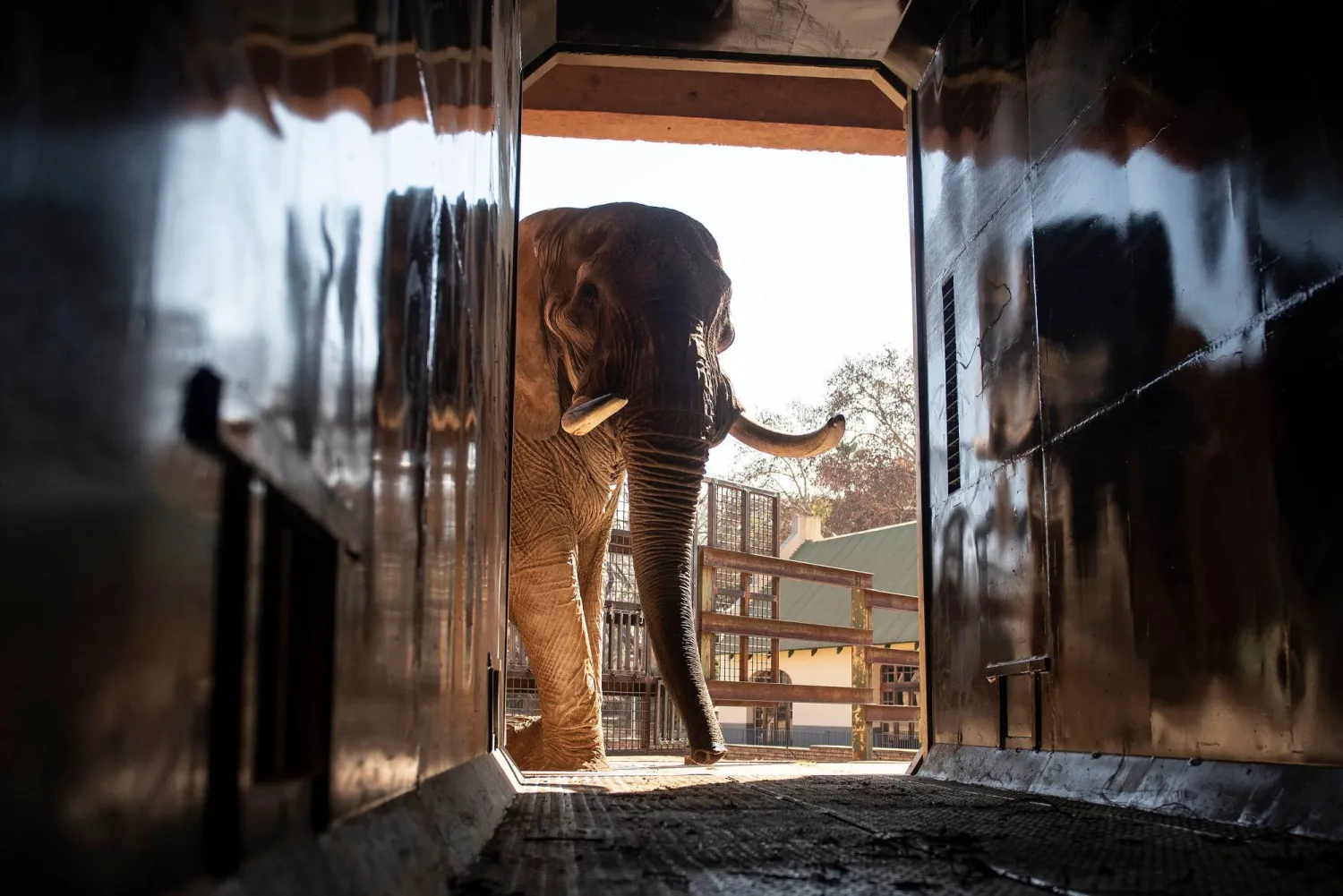
FILE - Charley, an ageing four-ton African elephant, is trained to enter a transport container, on Aug. 9, 2024 at the Pretoria, South Africa's, National Zoological Gardens. (AP Photo, File)
TT

Animal Welfare Groups: 3 South African Zoo Elephants Are Depressed, Sue to Move Them

FILE - Charley, an ageing four-ton African elephant, is trained to enter a transport container, on Aug. 9, 2024 at the Pretoria, South Africa's, National Zoological Gardens. (AP Photo, File)

The mental well-being of three elephants in a zoo in South Africa is the subject of an unusual court case, with animal welfare groups saying they are depressed and should be moved to a larger conservation park where they can be happy.

The case this week will ask a South African court to decide if the state is meeting its legal obligations with regard to the welfare of the animals and the conditions in which they are kept, according to David Bilchitz, a board member at Animal Law Reform South Africa, one of the groups bringing the case.

Experts would show in court that the elephants are unhappy, The Associated Press quoted Bilchitz as saying. The animal welfare groups said a part of the South African Constitution puts an obligation on authorities to look after animals.

The zoo in question in Johannesburg is publicly owned and has defended its management of the elephants, saying they are well cared for.

Bilchitz said elephants have highly complex social structures and specific physical and mental needs, and generally live in herds of 20-50 animals that roam large areas in the wild.

He said that the three elephants at the zoo — named Lammie, Ramadiba and Mopane — live in an enclosure not much bigger than a soccer field with none of the typical stimulation that elephants need, like trees to forage from and mud pools to bathe in.

“They are sad, depressed and frustrated,” Bilchitz told AP. “They are listless and stand around.”
He said the elephants had shown signs of psychological distress, like standing and rocking and other “repetitive compulsive behavior.”

Johannesburg Zoo said in a statement that there had been a “media scourge” over the condition of the elephants and maintained they were healthy and also popular with zoo staff and visitors. It also said that relocating elephants from zoos to semiwild sanctuaries is not always successful.

There is a kind of precedent for the case. In 2024, an old bull elephant called Charley was relocated from another South African zoo to a game reserve after he outlived his elephant companions at the zoo and animal experts believed he was lonely.

The zoo agreed that Charley should be taken to the reserve to retire after he spent decades in captivity, including around 16 years in a circus.



Flight Attendants and Pilots Have Highest Risk of Dying from Radiation-Linked Cancers, Study Says

American Airlines flight 718, the first US Boeing 737 MAX commercial flight since regulators lifted a 20-month grounding in November, lands at LaGuardia airport in New York, US, December 29, 2020. (Reuters)
TT

Flight Attendants and Pilots Have Highest Risk of Dying from Radiation-Linked Cancers, Study Says

American Airlines flight 718, the first US Boeing 737 MAX commercial flight since regulators lifted a 20-month grounding in November, lands at LaGuardia airport in New York, US, December 29, 2020. (Reuters)

Flight attendants and pilots are at the highest risk of dying from radiation-related cancers — even more than people who work with radioactive materials, according to a new study.

Cosmic radiation comes from space. Only a small amount reaches the Earth's surface, but exposure is greater for people flying at high altitudes.

There’s been limited evidence from small studies suggesting that the exposure translates to higher cancer death rates among people who fly often, particularly pilots and flight attendants. The new study “brings important new evidence to bear on this question,” two Australian radiation experts who weren't involved in the research wrote in an accompanying commentary.

The latest study, published Monday by JAMA Internal Medicine, used national data from more than 12 million death certificates that included information about occupations. The authors looked at death rates from cancers that are tied to radiation exposures, including leukemia, lymphoma, multiple myeloma, and cancers of the skin, breast, thyroid, prostate and central nervous system.

Among more than 500 occupations, flight attendants had the highest percentage of deaths from radiation-related cancers, and pilots were second, the researchers found. For those two occupations, the odds of dying were unusually high for each type of radiation-related cancer.

Neither group showed higher-than-normal death rates from cancers that aren't tied to radiation exposure, noted the commentary writers, Catherine Olsen and Ken Karipidis. That fact “supports the hypothesis that occupational radiation exposure, rather than lifestyle or socioeconomic factors, underlies the observed excess,” they wrote.

The researchers found that flight attendants had about 50% higher odds of dying from a radiation-related cancer than the general working population, and pilots had about 36% higher odds.

In terms of absolute risk, about 6.9% of flight attendant deaths were from these cancers — roughly 1 in 14. Among pilots, it was 6.7%. For the general working population, it was 5%, said the study's first author, Dr. Vishal Patel of Harvard Medical School.

The authors acknowledged some limitations in their study. They do not know how much exposure each flight attendant and pilot got in the air or from other sources. It's also possible occupations were misclassified on some death certificates.

They also could not account for another possible contributor specific to the professions: Cancer risk can be worsened by frequent disruption of the body’s internal clock, which can be affected by jet lag, crossing time zones and irregular work schedules.

The Federal Aviation Administration has acknowledged that aircrews are exposed to ionizing radiation, but the government does not set federal dose limits or require monitoring, the authors noted.

“You can't manage an exposure you've decided not to measure,” Patel said in an email.

Sara Nelson, who leads a union representing 55,000 flight attendants, said the report reinforces that radiation exposure needs to be taken seriously, as the union has suggested for years.

“The risk is known, but crew are not educated or informed. And, no one is taking responsibility,” said Nelson, president of the Association of Flight Attendants-CWA.

Annual skin examinations may be warranted for all people working on high-altitude flights, and women in those jobs may want to get mammograms earlier or more frequently, Olsen and Karipidis wrote. Doctors who care for pilots and flight attendants also should have a “heightened index of suspicion” for cancer when evaluating these patients, they said.


Misk Foundation and UN Youth Office Announce Establishment of Global Network for Youth

The network is the first platform of its kind established by Misk  - SPA
The network is the first platform of its kind established by Misk - SPA
TT

Misk Foundation and UN Youth Office Announce Establishment of Global Network for Youth

The network is the first platform of its kind established by Misk  - SPA
The network is the first platform of its kind established by Misk - SPA

The Mohammed bin Salman Foundation (Misk), in collaboration with the United Nations Youth Office, announced on Tuesday the establishment of the Global Network for Youth, a new international network connecting independent global organizations working to serve youth with leadership and policymaking pathways at the global level.

The announcement was made during the convening of the AFS Youth Assembly in Geneva, coinciding with International Youth Day.
The Global Network for Youth will be officially launched during the United Nations General Assembly in New York in September 2026, SPA reported.

The network is the first platform of its kind established by Misk in collaboration with the UN Youth Office, building on a partnership between the two dating back to 2018.

It brings together independent youth-focused organizations from different regions and provides tailored pathways enabling young people to participate in global policymaking and decision-making.

The network operates around four pillars: strengthening young people's capacities in public policy and advocacy; creating clear pathways to UN platforms and global forums; amplifying diverse youth voices and those of underrepresented groups; and equipping member organizations with tools, data, and shared knowledge.


Cat Missing For 10 Years Returns Home on Owner's 30th Birthday

Charlie's owners described her as a “bit fiery”. (Lucy Roberston)
TT

Cat Missing For 10 Years Returns Home on Owner's 30th Birthday

Charlie's owners described her as a “bit fiery”. (Lucy Roberston)

A 13-year-old tabby cat that went missing 10 years ago has found her way back home.

Her owners Lucy and Hannah Robertson were “heartbroken” in April 2016 when Charlie, then three-years-old, disappeared.

As an outdoor cat, Charlie would spend her days roaming the streets but one day, after recently moving to a new area, she never returned home.

The family spent months looking, never finding any leads.

But last month, the “impossible” happened on Lucy's 30th birthday, they received a call from the vet saying Charlie had been found.

Hannah, 37, moved from Newbridge to Abercarn, in Caerphilly county, a few miles away, 10 years ago.

Within three days, Charlie, whom she described as a “bit fiery,” had vanished.

“We did have one or two tip-offs... we tried to find her, but we kept missing her,” Hannah said. “We never lost hope. But sadly, we just couldn't find her,” she told BBC Radio Wales Drive.

Lucy said that, despite having asked around, as well as posting on Facebook, there was no sign of Charlie.

“It was heartbreaking. We were scared that she had been knocked over or that she wasn't around anymore,” she said.

But on 29 July, Hannah was left “gobsmacked” after receiving a call from a veterinary practice in Abercarn saying Charlie had been found.

A person living nearby had found Charlie living in bushes, feeding the supposed stray for weeks before taking her to the vets, who called Hannah from the number found on the microchip.

The vet was also “really shocked” to find out the cat had been missing for a decade, Hannah said.

The friendly tabby was in great health, her fur was fine and she did not look “disheveled.”

“She's been on an adventure,” Hannah said, and that she guessed “we'll never know” what happened to Charlie.

Lucy said their beloved pet had recognized them “straight away,” describing it as “lovely, because we didn't expect that.”

“She doesn't look much different at all, she looks exactly the same as the old photos we have of her,” she said.

Lucy said that it “is a bit of a work in progress” getting her used to living with their other pets, “but we're definitely getting there.”

However, Charlie had been loving the “food and attention,” Lucy said and was just as friendly as she was 10 years ago.

She had also been enjoying the “attention”, Lucy said. “Right now I feel like she knows she's a bit of a celebrity.”