

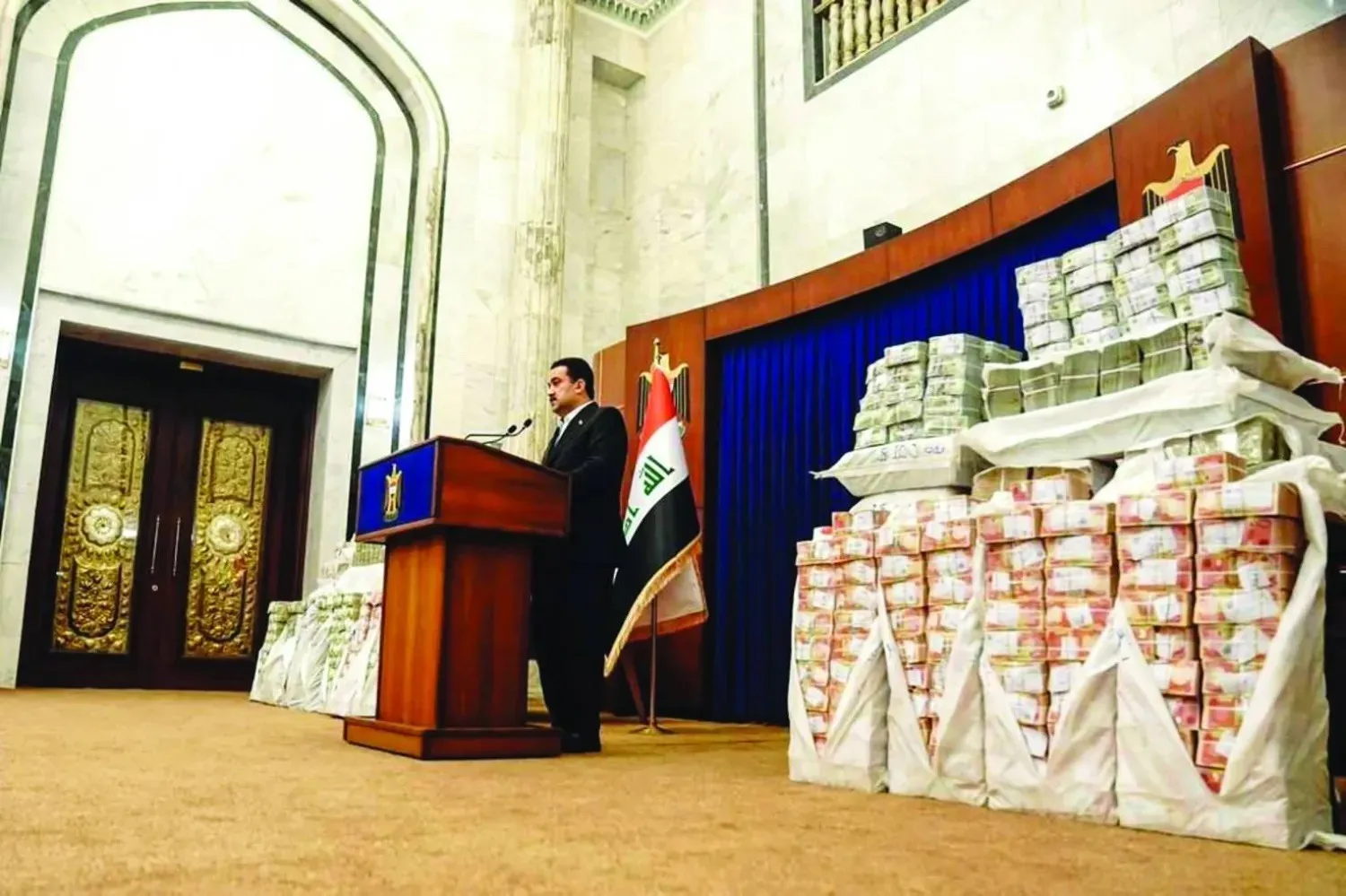

Iraq’s ‘Heist of the Century’ Returns to Spotlight with $5 Billion Figure

Former Iraqi Prime Minister Mohammed Shia al-Sudani announces the recovery of funds linked to the “Heist of the Century” scandal. (AFP)
TT

Iraq’s ‘Heist of the Century’ Returns to Spotlight with $5 Billion Figure

Former Iraqi Prime Minister Mohammed Shia al-Sudani announces the recovery of funds linked to the “Heist of the Century” scandal. (AFP)

Iraq’s massive tax embezzlement scandal - widely known as the “Heist of the Century” - has resurfaced with a dramatically higher estimated value of 8 trillion Iraqi dinars (about $5 billion), nearly double the amount originally announced when the scandal first erupted in October 2022.

The new figure was disclosed Tuesday by Talib al-Baidhani, a member of parliament’s Integrity Committee, who also revealed that about 30 additional individuals are now suspected of involvement in the case.

The latest development comes just days after parliament approved a new government led by Prime Minister Ali al-Zaidi, a businessman with no political background who has pledged to strengthen the economy and fight corruption - promises repeated by successive Iraqi governments since 2003.

The scandal dates back roughly four years and centers on the theft of tax deposit funds through five shell companies allegedly working with officials from the General Commission for Taxes and Rafidain Bank, as well as senior state officials, lawmakers, contractors, and brokers.

Speaking to Iraq’s state newspaper, al-Baidhani said parliament’s Integrity Committee is determined to recover Iraqi stolen funds and continue pursuing the case in coordination with the Federal Integrity Commission.

The scandal first became public on October 18, 2022, when former Prime Minister Mustafa al-Kadhimi confirmed an investigation into the theft of tax trust funds and accused some parties of exploiting the case to shield corrupt figures.

Two months later, former Prime Minister Mohammed Shia al-Sudani announced the recovery of more than 300 billion dinars, an amount critics described as negligible compared with the scale of the theft. Sudani promised the rest would be recovered, but his government later failed to do so.

Al-Baidhani, who belongs to the Asaib Ahl al-Haq movement, said some funds have already been recovered, while large sums remain outside Iraq and require coordinated efforts between parliament and al-Zaidi’s government to retrieve them.
He described the recovery effort as “the real beginning” of holding all those involved accountable for stolen public funds and suspicious deals.

Al-Baidhani added that the scandal was initially estimated at around 2.5 trillion dinars, but subsequent investigations by the Federal Integrity Commission uncovered much larger embezzlement operations, pushing the total to nearly 8 trillion dinars. He did not explain when or how those investigations were conducted.

In late October 2022, Iraqi authorities arrested the case’s main suspect, Nour Zuhair, chairman of one of the companies implicated in the scheme. He was later released on bail after Sudani announced the recovery of 5 percent of the stolen funds in exchange for Zuhair’s pledge to return the remaining money within days.

Shortly after his release, however, Zuhair fled Iraq and has remained missing ever since.

For years, Iraqi courts have continued issuing prison sentences against individuals linked to the tax theft, but without recovering the missing funds or apprehending the key suspects. The failure has fueled public criticism and accusations that the case is being used for political blackmail while influential political actors implicated “behind the scenes” remain protected.

Separately, al-Baidhani urged Iraq’s Foreign Ministry to recover properties tied to Saddam Hussein’s former regime through coordination with countries that have treaties with Iraq.

After Saddam Hussein’s fall in 2003, several Western governments froze Iraqi assets linked to the former regime and Hussein’s family under UN Security Council Resolution 1483, including bank accounts, real estate, and investments in countries such as France and Switzerland.



Lebanon Mulls Removing Restrictions Against 600,000 Syrians

Lebanese soldiers are seen at the Masnaa border crossing with Syria in wake of the collapse of the Syrian regime. (AP file)
TT

Lebanon Mulls Removing Restrictions Against 600,000 Syrians

Lebanese soldiers are seen at the Masnaa border crossing with Syria in wake of the collapse of the Syrian regime. (AP file)

Lebanese authorities began reviewing security restrictions against some 600,000 Syrians in the latest move that reflects Beirut’s desire to open a new chapter in relations with Damascus based on clear security and legal foundations.

The restrictions are among the thorniest issues in Lebanon and that emerged during the wave of Syrian displacement sparked by the civil war. The restrictions led to hundreds of thousands of Syrians being barred entry to Lebanon.

Addressing the issue would pave the way for Lebanese-Syrian relations that are based on security coordination and respect for the law.

Asharq Al-Awsat learned that Lebanon’s General Directorate of the General Security has kicked off the legal procedures to lift security restrictions against over 600,000 Syrians that barred their entry to Lebanon for years.

A prominent security source revealed that General Security chief Hassan Choucair has formed a committee that will study the file of Syrians who have security warrants against them that have prevented them from entering Lebanon.

The warrants are tied to residency or entry violations.

The source told Asharq Al-Awsat that authorities are now examining the file of every Syrian who has been barred entry to Lebanon over residency violations, such as entering Lebanon illegally or violating residency rules or exceeding the duration of their stay.

The source said the committee has already completed tens of thousands of files.

The General Security will issue a statement upon completion of the procedures. It will inform the Syrian authorities of its results.

The move is not limited to building trust between Beirut and Damascus, but it also aims to crack down on people smuggling across the Lebanese-Syrian border.

The latest procedures will allow Syrians to enter Lebanon with their identification papers or through travel agencies as long as they meet the necessary requirements.

Syrians wishing to work in Lebanon must obtain work and legal residency permits from the General Security.

“Lebanon welcomes anyone who wants to reside on its territory as long as they are doing so legally,” said the source.

“Syria is a sisterly country and organizing the movement of people in and out of both countries benefits them both,” he added.


More Displacement in Sudan as Battles Intensify

Sudanese army solders take part in a military parade on August 17, 2026, in the city of Gedaref in eastern Sudan during celebrations to mark the 72nd anniversary of the Sudanese Armed Forces. (AFP)
TT

More Displacement in Sudan as Battles Intensify

Sudanese army solders take part in a military parade on August 17, 2026, in the city of Gedaref in eastern Sudan during celebrations to mark the 72nd anniversary of the Sudanese Armed Forces. (AFP)

At least 12 people were killed and other wounded in Sudan’s North Kordofan as the army launched air strikes and drone attacks on the Rapid Support Forces (RSF).

The fighting sparked a wave of displacement to the city of El Obeid.

Military troops continued to mobilize on the Kordofan and Blue Nile fronts, a sign that more fighting was to come.

Witnesses said the army launched airstrikes on RSF positions in North Kordofan and the Blue Nile at a time when ground fighting had eased between the two warring parties. The two sides had been relying increasingly on drones in the war.

The army and its allied forces have been focusing on expanding their control in North Kordofan and securing the surroundings of El Obeid. The RSF is positioned in areas west and south of the city.

The latest strikes were aimed at stemming any possible renewed fighting in the area.

The United Nations Office for the Coordination of Humanitarian Affairs (OCHA) warned that ongoing violence in Sudan continues to kill civilians and force more people from their homes.

In North Kordofan State, local authorities reported that more than a dozen civilians were killed and others injured in clashes in Um Arada town, southwest of the state capital El Obeid, on Friday, OCHA said in a statement.

The International Organization for Migration (IOM) says that more than 4,200 people were displaced from the town and surrounding areas on Friday and Saturday.

Increased violence across North Kordofan is also affecting humanitarian operations, forcing humanitarian partners to suspend activities in Al Mazroub locality, which is facing a cholera outbreak.

Meanwhile, in Blue Nile State, renewed fighting was reported in Geisan and Kurmuk towns and surrounding areas last week. IOM says that about 5,400 people were displaced in recent days.

OCHA once again “called on all parties to protect civilians and civilian infrastructure, and to allow aid to reach people quickly, safely and without obstruction.”

“Despite the insecurity, the UN and its humanitarian partners continue to deliver assistance to people in need. Across the Darfur region, the World Food Program reached about 2.3 million people with food assistance last month,” said OCHA.

OCHA continues to urge donors to provide additional funding for the humanitarian response. This year's humanitarian appeal for Sudan remains about 41 percent funded, with $1.2 billion received against the $2.9 billion required, added the statement.


Tetteh Says Moving Libya's Political Process Forward Remains Crucial

The UN Security Council discusses the situation in Libya. Photo: The Security Council
TT

Tetteh Says Moving Libya's Political Process Forward Remains Crucial

The UN Security Council discusses the situation in Libya. Photo: The Security Council

Special Representative of the Secretary General and Head of the United Nations Support Mission in Libya (UNSMIL) Hanna Tetteh has revealed that Libya possesses Africa’s largest oil reserves, yet hundreds of thousands of people have spent nearly a month and a half without electricity or water.

“The need to move Libya's political process forward remains crucial,” Tetteh told the Security Council on Tuesday.

“The recent widespread electricity outages and public discontent, exacerbated by a prolonged heat wave, have exposed the consequences of institutional fragmentation,” she said.

“Approximately $1 billion is spent monthly on fuel imports. Yet electricity systems remain vulnerable to fuel shortages,” she said, seen as “evidence of large scale diversion of subsidized fuel in the electricity and security sectors.”

Politically, she said the UN roadmap is based on three mutually reinforcing pillars: A credible path to presidential and legislative elections through electoral reforms, an inclusive, structured dialogue and the reunification of executive institutions through a unified government.

She told the Council that the Four Plus Four Committee, since its inaugural meeting on April 29 has met seven times, “having addressed some of the most contentious issues” and is set to meet again on August 20.

“Its recommendations, which I presented to the Council in my last briefing, address governance, the economy, security, reconciliation and human rights,” Tetteh said.

On fiscal affairs, she said that the central Bank of Libya commenced in June implementing salary increases for military and security personnel in eastern Libya following a request from the Libyan National Army (LNA) in December 2025, and subsequent legislation for this by the House of Representatives.

A similar request was reportedly made to the central bank from western Libya.

On August 9, the governor of the Central Bank submitted a letter to the two chambers requesting to be relieved of his position. “The move is an indication of the mounting pressure on the central bank,” Tetteh told Council members.

On Security issues, she mentioned that on August 3 heavy clashes erupted among armed actors engaged in trafficking, illicit drugs, human trafficking and fuel smuggling in residential areas across Zawiya and Sorman, resulting in civilian deaths and injuries.

“Furthermore, the use of several drones against the oil refinery and other vital infrastructure in Zawiya is an emerging and worrying development, suggesting deliberate targeting of the oil facility, causing structural damage, risk of fire and disruption of water supplies.

“On the 10th of August, the National Oil Corporation declared a state of emergency at the refinery and called for urgent investigations into these attacks,” she added.

She also referred to the assassination of Major General Fawzi Mansouri, director of the Military Intelligence Department for the LNA, in Benghazi on August 10 in a reported car bombing.

In a positive development, the two Chiefs of General Staff from the West and East met in Sirte on July 12, attended by the Five Plus five Joint Military Commission and the three plus three military committee established under the US track and UNSMIL.

“The meeting demonstrated that practical confidence building measures remain possible,” she said.

“The chiefs agreed on the principle to establish a joint border force and undertake joint exercises, regular coordination and harmonized training,” she added.