


Sky Bridges, Citizen Science Protect Endangered Malaysia Monkeys

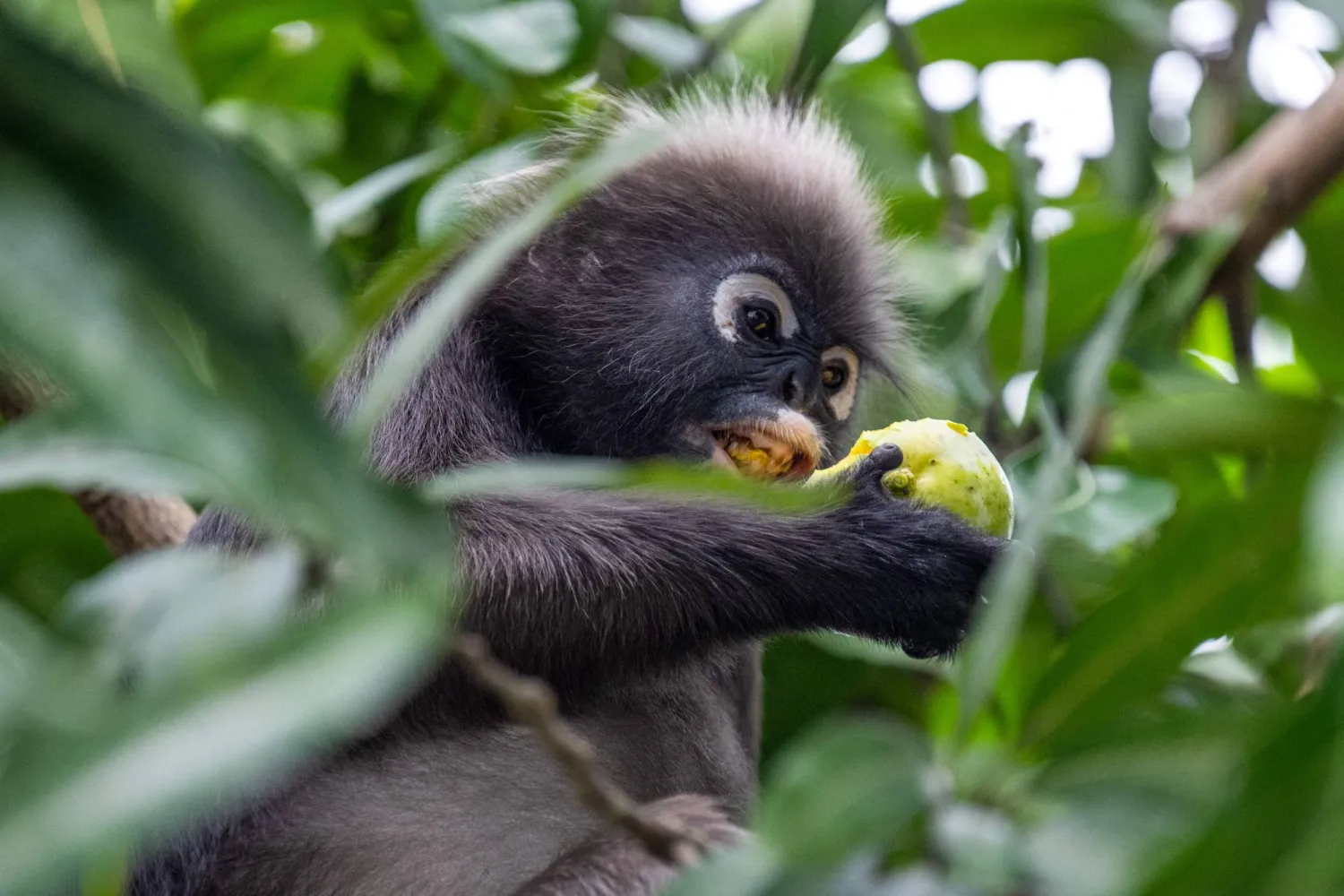
This picture taken on April 9, 2026 shows a dusky langur called "Julie", named by the Langur Project Penang (LPP), eating a mango from a tree in the Tanjung Bungah area of George Town on Malaysia's Penang Island. (Photo by Mohd Rasfan / AFP)
TT

Sky Bridges, Citizen Science Protect Endangered Malaysia Monkeys

This picture taken on April 9, 2026 shows a dusky langur called "Julie", named by the Langur Project Penang (LPP), eating a mango from a tree in the Tanjung Bungah area of George Town on Malaysia's Penang Island. (Photo by Mohd Rasfan / AFP)

A graceful black monkey edges across a swaying red rope bridge strung over a busy residential road in Malaysia's Penang, watched by local conservationists who carefully record her movements.

For Malaysia's endangered dusky langurs, recognizable by the "masks" of white fur that ring their eyes, survival increasingly depends on such man-made crossings and the work of "citizen scientists,” AFP reported.

A fragmented habitat, conflict with local communities, and poaching have all pushed the species to endangered status.

But the Langur Project Penang (LPP) conservation group hopes that low-tech engineering and high-tech community engagement can help protect the species, also known as the dusky leaf monkey.

Key to their efforts is helping the monkeys navigate fragmented habitat crisscrossed by busy roads where the animals are often killed.

LPP founder Yap Jo Leen realized the need for a solution when she saw dusky langurs repeatedly risking road crossings as she carried out fieldwork in 2016.

"I realized that they don't just stay in the forest. They also cross roads to the coastal area to look for food," she told AFP.

She came up with the idea of building some kind of crossing, and pairing the solution with community engagement.

"At the time, the idea was wild because no one in Malaysia had actually done it before" she said of the crossing plan.

Similar canopy bridges have helped other endangered primates elsewhere, including in Indonesia, where an orangutan was recently seen using such a crossing for the first time.
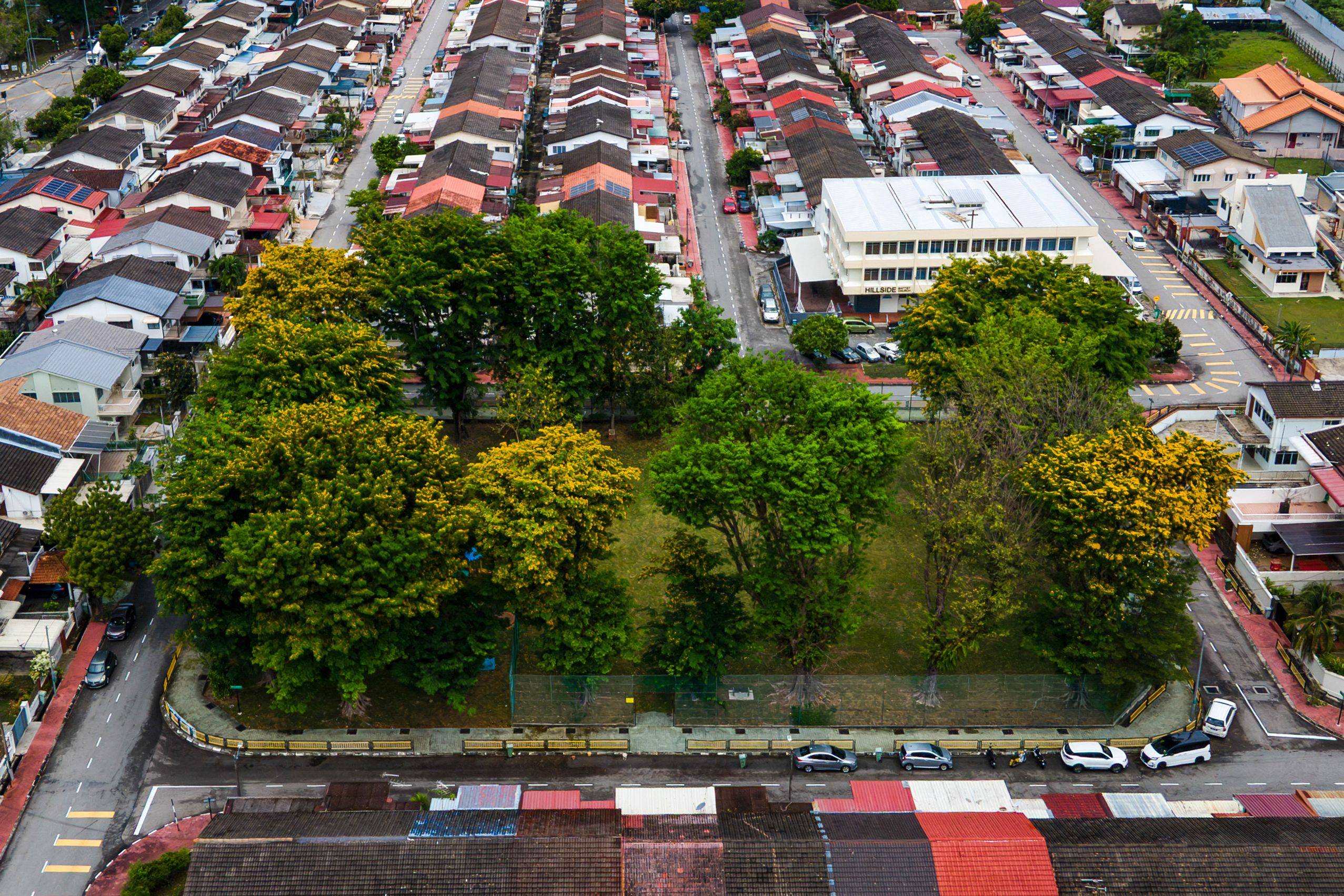
This picture taken on April 9, 2026 shows a view of a playground with dense trees where langur monkeys can be found surrounded by residential buildings in a development at the Tanjung Bungah area of George Town on Malaysia's Penang Island. (Photo by Mohd Rasfan / AFP)

Yap's team experimented with different materials before settling on upcycled fire hoses "twisted to mimic tree branches.”

They are suspended over roads from a tree on one side and a custom-installed pole on the other.

LPP has now installed three, including in April in the coastal suburb and beach destination of Batu Ferringhi.

Yap said the group's research showed they work. At one site, at least eight monkeys died in traffic accidents between 2016 and 2018. No deaths have been recorded since the crossing was installed in 2019.

The crossings also allow groups of monkeys that were once largely confined to an area to expand their range.

"They have more opportunity to venture closer to the hills... and find their way to a safe haven," she said.

That not only benefits the animals, but decreases pressure on local communities that have come into conflict with hungry roving bands of dusky langurs seeking food in urban neighborhoods.

Addressing that conflict is another part of LPP's efforts.

It recruits members of the local community to serve as "citizen scientists" who track langur movements, collect data and record GPS coordinates using spreadsheets and the Wikiloc trail app.

The volunteers receive a small stipend and training in fieldwork in return for committing to tracking the monkeys for at least three months.

The data helps researchers understand more about the monkeys, including their home range and their feeding habits, and could one day even help guide reforestation efforts.

The current volunteers range from age 17 to 65 and "call themselves the 'monkey stalkers' or 'monkey whisperers'", Yap said with a laugh.
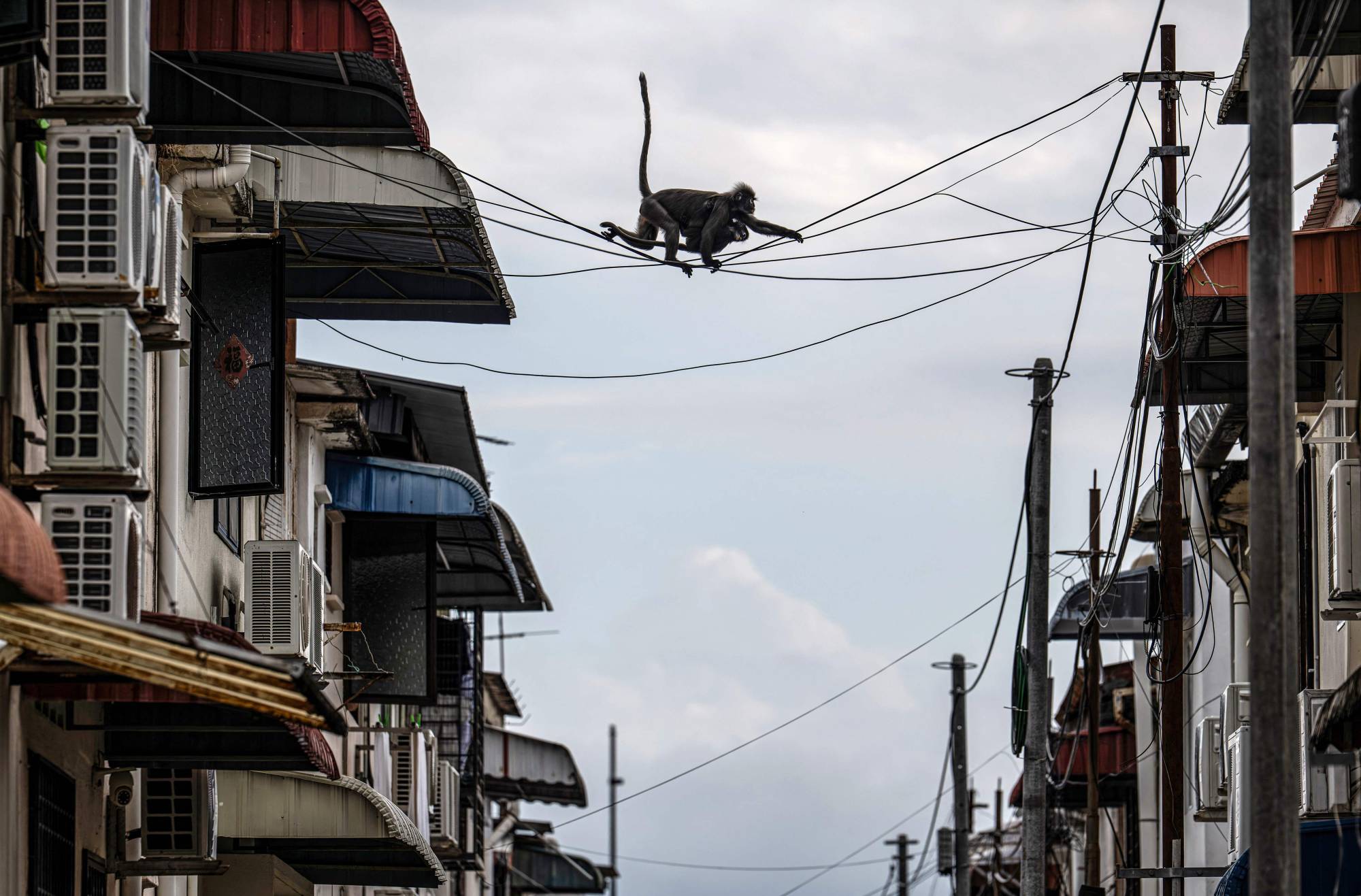
This picture taken on April 9, 2026 shows dusky langurs called "Julie" (top) and "Bulat" (bottom), named by the Langur Project Penang (LPP), crossing overhead utility wires in the back alley of a residential area in the Tanjung Bungah area of George Town on Malaysia's Penang Island. (Photo by Mohd Rasfan / AFP)

Former IT manager Teo Hoon Cheng signed up after encountering "magnificent" langurs on hiking trails over a decade ago.

"You don't need background knowledge in zoology or biology. Anyone can be a citizen scientist," he said.

Other locals work with LPP to ease tensions between the community and the monkeys, including retired graphic designer Tan Soo Siah.

"Somebody needs to step up to act as a bridge for this communication," the 64-year-old said.

Residents complain about the noise the monkeys make when crossing their roofs, as well as occasional "break-ins" when windows are left open.

Tan tries to explain why the monkeys are there, and how they can be gently moved along with a little spray of water.

The work has "taught me the meaning of coexistence," he said.

"It's good that we can use my experience to show how we can live in harmony with the primates."

Fellow resident Lim Hock Cheng said the community was gradually learning to accept the animals.

"We've encroached into their habitat... We have to coexist, learn to live with each other," the 66-year-old said.

"The dusky langurs are also part of our society."


Vets Bid to Save Kosovo's Stray Dogs from Cull Through Sterilization

Stray dogs sit inside cages waiting to be released after a sterilization process carried out by animal rights organization Four Paws near the town of Podujevo on May 19, 2026. (Photo by Armend NIMANI / AFP)
TT

Vets Bid to Save Kosovo's Stray Dogs from Cull Through Sterilization

Stray dogs sit inside cages waiting to be released after a sterilization process carried out by animal rights organization Four Paws near the town of Podujevo on May 19, 2026. (Photo by Armend NIMANI / AFP)

Panting puppies lie exhausted, wedged between the plastic bags and cartons spilling down a hillside in northern Kosovo, while other dogs snuffle around the dump hunting for edible morsels.

The sheer number of canines roaming free has become bothersome, and locals in the Podujevo district have drafted in experts to solve the problem "in the most humane way possible", according to vet Albatrit Halili.

He is part of a team of local veterinarians led by the Four Paws NGO who are sterilizing and vaccinating the mutts to keep the population under control.

Some estimates put their number at 50,000 in the tiny Balkan country, sandwiched between Serbia, Albania, Montenegro and North Macedonia.

"I believe this program is the only viable solution," said Halili.

The animals don't seem to mind -- one puppy wags its tail and bounces playfully as its cage is loaded into a van, while another enjoys having its coat ruffled by the vets.

Certainly they are better off this way than the more customary practice of culling, AFP reported.

And as there are not enough shelters to house them, these animals will be released and able to return to their life roaming the rubbish dumps.

Podujevo, which shares a long border with Serbia, is one of the worst-affected areas.

"In the absence of cross-border cooperation, the dogs can move around, sometimes on their territory, sometimes on ours," said Podujevo mayor Shpejtim Bulliqi.

This makes it difficult, he says, to even count the number of dogs.

But Luciana D'Abramo from Four Paws is confident that they will succeed, partly because the local community is on board with the campaign.

"We knew that there were lots of (attempts) and lots of goodwill to find solutions," she said, but the latest effort would be longer-term and better planned.


Bangladesh's 'Donald Trump' Buffalo Wins Fans

This photograph taken on May 17, 2026 shows a caretaker attending an albino buffalo nicknamed "Donald Trump" for sale ahead of Eid al-Adha at a livestock farm in Narayanganj. (Photo by Salahuddin AHMED / AFP)
TT

Bangladesh's 'Donald Trump' Buffalo Wins Fans

This photograph taken on May 17, 2026 shows a caretaker attending an albino buffalo nicknamed "Donald Trump" for sale ahead of Eid al-Adha at a livestock farm in Narayanganj. (Photo by Salahuddin AHMED / AFP)

Crowds in Bangladesh are flocking to snap photographs with an unlikely social media star -- an albino buffalo with flowing blond hair nicknamed "Donald Trump" due to be sacrificed within days.

Owner Zia Uddin Mridha, 38, said his brother named the 700 kilogram (1,500 pound) bull over its flowing helmet of hair resembling the signature look of the US president.

"My younger brother picked this name because of the buffalo's extraordinary hair," he told AFP at his farm in Narayanganj, just outside the capital Dhaka.

Mridha said a constant stream of curious visitors -- social media fans, onlookers and children -- have come throughout May, eager to see the internet sensation.

He watched as men poured a cool bucket of water over the bull's head, running a pink brush through its blond combover, neatly tucked between sweeping curved horns.

"The only luxury he enjoys is bathing four times a day," Mridha said, stressing that the similarities between the bull and the president stopped at the hair.

This photograph taken on May 17, 2026 shows an albino buffalo nicknamed "Donald Trump" for sale ahead of Eid al-Adha at a livestock farm in Narayanganj. (Photo by Salahuddin AHMED / AFP)

Officials from the livestock department said albino buffaloes are extremely rare, and appear white or pink due to a lack of melanin production.

Muslim-majority Bangladesh, a South Asian nation of 170 million people, is preparing for Eid al-Adha later this month.

More than 12 million livestock -- including goats, sheep, cows and buffaloes -- are expected to be sacrificed during the holiday, when many poorer families get a rare chance to feast on meat.

Mridha said the stress of the crowds had caused the buffalo to lose weight, forcing restrictions on public viewing.

Still, children continue to peer through the gates for a glimpse.

Businessman Faisal Ahmed, 30, was among those who managed to get close, snapping photographs.

"Truly, the features are similar between the buffalo and President Donald Trump," Ahmed told AFP, after arriving with five friends and relatives to see the animal.

"My nephew took a one-hour boat journey just to come and see 'Donald Trump'," he added.

This photograph taken on May 17, 2026 shows content creators shooting videos of an albino buffalo nicknamed "Donald Trump" for sale ahead of Eid al-Adha at a livestock farm in Narayanganj. (Photo by Salahuddin AHMED / AFP)

While the Trump buffalo has become a national star online, it is not the only buffalo with a nickname.

His companions include an aggressive bull named "Tufan", meaning "storm", a generously sized animal called "Fat Boy" and the gentle-natured "Sweet Boy".

One golden-haired bull was named after Brazilian footballer Neymar for his bleached-blond cut.

Mridha, who has cared for his four-year-old buffalo for the past year, looked with affection at the animal, snuffling through a bowl of fodder.

"I am going to miss Donald Trump, but that is the core spirit of Eid al-Adha -- making a sacrifice."


Saudi Traveler Showcases Al-Ahsa’s Beauty and the Rise of Solo Camping Adventures

Traveler Salwa Ibrahim climbing the rock formations of AlUla (Traveler’s Archive) 
TT

Saudi Traveler Showcases Al-Ahsa’s Beauty and the Rise of Solo Camping Adventures

Traveler Salwa Ibrahim climbing the rock formations of AlUla (Traveler’s Archive) 

In recent years, Saudi Arabia has undergone a transformation in the way travel is perceived. Journeys are no longer viewed simply as movement from one place to another, but as immersive cultural experiences that deepen people’s connection to places and redefine the meaning of discovery. Interest in overland travel and camping has grown steadily, evolving into a lifestyle rooted in environmental awareness and respect for nature.

This shift has been driven in part by the Kingdom’s remarkable geographic diversity — from sweeping deserts and lush valleys to dramatic coastlines — creating an ideal environment for exploration and outdoor adventure.

Solo travel, in particular, has emerged as a powerful form of self-discovery, where camping is no longer a casual pastime, but an experience built on careful planning, openness to uncertainty, and a balance between safety and adventure.

Saudi traveler and content creator Salwa Ibrahim has made local geography the focus of her work. Specializing in highlighting tourism destinations across Saudi Arabia, Ibrahim says her goal is to help audiences experience places as she did — emotionally as much as visually.

Speaking to Asharq Al-Awsat, Ibrahim said that despite the growing accessibility of international destinations, she remains deeply connected to the region she calls home.

“My primary focus has been Saudi Arabia and the Gulf countries because of the richness of their landscapes,” she said. “I documented these places through a series called The Other Side, where I showcase unconventional destinations and experiences beyond the usual tourist routes. There are astonishing places across Saudi Arabia that many people still know very little about.”

Unlike tightly scheduled travel itineraries, Ibrahim prefers a slower, more immersive approach.

“I don’t rely on a strict daily schedule,” she said. “I give myself enough time to absorb a place fully. I might spend two or three nights in one location, or even several days if I feel it deserves more time.”

She pointed to Wadi Al-Disah as one destination she has returned to repeatedly throughout her travels.

Among the places that have left the strongest impression on her are three major valleys in Saudi Arabia, each defined by its own distinct landscape and atmosphere. Ibrahim described Wadi Al-Disah as a vast natural sanctuary surrounded by towering mountains, threaded with green pathways and seasonal streams that create an environment strikingly different from the surrounding desert.

Wadi Tayyib Al-Ism, she said, is distinguished by the dramatic meeting of jagged mountain formations and the waters of the Gulf of Aqaba, creating a rare harmony between contrasting natural elements. As for Wadi Lajab, Ibrahim called it “a sensory experience in itself,” where visitors pass through a narrow rocky canyon flanked by soaring cliffs and flowing water.

She also described the Bajdah Desert in the Tabuk region as “one of the most visually surreal places” in Saudi Arabia, citing the interplay of red mountains, sand dunes, and complex geological formations, as well as the abundance of natural caves that make the area ideal for advanced exploration.

Ibrahim said her Jeep Wrangler four-wheel-drive vehicle was essential to launching these journeys.

“My Jeep Wrangler was a fundamental part of the experience,” she stated. “It allowed me to reach places that smaller vehicles simply cannot access.”

Her trips begin long before she sets out on the road. Preparation, she explained, involves more than logistics; it requires complete mental readiness. Her planning process includes studying maps and access routes, pinpointing campsites, saving emergency contacts, coordinating with trusted local guides, and packing enough food supplies and practical cooking equipment to minimize risks during each trip.

Despite her meticulous planning, Ibrahim intentionally leaves room for spontaneity.

“Some of the most memorable experiences come from unexpected changes in direction,” she said. “Those moments often lead me to places that were never part of the original plan.”

That balance between discipline and flexibility has become central to her style of travel and exploration.

Ibrahim selects destinations through a combination of research, recommendations from followers on social media, and personal intuition, which she says often plays a decisive role in her final decisions. She relies heavily on mapping applications and advice from local guides, while also paying close attention to recurring suggestions from her audience.

In her interview with Asharq Al-Awsat, Ibrahim stressed that Al-Ahsa holds a particularly special place in her work. More than just another stop on her travels, the region has become a personal project through which she hopes to reshape visual perceptions of the area. Al-Ahsa is also her hometown.

“I don’t present palm trees as a stereotypical image,” she said. “I try to convey a complete experience that reflects Al-Ahsa’s unique diversity. The region is home to millions of palm trees and multiple landscapes that coexist within one area, alongside vast deserts stretching toward the Rub’ al Khali and Al-Dahna, as well as a coastal extension. This overlap makes Al-Ahsa one of the richest natural environments in Saudi Arabia.”

Ibrahim’s philosophy of travel goes beyond sightseeing. She believes beauty is not defined by a destination’s popularity, but by a traveler’s emotional connection to it. In her view, even simple or lesser-known places can hold extraordinary value for those who connect with them deeply.

She cited AlUla as one example, describing its rock formations and mountains as possessing a uniquely powerful visual and spiritual presence.

Solo travel, however, was not easy at first. Ibrahim said fear accompanied her during her earliest camping trips, prompting her to stay close to main roads for safety. Over time, those fears evolved into a turning point that shaped both her personal and professional life.

As solo travel became a defining part of her identity, its impact extended into her work as a nurse, strengthening her ability to make decisions and handle pressure with confidence.

Ibrahim’s experience reflects the high levels of safety found across Saudi Arabia and the Gulf region, though she emphasizes that awareness and personal responsibility remain essential — particularly for young women interested in solo travel or camping. Advance planning, choosing familiar destinations, and avoiding isolated areas without sufficient experience are all critical to ensuring a safe experience.

Saudi Arabia’s tourism sector has also seen significant development in recent years, including the expansion of designated camping facilities and stronger tourism infrastructure. These changes have helped foster a growing culture of overland travel and exploration, positioning the Kingdom as an increasingly attractive destination for travelers from within Saudi Arabia and abroad, especially during the winter season.
