


'Their Story is Our Story': Pigeons and Humans, 3,500 Years Together

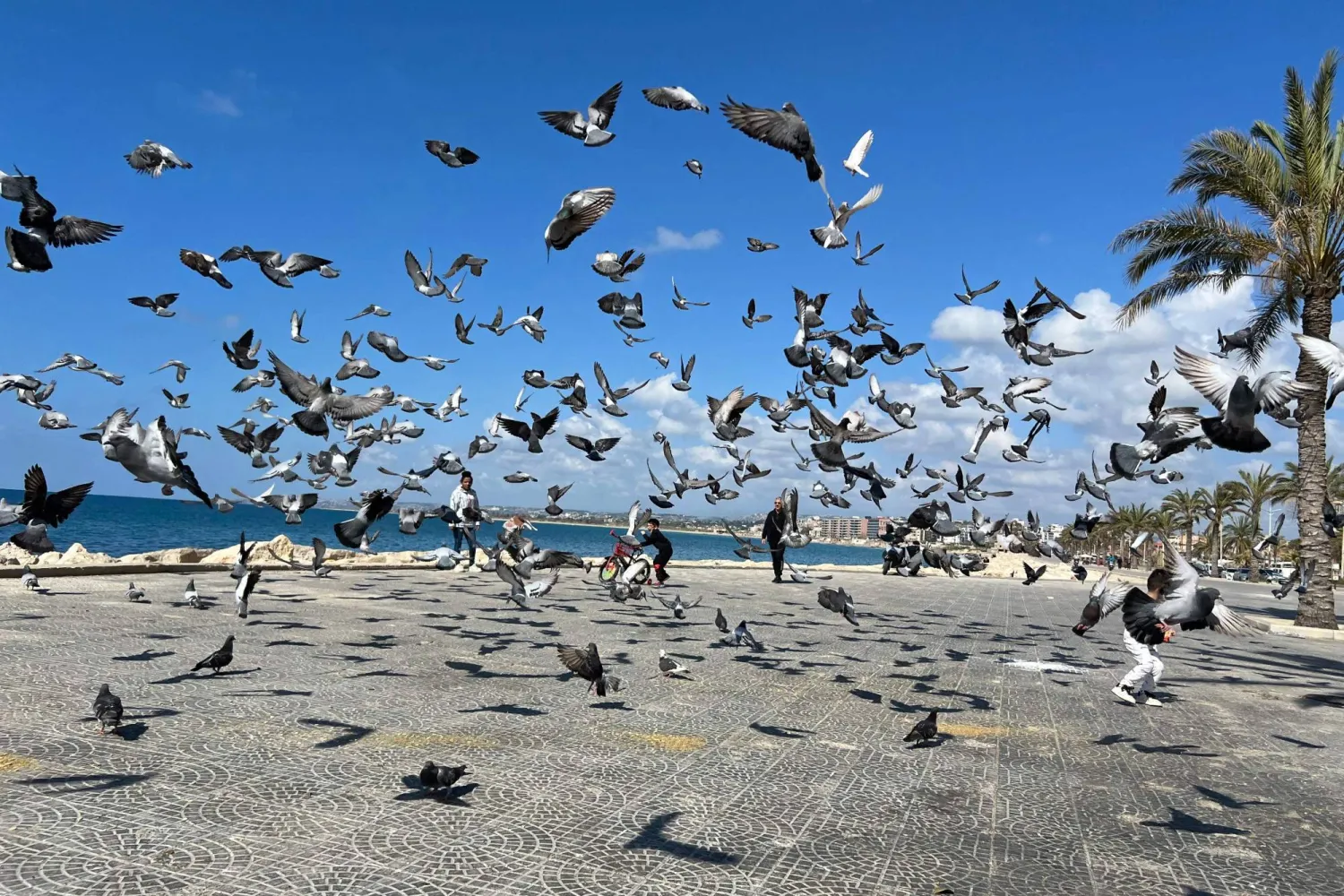
Children chase pigeons as they play on the seaside promenade in the southern Lebanese coastal city of Tyre on April 21, 2026. (Photo by Mahmoud ZAYYAT / AFP)
TT

'Their Story is Our Story': Pigeons and Humans, 3,500 Years Together

Children chase pigeons as they play on the seaside promenade in the southern Lebanese coastal city of Tyre on April 21, 2026. (Photo by Mahmoud ZAYYAT / AFP)

They have been our meat and our messengers, a source of fertilizer and a religious symbol: while pigeons are now mostly reviled as dirty city pests, they long played an important role in human society.

Now, research published on Thursday has revealed that the humble birds were first domesticated 3,500 years ago, meaning they have been enmeshed in our lives for nearly a millennium longer than previously thought.

"Humans forgetting about pigeons happened relatively recently in human history," Anderson Carter, a bioarchaeologist at the University of Groningen in the Netherlands, told AFP.

Pigeons were still a useful part of society as recently as the 19th and 20th centuries, explained the lead author of a new study in the journal Antiquity.

"They were still being used to carry messages and even had an important role in wars in particular," she added.

"But then a lot of technological advancements happened, the telegraph was invented and then the telephone, and pigeons were out of a job".

However, because we had spent thousands of years conditioning them to live alongside us, the birds stayed nearby.

It was only when huge cities emerged after the industrial revolution that "there was a rising view that they were pests, dirty and spreading diseases," Carter said.

Now, "anti-pigeon architecture such as spikes on top of buildings" are a common sight, she added.

The common pigeon -- or rock dove -- originally came from the Mediterranean region. Genomic analysis has shown that today's city-dwellers are closely related to wild doves from the Middle East.

For the new research, a Dutch-led team of scientists went to the Hala Sultan Tekke archaeological site on the shores of the Larnaca salt lake in southeast Cyprus.

They analyzed 159 ancient pigeon bones to find out how they lived and died -- and look for signs of human intervention, such as cuts.

Biometric and isotopic analysis revealed that the pigeons lived in the 13th and 14th centuries BC, during the Bronze Age.

By extracting collagen from the bones, the scientists were able to find out their ratios of nitrogen and carbon, which is closely linked to an animal's diet.

The results were then compared with animals and humans found in Cyprus dating to the same period.

"The Hala Sultan Tekke pigeons overlapped pretty significantly with the results from humans from other Bronze Age Cypriot sites, showing that they likely ate a very similar diet to humans," Carter said.

"This very likely means that they were domesticated or on their way to being domesticated" at around 1,400 BC, senior study author Canan Cakirlar of the Royal Netherlands Institute of Sea Research said in a statement.

That is nearly a thousand years earlier than previous research has found, including giant stone structures used as pigeon nesting houses discovered in Greece dating from around 300 BC.

One goal of the research is "to change how we interact with and think about this bird," Carter said.

"And start realizing that their story is also our story."


Harvard Agrees to Pay $53 Mn after Morgue Manager Sold Body Parts

FILE PHOTO: Students walk past Widener Library at Harvard University in Cambridge, Massachusetts, US, November 19, 2025. REUTERS/Reba Saldanha/File Photo
TT

Harvard Agrees to Pay $53 Mn after Morgue Manager Sold Body Parts

FILE PHOTO: Students walk past Widener Library at Harvard University in Cambridge, Massachusetts, US, November 19, 2025. REUTERS/Reba Saldanha/File Photo

Harvard University has agreed to pay a $53 million settlement after its former morgue manager stole and sold body parts donated for scientific research, with a Boston court reportedly approving the plan on Tuesday.

Cedric Lodge, who managed the morgue at the prestigious Harvard Medical School before being fired in 2023, was sentenced to eight years in prison in December after pleading guilty to trafficking stolen remains.

Investigators said Lodge and his wife took body parts from the school "without the knowledge or permission of his employer, the donor, or the donor's family" and shipped them to buyers in other states since 2018.

According to AFP, Harvard University said in a letter on Monday that it will seek the court's permission to set up "two class action settlement funds totaling $53 million."

"We are grateful to be working together with the plaintiffs to move forward in a way that prioritizes support for families and the (organ donation program) and avoids prolonged litigation," read the letter co-signed by Harvard Medical School Dean George Daley and Bernard Chang, dean for medical education.

Lodge's violations "were despicable, abhorrent, and a flagrant betrayal of our values as a medical community," they said.

"We reaffirm our deep sorrow and empathy for the families of donors who may have been impacted."

A Boston state court judge gave preliminary approval to the settlement plan on Tuesday, US media reported.

Harvard said the process of distributing funds is expected to take several months.

Lodge's wife Denise was earlier sentenced to one year in prison.

Six other co-conspirators who bought remains from Lodge have also pleaded guilty and received sentences.

The Harvard Medical School will set up an annual financial aid scholarship starting in the 2027-28 academic year "in appreciation and in honor of all of our anatomical donors," the school said.

The settlement plan also includes a pledge by the school to provide a statement to the claimant families condemning Lodge's criminal acts, and to detail improvements made to the organ donation program.


Chinese Space Program Pioneer Liu Jiyuan Dies at 93

Commuters ride past the Tiananmen Square in Beijing on August 18, 2026. (Photo by ADEK BERRY / AFP)
TT

Chinese Space Program Pioneer Liu Jiyuan Dies at 93

Commuters ride past the Tiananmen Square in Beijing on August 18, 2026. (Photo by ADEK BERRY / AFP)

A pioneer of China's aerospace program, Liu Jiyuan, died in Beijing aged 93 after an illness, the main space contractor said on Wednesday.

In a career of nearly four decades from 1960, Liu worked on, and ⁠led development of, ⁠control systems for China's first generation of strategic weapons and launch vehicles.

Born in 1933, Liu died ⁠on Monday due to illness, the contractor, China Aerospace Science and Technology Corporation, said.

The expert in missile and rocket control technology was deputy commander of the manned space program in 1992 before heading the ⁠newly ⁠set-up National Space Administration from 1993 until he retired in 1999.

His death follows the August 12 demise of Wang Xiji, who led the development of China's first sounding rocket.


Italian Scientists Bet on Octopus to Fight Crab Invasion

Live blue crabs harvested by local fishermen in the Po river are seen in a waste bucket at Scardovari, Italy, northeast Italy, on June 26, 2026. (AFP)
TT

Italian Scientists Bet on Octopus to Fight Crab Invasion

Live blue crabs harvested by local fishermen in the Po river are seen in a waste bucket at Scardovari, Italy, northeast Italy, on June 26, 2026. (AFP)

From a fishing trawler in the Adriatic, Italian scientists gently release thousands of tiny octopuses in the hope of fighting an invasive crab species that has devastated local fisheries.

A team from the University of Bologna is betting that the common octopus can help contain the burgeoning population of blue crab -- a voracious crustacean that has ravaged shellfish production in the Adriatic.

"We chose the octopus because, in the wild, it is a formidable predator of crustaceans," Antonio Casalini, one of the researchers, told AFP.

Native to the North American Atlantic coast, blue crabs arrived in the Mediterranean decades ago, likely transported via ballast water from ships.

But their numbers have ballooned in recent years, with the government and fishing groups linking the boom to warming waters and climate change.

With sharp, blue-tinted claws that are particularly apt at prying open shells, they have wreaked havoc in Italy's northeast -- one of Europe's top clam producing regions.

Authorities in Bologna's Emilia-Romagna region said last year the species has caused almost 17 million euros ($20 million) in damages there since 2022.

Farming and fishing group Coldiretti has put the figure at about 200 million for the whole of Italy, with the northern Veneto region also badly affected.

"It eats everything including young clams lying on the seabed," said Davide Sanulli a fishermen and mussels farmer with thick eyebrows and grizzled hair, said of the crab.

In lagoon-like areas off the Po River delta "it has caused a massacre", added the 64-year-old, who is helping the university project.

Excellent swimmers and weighing up to one kilogram (2.2 pounds), the crabs have few natural predators -- something the researchers are hoping to change.

- Crab-eaters -

Launched last year and funded by the Emilia-Romagna region, the "Octo-Blu" project seeks to increase octopus numbers as a counterweight to the hard-shelled invaders.

The team breeds octopus hatchlings in white water tanks at a lab in the port town of Cesenatico.

When ready, the tiny invertebrates are scooped out by the thousands into a large plastic bag and taken out to sea, sometimes using Sanulli's rugged blue fishing boat.

The hatchlings are then released near underwater reefs where the group has laid cement-and-clay artificial dens to help the octopuses thrive.

Some 80,000 have been let out since June, an amount the research team is seeking to double by the end of August, hoping to see a few grow into fully developed octopuses.

"The idea is to establish a small community close to shore so that it can better combat the spread of the blue crab," said Casalini, an aquaculture technician.

The project has some clear drawbacks.

The common octopus is not prone to live in the sandy, warm waters typical of the lagoon areas where the blue crab is making the most damage, making its potential impact there negligible -- something the researchers are well aware of.

Other experts have suggested that seabass could be more effective at crab-fighting and the Bologna University team is also looking at eels, which are avid eaters of crustacean eggs, to complement the octopus's efforts.

Yet, if replicated, the pilot could still help limit blue crab numbers and the related impact on the Adriatic coast's marine environment, Casalini said.

"Blue crabs have an incredible reproductive potential and fertility rate," said Pietro Emmanuele, another University of Bologna researcher, noting a single crab lays millions of eggs, most of which hatch.

Although only some hatchlings reach adulthood, were an octopus to catch even a single female, it would make a difference, he said.
