


Motjaba Khamenei Sets ‘Red Line’ on Sending Enriched Uranium Abroad

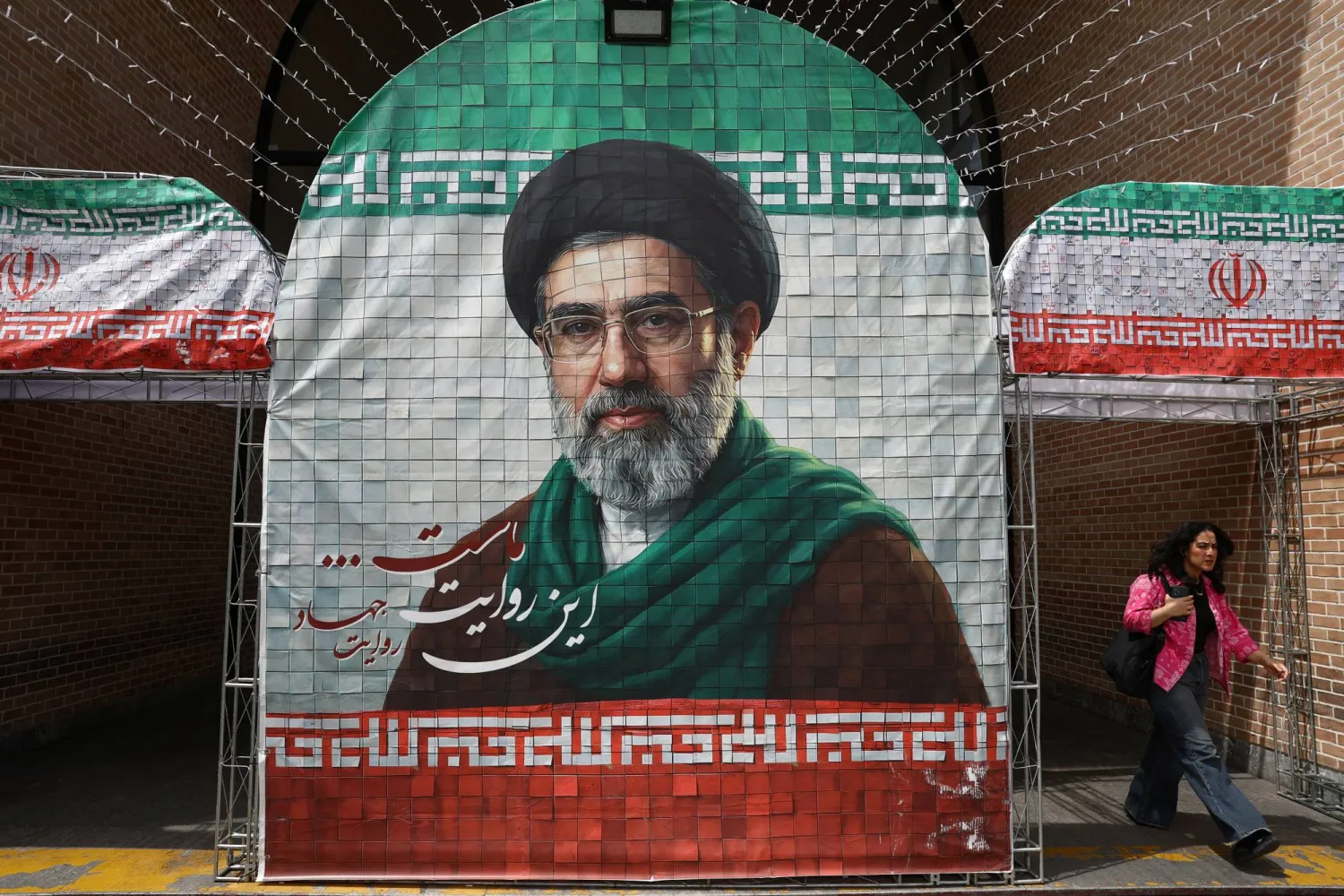
A woman walks next to a banner with a picture of Iran's new Supreme Leader Mojtaba Khamenei in Tehran, Iran, May 8, 2026. Majid Asgaripour/WANA (West Asia News Agency) via REUTERS
TT

Motjaba Khamenei Sets ‘Red Line’ on Sending Enriched Uranium Abroad

A woman walks next to a banner with a picture of Iran's new Supreme Leader Mojtaba Khamenei in Tehran, Iran, May 8, 2026. Majid Asgaripour/WANA (West Asia News Agency) via REUTERS

Iran's Supreme Leader has issued a directive that the country's near-weapons-grade uranium should not be sent abroad, two senior Iranian sources told Reuters on Thursday.

The directive sets an additional red line on one of the main US demands at peace talks, amid signs of a widening rift between Tehran and Washington over the future of Iran's nuclear program.

On Thursday, the Reuters report came shortly after Iran's foreign ministry spokesman Esmail Baghaei affirmed his country will not transfer uranium to any other state.

“Why should Iran move its material to another country?” he said. The spokesperson added that the US has proposed “several demands,” but Iran's nuclear program “has been and remains 100% peaceful,” Iranian media reported.

Mojtaba Khamenei's order could further frustrate US President Donald Trump and complicate talks on ending the US-Israeli war on Iran, according to Reuters.

Israeli officials have told the news agency that Trump has assured Israel that Iran's stockpile of highly enriched uranium, needed to make an atomic weapon, will be sent out of Iran and that any peace deal must include a clause on this.

Israel, the United States and other Western states have long accused Iran of seeking nuclear weapons, including pointing to its move to enrich uranium to 60%, far higher than needed for civilian uses and closer to the 90% needed for a weapon. Iran denies seeking nuclear weapons.

Israeli Prime Minister Benjamin Netanyahu has said he will not consider the war over until enriched uranium is removed from Iran, Tehran ends its support for ⁠proxy militias, and its ballistic missile capabilities are eliminated.

“The Supreme Leader’s directive, and the consensus within the establishment, is that the stockpile of enriched uranium should not leave the country,” said one of the two Iranian sources, who spoke on condition of anonymity because of the sensitivity of the matter.

Iran's top officials, the sources said, believe that sending the material abroad would leave the country more vulnerable to future attacks by the United States and Israel. Khamenei has the last say on the most important state matters.

The two sides have started to narrow some gaps, the sources said, but deeper splits remain over Tehran's nuclear program — including the fate of its enriched uranium stockpiles and Tehran's demand for recognition of its right to enrichment.

Iranian officials have repeatedly said Tehran’s priority is to secure a permanent end to the war and credible guarantees that the US and Israel will not launch further attacks.

Only after such assurances are in place, they said, would Iran be prepared to engage ⁠in detailed negotiations over its nuclear program.

Israel is widely believed to have an atomic arsenal but has never confirmed or denied it has nuclear weapons, maintaining a so-called policy of ambiguity on the issue for decades.

Before the war, Iran signaled willingness to ship out half of its stockpile of uranium which has been enriched to 60%, a level far higher than what is needed for civilian uses.

But sources said that position changed after repeated threats from Trump to strike Iran.

Israeli officials have told Reuters it is still unclear whether Trump will ⁠decide to attack and whether he would give Israel a green light to resume operations. Tehran has vowed a crushing response if attacked.

However, the source said there were “feasible formulas” to resolve the matter.

“There are solutions like diluting the stockpile under the supervision of the International Atomic Energy Agency,” one of the Iranian sources said.

The IAEA estimates that Iran had 440.9 kg of uranium enriched to 60% when Israel and the US attacked Iranian nuclear facilities in June 2025.

IAEA chief Rafael Grossi said in March that what remained of that stock was “mainly” stored in a tunnel complex in Iran's Isfahan nuclear facility, and that his agency believed slightly more than 200 kg of it was there. The IAEA also believes some is at the sprawling nuclear complex at Natanz, where Iran had two enrichment plants.

Iran says some highly enriched uranium is needed for medical purposes and for a research reactor in Tehran which runs on relatively small amounts of uranium enriched to around 20%.



Burkina Faso Cuts Diplomatic Relations with France, Once a Key Ally

FILE - In this photo provided by RIA Novosti, Burkina Faso President Ibrahim Traore arrives at the Grand Palace at the Kremlin in Moscow, Russia, on May 10, 2025. (Stanislav Krasilnikov/RIA Novosti via AP, File)
TT

Burkina Faso Cuts Diplomatic Relations with France, Once a Key Ally

FILE - In this photo provided by RIA Novosti, Burkina Faso President Ibrahim Traore arrives at the Grand Palace at the Kremlin in Moscow, Russia, on May 10, 2025. (Stanislav Krasilnikov/RIA Novosti via AP, File)

Burkina Faso’s military government severed diplomatic ties with France, its former colonial ruler that had been a key security partner for the West African nation before relations fractured.

The junta said in a statement Friday it broke off relations with France effective immediately, accusing it of "blatant neo-colonial ambitions and active support for subversive networks and terrorists,” without providing evidence.

France’s Foreign Ministry spokesman Pascal Confavreux said in a statement that the country regrets the “hostile and unfounded decision, which illustrates the worrying drift of the Burkinabè authorities.”

“Necessary reciprocal measures are currently under review,” he said. Confavreux added that France is monitoring the safety of French government personnel and citizens in Burkina Faso and urged them to exercise heightened vigilance.

The West African country of 23 million people has been battered by yearslong violence perpetrated by extremist groups linked to al-Qaida and the ISIS group, as well as government forces often accused of extrajudicial killings.

It was unclear what would follow the end of diplomatic relations or how the French embassy in Burkina Faso would be affected.

“The conditions essential for fostering relations based on mutual respect, reciprocal trust, and respect for the principle of non-interference in internal affairs and national sovereignty are no longer met,” Burkina Faso’s Communications Minister Pingdwende Gilbert Ouedraogo said in a statement.

The two sides suffered broken relations for years.

Burkina Faso's military government has in the past targeted foreign diplomats, including the French, whom it has often accused of working against its interests. In 2023, the junta asked France to recall its ambassador and declared the United Nations’ resident and humanitarian coordinator in the country persona non grata, while in 2024, it expelled three French diplomats for alleged subversive activities.

France was Burkina Faso's major security partner until a 2022 coup. The junta then sacked hundreds of French forces sent to fight extremist groups.

The violence has worsened under the military government that had promised to curb it, analysts say.

In the two years following the coup, Burkina Faso forces allegedly killed twice as many civilians as extremists, according to a recent report by the Human Rights Watch, which blamed government forces for at least 1,200 of the 1,837 civilians killed in the country between January 2023 and August 2025.


Iran Accuses US of 'Blatant Violation' of Peace Deal

Oil tanker Al Shaffiah sails at the sea near the Omani coast, as seen from Musandam, Oman, June 26, 2026. REUTERS/Stringer
TT

Iran Accuses US of 'Blatant Violation' of Peace Deal

Oil tanker Al Shaffiah sails at the sea near the Omani coast, as seen from Musandam, Oman, June 26, 2026. REUTERS/Stringer

Iran on Saturday accused the United States of a "blatant violation" of the peace deal reached between the two sides to end the Middle East war after the latest American strikes on the country.

"These brutal attacks, which targeted Iranian coastal surveillance facilities, are a blatant violation" of the memorandum of understanding to end the war, the Iranian foreign ministry said in a statement.

The US military said its forces struck Iranian missile and drone storage sites and coastal radar locations on Friday in response to an Iranian attack on a cargo ship transiting the strategic Strait of Hormuz.


Rubio: Trump Likely to Visit India Early Next Year

 US Secretary of State Marco Rubio speaks with members of the media before departing for Bahrain International Airport after his visit to the Middle East, Manama, Bahrain, June 25, 2026. (Reuters)
US Secretary of State Marco Rubio speaks with members of the media before departing for Bahrain International Airport after his visit to the Middle East, Manama, Bahrain, June 25, 2026. (Reuters)
TT

Rubio: Trump Likely to Visit India Early Next Year

 US Secretary of State Marco Rubio speaks with members of the media before departing for Bahrain International Airport after his visit to the Middle East, Manama, Bahrain, June 25, 2026. (Reuters)
US Secretary of State Marco Rubio speaks with members of the media before departing for Bahrain International Airport after his visit to the Middle East, Manama, Bahrain, June 25, 2026. (Reuters)

US Secretary of State ‌Marco Rubio said the US is seeking to arrange a visit to India by President Donald Trump early next year as the countries work on a bilateral trade deal, Indian media outlet IANS reported on Saturday.

Rubio is likely to travel to India this year to prepare for the president's visit, he told ‌IANS in ‌an interview.

"We're working towards sometime ‌early ⁠next year to ⁠have the president come," he said, according to IANS.

Prime Minister Narendra Modi met Trump last week on the sidelines of a summit of the Group of Seven industrial powers in France. Trump ⁠said that they had a "very ‌good" conversation.

India ‌has been pressing the United States for ‌months for a Trump visit, potentially as ‌part of a meeting including Japan and Australia.

India-US ties have been rocky over the past year since Washington imposed high tariffs on ‌Indian goods, punishing New Delhi for purchasing Russian oil, and engaging ⁠closely ⁠with India's arch-rival Pakistan.

Rubio visited India last month seeking to repair ties, but the killing of three Indian sailors in attacks on commercial ships by the US Navy in the Gulf has roiled relations again.

In the IANS interview, Rubio said the US hoped to conclude a trade deal with India. "We're on the last inches of getting it done and it's very positive."