

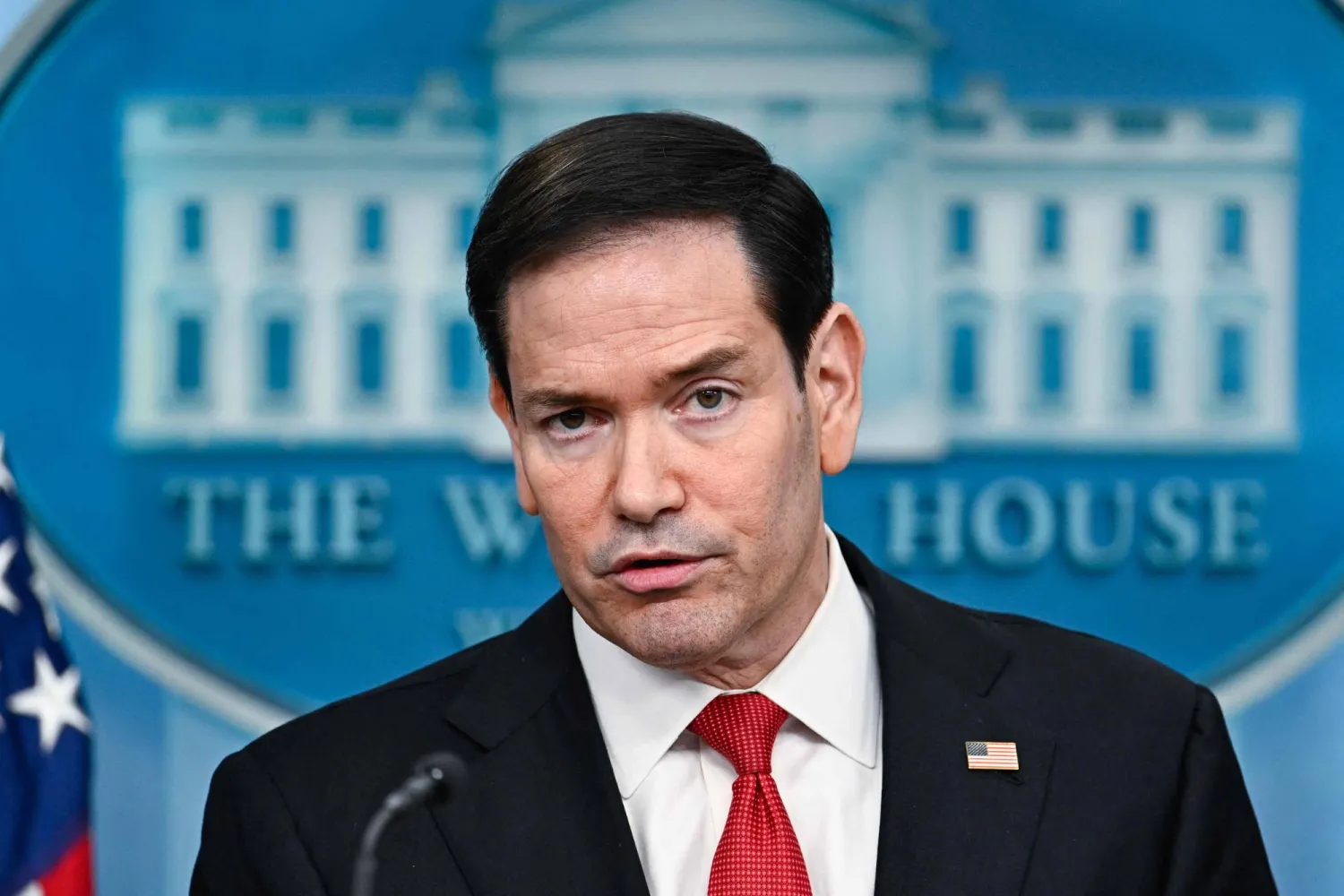

Rubio Doubtful of Diplomacy with Cuba as Trump Raises New Threat of Military Action

(FILES) US Secretary of State Marco Rubio speaks during a press briefing in the Brady Briefing Room of the White House in Washington, DC, on May 5, 2026. (Photo by Kent NISHIMURA / AFP)
TT

Rubio Doubtful of Diplomacy with Cuba as Trump Raises New Threat of Military Action

(FILES) US Secretary of State Marco Rubio speaks during a press briefing in the Brady Briefing Room of the White House in Washington, DC, on May 5, 2026. (Photo by Kent NISHIMURA / AFP)

President Donald Trump and America's top diplomat on Thursday again raised the specter of US military intervention in Cuba, a renewed threat that takes on greater weight a day after the administration announced criminal charges against the island's former leader, Raúl Castro.

Trump said previous US presidents have considered intervening in Cuba for decades but that “it looks like I’ll be the one that does it.”

“Other presidents have looked at this for 50, 60 years, doing something,” Trump told reporters when asked about Cuba during an environmental event in the Oval Office. “And, it looks like I’ll be the one that does it. So, I would be happy to do it.”

Secretary of State Marco Rubio told reporters separately that Cuba has been a national security threat for years because of its ties to US adversaries and that Trump is intent on addressing it, The Associated Press said.

Rubio says the US prefers a negotiated agreement with Cuba

Rubio, the son of Cuban immigrants who has long taken a hard-line against Cuba’s socialist leadership, said the Trump administration wants to resolve differences with Cuba peacefully but is doubtful the US can reach a diplomatic resolution with the island's current government.

Trump's “preference is always a negotiated agreement that’s peaceful. That’s always our preference. That remains our preference with Cuba,” Rubio said in Miami before boarding a plane to attend a NATO meeting in Sweden and then visit India.

“I’m just being honest with you, you know, the likelihood of that happening, given who we’re dealing with right now, is not high,” he said.

Top Trump aides — including Rubio, CIA chief John Ratcliffe and other senior national security officials — have met with Cuban officials in recent months to explore possible improvements in relations. But the US side has come away unimpressed from those talks, leading to even more sanctions imposed on the Cuban government in the past week.

Over the years, Cuba has gotten used to “buying time and waiting us out,” Rubio said. “They’re not going to be able to wait us out or buy time. We’re very serious, we’re very focused.”

When asked whether the US would use force in Cuba to change the island's political system, Rubio repeated that a diplomatic settlement was preferred but noted that “the president always has the option to do whatever it takes to support and protect the national interest.”

He pushed back on a reporter’s suggestion that it sounded like “nation-building,” insisting it was about addressing a national security risk.

New threats follow US announcement of charges against Castro Federal prosecutors on Wednesday unveiled an indictment that accuses Castro of ordering the shootdown in 1996 of civilian planes flown by Miami-based exiles. The charges, which were secretly filed by a grand jury in April, included murder and destruction of an airplane.

Cuban President Miguel Díaz-Canel has condemned the indictment as a political stunt that sought only to “justify the folly of a military aggression against Cuba.”

The Castro indictment has led many to believe that the Trump administration is following the same playbook it did when it captured then-Venezuelan President Nicolás Maduro in a military operation in early January. Maduro, who has been imprisoned in the US since his seizure, faces federal drug trafficking charges and has pleaded not guilty.

The US military touted the arrival of the USS Nimitz aircraft carrier and accompanying ships to the Caribbean Sea on the same day the charges against Castro were announced. US Southern Command said the ships are taking part in maritime exercises with partners in Latin America that began in March.

Rubio would not discuss how the US might move to implement the indictment against Castro, who turns 95 next month.

Trump has been threatening military action in Cuba ever since ousting Maduro and then ordering an energy blockade that choked off fuel shipments to Cuba. That has led to severe blackouts, food shortages and an economic collapse across the island.

The Trump administration this month also has slapped new sanctions on Cuba, the largest of which is against Grupo de Administración Empresarial S.A., a business conglomerate operated by the Cuban Revolutionary Armed Forces.

On Thursday, Rubio announced that the sister of the GAESA's executive president, who was living in the US, has had her green card revoked and been arrested, and is now in US Immigration and Customs Enforcement custody.

“Past Administrations have permitted the families of Cuban military elites, Iranian terrorists and other reprehensible organizations to enjoy lavish lifestyles in our country funded by stolen blood-money, while the people they repress at home suffer in increasingly dire circumstances. No longer,” Rubio said in a statement.

Trump has ratcheted up talk of regime change in Cuba after pledging to conduct a “friendly takeover” of the country if its leadership did not open its economy to American investment and kick out US adversaries.

On Thursday, Rubio said Cuba poses a serious national security threat to America because of its security and intelligence ties with China and Russia and friendly relations with US foes in Latin America.

China opposes US sanctions and pressure on Cuba, a Chinese Foreign Ministry spokesperson, Guo Jiakun, said Thursday.

“China firmly supports Cuba in safeguarding its national sovereignty and national dignity and opposes external interference,” Guo added.



Trump Warns of 'Economic D-Day' against Iran, but Tehran is Well Acquainted with Sanctions

President Donald Trump speaks during a meeting with technology leaders in the Roosevelt Room of the White House, Wednesday, Aug. 19, 2026, in Washington. (AP Photo/Jacquelyn Martin)
TT

Trump Warns of 'Economic D-Day' against Iran, but Tehran is Well Acquainted with Sanctions

President Donald Trump speaks during a meeting with technology leaders in the Roosevelt Room of the White House, Wednesday, Aug. 19, 2026, in Washington. (AP Photo/Jacquelyn Martin)

Nearing the six-month mark of the Iran war and facing diminishing stockpiles of key weapons, the Trump administration is touting a crushing financial campaign against Tehran, promising an “economic D-Day” against a country that has so far withstood nearly five decades of punishing American sanctions.

With sparse details, President Donald Trump announced this week that the US would be imposing an “unprecedented” level of economic warfare and isolation on Iran, aiming to force its leadership to cave to demands to end its nuclear program and fully reopen the crucial Strait of Hormuz to oil and natural gas tankers, The Associated Press said.

It reflects the dire reality Trump faces with an increasingly unpopular war he can't seem to end just months before pivotal midterm elections that will decide whether his Republican Party keeps control of Congress. Whether out of desperation or strategy, the president is refocusing America's might on bringing Iran to its knees through an accelerated sanctions campaign against one of the most economically penalized countries in the world.

The immediate response from Iran hawks has been praise and a call for patience as it plays out, while other analysts warn that Trump is refusing to learn the lessons of his predecessors.

In an interview Thursday on CNBC, Treasury Secretary Scott Bessent offered a small glimpse of what may be ahead, threatening secondary sanctions on nations and companies that conduct business with Iran.

He did not say exactly whom would be targeted as part of this next phase of the administration’s “ Operation Economic Fury, ” which earlier had focused on entities and individuals that buy oil from or bank with Iran. China and India, however, are major buyers of Iranian oil.

“If you insist on doing business with them, then the US Treasury and US government will put its full might and force against you,” Bessent said. “It’s time for our allies and the rest of the world to make a decision."

Some experts see ‘uncharted waters’ that could force Iran's hand

Despite decades of US sanctions against Iran, the Trump administration is arguing that it’s only a matter of time and that striking the right economic target would get Tehran to its breaking point.

Richard Goldberg, who coordinated efforts to put diplomatic pressure on Iran in Trump's first term, said the consequences of US strikes on Iran's nuclear sites last year, the war this year and the American naval blockade on Iranian ports have created the perfect storm for capitulation — one that didn't previously exist.

“I think we’re watching a strategy, whether it takes a short time or a long time, that is very much about fundamentally changing the future of the world by seeing the end of this regime," said Goldberg, who is now at the hawkish Washington think tank Foundation for Defense of Democracies.

“I caution everyone — including myself, who has worked on sanctions, who’s worked on financial warfare — to have the humility to admit that we are in uncharted waters,” he said.

He said the decision this week by the United Arab Emirates — once one of Tehran's most important trading partners — to suspend trade with Iran over a missile attack will only further isolate the government.

Targeting allies and partners comes at a price

With nearly all of Iran's energy, financial and transportation sectors already covered by US sanctions, Trump’s aim appears to be to apply secondary sanctions on countries, including allies and partners, that have not cut all ties with Iran to starve the country of any remaining income it may still be receiving.

In many ways, it is a redux of Trump’s first-term “maximum pressure” campaign, which he has ramped up during his second term to include military action.

But as Trump and his allies discovered during his first administration, it can be difficult to enforce secondary sanctions without harming US interests and provoking reciprocal measures. There were numerous instances of the administration granting sanctions waivers to countries, particularly those that rely on Iranian oil for their energy needs.

“Trump’s strategy now rests on targeting Tehran directly by impeding its touch points and access to the formal financial system and international economy,” said Behnam Ben Taleblu, senior director of FDD’s Iran program. “This will require making the Iran issue more important in US bilateral relations with countries in Europe and Asia.”

Iran doesn't see an ‘open door’ at the end of the sanctions campaign Iranian officials and analysts have accused the Republican president of flip-flopping with his latest pivot to economic pressure against Iran. Trump has long derided past leaders who used sanctions to limit Iran’s ability to pay for its military and nuclear development.

In a post last week on X, Esmail Baghaei, spokesman for Iran’s Foreign Ministry, wrote that Washington's pattern of retreating to sanctions when it doesn't want to pursue diplomacy has proven to be futile.

“Iran has demonstrated over decades that it will not be strangled by these exhausted refrains,” he said. “The real risk is that American politicians, clinging to this bad habit, will instead strangle their own remaining chances of a less humiliating exit from a crisis of their own making.”

Ali Vaez, Iran director at the International Crisis Group, said the Trump administration's decision to take its own “maximum pressure” policy to new heights with military action seems to ignore years of US foreign policy lessons that show Iran does not respond well to pressure.

If anything, he says, the latest economic campaign has only “hardened Iran's position.”

“I think (Trump's) blind spot is the fact that the only thing that the Iranian regime views as more dangerous than suffering from US sanctions is surrendering to US terms," Vaez said.

Plus, the past year of start-stop diplomacy has only worsened the already fragile dynamic between the longtime adversaries, Vaez says, adding that Iranian officials' lack of trust in Trump and his mediators has created an untenable foundation.

“They believe that even if they capitulate to US terms under economic duress, Trump would move the goalposts and ask for more,” he said. “And this is really the fundamental problem: Pressure without an open door is an exercise in futility.”


Scores Dead after Boat Capsizes in Nigeria

Bodies of victims of a boat accident lie in the forecourt of a community mosque ahead of their burial in Gorau, Sokoto State, Nigeria, August 20, 2026. Picture taken with a mobile phone. REUTERS/Abubakar Imam
TT

Scores Dead after Boat Capsizes in Nigeria

Bodies of victims of a boat accident lie in the forecourt of a community mosque ahead of their burial in Gorau, Sokoto State, Nigeria, August 20, 2026. Picture taken with a mobile phone. REUTERS/Abubakar Imam

At least 51 people have died after a boat sank in northwest Nigeria's Sokoto state Thursday, a local resident told AFP, as authorities said rescue operations were ongoing.

Such accidents are common on Nigeria's busy rivers and waterways, often caused by overloaded boats, poor maintenance or failure to comply with safety regulations.

Scores drown each year.

"The situation is bad," said Ibrahim Musa, a former councilor of Gorau village, in Goronyo district, where the accident occurred.

"We already buried 46 bodies, and five others have just been brought out of the river."

Dahir Kure, spokesman for the National Emergency Management Agency in the state, told AFP, said rescue operations were underway.

"We are now at the scene of the boat accident and have begun rescue work," Kure said.

Kure said he could not immediately give a toll, saying authorities were still "collecting necessary information on the incident.”

At least five people drowned when a boat capsized in Jigawa state last month.

In January, at least 26 people drowned when a boat carrying farmers and fishermen from Jigawa to Yobe state capsized.


Iran Executes Afghan National over 2026 Protests

Iran's Evin Prison (File photo: Reuters)
TT

Iran Executes Afghan National over 2026 Protests

Iran's Evin Prison (File photo: Reuters)

Iran on Thursday executed an Afghan national convicted over the killing of police officers during anti-government demonstrations, the 30th in a wave of hangings since the start of the Middle East war, a rights group said.

Ghaem Hosseini was executed after being convicted of involvement in the deaths of four police officers, the Iranian judiciary's Mizan Online website reported.

It said he was a foreign national, without providing further details. But, the Norway-based Iran Human Rights (IHR) group said the 21-year-old was from Afghanistan and was hanged at Isfahan central prison.

Mizan Online said Hosseini was convicted "of drawing a weapon and causing fear and terror, creating widespread insecurity, acting against people's physical integrity and national security in a manner that seriously disrupted public order".

But according to IHR, Hosseini was accused of kicking one of the policemen and the "authorities have presented no evidence proving that his actions led to the death of any of the policemen".

The case "is a stark example of collective punishment and the arbitrary use of the death penalty by the Islamic Republic," said IHR director Mahmood Amiry-Moghaddam.

He is the fifth person to be hanged over the case involving the death in Isfahan of four policemen during the nationwide protests that peaked in January.

He is also the second Afghan national to be executed over the protests, after Gol Mohammad Mohammadi was hanged in the same case in July.

At least 12 defendants in the case have been sentenced to death, said IHR.

IHR said that since wartime executions resumed on March 19, at least 30 protesters have been executed -- 28 in connection with the January protests and two in connection with the "Woman. Life. Freedom." protests that erupted in 2022.

"That is an average of more than one protester execution per week," it said.

IHR says hundreds of other protesters have been sentenced to death or are facing charges which could carry the death penalty, including over 70 in Isfahan, the main city of central Iran which saw intense protests in January.

Iran's escalating use of the death penalty has triggered international concern, with rights groups and governments accusing Tehran of using executions to instil fear into society and prevent further protests.

According to Amnesty International, Iran executed at least 2,159 people in 2025. But authorities now appear to be intensifying executions of protesters and others deemed political prisoners during the conflict.

More than 30 nations, including France, Britain and Canada, last week condemned Iran's use of capital punishment, saying the Islamic republic was executing protesters to "silence dissent".