


Giant Wind Turbine Rises in Germany amid Far-right Headwinds

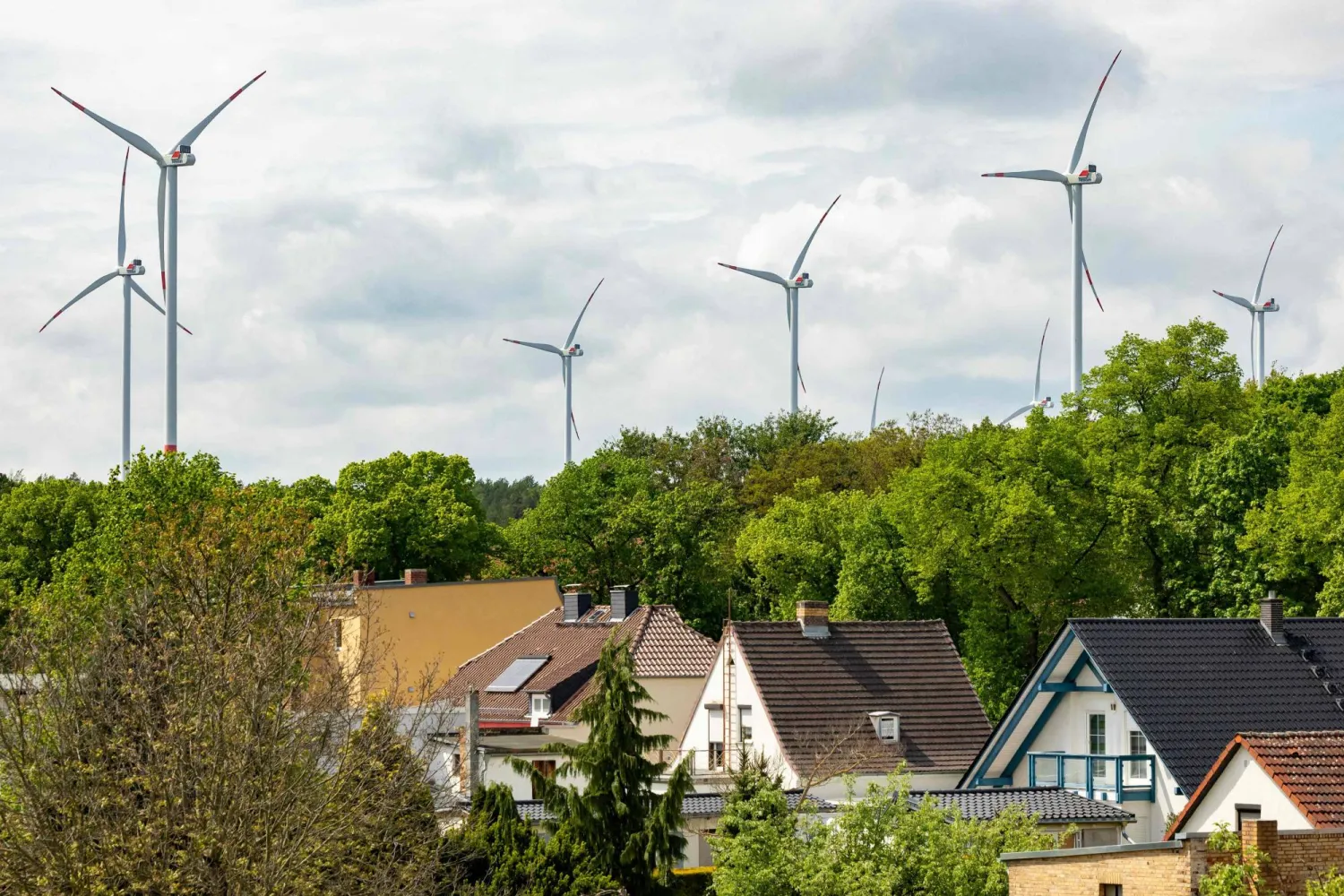
Conventional wind turbines are seen behind houses in Schipkau, eastern Germany on May 13, 2026. (Photo by Odd ANDERSEN / AFP)
TT

Giant Wind Turbine Rises in Germany amid Far-right Headwinds

Conventional wind turbines are seen behind houses in Schipkau, eastern Germany on May 13, 2026. (Photo by Odd ANDERSEN / AFP)

A wind turbine billed as the world's tallest is rising in eastern Germany, winning praise as a beacon for a clean, green energy future and headwinds from the far-right AfD party.

The giant structure -- set to dwarf the Eiffel Tower at 365 meters (1,200 feet) once completed -- is going up in the former coal-mining region of Lusatia in Brandenburg state, said AFP.

Once its huge rotor blades start spinning in the steady high-altitude winds before the end of the year, it is expected to generate enough electricity to power 7,500 households.

"We're achieving the same performance levels as an offshore wind farm, which means double the output compared to standard wind turbines," Jochen Grossmann, founder of the Dresden-based developer Gicon, told AFP during a visit to the site in a forest near the town of Schipkau.

As workers braved a cold rain, the structure doubled in height within a matter of hours, as 350 tons of steel were hoisted into place by huge yellow construction cranes.

The project is financed to the tune of 20-30 million euros through a government agency that sponsors cutting-edge tech, and seen by promoters as a new milestone in Germany's decades-old energy transition.

Europe's top economy has shuttered its nuclear plants and is phasing out coal while subsidizing renewables, which last year generated almost 59 percent of electricity, about half of it through wind.

Grossmann sees such projects as the way forward if resource-poor Germany wants to meet its emissions targets and wean itself off fossil fuels from conflict-torn regions.

"For the time being, our only options are solar and wind power," he argued.

"Coal reserves are running out, and nuclear power has been phased out. We have only limited supplies of natural gas and oil.

"And at the moment, with the situation in the Strait of Hormuz and everything else, it's clear that we're also not independent when it comes to natural gas and oil."

- 'Windmills of shame' -

Not everyone shares Grossmann's enthusiasm.

The project is located in a stronghold region of the far-right Alternative for Germany (AfD), whose climate-sceptic leaders have decried the smaller "windmills of shame" that already dot the Schipkau area and much of Germany.

The loss of coal mining jobs has only fue led local support for the AfD, which won nearly half the vote there in last year's parliamentary elections.

Birgit Bessin, an AfD member of the regional parliament, told AFP that turbines had effects on the local wildlife and suggested that nuclear energy would be a better alternative for emission-free power.

"When there are such fundamental impacts on residents, they should be consulted," she said, citing opposition from hunters and a local airfield.

The AfD also points to microplastics given off by wind turbines, although scientific studies have found no impact on human health.

- 'Get the public on board' -

While the AfD is adamantly opposed to wind power, Germany's year-old government under conservative Chancellor Friedrich Merz has also been less enthusiastic about renewables than the previous ruling coalition that included the Greens party.

Economy Minister Katherina Reiche has promised a wave of new gas power plants to compensate for renewables' intermittency, arguing this will help bring down German energy costs, among the highest in the world.

The German economy has been flatlining for years, in part because of soaring energy prices in the wake of Russia's 2022 full-scale invasion of Ukraine and the US-Israeli conflict with Iran that started in late February.

Outside the fences guarding the Schipkau site, local citizens sometimes come to have a look, some voicing anger about the project, Gicon staff said.

Klaus Prietzel, Schipkau's independent mayor, has floated the idea of the town taking over the turbine in the future to lower residents' energy bills.

Local authorities already share some of the gains from the existing windfarm, paying each resident 80 euros ($92) a year, usually just before Christmas.

"Our idea was that every citizen living in the municipality of Schipkau who can see the wind turbines should also benefit from them," said the mayor.

The AfD's Bessin dismissed such payments as "bribery", but Prietzel argued they are a useful.

"Around four million euros have already been paid out as part of a so-called acceptance-promoting measure," he said. "You have to get the public on board."


Saudi Arabia Leads Global Coral Reef Efforts as ICRI Adopts Five Key Recommendations

Saudi Arabia Leads Global Coral Reef Efforts as ICRI Adopts Five Key Recommendations
TT

Saudi Arabia Leads Global Coral Reef Efforts as ICRI Adopts Five Key Recommendations

Saudi Arabia Leads Global Coral Reef Efforts as ICRI Adopts Five Key Recommendations

Saudi Arabia has enhanced its global leadership role in coral reef protection by chairing the 39th General Meeting of the International Coral Reef Initiative (ICRI), a step that paves the way for the Kingdom to host the first Global Coral Reef Summit in early November 2026.

The four-day meeting featured high-level dialogue sessions and scientific and policy discussions focused on developing an integrated practical framework that brings together science, policy, and sustainable financing, enhancing international coordination and tangible on-the-ground impact.

The meeting unanimously adopted five strategic recommendations proposed by Saudi Arabia. The recommendations focused on boosting the link between international commitments and actual implementation at the national level, developing supportive regulatory frameworks, unifying scientific references, and enabling sustainable financing, SPA reported.

The recommendations also endorsed the first Global Coral Reef Summit, which Saudi Arabia announced it would host during the Saudi House events at the World Economic Forum (WEF) Annual Meeting 2026 in Davos.

This reflects international consensus on the summit's importance and its pivotal role in supporting a Saudi-led effort to develop a comprehensive global framework that integrates science, policy, and sustainable financing while enabling countries to implement practical and actionable solutions to protect coral reefs.

The meeting also witnessed the acceptance of membership applications from four new countries: Somalia, Papua New Guinea, Vanuatu, and Trinidad and Tobago. In addition, the World Bank and the UN Global Fund for Coral Reefs joined the initiative, reflecting the expanding scope of international partnership and enhancing global momentum toward coral reef protection and sustainability. The total number of member states has now reached 48, accounting for some 84% of the world's coral reefs.


Russia Unblocks Roblox after Widespread Child Anger

People rest outside the Kremlin on a warm summer day in downtown Moscow, Russia, 05 June 2026. EPA/MAXIM SHIPENKOV
TT

Russia Unblocks Roblox after Widespread Child Anger

People rest outside the Kremlin on a warm summer day in downtown Moscow, Russia, 05 June 2026. EPA/MAXIM SHIPENKOV

Russia has lifted its ban on the popular gaming platform Roblox, after tens of thousands of children and parents sent letters complaining about the measure.

The platform -- which allows users to build their own games and share them with others -- was among Russia's most popular mobile games, tying third with TikTok in usage time among children in early 2025, according to Kaspersky Lab, a Moscow-based global cybersecurity firm.

In a statement published Wednesday, Russia's digital ministry said Roblox had successfully implemented measures to "protect children, including by launching a mechanism to restrict access to games by age group.”

"Roblox has also committed to continuing to combat the spread of undesirable content on the platform," the statement added.

Russia banned access to the US-owned platform last December, accusing it of distributing extremist materials and promoting "LGBT propaganda.”

A Roblox spokesperson told AFP at the time that the company was committed to safety and respected "local laws and regulations.”

Ekaterina Mizulina, the head of Russia's state-sponsored internet censorship watchdog, said in December she had received "63,000 emails" from disgruntled schoolchildren and parents commenting on the ban.

"This raises a question. Perhaps it's time to look for other ways to combat pedophiles and provocateurs who target children online?" she said.

Around 100 million people use Roblox daily, with under-13s accounting for around 40 percent of its 2024 users, according to the company.

Kremlin spokesman Dmitry Peskov said Thursday that Roblox's unblocking in Russia "shows that all services can return if they comply with the law,” in comments to the state TASS news agency.


Moose Put Down after Wandering Into Central Oslo

People and personell from the wildlife board mill around a dead moose that had strayed into Majorstuen,a inner city area in Oslo, Norway on, June 11, 2026. (Photo by Javad Parsa / NTB / AFP)
TT

Moose Put Down after Wandering Into Central Oslo

People and personell from the wildlife board mill around a dead moose that had strayed into Majorstuen,a inner city area in Oslo, Norway on, June 11, 2026. (Photo by Javad Parsa / NTB / AFP)

Norwegian police said Thursday that a moose that had wandered into downtown Oslo, drawing curious crowds, had been shot and killed.

Videos taken by witnesses and published by Norwegian media show the disoriented animal galloping through the streets of the Norwegian capital, weaving around cars and pedestrians.

"For animal welfare reasons, the moose was put down" by the wildlife authorities, AFP quoted the police as saying.

Although such incidents remain rare -- moose tend to avoid metropolitan areas -- this is the second such incident recorded in two days in Scandinavia.

On Tuesday, a young moose was put down in Sweden after it strayed into the streets of Stockholm.
