


Saudi Arabia Says Will Not Allow Practices That Deviate Hajj from its Objectives

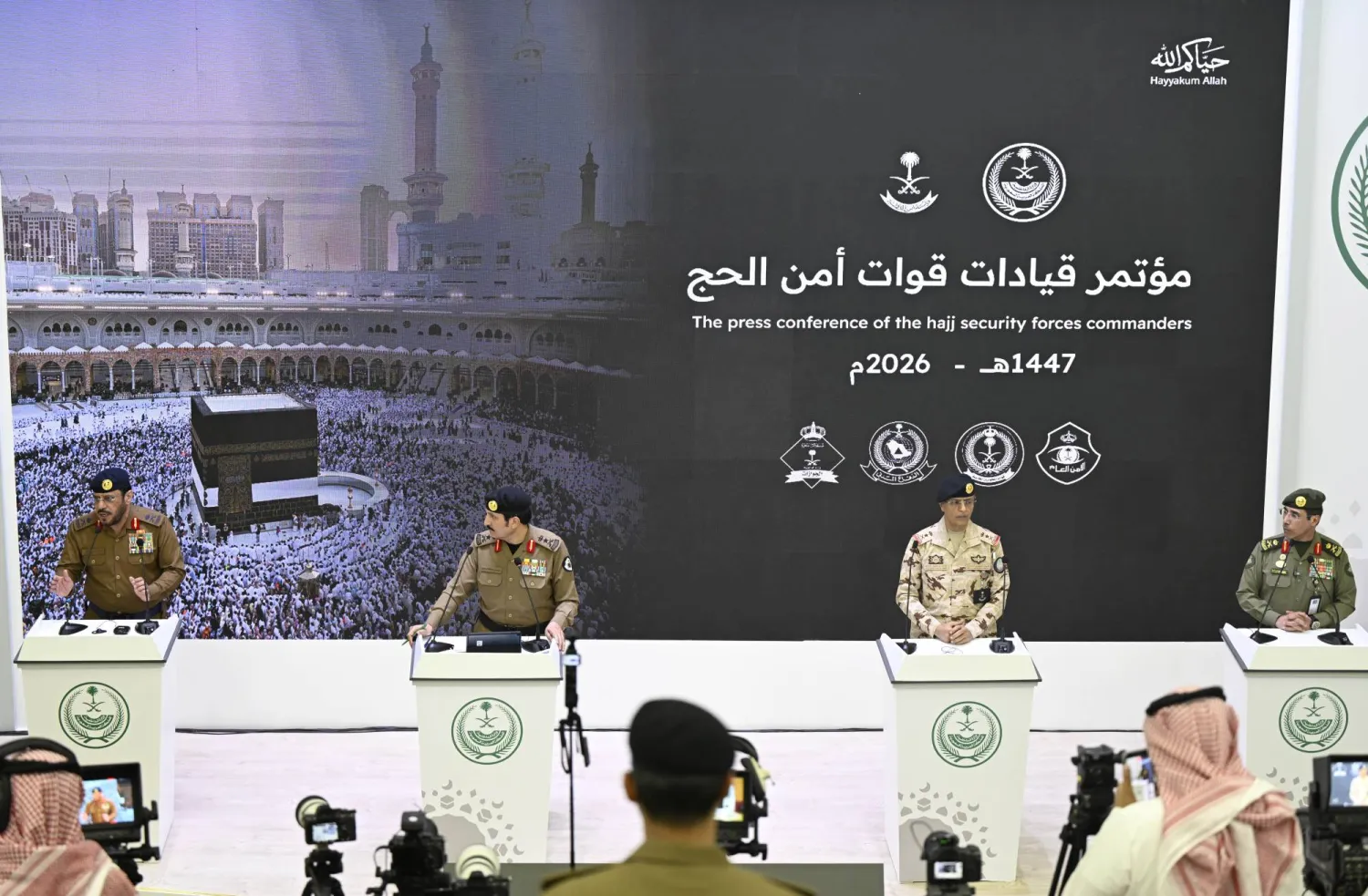
Security commanders are seen at the press conference in Makkah on Friday (Bashir Saleh)
TT

Saudi Arabia Says Will Not Allow Practices That Deviate Hajj from its Objectives

Security commanders are seen at the press conference in Makkah on Friday (Bashir Saleh)

Saudi Arabia said it would not allow the Hajj to be used for any activity that strays from its religious purpose, as more than 1.5 million pilgrims arrived from abroad by Friday afternoon.

He made his statement during a press conference by Hajj security commanders at the Unified Security Operations Center (911) in the Makkah region.

Officials outlined security, traffic, and organizational plans for this year’s holy pilgrimage, along with related instructions and guidelines.

Lt. Gen. Mohammed Al-Bassami, director of Public Security, said the Hajj security system was fully ready to carry out its duties.

“Our goal is for pilgrims to reach their destination, perform their rituals, and return home safely,” he stressed.

Al-Bassami said crowd management plans focused on regulating pilgrim flows and minimizing overlap between routes. Technology, he said, was playing a key role alongside security personnel on the ground.

He said authorities were prepared for various scenarios based on risk assessments, following extensive drills and field exercises to test the readiness of all security agencies.

Lt. Gen. Mohammed Al-Omari, commander of the Special Emergency Forces at the Presidency of State Security, described the security plans as “integrated, proactive and flexible.” He said security forces were deployed in the central area and the holy sites to protect pilgrims.

Maj. Gen. Dr. Hammoud Al-Faraj, director general of Civil Defense, said preparations for the Hajj season were complete.

“We trained all bodies involved in serving pilgrims on self-protection,” he said, adding that male and female volunteers were working alongside Civil Defense personnel across all tasks and operations.

Maj. Gen. Dr. Saleh Al-Murabba, commander of the Passports Forces for Hajj, said the “Makkah Route” initiative accounted for 30% of arriving pilgrims. He said 1,518,153 pilgrims had arrived from outside Saudi Arabia by Friday afternoon.


Saudi, Pakistani Interior Ministers Discuss Security Cooperation

Saudi Minister of Interior Prince Abdulaziz bin Saud bin Naif bin Abdulaziz. (SPA)
TT

Saudi, Pakistani Interior Ministers Discuss Security Cooperation

Saudi Minister of Interior Prince Abdulaziz bin Saud bin Naif bin Abdulaziz. (SPA)

Saudi Minister of Interior Prince Abdulaziz bin Saud bin Naif bin Abdulaziz received on Friday a telephone call from his Pakistani counterpart Mohsin Naqvi for talks on issues of common interest.

They also reviewed aspects of security cooperation and coordination.


Saudi Leadership Congratulates Yemen on Unity Day

Custodian of the Two Holy Mosques King Salman bin Abdulaziz Al Saud and Prince Mohammed bin Salman bin Abdulaziz Al Saud, Crown Prince and Prime Minister. (SPA)
TT

Saudi Leadership Congratulates Yemen on Unity Day

Custodian of the Two Holy Mosques King Salman bin Abdulaziz Al Saud and Prince Mohammed bin Salman bin Abdulaziz Al Saud, Crown Prince and Prime Minister. (SPA)

Custodian of the Two Holy Mosques King Salman bin Abdulaziz Al Saud sent on Friday a cable of congratulations to Chairman of Yemen's Presidential Leadership Council Dr. Rashad Mohammed Al-Alimi on the occasion of his country's Unity Day.

King Salman wished the president continued good health, and the government and people of Yemen further security and stability.

Prince Mohammed bin Salman bin Abdulaziz Al Saud, Crown Prince and Prime Minister, sent Al-Alimi a similar cable on the occasion.


42,000 Iraqi Pilgrims Arrive in Makkah

Muslim pilgrims at the Grand Mosque complex, ahead of the annual hajj pilgrimage, in the holy city of Makkah, Saudi Arabia, May 22, 2026. Picture taken with a mobile phone. REUTERS/Ibraheem Abu Mustafa
TT

42,000 Iraqi Pilgrims Arrive in Makkah

Muslim pilgrims at the Grand Mosque complex, ahead of the annual hajj pilgrimage, in the holy city of Makkah, Saudi Arabia, May 22, 2026. Picture taken with a mobile phone. REUTERS/Ibraheem Abu Mustafa

Sami al-Masoudi, head of Iraq’s High Commission for Hajj and Umrah, said 42,000 Iraqi pilgrims have arrived in Saudi Arabia, praising the Kingdom’s efforts to ensure pilgrims’ comfort through a wide range of services and facilities aimed at helping worshippers perform their rituals with ease.

Al-Masoudi told Asharq Al-Awsat that the arrival of Iraqi pilgrims came amid early and well-organized preparations following directives from Saudi Arabia’s Ministry of Hajj and Umrah, which called for readiness across all sectors, including accommodation, catering, services at the holy sites, and internal and external transportation, to guarantee pilgrims’ comfort and the smooth performance of rituals.

One of the most notable features of this year’s Hajj season for Iraqi pilgrims is the adoption of sacrificial offerings services through the electronic platform after they became managed under the Saudi Project for Utilization of Hady and Adahi, a step al-Masoudi described as “qualitative.”

“It reflects the level of development and organization within the Hajj system,” he said.

“Today, all contracts, including sacrificial offerings, are completed electronically, which has helped simplify procedures, reduce bureaucracy and improve the level of services provided to pilgrims,” he added.

The Saudi Project for Utilization of Hady and Adahi is one of the initiatives of the Royal Commission for Makkah City and Holy Sites.

The project aims to facilitate the performance of Hady and expiation rituals for pilgrims and enable Muslims worldwide to carry out sacrifices, charity donations and aqiqah on their behalf, while distributing the meat to eligible beneficiaries inside and outside the Kingdom.

Al-Masoudi also highlighted the major transformation and development projects supported by artificial intelligence technologies that Saudi Arabia has deployed to serve pilgrims.

“Year after year, we witness continuous progress and major efforts by the Saudi Ministry of Hajj and Umrah and supporting agencies in the Kingdom, especially in automation and digital transformation, which directly improve pilgrims’ comfort and the quality of services provided to them,” he said.

Saudi Arabia has consistently worked to improve services for pilgrims arriving from around the world through projects that are upgraded and expanded annually, reflecting the leadership’s commitment to serving pilgrims and Umrah performers, enhancing service quality and enriching their religious experience in line with the goals of Saudi Vision 2030.

The first groups of Iraqi pilgrims began arriving in the Kingdom through the al-Haditha border crossing in al-Qurayyat and the Jadidat Arar crossing, where entry procedures were completed smoothly within minutes under an integrated service system designed to ease the burden of long-distance travel and provide a more comfortable and reassuring experience for pilgrims traveling by land to Makkah.

Expressions of gratitude were evident among Iraqi pilgrims, many of whom described the reception as “beyond expectations,” saying the welcome they received upon entering the Kingdom gave them a sense of comfort and reassurance even before reaching the holy sites.